


TL;DR: Roughly half of enterprise AI compute is consumed by if-checks: validation, guardrail, and fact-verification logic. They double cost without doubling output. Traditional cloud dashboards can't see them because they report aggregate spend, not workload purpose. An AI workload audit that classifies every call by logical function recovers the waste through systematic reallocation, without removing required safety controls.
Key Takeaways: - About half of enterprise AI workloads are if-checks: validation, filtering, and guardrail logic running on every request. - Fewer than 30% of organizations have mature cost allocation for AI, so the waste stays invisible in aggregate dashboards. - A workload audit using AI-native log analysis can recover the spend without removing required safety controls.
The If-Check Tax: Where Your AI Budget Actually Goes
Your AI bill doubled last quarter. You didn't ship twice the features. You didn't double your users.
The culprit is hiding in plain sight: about half of your AI workloads are if-checks. Nobody on your team can tell you which half.
An if-check is any AI call whose job is to evaluate, filter, or validate another AI's output. Content moderation, PII scrubbing, hallucination detection, safety classifiers, and LLM-as-judge loops all qualify. These checks fire on every request, consume tokens at full enterprise rates, and produce no new business value on their own.
The problem compounds when teams add checks independently. One team builds a content filter. Another adds a hallucination detector. A third wraps the same prompt in a guardrail. Each one makes sense in isolation.
Together, they increase the compute cost of the same user request. The same token-curve pattern we tracked in LLM cost scaling from 100K to 100M tokens shows up here. Cost grows faster than value once checks pile up.
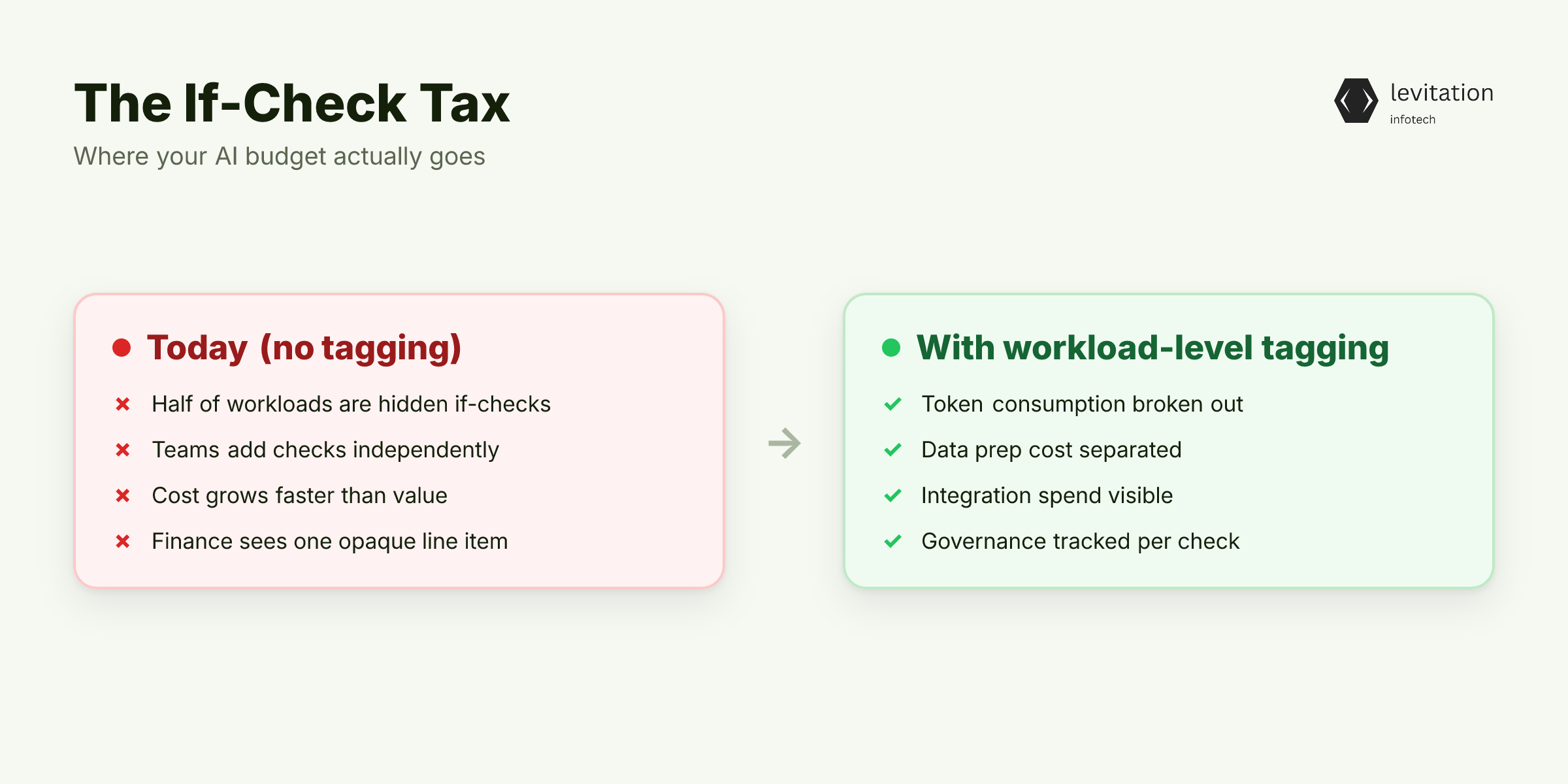
The four line items most often misallocated are token consumption, data preparation, integration, and governance. When these live inside a single enterprise AI platform without workload-level tagging, finance sees a single line item with no purpose breakdown. The waste stays invisible.
If the bloat is this obvious in the logs, why hasn't your finance team caught it already?
Why Traditional Cost Dashboards Miss the Waste
Because the dashboard is the wrong lens.
Cloud cost tools report GPU-hours, API call counts, and token volume. They were built for workloads where one call equals one unit of work. AI doesn't work that way.
An if-check that validates output, a guardrail that filters toxic content, and a business-critical inference all look identical on a billing statement. Same endpoint, same token count, same SKU.
Without workload-level tagging, finance sees one lump sum. Engineering sees one feature. Nobody sees the difference between a model call that drives revenue and a model call that double-checks another model call.
This opacity is why AI costs erode budget quietly. It is also why trust between finance and engineering frays every quarter when the bill lands. The same blind spot behind CFO GPU autoscaling cost surprises shows up here, one layer deeper.
The numbers back this up. Fewer than 30% of organizations have mature cost allocation for AI workloads. Most teams are flying blind, so the if-check tax compounds for years before anyone notices.
The enterprise AI systems that recover this spend do so by classifying every call by purpose, not by token count.
That is the lens cost-aware teams adopt. What does the waste actually look like when you zoom in?
What If-Check Bloat Actually Looks Like in Production
It looks like redundant layers stacked by teams that don't talk to each other.
Picture this: a customer support assistant running in production. Team A wraps the prompt in a content filter. Team B adds a PII scrubber on the response. Team C layers in an LLM-as-judge call to verify the answer.
The downstream system also runs its own hallucination check. That is four validation passes on one user message, each consuming tokens at full rates.
It looks like guardrails tuned for the wrong risk profile. A safety filter set to maximum sensitivity on a low-risk internal tool. A toxic-content classifier firing on every prompt for a workflow that handles structured data.
Each call looks small in isolation. Multiplied across thousands of requests, it consumes budget that produces no business output.
It looks like fact-checking loops that re-validate work already validated. An LLM-as-judge call that scores an output a downstream system has already scored. The result is a second invoice for the same answer.
This mirrors a pattern already documented on the human side. An Upwork study found that 77% of employees report AI has increased their workload, not reduced it.
The same dynamic applies to the AI itself. Checks run that no human asked for, generating cost no human approved. The pattern is identical: redundant verification layered on top of work that was already verified. Building this discipline into a production AI implementation is what separates cost-aware teams from cost-blind ones.
If you can't see this manually, you can't fix it. What does an actual audit look like?
The AI Workload Audit: A Framework for Cost Recovery
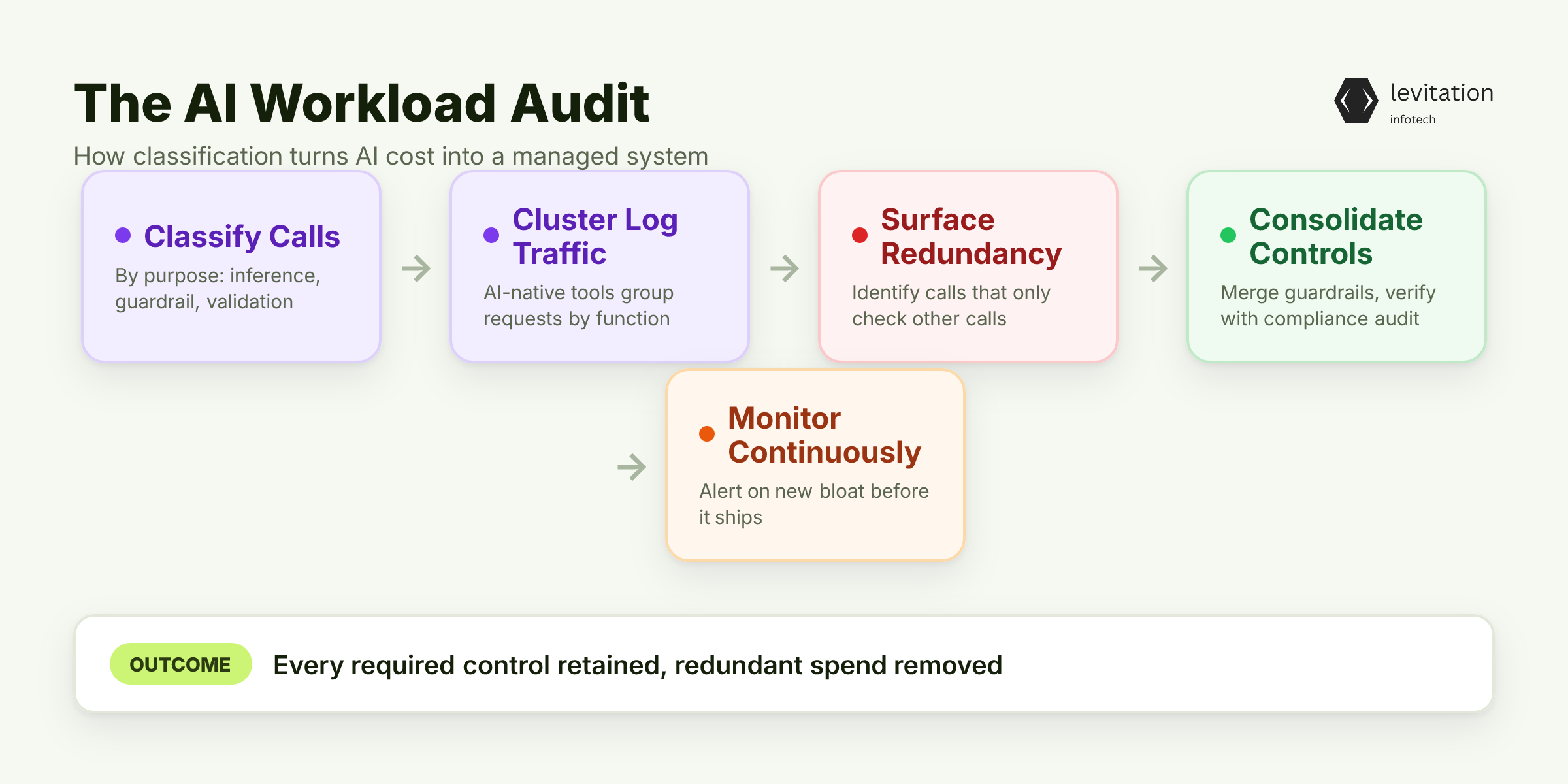
An AI workload audit is a systematic review that classifies every model call by its logical purpose. Categories include inference, validation, guardrail, transformation, or orchestration. Once classified, cost falls out of the data automatically.
The mechanics matter here. AI-native log analysis tools parse request payloads and cluster them by function. They identify which calls produce business value and which calls only check other calls.
This is work that would otherwise require a data team to manually sift through logs. AI-native tooling surfaces redundant if-checks automatically by grouping requests by purpose. Teams that have already started stopping the bleed on LLM inference recognize the same mechanism at the guardrail layer.
The audit produces three outputs: a cost-per-purpose distribution, a list of redundant checks, and a consolidated guardrail design. Together these keep every required control. AI-native continuous control monitoring then replaces the one-time audit with ongoing cost hygiene. New bloat triggers an alert before it ships.
The guardrail consolidation step is where most teams get nervous, and rightly so. Removing checks without verification opens security and compliance gaps.
Automated compliance audits solve this by confirming that every removed control is genuinely redundant, not merely unpopular. The cost reduction stays defensible because every control is mapped to a requirement.
This is the discipline that turns AI from a black-box cost line into a managed system. The pattern is repeatable across regulated deployments, including AI solutions for cost allocation purpose-built for enterprises.
The framework is clear. How do you run it in the next quarter?
Implementation: Three Steps to Eliminate If-Check Waste
Step one is tagging. Tag every prompt template with its logical purpose: inference, validation, guardrail, transformation, or orchestration. Run a 30-day log analysis to map the cost-per-purpose distribution.
In most organizations, validation and guardrail calls together account for roughly half of the spend. You will see it in the first chart.
Step two is consolidation. Take the redundant validation layers you found and merge them into a single shared guardrail service. Retire the duplicates.
Use automated compliance audits to confirm that no required control disappears in the process. This step alone typically recovers the largest share of the if-check tax. Most redundant layers were never doing anything the consolidated layer doesn't already do.
Step three is guardrails for guardrails.
Sources
Research and references cited in this article:
- 5 Enterprise AI Budget Traps (And How to Avoid Them)
- The Hidden Costs of Enterprise AI: What Your Budget Is Missing
- The Million-Dollar AI Bill: Managing Enterprise AI Costs in 2026 - futureaibiz
- AI Project Cost Breakdown | MI
- Enterprise AI Spending Hits $2.59T. Where's the ROI?
- AI cost optimization in 2026: what AI actually costs and how to cut it
- Optimizing AI costs: Three proven strategies | Google Cloud Blog
- How Using AI Reduce Operational Costs in 2026?
- Cutting Costs with AI | Exadel
- AI-Driven IT Spend Compression: Autonomous Budget Optimization ...
- Powerful automated compliance audit with AI for business success in 2026
- AI-driven audit automation: streamlining processes for scalable ...
About the author
Mayank Singh is a software developer at Levitation Infotech, where he builds web and AI-powered applications across the company’s fintech, healthcare, and enterprise projects.