


TL;DR: Vendor decks promise 80% breach reduction. IBM's median rollout data shows 9%. The gap is structural, not marketing. It lives in how Zero Trust is scoped, sold, and measured. Closing it needs identity-first sequencing, workload-level segmentation, and outcome-based contracts. These replace coverage metrics with blast-radius and containment time.
Key Takeaways: - The 71-point gap between vendor claims and median outcomes is a procurement problem. It is not a technology problem. - Zero Trust is an umbrella term. It covers ZTNA, microsegmentation, IAM, and service-mesh mTLS. Each has a different ROI profile. - Top-quartile deployments (287% ROI per Portnox's Forrester study) start with identity inventory and trust boundaries. They do not start with perimeter products. - Measure blast radius, MTTI/MTTC, and tool count, not percentage of users on MFA
The 71-Point Gap Nobody Puts in the Pitch Deck
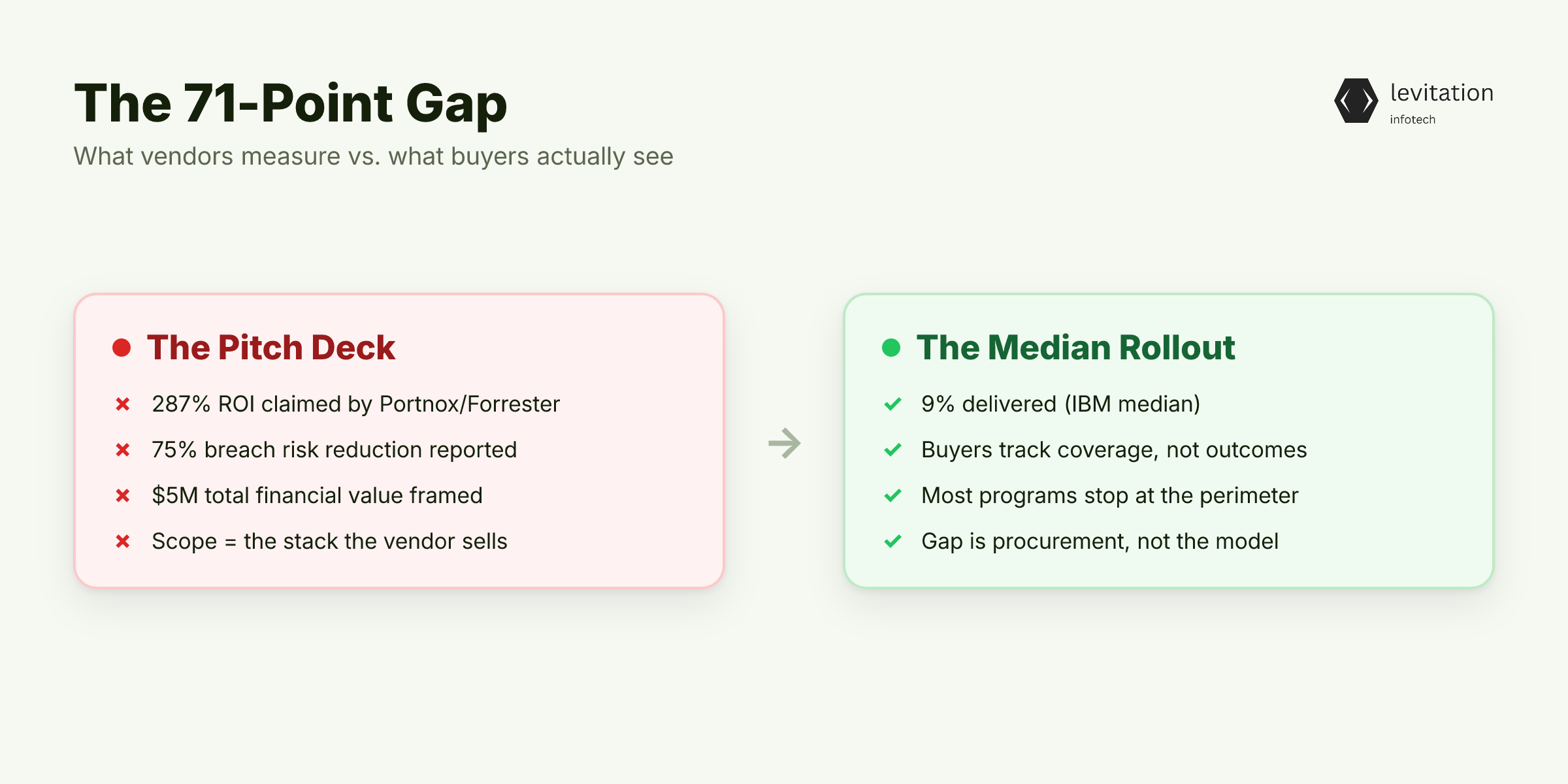
Portnox's Forrester study claims 287% ROI, 75% reduction in breach risk, and $5M in total financial value. AppGate reports an 80% decrease in exposure to breach-related losses. Their research also frames credential vulnerability as the root cause behind roughly 80% of breaches.
IBM's median Zero Trust rollout delivered 9%.
That's a 71-point gap. And it's not marketing inflation. It's structural.
It lives in how Zero Trust is scoped at procurement. It lives in how it is sold by vendors. It lives in how the teams that buy it measure results.
Vendors measure the parts of the stack they sell. Most buyers measure coverage, not outcomes. The 9% median reflects both habits.
The gap isn't about whether Zero Trust works. Most programs never get past the perimeter layer where actual breach movement happens. The 9% median is a fact about how organizations buy Zero Trust. It is not a fact about Zero Trust itself.
What 'Zero Trust' Actually Means in a Procurement Contract
"Zero Trust" has become an umbrella marketing term. It covers ZTNA, microsegmentation, identity governance, SASE, and service-mesh mTLS.
Each layer has a different ROI profile. Each needs different skills to deploy. Each shows up in a vendor pitch deck as if it were the same thing.
A single "Zero Trust project" line item in a procurement contract is a red flag. Real builds span the identity, network, workload, and data planes.
They take multiple quarters. They need different teams. The Zero Trust architecture and cloud security conversation needs to start with the scope question. It should not start with vendor selection.
The Portnox Forrester study ties its top-quartile outcome to identity-centric sequencing. But that result only shows up when identity is the foundation. It does not show up when identity is a feature added in year two. Most procurement timelines put identity last because vendors sell ZTNA first.
Tool consolidation is the hidden ROI driver. Firewall, VPN, and proxy rationalization generate savings. These savings show up in year one, before any breach metric moves. It's the cash that funds phase two of the program. Most procurement committees never price it in.
The term itself is where the underperformance starts. The rollout method is where it gets worse.
The Four Failure Modes That Pin Rollouts at 9%
Most programs stall at 9% because of four predictable failure modes. Each one is structural, not technological.
Failure mode 1: Perimeter-first thinking. Organizations buy ZTNA gateways and call it Zero Trust. But east-west traffic, service to service inside the data center and cloud, is where most modern breaches actually move. They move laterally.
A perimeter ZTNA deployment protects nothing inside the trust zone. Attackers who phish one credential walk straight through. This is the pattern that keeps showing up in Zero Trust leaks draining fintech budgets.
Failure mode 2: Product purchase instead of architecture shift. Zero Trust bought as a SKU delivers vendor ROI, not enterprise ROI. The mismatch shows up in year-two renewal debates. At that point, coverage metrics say the program is "done" but breach costs haven't moved.
The architecture was never changed. Only the access list was.
Failure mode 3: Measuring coverage instead of outcomes. Teams report "95% of users on MFA" and call it progress. The right number is mean time to identify and contain. That number drops sharply with proper Zero Trust build because lateral movement paths shrink. Coverage metrics correlate weakly with that number.
Failure mode 4: Skipping the workload layer. Kubernetes clusters and service-to-service mTLS are routinely left out of Zero Trust scopes. That's the highest-blast-radius path in any modern stack.
Cloud security solutions and service-mesh architectures are non-negotiable here. Without them, the perimeter holds while the workload layer burns. The service mesh mTLS hidden backdoor problem gets worse. It gets worse when mTLS is deployed without policy attached.
So what does a 287% ROI deployment actually look like under the hood?
The Anatomy of a 287% ROI Deployment
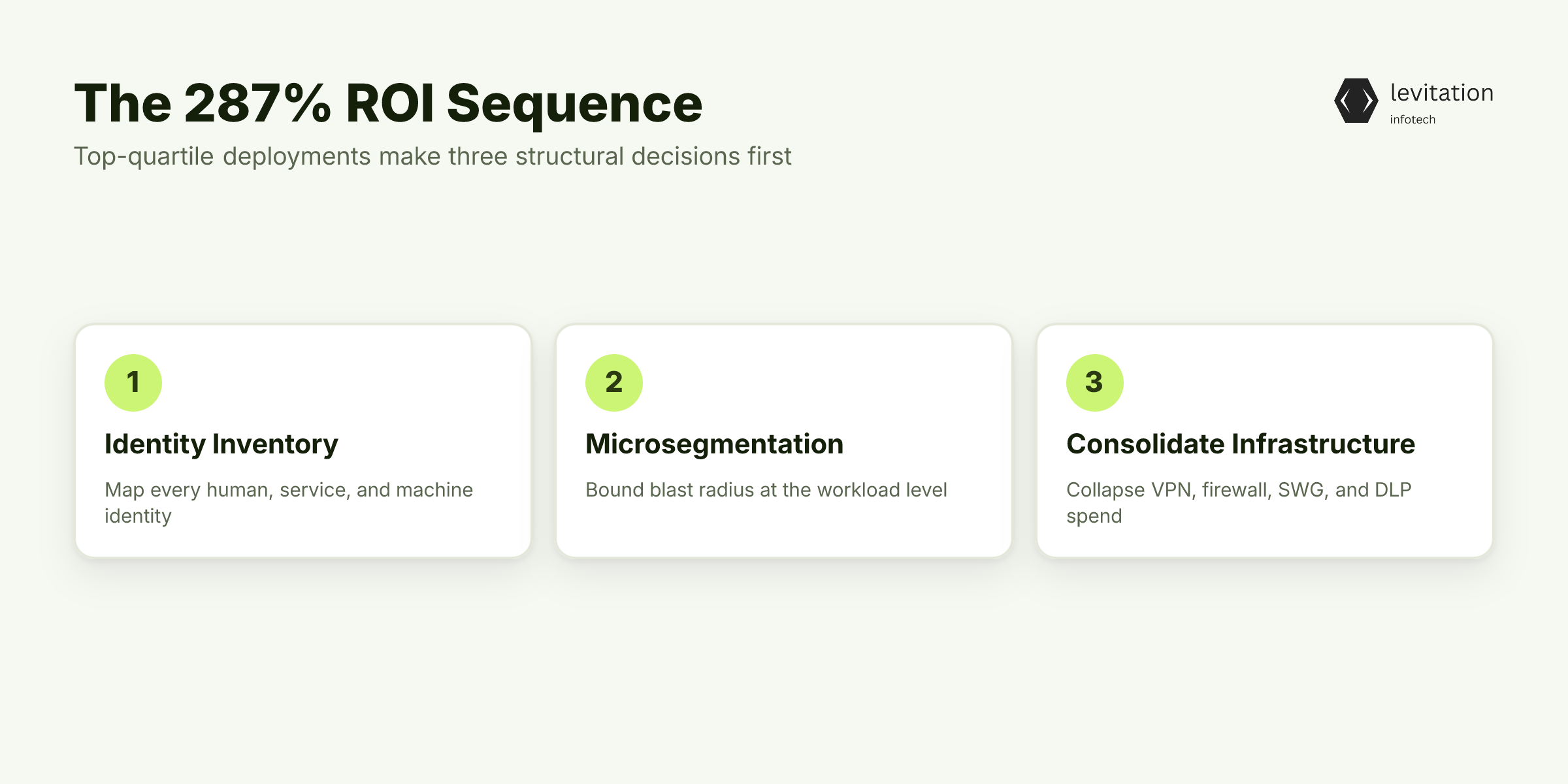
Top-quartile deployments share three structural decisions. They make them before any network control is purchased.
First, they start with an identity inventory. Every human, service account, and machine identity is mapped. Every trust boundary is explicit.
Without this, microsegmentation policies operate on guesswork. Then the rollout turns into a year-long firewall exercise.
Second, microsegmentation drives the largest measured gains. Workload-level segmentation bounds the blast radius of any single breach. It does this by cutting off the lateral paths an attacker can walk.
The blast radius is the number that matters. It bounds the cost of any single breach. Halve the blast radius and you roughly halve the average incident cost.
Third, the gains compound. Infrastructure consolidation across VPN concentrators, firewalls, SWGs, proxies, DLP appliances, and VDI creates predictable OPEX reductions.
Portnox's Forrester study found $5M in total financial value for a single deployment. That cash directly funds the next phase.
Cloud security and IAM for Zero Trust is where the architecture meets the budget. Programs that get the sequencing right build systems still running in production years after deployment. The longevity comes from policy as code and identity as the control plane. It also comes from workloads that don't depend on a single vendor's tunnel.
Architecture alone doesn't get you to 287%. The rollout sequence is where most programs collapse. It's also where the 9% median gets cemented.
A Measurable Rollout Sequence for CTOs
The four phases below are the pattern shared by top-quartile deployments. Each has a measurable exit criterion. Each gates the next.
Phase 1: Inventory and instrument. Map every identity, service, and trust boundary. Baseline MTTI and MTTC. Map lateral-movement paths.
Without this baseline, you're measuring coverage, not outcomes. Exit criterion: a current identity and workload inventory plus a baseline report.
Phase 2: Identity-first controls. Enforce MFA, least privilege, and just-in-time access. This is where identity-centric sequencing becomes real. It's also where IAM anchors the rest of the program. The Zero Trust build on cloud security sequence starts here, not at the network edge.
Exit criterion: standing privilege cut sharply, MFA coverage at critical access paths.
Phase 3: Microsegmentation and mTLS. Close east-west movement with workload-level controls. Kubernetes-native service mesh and cloud security solutions are the practical path here, not more firewalls.
The mesh mTLS data leak failure mode is avoidable if segmentation is policy-driven, not just certificate-driven. Exit criterion: blast radius cut by 50% or more from baseline.
Phase 4: Continuous verification and tool consolidation. Replace VPN, SWG, and legacy proxies with ZTNA. Measure the OPEX delta. Reinvest in detection.
This is the phase that converts 9% rollouts into the breach-risk reductions. Those reductions are what Portnox's Forrester study documents. Exit criterion: 30% or more reduction in tool count; OPEX savings redirected to detection and response.
Metrics that matter: - Blast radius (target 50%+ reduction) - MTTI and MTTC (target reduction from baseline) - Tool count consolidated - Engineering hours reclaimed
Not "percentage of users on MFA."
Sequencing at this depth needs engineering capacity most procurement committees don't budget for. The operational maturity that runs this kind of program is rare. The median stays low because most teams skip the measurement discipline that the rollout sequence enforces.
And the returns compound in ways that don't show up in a first-year ROI model. That's why the median stays low and the top quartile keeps pulling away. The procurement decision that separates them rarely makes it into the RFP.
From 9% to 287%: What Actually Changes
The shift from 9% to upper-quartile outcomes is not a technology purchase. It's a measurement discipline and an architecture sequencing problem.
Real outcomes stack: faster breach containment, blast-radius reduction, infrastructure savings, and engineering hours reclaimed. These are the components of the 287% number Portnox's Forrester study reports, not its cause. The cause is the order in which they're built.
The CTO's job is to refuse single-vendor "Zero Trust in a box" framing. Demand outcome-based contracts. Sequence identity, then segmentation, then consolidation.
Measure blast radius and MTTI, not coverage. The cloud security for Zero Trust rollouts conversation has to start with those terms, not with SKU selection.
Most programs fail at procurement, not at deployment. The 9% median is a buying problem wearing a security costume.
Frequently Asked Questions
What is a realistic Zero Trust ROI to expect in the first 18 months?
Median deployments see roughly 9% reduction in breach costs within 18 months, per IBM data. Top-quartile deployments, like the Portnox deployment measured by Forrester, show 287% ROI. They also show 75% reduction in breach risk. Those outcomes need identity-first sequencing and tool consolidation, not a perimeter ZTNA purchase.
Why do most Zero Trust rollouts underperform vendor claims?
The underperformance is structural, not technological. Most programs treat Zero Trust as a product purchase. They start at the perimeter instead of the identity layer. They skip workload and Kubernetes east-west segmentation.
They measure user coverage instead of blast radius and containment time. Each of these alone can cap outcomes near the 9% median.
How should a CTO measure Zero Trust outcomes?
Track blast-radius reduction, mean time to identify and contain, tool count consolidated, and engineering hours reclaimed. Avoid coverage metrics like "percentage of users on MFA." They correlate weakly with breach cost reduction.
What is the most expensive mistake in a Zero Trust build?
Buying a single-vendor Zero Trust platform and measuring it against a coverage-based procurement scorecard. This locks the program into a perimeter-first model. It leaves east-west and workload traffic exposed. The result is the 9% median outcome that triggers year-two budget cuts.
How long does a Zero Trust rollout take to show measurable ROI?
Tool-consolidation savings and identity-layer controls show measurable ROI within 6-9 months. Blast-radius reduction and breach-cost impact typically show up in the 12-18 month window. Outcome-based measurement, not quarterly coverage reporting, is the only way to sustain executive support through that trough.
About the author
Mayank Singh is a software developer at Levitation Infotech, where he builds web and AI-powered applications across the company’s fintech, healthcare, and enterprise projects.