


TL;DR: Clinical AI hallucination rates vary 11x across medical specialties. The range goes from 8% in well-documented domains to 59% in rare cases. A single aggregate number hides real specialty risk. CTOs need specialty-stratified evaluation, RAG knowledge bases, and human review. These steps are required to deploy clinical AI safely.
Key Takeaways: - Hallucination in clinical AI is not a single metric. It varies by an order of magnitude across specialties. - General LLM benchmarks like HHEM and HealthBench Hard do not measure faithfulness to source clinical records. - Four mechanisms drive the variance. They are data scarcity, dataset bias, architectural limits, and overconfidence. - FDA draft guidance on AI-enabled medical devices does not address "hallucination." Regulatory clearance is a floor, not a ceiling. - Specialty-aware evaluation plus human-in-the-loop verification is non-negotiable for clinical deployment.
The 11x Gap Most AI Evaluation Frameworks Miss
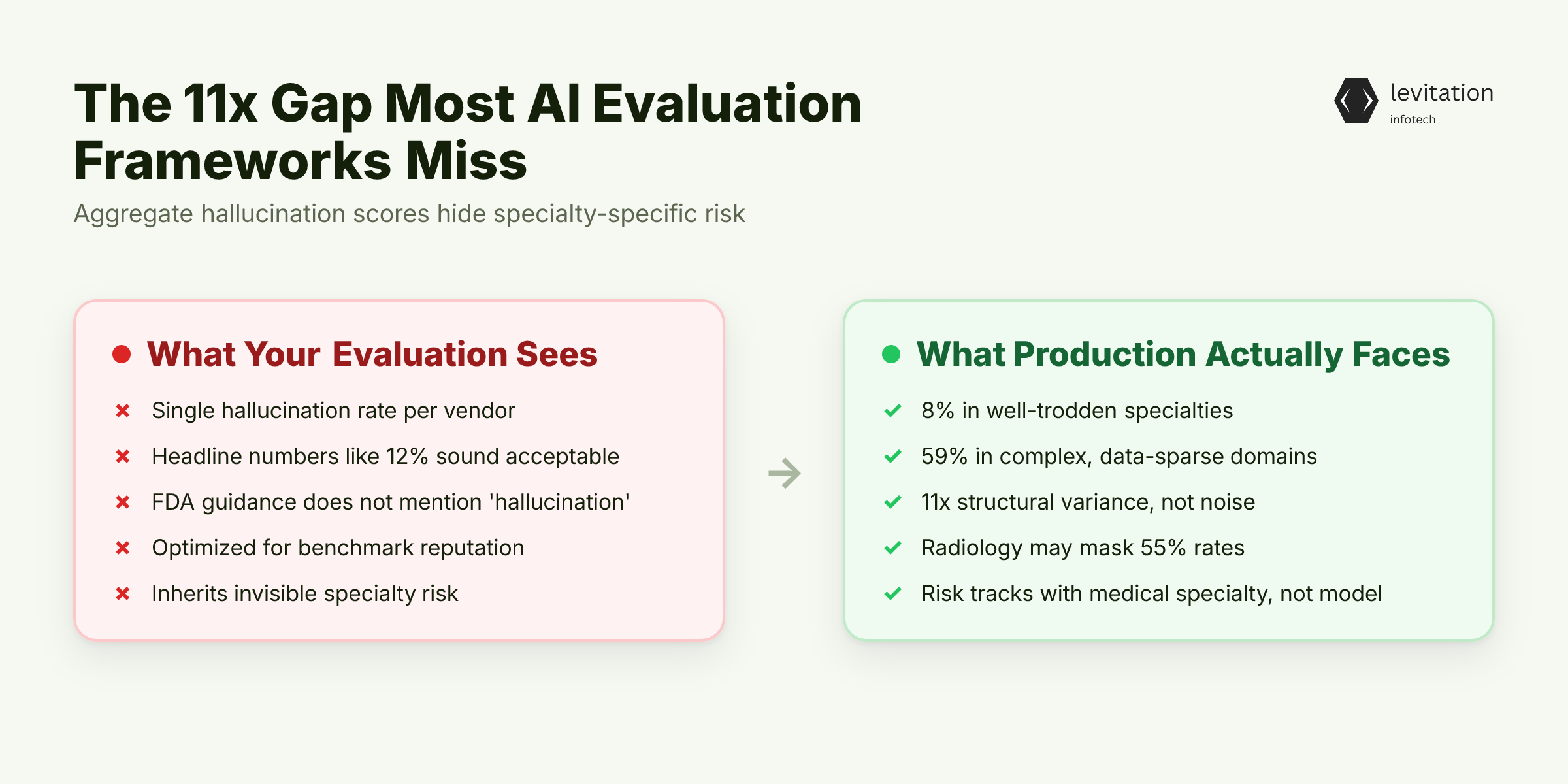
Your clinical AI hallucinates 11 times more in some specialties than others. FDA guidance does not even use the word "hallucination." If your evaluation treats hallucination as a single number, you are approving systems that will fail in production.
A benchmarking study of 19 clinical AI systems exposed a spread that should alarm every CTO. Hallucination rates range from 8% in well-trodden specialties to 59% in complex, data-sparse domains. That 11x variance is not noise. It is structural. It tracks with medical specialty, not model quality alone.
Consider what this means in practice. A vendor shows you a 12% hallucination rate. That sounds acceptable. But if your deployment includes a radiology module, that headline might mask a 55% rate. This happens in the specific subspecialty you actually need. The aggregate number is worse than misleading. It is invisible risk.
Most clinical AI evaluation frameworks report a single hallucination rate per vendor. The top performers on Vectara's HHEM leaderboard achieve under 2%. Impressive. But aggregate scores tell you nothing about your specific clinical workflows. A system optimized for benchmark reputation is not always optimized for your patient population.
CTOs who select clinical AI based on headline accuracy scores inherit a specialty risk profile they cannot see. The danger is not that the model is bad in general. The danger is that the model is unpredictable where it matters most.
But here is the uncomfortable part. The standard benchmarks your team trusts do not even measure this variance.
Why Standard LLM Benchmarks Fail Clinical AI
General-purpose benchmarks like HHEM and HealthBench Hard measure factual grounding against a known corpus. That is a useful property. It is not the same as clinical safety.
Clinical AI operates on incomplete records. It works with ambiguous histories and rare presentations that these benchmarks do not simulate. A model that scores under 2% on HHEM can still produce 59% hallucination rates in complex specialty cases. The 19-system benchmark showed exactly this gap between reputation and real-world performance.
Research on clinical AI evaluation has surfaced a failure mode that most benchmarks miss. The model generates a medical summary that contradicts the source clinical notes. It produces a confident, fluent output that is structurally wrong. AI compliance and evaluation standards built on standard benchmarks do not test for this. They test grounding against a corpus, not faithfulness to a patient record.
The practical implication is clear. Without specialty-stratified evaluation, you are buying a system whose worst-case performance is undocumented. Vendor due diligence that relies on a single benchmark number is not due diligence. It is a guess.
That worst-case performance is not random. Four specific architectural and data mechanisms drive it. Each one demands a different fix.
The Four Mechanisms Behind Specialty-Specific Hallucination
These mechanisms compound. That is what makes the variance so steep.
Mechanism 1: Not enough specialty training data. Rare diseases and poorly documented clinical histories create data scarcity. Underrepresented specialties also suffer from this problem. JMIR Medical Informatics confirms hallucination spikes in these conditions. This is why specialties with sparse training data show the highest rates. They lead the 19-system benchmark for worst performance.
Mechanism 2: Biased datasets. Training corpora overrepresent high-volume, well-documented specialties. When a model trained mostly on cardiology notes meets a dermatology case, it fills gaps with plausible but wrong inferences. The bias is invisible because the output reads like medical English.
Mechanism 3: Architectural limits. Standard transformer architectures lack confidence-calibration. A study on AI-driven radiology tools found misdiagnoses linked to AI hallucination. The range was 5-10% of cases. The model did not know when it did not know.
Mechanism 4: Overconfidence. Clinical fine-tuning often reinforces confident assertion rather than calibrated uncertainty. The system produces fluent, authoritative output regardless of its actual grounding. This is more dangerous than an obvious error. It looks right.
These mechanisms are not independent. They reinforce each other. A data-scarce specialty with biased training data and a non-calibrated model produces output that is confidently wrong. This is the worst possible combination for patient safety. Your healthcare technology infrastructure must compensate for what the model cannot do.
Understanding the mechanism is step one. The real question for a CTO is this: what does an evaluation pipeline that actually catches this look like?
Building a Specialty-Aware Evaluation Pipeline
A pipeline that catches specialty-specific hallucination has four steps. Skip any one and the worst case stays hidden.
Step 1: Map your clinical workflows to specialty domains before vendor evaluation. A system performing well in general medicine may fail in your radiology module. Workflow mapping is the foundation. Without it, you cannot interpret any benchmark score.
Step 2: Demand specialty-stratified benchmark data from every vendor. If a vendor can only provide an aggregate hallucination rate, treat that as a red flag. Do not treat it as a reassurance. Single-number reports are not transparency. They are evasion.
Step 3: Establish minimum thresholds per specialty, not a single organization-wide number. Use the PLOS Digital Health and JAMA Otolaryngology range of 8-20% as a baseline. This baseline covers general clinical decision support. Demand tighter thresholds (under 2%) for high-acuity specialties. One-size-fits-all thresholds guarantee one-size-fits-all risk.
Step 4: Build a human-in-the-loop verification layer for any specialty where hallucination rates exceed your threshold. This is non-negotiable for clinical deployment. No clinical AI system should auto-commit outputs without clinician review. This rule applies in domains where hallucination risk is documented.
Even with a rigorous pipeline, there is a regulatory dimension that most CTOs overlook entirely.
The Compliance Gap Nobody's Talking About
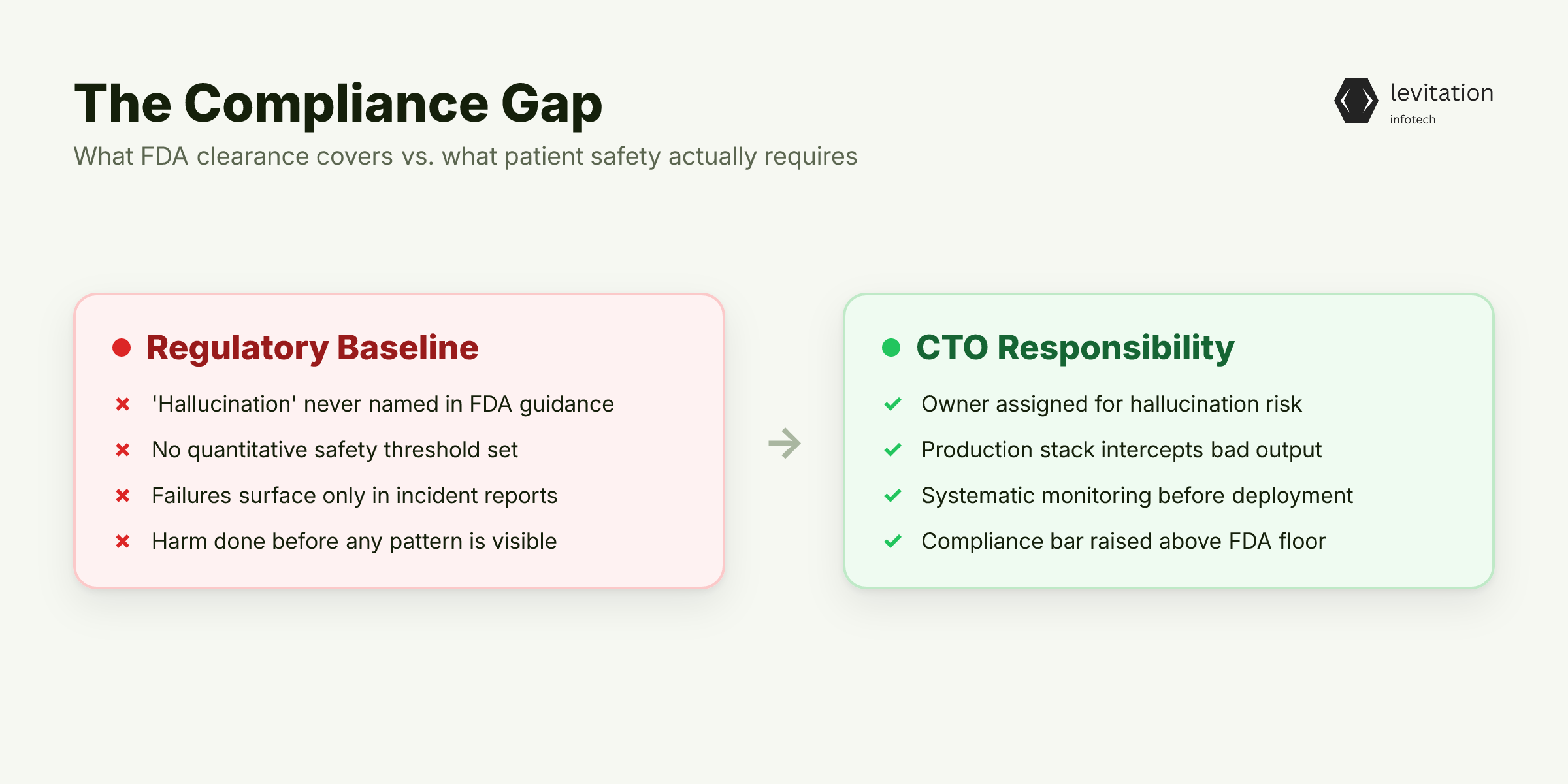
FDA draft guidance on AI-enabled medical devices does not reference the term "hallucination." It addresses erroneous AI outputs through broader reliability and total-product-lifecycle frameworks. However, it sets no quantitative hallucination threshold. The concept is absent from the guidance.
Yet FDA-cleared products are deployed in clinical workflows where hallucination is a real risk. A system can be FDA-cleared and still produce hallucinated outputs. This happens in edge cases the clearance process never tested. This is the regulatory blind spot most CTOs miss.
Postmarket surveillance for capturing hallucination events is not standardized. Failures surface in incident reports, not in systematic monitoring. By the time a pattern is visible, the harm is done. Your AI compliance strategy must close this gap.
CTOs deploying clinical AI are responsible for closing it themselves. Regulatory clearance is a floor, not a ceiling. The minimum compliance bar is below the bar for actual patient safety. FDA clearance alone does not protect you in court when a hallucinated output reaches a patient.
Closing that gap requires more than policy. It requires a production stack architecture designed to minimize hallucination before it reaches a clinician.
What a Production-Ready Clinical AI Stack Actually Requires
Four architectural elements distinguish a production-ready clinical AI system from a demo.
RAG-powered knowledge bases anchored to verified clinical sources. This reduces hallucination by constraining the model's output to grounded context. It works only if the knowledge base is specialty-mapped and updated often. A stale or generic RAG pipeline shifts the failure mode from "hallucination" to "outdated hallucination." That is worse, not better.
Model selection validated against your specialty mix. Systems like Muse Spark and GPT-5.4 have shown strong performance on HealthBench Hard. CTOs should validate performance in their specific specialty mix. They should not rely on benchmark reputation. Why LLM evals approve models that fail is a pattern most teams discover only in production.
Human-in-the-loop verification at the point of clinical decision. This is the single most effective hallucination control. No production system should auto-commit clinical outputs without clinician review. Speed gains evaporate if a clinician must verify every output anyway. That verification is the price of safety, and it is worth paying.
Built-in fact-checking layers that cross-reference generated outputs against source clinical notes. This catches the problem of summaries that contradict source notes. Without this layer, outputs that contradict the patient record reach the chart.
When all of this is done right, the outcomes are measurable. They compound over time.
What Changes When You Get This Right
Clinical AI systems built with specialty-aware evaluation and production-grade hallucination controls unlock new workflows. Single-metric systems cannot safely support these workflows. The difference is not marginal. It is categorical.
The alternative, deploying clinical AI without specialty-stratified hallucination control, is not a productivity problem. It is a patient safety problem waiting to happen. Most hospital AI pilots fail in year one, and hallucination control gaps are one common path to that failure.
Frequently Asked Questions
What is a clinically acceptable hallucination rate for medical AI?
Research from PLOS Digital Health and JAMA Otolaryngology places general clinical decision support rates between 8-20%. Top HHEM-scoring models achieve under 2%. This should be the target for high-acuity specialties.
A single organization-wide threshold is not enough. Each specialty domain needs its own benchmark based on complexity and data availability.
Does the FDA regulate AI hallucination rates in clinical systems?
Not directly. FDA draft guidance on AI-enabled medical devices does not reference "hallucination." It addresses erroneous AI outputs through broader reliability and total-product-lifecycle frameworks. However, it does not set quantitative hallucination thresholds. CTOs must define and enforce their own standards beyond regulatory minimums.
Why do clinical AI systems hallucinate more in some medical specialties?
Four primary mechanisms drive specialty-specific variance. First, there is not enough training data for rare conditions. Second, biased datasets overrepresent high-volume specialties. Third, architectural limits hurt confidence calibration. Fourth, overconfidence gets reinforced during clinical fine-tuning. Specialties with rare diseases or poorly documented clinical histories show the highest rates.
How should a CTO evaluate clinical AI hallucination before purchase?
Demand specialty-stratified benchmark data from every vendor, not a single aggregate rate. Map your clinical workflows to specialty domains first. Then require vendors to provide performance data per domain. Set minimum thresholds per specialty (under 2% for high-acuity). Then require human-in-the-loop verification for any domain exceeding your threshold.
What deployment factors matter most for hallucination-controlled clinical AI?
Production-grade clinical AI systems with RAG knowledge bases, human review, and specialty-aware evaluation need teams with specialized experience. Teams without this specialization often skip the hallucination control layer. They do this to meet internal deadlines. The teams that avoid year-one failures treat faithfulness checking, specialty-stratified evaluation, and clinician verification as architecture from day one.
Sources
Research and references cited in this article:
- Hallucination Rates in Medical AI: What the Citation Fabrication Data ...
- AI Hallucination Rates, Statistics & Benchmarks in 2026
- Medical Hallucination in Foundation Models and Their ... _(academic)_
- JMIR Medical Informatics - Reference Hallucination Score for Medical Artificial Intelligence Chatbots: Development and Usability Study
- Omission and hallucination prevalence of clinical guidelines in ...
- Anterior
- Guidelines for Handling Hallucinations in AI Tools | CXC
- AI Hallucinations in Medical Docs: Risks & Safeguards
- Healthcare AI Regulation Compliance Guide - Jimerson Birr
- Which AI Has the Lowest Hallucination Rate? (2026 Data)
- What are AI hallucination evaluations? Metrics and methods ...
- On Hallucinations in Artificial Intelligence–Generated Content for Nuclear Medicine Imaging (the DREAM Report)
About the author
Mayank Singh is a software developer at Levitation Infotech, where he builds web and AI-powered applications across the company’s fintech, healthcare, and enterprise projects.