


TL;DR: A generic pharma ERP handles day-to-day transactions but collapses when asked to reverse-trace a single batch through suppliers, equipment, and personnel. The first recall exposes whether traceability was built into the data model or patched on after the fact. Plant heads who want recall readiness need a parent-child lot architecture, potency-adjusted forward distribution, and a mock recall protocol that proves the system works before the regulator tests it for them.
Key Takeaways: - The first real test of a pharma ERP is the first recall, not UAT or go-live; if the data model doesn't enforce parent-child lot relationships, the system will fail when seconds matter. - Patching a generic ERP with custom code raises the three-year ownership cost and slows regulatory submissions because every custom field must be re-validated. - A recall-ready architecture turns a multi-day fire drill into a single targeted query and generates the audit trail the regulator wants, automatically.
The ₹15 Lakh ERP That Passed Every Test Except the Real One
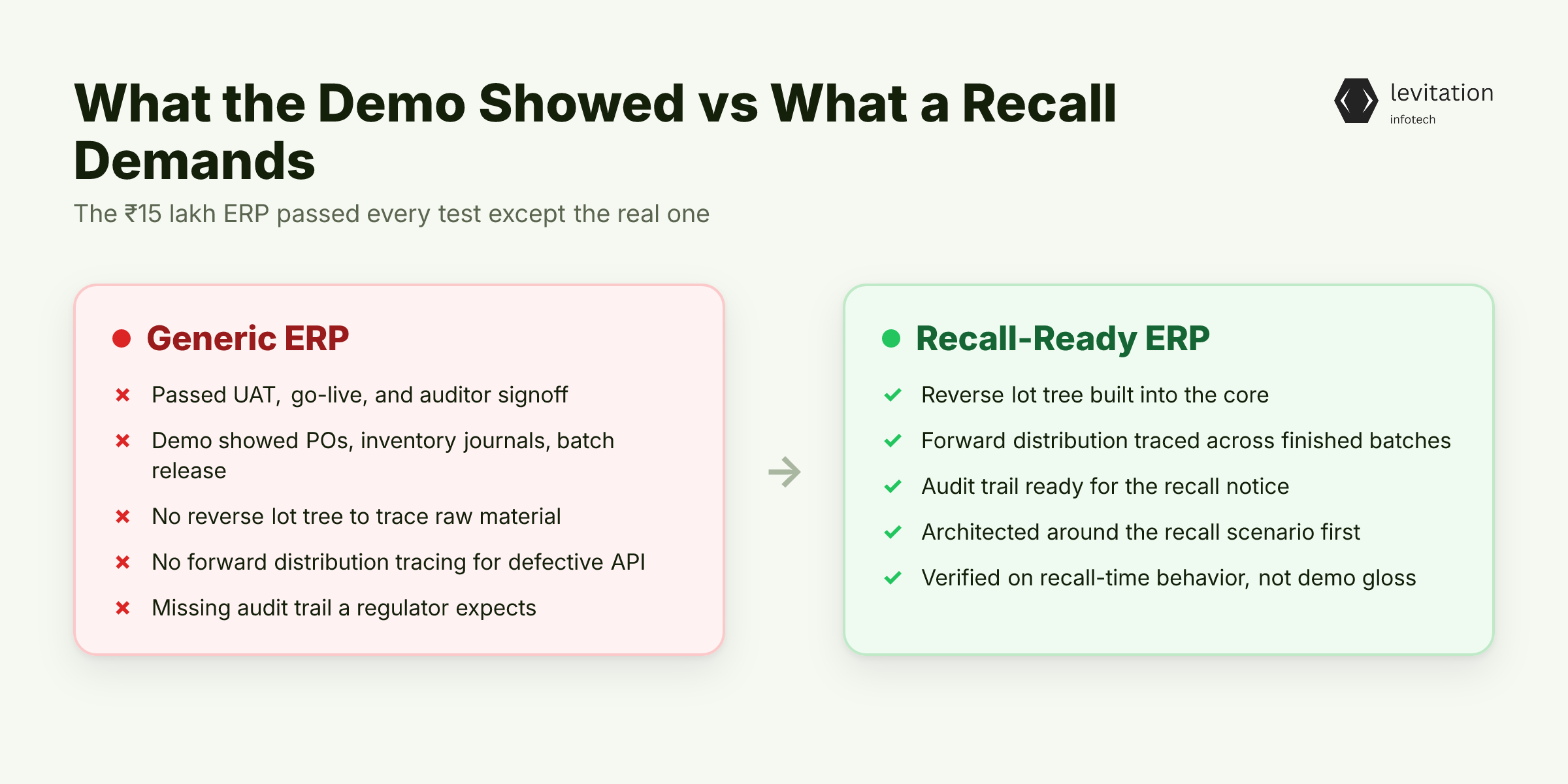
The system passed UAT. The go-live was clean. The auditor signed off. Then the regulator calls for a batch recall. Your team spends days chasing spreadsheets because the ERP can't trace one lot back to one raw material.
The ₹15 lakh you spent bought you software. It didn't buy you recall readiness.
This is the gap that catches plant heads off-guard. The vendor demo showed you purchase orders, inventory journals, and batch release screens that looked like pharma. What the demo did not show was a reverse lot tree.
The demo also did not show forward distribution for a defective API diluted across multiple finished batches. It did not show the audit trail a regulator expects to see when the recall notice arrives.
The industry knows the math even if individual plants absorb it as a one-time shock. Recalls, returns, and product expirations cost the pharma industry about $2 billion each year. Another $2 billion goes to processing these events. Most of that processing time is manual because the ERP cannot do it.
The failure pattern stays the same. Plant heads buy on module count, demo gloss, and the cost line on the capex sheet. They don't buy on recall-time behavior. A well-architected ERP software development engagement starts with the recall scenario, not the transaction screen.
But the plant head didn't buy a bad system on purpose. So where exactly does the generic ERP fall short of what a recall actually demands?
Why Generic ERPs Miss the Three Things Recalls Actually Need
Generic ERPs are built around financial transactions, not around parent-child lot relationships. A raw material lot, a semi-finished batch, and a finished pack are stored as separate records. There is no enforced lineage between them.
Someone fills in a "parent lot" field in a form, and the system trusts that field at face value. Trust is not traceability.
Consider a real recall scenario. An API supplier flags contamination in a raw material lot. That lot was diluted into multiple finished batches across different product strengths and pack sizes. It was then distributed to many customers over several weeks.
The recall notice must list every customer shipment, every pack, every batch, and the raw material pedigree behind each one. A purpose-built ERP for manufacturing India handles this as a single query. A generic ERP makes QA export multiple CSVs and reconcile them in Excel.
Three features separate a recall-ready ERP from a generic one: - Potency and yield-adjusted traceability. A recalled API may have been diluted into multiple finished batches. The system must calculate forward distribution from the potency ratio, not from inventory counts. Generic ERPs store quantities, not concentrations. - Equipment and personnel attribution. The recall note must show which mixer, which line, which shift, and which operator handled the batch. Most generic ERPs capture this at the work order level, not at the batch level. The attribution turns fuzzy when regulators ask. - Bidirectional recall reach. Going forward to every customer who received the batch, and backward to every raw material and packaging component that went into it, in a single query. Most systems do one direction, slowly.
None of this is exotic. It is table stakes for any plant under Schedule M or 21 CFR Part 11. The reason it is missing comes down to design.
Generic ERPs were built for discrete manufacturing, where lot genealogy is a nice-to-have. They were also built for finance teams, where lot genealogy is invisible. You can see the same gap in how ERP implementation cost in India shifts once teams realize they need a pharma-specific data model rather than a configured general ledger.
Once the gaps are visible, most teams do the obvious thing: they ask the vendor for customizations. That's where things get worse.
The Custom Code Trap: Why Patches Make Recalls Worse
When a generic ERP lacks batch traceability and potency calculations, the standard response is to bridge the gap with custom coding or add-on modules. This is the most common source of compliance risk in mid-size pharma plants. Almost no one sees it coming.
Custom code sits outside the core data model. It doesn't follow the same upgrade path, the same validation rules, or the same audit trail as native modules. Every time the vendor ships a patch, your customizations need to be re-tested.
Every time a regulator audits your system, your validation team must prove the custom code behaves the same as the native code. That proof is expensive and slow.
The cost curve is the part vendors don't model. A ₹15 lakh license looks attractive. The first customization adds licensing, development, and validation cost. The second-year re-validation adds re-testing cost.
By year three, the cost of maintaining a customized generic ERP has grown well past the original license for what was sold as a budget system. You can see the same pattern play out across pharma verticals in any honest pharma ERP implementation review.
There is a second, quieter cost. Custom-heavy ERPs slow down over time instead of speeding up. Every regulatory submission requires re-testing every custom field. Every vendor upgrade risks breaking a patch.
The engineering hours to keep it all working grow, and most in-house teams cannot keep pace. A proper pharma ERP implementation with native traceability deploys faster when scoped by a partner who has done it before. The partner has already worked through the Schedule M and 21 CFR Part 11 requirements that consume most first-time builds.
So patching the generic ERP is the wrong move. What's the right architecture for an ERP that actually survives a recall?
What a Recall-Ready Architecture Actually Looks Like
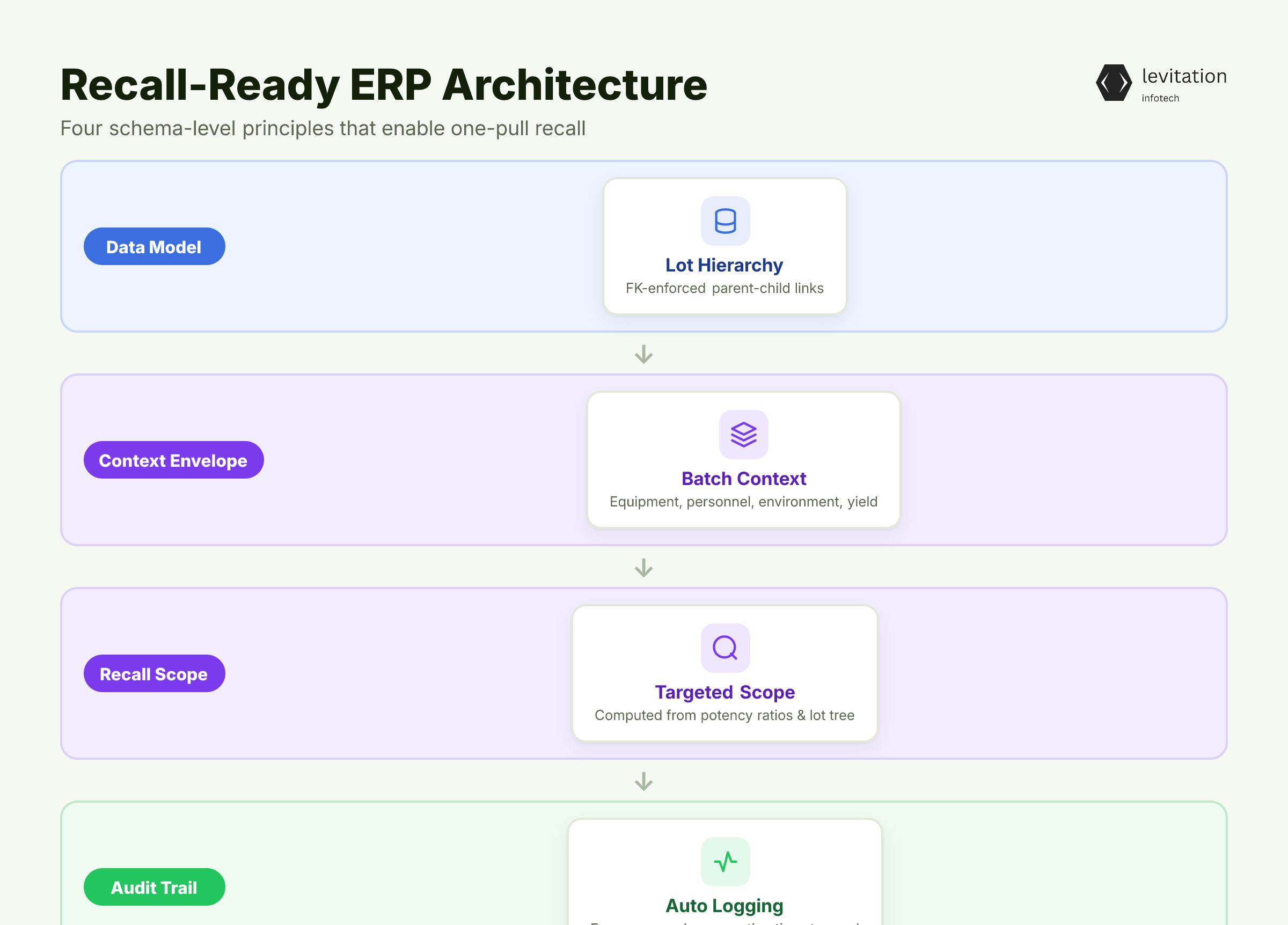
Recall readiness is a data model decision, not a feature decision. Every other capability flows from how you structure the lot hierarchy at the schema level.
The first principle is that the lot hierarchy must be a first-class relationship enforced by the database. Raw material, intermediate, bulk, and finished pack must all reference their parents and children through foreign keys the system will not let you orphan.
If someone forgets to record a parent link at goods receipt, the batch record cannot be saved. This is the opposite of a form field someone fills in if they remember.
The second principle is the context envelope. Every batch record must carry the equipment IDs, personnel IDs, environmental readings, and potency or yield calculations that describe how it was made. The recall query returns the full picture in one pull.
No joining multiple tables. No calling the production supervisor to ask which mixer was running that week. You can see why batch traceability software in India is treated as a separate category from generic ERP modules.
The third principle is targeted recall scope. The regulator does not want you to pull every batch made in a quarter. They want the defective lot and its forward and backward children, isolated.
A recall-ready ERP computes that scope from the potency ratios and the lot tree, not from a date range. This is what shrinks the recall volume and the recall cost.
The fourth principle is automatic audit trail. Every query, every status change, every quarantine action taken during the recall is logged with timestamp, user, and reason. The post-recall regulatory submission is already written by the time the recall closes.
No after-the-fact reconstruction. No panic emails asking who changed what. The same architecture shows up across the industry's best-run plants. Teams with deep regulated-industry experience treat traceability as a schema property, not a workflow.
An architecture on paper is still just an architecture. The real question is how to test it before the regulator tests it for you.
The 12-18 Month Mock Recall Protocol Your Vendor Won't Run
Industry practice is to conduct mock recalls every 12 to 18 months. These exercises identify weaknesses in the recall process so you can address them before a real event forces you to.
Your vendor will not run them for you, because the mocks often surface gaps in the vendor's own system.
The first mock recall test is the reverse lot tree. Pick a random finished batch number. Ask the ERP to return the complete parent-child lot tree, from raw material to pack, without manual reconciliation.
If the result is missing one of the parent lots, the lineage is not enforced at the schema level. Either failure means your recall will be a manual scramble rather than an automated query. This is the first question any honest ERP implementation cost in India review should answer before signing the purchase order.
The second test is forward distribution. Ask the ERP to generate the customer shipment list for every pack that contains any quantity of the recalled lot.
If QA has to pull reports from multiple modules and reconcile them in Excel, the recall path is broken. Potency-adjusted forward distribution is the test most generic ERPs fail, and it is the one that costs plants the most during a real event.
The third test is audit trail reconstruction. Have the regulatory team trace every action you took during the mock recall back to a system log entry. Each entry should show user, timestamp, and reason.
If a single action is missing, your post-recall regulatory submission will be questioned. If the timestamp is approximate rather than exact, the audit response will be rejected.
Between mocks, schedule quarterly system reviews. The ERP must evolve with regulation changes rather than fall behind and force a rushed upgrade during a live recall. The teams that win here treat the ERP as a living compliance asset, not a one-time capex line item.
A properly scoped ERP software development engagement, delivered by a partner with pharma experience, deploys faster than an in-house rebuild. It also survives vendor upgrades without breaking custom logic.
Run that protocol once and you'll see exactly what your current ERP is missing. Here's what changes when the system passes it.
From Multi-Day Fire Drills to Single Targeted Pulls
A recall-ready ERP collapses a multi-day scramble into a single query. The plant head opens one screen and sees the lot tree, the forward customer list, and the regulatory audit trail. All of it is generated from the same lineage model that runs the rest of the plant.
The cost impact is immediate. Targeted recall scope pulls only the defective lot and its direct children from the market. That smaller scope directly cuts into the $2 billion in annual recall and return losses the industry absorbs.
The audit trail generated during the recall becomes your regulatory submission. There is no separate documentation project. No all-hands emergency to assemble a paper trail under regulatory pressure.
The same architecture pays off long after the recall closes. Batch release gets faster because the potency and yield calculations are already in the system. Deviation investigations get shorter because the equipment and personnel context sits on the same record as the batch.
The annual product quality review compiles in hours instead of weeks, because the data is already structured for retrieval. For plant heads who want this without a year-long rebuild, the path runs through a purpose-built ERP for manufacturing India engagement, not a reconfigured generic system.
The goal is not to buy more software. The goal is to pass the first real test the day it arrives.
Frequently Asked Questions
How much does pharma ERP implementation actually cost in India?
For a mid-size plant, total cost varies widely. It includes licensing, validation, and integration. The cost shifts based on whether you choose a generic system requiring heavy customization or a recall-ready validated pharma ERP. The variable most teams underestimate is the cost of custom coding to bridge generic ERP gaps. That cost grows over the system's life because every custom field must be re-validated with each upgrade and regulatory submission.
What is batch traceability software and why do generic ERPs fail at it?
Batch traceability software maintains a parent-child relationship between raw material lots, intermediate batches, and finished packs. It does this so any lot can be reverse-traced and forward-distributed in one query.
Generic ERPs treat lots as flat records tied to inventory transactions. They cannot calculate potency-adjusted forward distribution or surface equipment and personnel context for a specific batch.
How often should pharma companies run mock recalls?
Industry practice is every 12 to 18 months. Each mock recall should test three things. First, reverse lot tree generation without manual reconciliation. Second, forward customer distribution from a single query. Third, complete audit trail reconstruction.
Plants that skip mocks typically discover their ERP gaps during a real regulatory recall.
How long does a pharma-specific ERP implementation take?
A properly validated pharma ERP deploys faster when scoped and delivered by an experienced build partner. It should include native batch traceability, potency calculations, and audit trails. In-house teams without prior pharma ERP experience take longer because they underestimate the validation workload that Schedule M and 21 CFR Part 11 require.
About the author
Mayank Singh is a software developer at Levitation Infotech, where he builds web and AI-powered applications across the company’s fintech, healthcare, and enterprise projects.