


You signed the cheque, approved the rollout, and gave the team logins. Six months later, your finance team is still entering every transaction in Tally. Your shiny ERP dashboard is still showing Q2 data. The CFO is asking why. The vendor is asking for a change management workshop. And your accounts team is asking, quietly, if you really need to do this.
TL;DR: The reason your finance team still uses Tally after a ₹10 lakh ERP rollout isn't user resistance. It's that your ERP tried to replace a system that already does compliance perfectly. A Tally-integrated custom ERP treats Tally as the source of truth and builds the rest of the business around it, reaching a working dashboard in weeks rather than the many months a full replacement takes.
Key Takeaways: - The ERP problem in Indian mid-market companies is architectural, not cultural. Tally is the compliance system of record, and any ERP that fights it will lose. - Mandating ERP-only entry creates shadow spreadsheets, not compliance. Finance teams find the path of least resistance. - Tally-integrated custom ERP preserves Tally workflows entirely, avoiding the retraining tax that kills adoption. - Companies that replace Tally create a long dual-entry period. Companies that integrate it avoid that tax entirely.
The ₹10 Lakh Invoice Your Finance Team Never Read
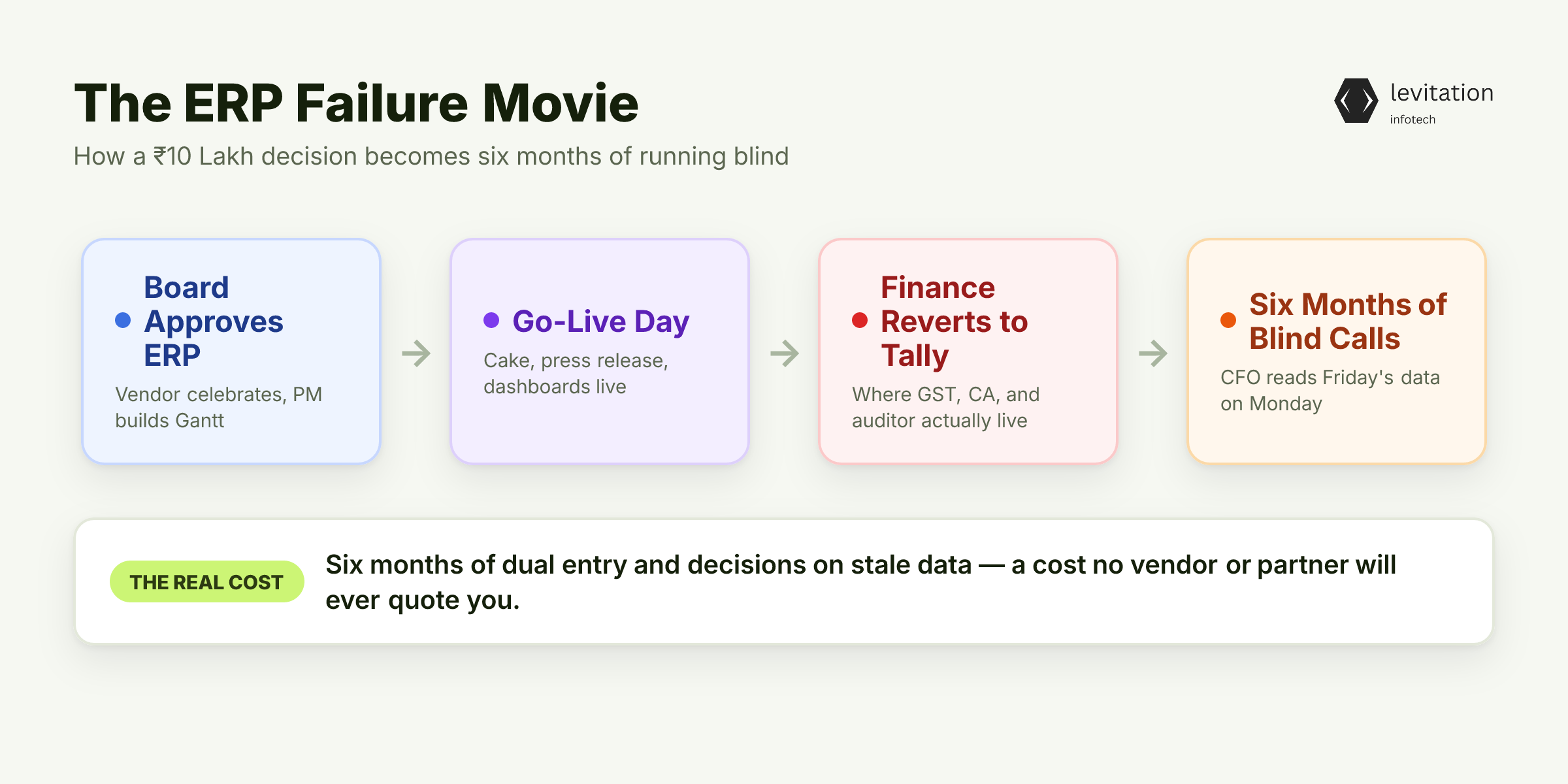
You've seen the movie. The board approves the ERP. The vendor celebrates. The project manager builds a Gantt chart.
Go-live day arrives with cake and a press release. Then the dashboards go quiet.
Finance keeps entering vouchers in Tally. That's where GST returns get filed, where the CA picks up data, and where the auditor feels comfortable.
The pattern is depressingly consistent. The CFO blames "user adoption." The vendor blames "change resistance." Nobody asks the obvious question: what if the finance team isn't wrong?
The real cost isn't the licence. It's the six months of dual entry and the decisions made on incomplete data. When your CFO looks at receivables on Monday, those numbers are actually from the previous Friday. By the time the board meeting happens, the dashboard is a historical artefact. Nobody quotes this cost. Not the vendor. Not the implementation partner. It's the opportunity cost of running blind for half a year while your team pretends to use the new system.
So what do most CFOs do next? They push harder. And that's exactly where things get worse.
Why Cracking Down on Tally Backfires
Mandating ERP-only entry sounds reasonable in a steering committee meeting. Finance will be told: stop using Tally, enter everything in the new system. The vendor will help. Training will be provided. Adoption will be measured.
What actually happens: your accounts team starts a parallel Excel file. They enter every transaction in Tally first (because that's what the CA expects), then re-enter the same voucher in the ERP (because that's what the mandate says). Reconciling the two becomes a Friday afternoon ritual. The shadow spreadsheet grows. The ERP fills with half-truths nobody trusts.
Here's why this happens. Generic ERPs force teams to relearn GST filing, voucher entry, and reconciliation flows that Tally already does in three clicks. Your CA knows Tally. Your plant accountant has muscle memory for voucher classes. Your auditor opens Tally data first because that's the format they understand. Asking them to abandon Tally is asking them to absorb risk for a tool they don't own.
The "adoption problem" framing puts the burden on users. The real burden belongs on the system's design. If your ERP needs six months of training to match three clicks in Tally, the system is wrong. Not the user.
A finance team under pressure to switch will comply on paper and resist in practice. They'll enter stale data. They'll mark vouchers as "pending." They'll keep one Tally window open "just for GST." Six months later, your enterprise resource planning system has the worst data quality in your company. The dashboard still shows Q2.
If the problem isn't the people, and the problem isn't the spend, then where is it?
It's Not Your Team. It's Your ERP Architecture
It is not your finance team failing you. It is your internal process that's broken. The process assumed Tally could be ripped out. It can't.
Monolithic ERP systems were designed for greenfield companies. They were not designed for Indian businesses where Tally is the system of record for compliance. Tally speaks GST natively. It produces e-invoices. It handles TDS, reversal entries, and CA-friendly exports. Your accounts team has spent a decade building workflows around it.
The architectural mistake is treating Tally as a legacy system to be retired instead of a trusted ledger to be connected. That single decision cascades through everything. Your vendor configures the ERP to "own" finance. Your finance team fights back. Your rollout stalls. The dashboard goes dark.
A custom ERP built around Tally as the source of truth, not a competitor to it, changes the entire deployment dynamic. Finance keeps doing what finance does. The rest of the business gets live data without disrupting the ledger. The architecture respects what already works.
This isn't a small philosophical difference. It's the difference between a 12-month adoption war and a 12-week integration project. Indian ERP rollouts that stall at adoption do so because they ignore this. (See our analysis of why 60% of Indian ERP rollouts fail at adoption.)
That reframing forces a different question entirely: should you replace Tally or integrate with it?
Tally Integration vs. Tally Replacement: The Honest Build vs. Buy
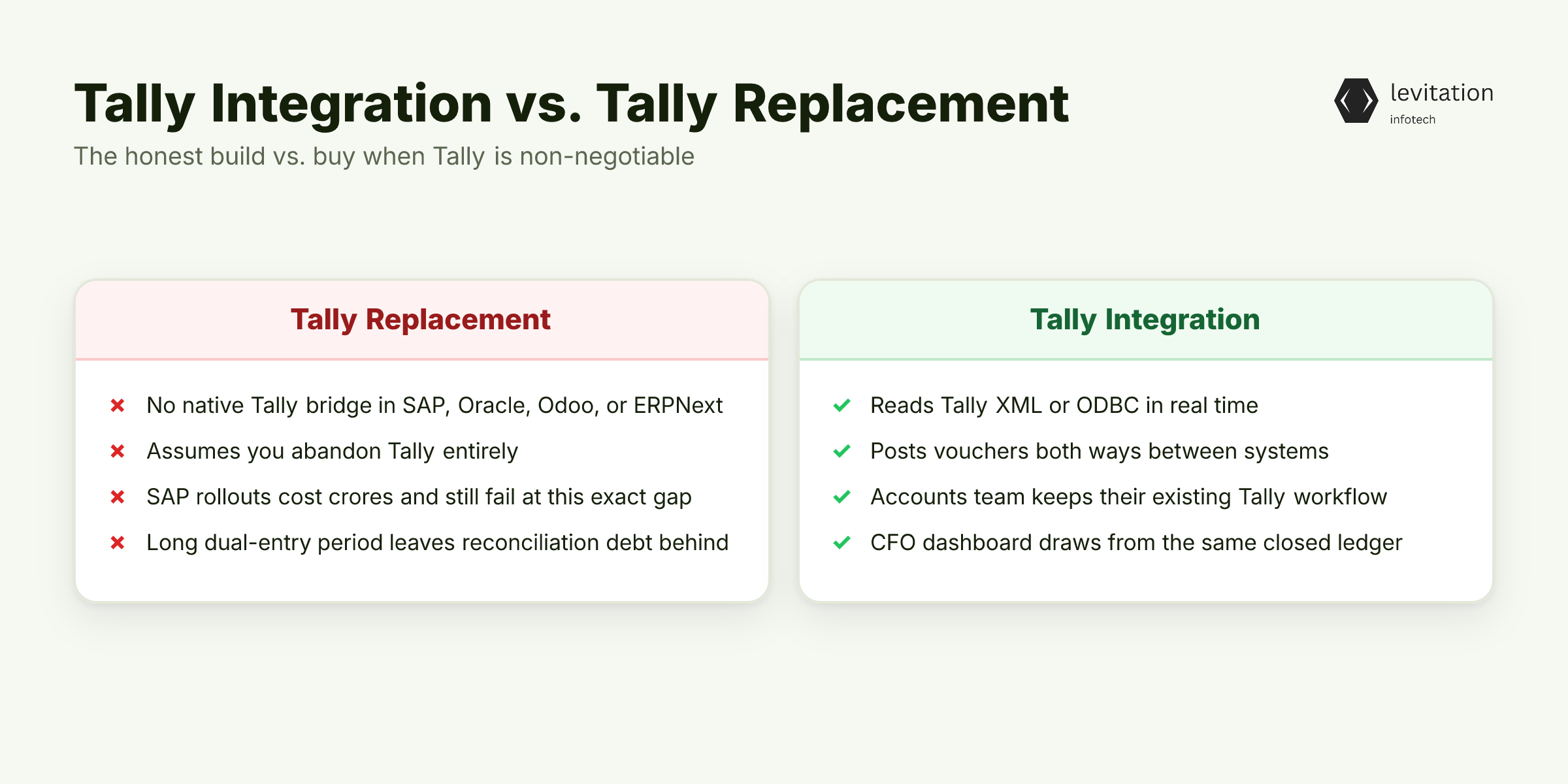
Off-the-shelf ERPs (SAP, Oracle, generic cloud) have no native Tally bridge. They assume you abandon it. That's why rollouts stall. The vendor's training materials don't cover Tally migration because the vendor's business model requires you to forget Tally exists.
The build vs buy ERP in India tilts heavily toward custom when Tally integration is non-negotiable. No vendor product is optimised for that handoff. You'll pay SAP prices and still face a six-month project to build a connector your vendor should have provided.
A custom ERP layer can read Tally XML or Tally ODBC in real time. It can post vouchers both ways. It lets your accounts team stay in Tally while the rest of the business sees live data. Your CFO's dashboard updates from the same ledger your accountant closes at 7 PM. There's no second source of truth.
The cost comparison is stark. SAP rollouts routinely run into crores and still fail at this exact problem. Odoo cost and ERPNext cost are lower, but the Tally gap remains unless you build the connector yourself. And once you're building the connector, you're already halfway to a fully custom ERP.
The pattern is consistent across regulated industries. Companies that try to replace Tally create a long dual-entry period and still end up with reconciliation debt. Companies that integrate it reach a working dashboard while finance keeps its existing workflow. The SAP vs Odoo debate misses the point entirely when Tally is the constraint.
Sounds clean on a slide. What does it actually look like under the hood?
How a Tally-Integrated Custom ERP Actually Works
The architecture has three layers, each doing one job well.
Layer 1: The Tally connector. A small service that reads and writes vouchers in real time using Tally's XML gateway or ODBC bridge. It doesn't alter the local Tally file. It doesn't replace Tally's UI. It just listens for new vouchers. Then it mirrors them into the ERP schema, or pushes ERP entries back into Tally when needed.
Layer 2: The middleware sync engine. This maps Tally ledgers, cost centres, and GSTINs into the ERP schema, not the other way around. The mapping respects how your accountant organises Tally. No reformatting. No "data cleansing" workshops. Your Tally structure becomes the ERP's source of truth.
Layer 3: The custom ERP front end. This is what sales, purchase, inventory, and production teams actually use. It's built for their workflows, not for accountants. Live P&L. Real-time receivables. Stock views that match the warehouse. All of it reading from the same Tally data the finance team trusts.
What your finance team sees vs. what your ERP users see
The data is identical. The interface is role-specific. Finance stays in Tally for GST returns, TDS, audit, and CA handoff. Everything else happens in the ERP integration layer. Reconciliation runs automatically on a short cycle. When the CFO opens the dashboard, it matches what the accountant sees in Tally at that moment. No discrepancy. No Friday afternoon reconciliation ritual. No "pending" status.
This is what Tally ERP integration looks like when it's done as architecture, not as a workaround.
The architecture is elegant. But what does the bill look like, and how does it compare to the ₹10 lakh you already spent?
ERP Rollout Cost in India: Where the ₹10 Lakh Actually Goes
Generic ERP rollout cost in India is usually quoted at a price that sounds reasonable for licences alone. Then the real numbers arrive. Change management workshops. Retraining sessions. The lost productivity of dual entry for six months. The consulting hours to "fix data quality." By year one, the bill balloons well past the quote.
A Tally-integrated custom ERP sits in a different bracket. The connector plus a focused module layer costs less than a generic ERP rollout because the retraining tax disappears entirely. Finance doesn't need retraining. Sales and ops need a short onboarding, not a quarter-long programme.
The line items that matter shift dramatically. Data migration is minimised because Tally is the source of truth, not a legacy system to be archived. User training applies only to non-finance users, and it's measured in weeks, not quarters. Ongoing maintenance is one vendor, not three. (For a deeper look at where the hidden costs hide, see Indian ERP Vendors Hide ₹5.5 Lakh Across Three Years.)
The hidden cost of forcing adoption
Six months of finance productivity loss from dual entry, plus the opportunity cost of decisions made on stale data, usually exceeds the rollout budget. That's the cost nobody quotes. A CEO making pricing decisions on Tuesday based on Friday's numbers is a real liability, and it costs more than any licence.
When you compare Odoo cost and Tally-integrated custom ERP side by side, the seat price tells you nothing. The total cost of ownership over the life of the system tells you everything. (Our analysis of Noida founders making this exact switch is instructive: Noida Founders Are Quietly Replacing Odoo With Custom ERP.)
So the money works differently. What about the outcome? Does this actually change how the finance team operates?
What Changes When Finance and ERP Stop Fighting
Finance keeps their workflow. No training. No resistance. No shadow spreadsheets. They just get to stop being the data-entry bottleneck for the rest of the business. Vouchers land in Tally as always. The ERP sees them on a short sync cycle. The CA picks up data in the format they expect. The auditor finds a clean trail.
The CFO gets a dashboard that matches the Tally ledger to the rupee. It's updated in near-real-time, with drill-downs to voucher level for audit defence. No more "the numbers look different" conversations. No more "let me check with finance" delays on board calls.
Sales, purchase, and plant teams finally operate on numbers the finance team has already validated. Not on their own approximations. Not on stale data. The sales team sees receivables the accountant has closed. The plant manager sees inventory the warehouse has confirmed.
The pattern is clear. The systems that last are the ones that respect existing workflows instead of fighting them.
This is the architecture question most ERP vendors don't want you to ask. They're selling replacement. Indian finance teams need integration. Those are different products, and the difference shows up in your P&L within six months.
Frequently Asked Questions
Can Tally really be integrated with a custom ERP without replacing it?
Yes. A custom ERP can read and write to Tally through its XML gateway or ODBC bridge. Tally remains the system of record for GST, TDS, and audit. Your finance team keeps using Tally exactly as they do today. The ERP pulls live data from it for other departments.
How much does custom ERP development cost in India compared to SAP or Odoo?
SAP rollouts in India typically run into crores for mid-market companies. Odoo cost and ERPNext cost are lower but still require a Tally integration layer if you need to preserve Tally workflows. A Tally-integrated custom ERP usually lands below the cost of a SAP rollout and avoids the dual-entry tax that replacement projects carry.
Why do Indian finance teams still trust Tally over new ERPs?
Tally is built around Indian compliance workflows. GST returns, TDS, e-invoicing, CA handoff. Most generic ERPs are not built for this. Decades of muscle memory, localised support, and audit familiarity make it the default system of record. ERPs that try to replace it without replicating that compliance comfort usually fail at adoption.
How long does it take to build a Tally-integrated custom ERP?
A focused Tally-integrated custom ERP covering finance sync, sales, purchase, and inventory typically ships in weeks. A full SAP or generic cloud ERP rollout often runs over a year.
Is it better to buy Odoo or build a custom ERP for Tally integration?
Odoo is a strong platform for many use cases, but it has no native Tally integration. Tally must remain in place for most Indian mid-market companies. In that case, a custom integration layer or a fully custom ERP is faster and cheaper than retrofitting Odoo to a Tally-first workflow.
If you want to see what a Tally-integrated ERP would look like for your setup, a short architecture review is the place to start.
About the author
Mayank Singh is a software developer at Levitation Infotech, where he builds web and AI-powered applications across the company’s fintech, healthcare, and enterprise projects.