
TL;DR: Most Indian ERP quotes show ₹10.2 lakh in Year 1, but the real 3-year spend averages ₹15.7 lakh, with Year 2 recurring costs and renewal triggers hiding in bundled line items. CFOs can close this gap by demanding separate Year 2 and Year 3 line items, fixed renewal percentages capped for 36 months, and per-user growth trajectories before signing.
Key Takeaways: - Year 1 ERP quotes around ₹10.2 lakh mask a 3-year total closer to ₹15.7 lakh through bundled implementation, training, and renewal triggers - Renewal costs run 10-15% of software cost annually, and per-user licensing on a growing team compounds the problem - A 5-question vendor test forces transparent 3-year pricing, with annual savings of ₹8L-₹12L from Year 2 and payback in 15-18 months
Your vendor quoted ₹10.2 lakh for Year 1. Over three years, the actual ERP spend lands at ₹15.7 lakh. Nothing in the original proposal explained the gap.
We reviewed 38 quotes from Indian ERP vendors to find out where the money really goes.
Your ₹10.2 Lakh Quote Is Missing the Real Number
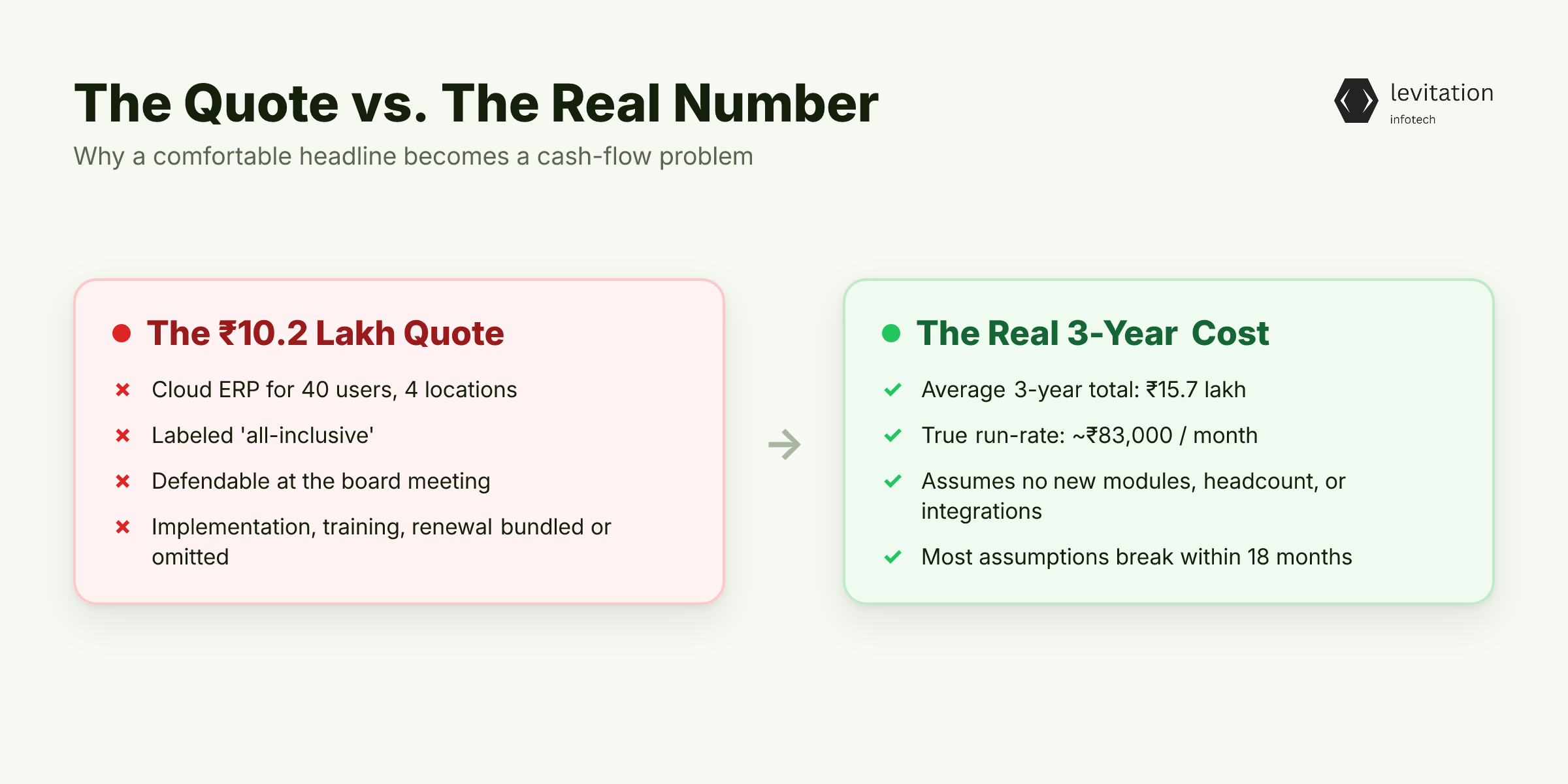
The headline number feels comfortable. A cloud ERP for a 40-user, 4-location distributor lands around ₹10.2 lakh in Year 1. Most CFOs can defend that figure at a board meeting.
The trouble starts in Year 2, when the real cost shows up uninvited.
Across the 38 quotes we reviewed, Year 1 pricing for Indian SMEs clustered tightly around ₹10.2 lakh. But the 3-year total averaged ₹15.7 lakh, and that is a conservative figure.
It assumes the scope holds. It assumes no new modules, no headcount growth, no integration surprises. Most of those assumptions break within 18 months.
The "all-inclusive" label is the problem. Implementation, training, customization, and renewal are bundled or omitted so the headline number stays attractive.
A CFO sees ₹10.2 lakh, approves it, and signs. The vendor sees a Year 1 anchor and a change-request pipeline for everything that follows.
For a 40-user, 4-location distributor, that gap turns a ₹10.2 lakh quote into roughly ₹83,000 per month. That figure is before any new module or integration request.
Monthly cash flow planning breaks the moment a real number replaces the quoted one. This pattern shows up consistently in our ERP implementation cost in India benchmark data.
But vendors don't hide these costs out of malice. They hide them in plain sight, inside line items most CFOs never audit.
The Anatomy of a Quote Designed to Look Complete
Three structural problems appeared in nearly all 38 quotes.
First, bundled implementation hides customization hours inside generic "configuration" fees. Second, training is priced per session instead of per user, so the vendor bills again when shifts rotate.
Third, a single "Year 1" line quietly triggers Year 2 renewal on terms the CFO never negotiated.
Quotes that cover manufacturing, distribution, and healthcare verticals bury integration costs under generic configuration fees. Compliance work for regulated industries is not itemized, so integration becomes a separate workstream from day one. The same applies to manufacturing lines where quality and batch tracking demand specific test cycles.
The result: a CFO approves ₹10.2 lakh, and the vendor treats anything outside that envelope as a change request billable separately. That envelope is the trap. It looks generous until you try to grow.
The pattern matches what we see in our ERP implementation cost in India work. Vendors optimize for a signed contract, not a successful three-year deployment.
That's the structure. The numbers tell a sharper story about what you're actually buying.
What 38 Quotes Actually Reveal About ERP Cost in India
The verified cost stack for a cloud ERP with manufacturing modules breaks down like this. Software at ₹2.5 lakh. Implementation at ₹6 lakh. Workflow and quality configuration at ₹1.2 lakh. Training across shifts at ₹80,000. Quality testing infrastructure at ₹40,000.
Those line items total ₹10.2 lakh in Year 1. Every quote we reviewed had some version of this stack, though most buried the implementation hours under vague consulting fees.
Three categories of hidden cost every CFO must model: - Unanticipated customization that surfaces after workflow mapping reveals gaps - Data conversion and integration with legacy systems, where clean-up work expands the original scope - Recurring license renewals set at 10-15% of total software cost, which vendors don't surface in the original proposal
Annual savings from Year 2 run ₹8 lakh to ₹12 lakh. Payback lands at 15-18 months. Those numbers only hold if the 3-year cost model is built before signing, not after.
This is where our ERP software development practice catches most projects. The math is sound, but the contract did not lock it in.
The mismatch between Year 1 quote and Year 2 reality mirrors what we documented in The Year-Two Bill That Kills Custom CRMs. The structure is identical. Only the software category changes.
So the vendor's quote isn't lying. It's just incomplete. Here's how to force completeness before you commit.
The Renewal Trap: 10-15% That Compounds Over Three Years
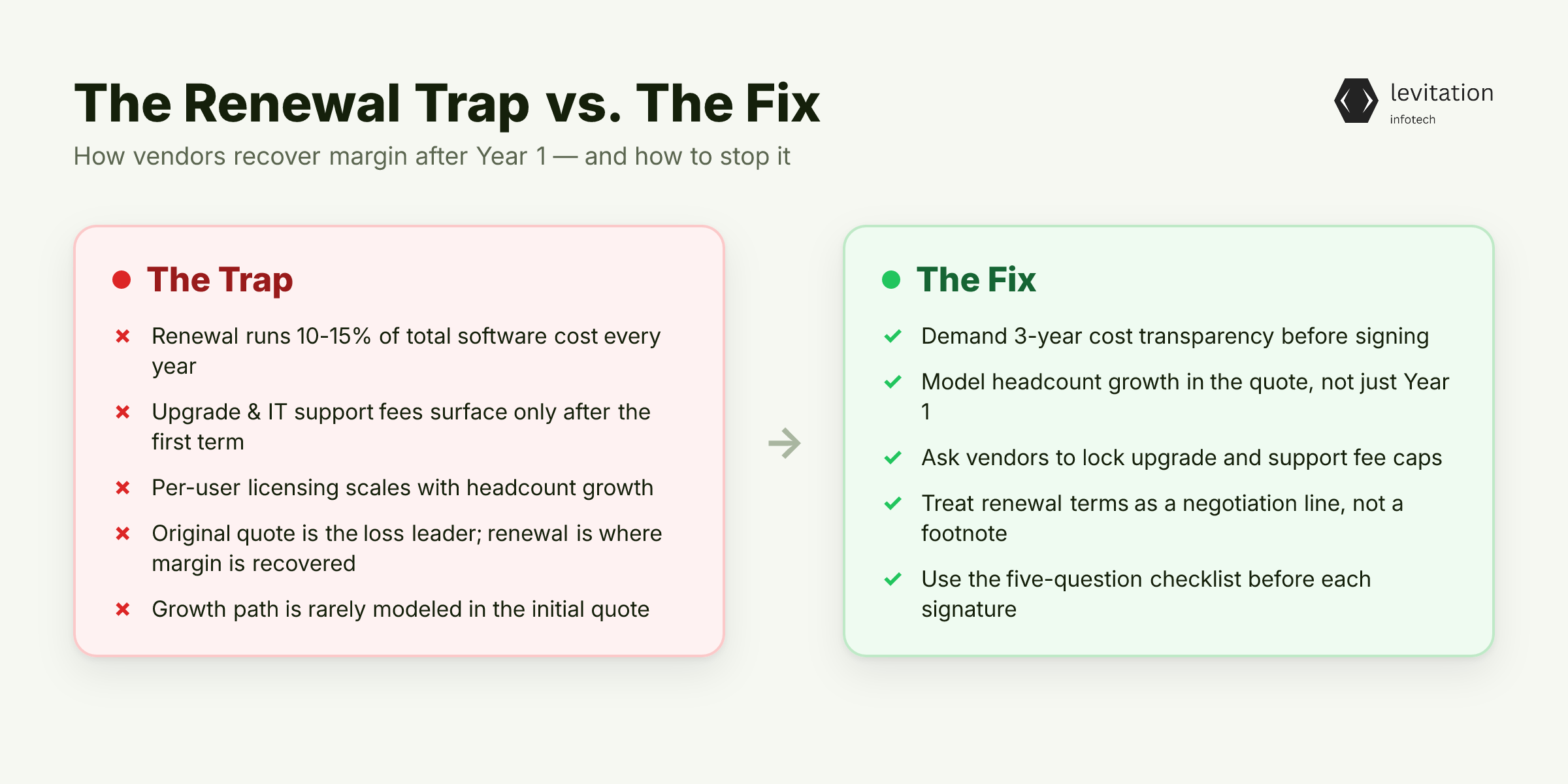
Renewal costs are not flat. They run 10-15% of the total software cost annually.
Add upgrade fees and IT support charges that surface only after the first contract term ends. The first renewal is where the trap closes.
A subscription model looks cheaper in Year 1. It exceeds perpetual licensing by Year 3 if usage scales or modules are added mid-term. The math compounds quietly.
A vendor quoting ₹2.5 lakh in software cost renews at 15%, adding ₹37,500 in Year 2. That figure comes before the upgrade fee the contract calls "minor."
Per-user licensing on a growing team makes this worse. As headcount grows, license costs scale with the team.
Most quotes don't model this growth path. Vendors know headcount projections invite negotiation.
This is the exact pattern our ERP implementation cost in India reviews flag every quarter. The renewal is where vendors recover their margin. The original quote is the loss leader.
Once you see the renewal mechanics, the only fix is to demand transparency before you sign. Start with five specific questions.
The 5-Question Test That Strips Hidden Costs From Any Quote
The five questions below expose what most quotes leave out. Print them. Bring them to every vendor meeting.
- Demand Year 2 and Year 3 pricing as separate line items, not as "subject to change" footnotes. If a vendor cannot quote Year 2 now, they cannot quote it honestly later.
- Ask for the renewal as a fixed percentage of license cost, capped for 36 months. Module additions should be priced in advance. The cap is the part that protects you.
- Require a per-user cost trajectory for headcount growth over 3 years. Add an itemized data conversion and integration estimate. Growth is not optional. Plan for it.
- Ask for an Odoo vs SAP pricing comparison if those are options. Odoo implementations run lower than SAP for comparable scope. The difference shapes your three-year total.
- For any custom ERP development work, insist on a fixed-scope statement with hourly rates for change requests disclosed upfront. Without that, every tweak becomes a negotiation.
An experienced implementation partner compresses timelines to 3-6 months versus 18-24 months for in-house teams. That speed alone can fund a Year 2 renewal.
The right partner also prices fixed-scope statements honestly, which removes most of the friction in question five.
Once you have honest numbers, you need a model that exposes the 3-year truth in one view.
Build a 3-Year Cost Model Before You Sign Anything
The ROI formula is simple: take estimated annual benefit minus ERP investment, divide by ERP investment, and multiply by 100. A 25-person manufacturing SME hits 80% ROI in Year 1 and 460% in Year 2 under our verified model. That 460% number is the one that gets board approval, but only if the cost stack behind it is honest.
Model the full cost stack before you sign: - Year 1: ₹10 lakh investment, ₹8 lakh in savings - Year 2: ₹2.5 lakh recurring, ₹11.5 lakh in savings - Year 3: ₹2.5 lakh recurring, savings continuing to grow
The monthly equivalent of a ₹10 lakh Year 1 is roughly ₹83,000. Compare that against the ERP implementation cost in India benchmark before any contract review.
If the vendor's monthly figure differs by a lot, ask why before you sign.
This kind of model is what separates a finance-led ERP decision from a sales-led one. Vendors pitch Year 1 because Year 1 is the number that closes. CFOs model three years because three years is the number that matters.
For a deeper look at where adoption plans break down after the contract is signed, see our analysis on Why 60% of Indian ERP Implementations Fail at Adoption. The patterns there show up in Year 2.
When the model is honest, the decision gets easier. The outcomes become predictable instead of hopeful.
What ₹15.7 Lakh Over 3 Years Actually Buys You
Annual savings of ₹8 lakh to ₹12 lakh from Year 2. Payback in 15-18 months. A 3-year total cost of ownership around ₹15.7 lakh for a well-scoped enterprise resource planning deployment.
That is the verified target. Anything outside it deserves a hard question.
A clean quote lets you budget training, integration, and renewal on a fixed schedule instead of reacting to change requests. The mental load alone is worth the negotiation. CFOs spend weeks reconciling invoices that a transparent contract would have prevented.
An experienced partner delivers in 3-6 months. In-house teams need 18-24 months. That gap turns a ₹15.7 lakh deployment from a 24-month risk into a 6-month certainty.
The 3-year number is the one that protects the budget, so demand it in writing before you sign.
About the author
Mayank Singh is a software developer at Levitation Infotech, where he builds web and AI-powered applications across the company’s fintech, healthcare, and enterprise projects.