


TL;DR: A ₹2 crore AI contract tells you nothing about who builds your system. In 2026, vendors price by seats, tokens, and outcomes, never by seniority. So four engineers, half of them junior, can sit behind a crore-level deal and you won't see it in the SOW. The fix is a vendor team audit before signing, not after the model breaks in production.
Key Takeaways: - AI pricing models in 2026 hide headcount and seniority behind per-seat, usage, and hybrid structures - Junior engineers with AI tools can ship code that passes review but lack the judgment to run a production system - Seven specific questions before you sign reveal whether the team has depth or is just demo-deep
You signed the ₹2 crore contract because the demo was flawless. Six months in, the model breaks in production, the Slack channel goes quiet, and you discover the team behind your "enterprise AI platform" is two junior engineers and a founder doing sales calls.
The ₹2 Crore Disconnect Nobody Talks About
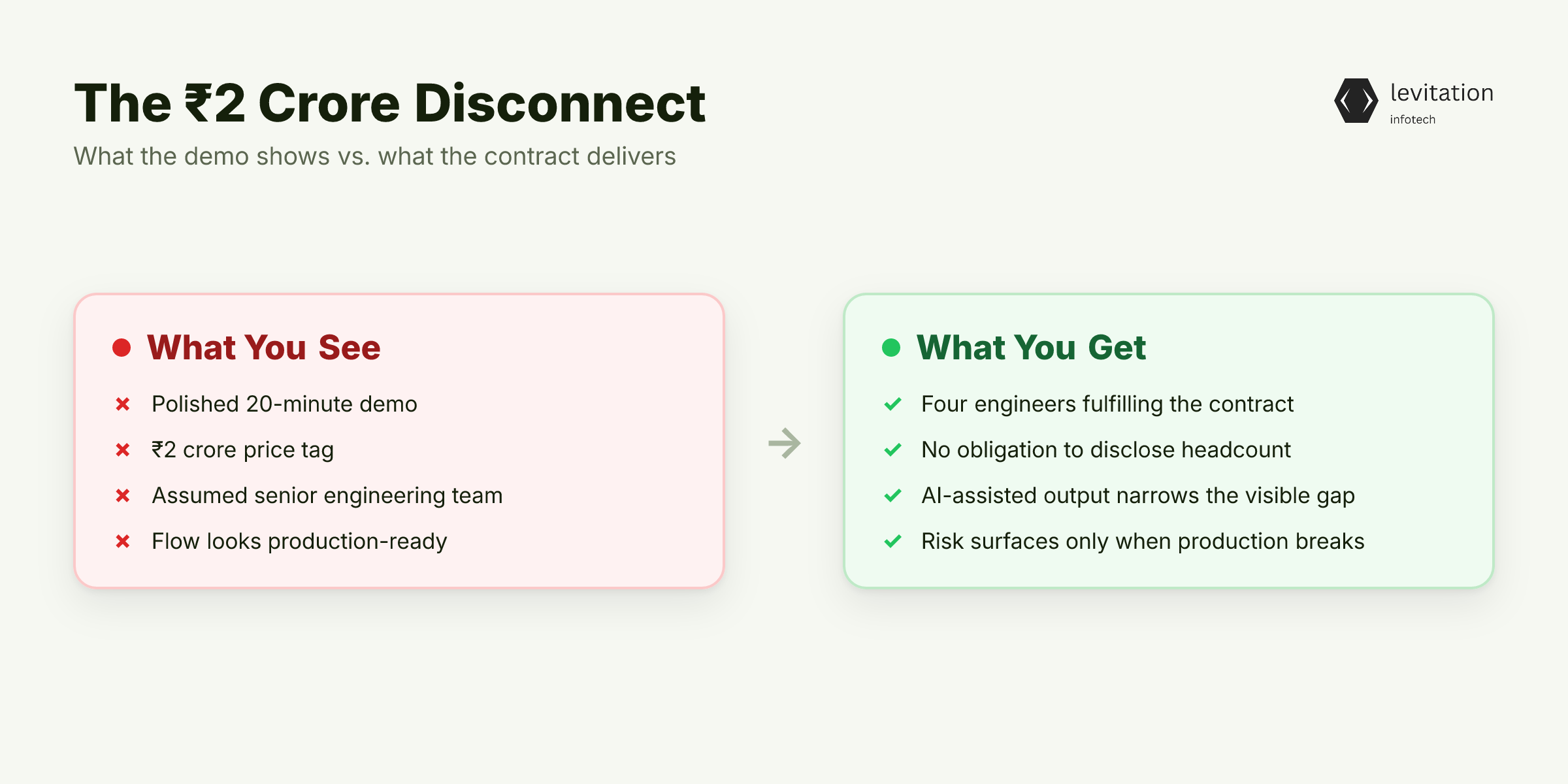
The price tag on an AI contract is now decoupled from the size of the team building it. This is not an accident. It is a structural outcome of how AI services are sold in 2026.
Three things are happening at once. The enterprise AI solutions market has shifted to hybrid pricing, a base subscription plus usage or outcome overage.
The cost line is transparent. The team line is not.
CTOs evaluate demos. The demo is a 20-minute performance, and AI tools have made it cheap to build. A founder with a weekend and a coding assistant can wire a flow that talks to a vector store and looks production-ready.
Nobody in the room asks how many engineers are behind it. Nobody asks because the demo is smooth, and smooth is what gets contracts signed.
The AI coding wave has flattened what "competent" looks like on paper. The gap between a senior engineer's output and a junior's AI-assisted output has narrowed, at least in a meeting room. That makes the demo harder to read.
It also means the price is high and the team is small. You have no way to see the gap until production breaks.
Here is the part most procurement teams miss: a ₹2 crore contract can be fulfilled by four engineers. It happens because the pricing model describes what you pay, not who builds it.
The vendor has no obligation to disclose headcount. In 2026, the vendor's incentive is to keep that number hidden.
But if the price tag is high, surely the team must be senior. That's where the story gets uncomfortable.
Why 2026 Pricing Models Hide the People Problem
Six pricing models dominate the AI vendor market in 2026: per-seat, usage-based, outcome-based, tiered, hybrid, and flat. Every one of them describes what flows out of your bank account. None of them name the engineers touching your codebase.
Per-seat pricing used to be a rough proxy for team size. That broke. Per-seat has fallen as a share of contracts.
The reason is simple: AI has multiplied what a single seat can produce. The link between headcount and output has collapsed. Pricing has not followed.
Some vendors have gone further. They change pricing structures repeatedly. Major enterprise AI vendors have cycled through multiple pricing models in 2025 and 2026, as reported in coverage on vendor pricing experiments leaving CIO costs in flux.
When the vendor itself cannot settle on a price, your procurement team cannot benchmark it. Benchmarking is the only way to spot that a "₹2 crore" deal is staffed by four people.
Chargebee's survey found 43% of AI vendors mixing subscription with use-based pricing. High Alpha puts hybrid at 31%. That is most of the market operating in a pricing layer where team composition is invisible.
Even your finance team is comparing line items, not LinkedIn profiles. We have covered the pricing model trap in earlier work, and the pattern is consistent: the contract hides the org chart.
The pricing fog is intentional. The real problem is what AI has done to the engineering ranks inside these vendors.
The Junior Engineer Paradox: Better Code, Worse Judgment
In 2026, a junior engineer with the right AI tools can produce code that passes code review. This is a real and documented shift. Engineer Alex Kul, writing publicly about his own team, put it bluntly: "AI made my junior engineers look senior. That's exactly what worries me."
His concern is not the code. It is the judgment that surrounds the code.
Kul went further. He said juniors with AI assistance "will probably make wrong calls" on architecture, failure modes, and edge cases.
The code looks right. The reasoning underneath it is shallow. A production enterprise AI platform is held together by those calls.
When traffic spikes, when the model hallucinates in front of a customer, when a regulatory audit lands, that is when judgment matters. Not at the demo.
The paradox is sharp. On narrow coding tasks, AI-assisted juniors can match or beat seniors.
The task tests output, not ownership. The senior has spent a decade learning what breaks. The junior has spent a week learning what compiles.
The vendor demo tests the second skill. Production tests the first.
Fast Company has tracked a counter-intuitive hiring trend: companies are hiring more juniors in 2026, not fewer, because juniors understand AI-generated code in a way many seniors do not.
Understanding the code is not the same as owning a production enterprise AI system for years. The vendor demo is often built by a junior with AI tools in a weekend. That is not evidence the vendor can run your production AI workload long-term.
This is where most CTOs get fooled. They see a fast-moving demo, a confident founder, and a slick architecture diagram.
The right vendor has systems still operating in production. The wrong one has a prototype in a meeting room, sold to you as a platform.
So how do you separate a vendor with real depth from one with a good demo and two juniors? You audit.
The Vendor Team Audit: 7 Questions Before You Sign
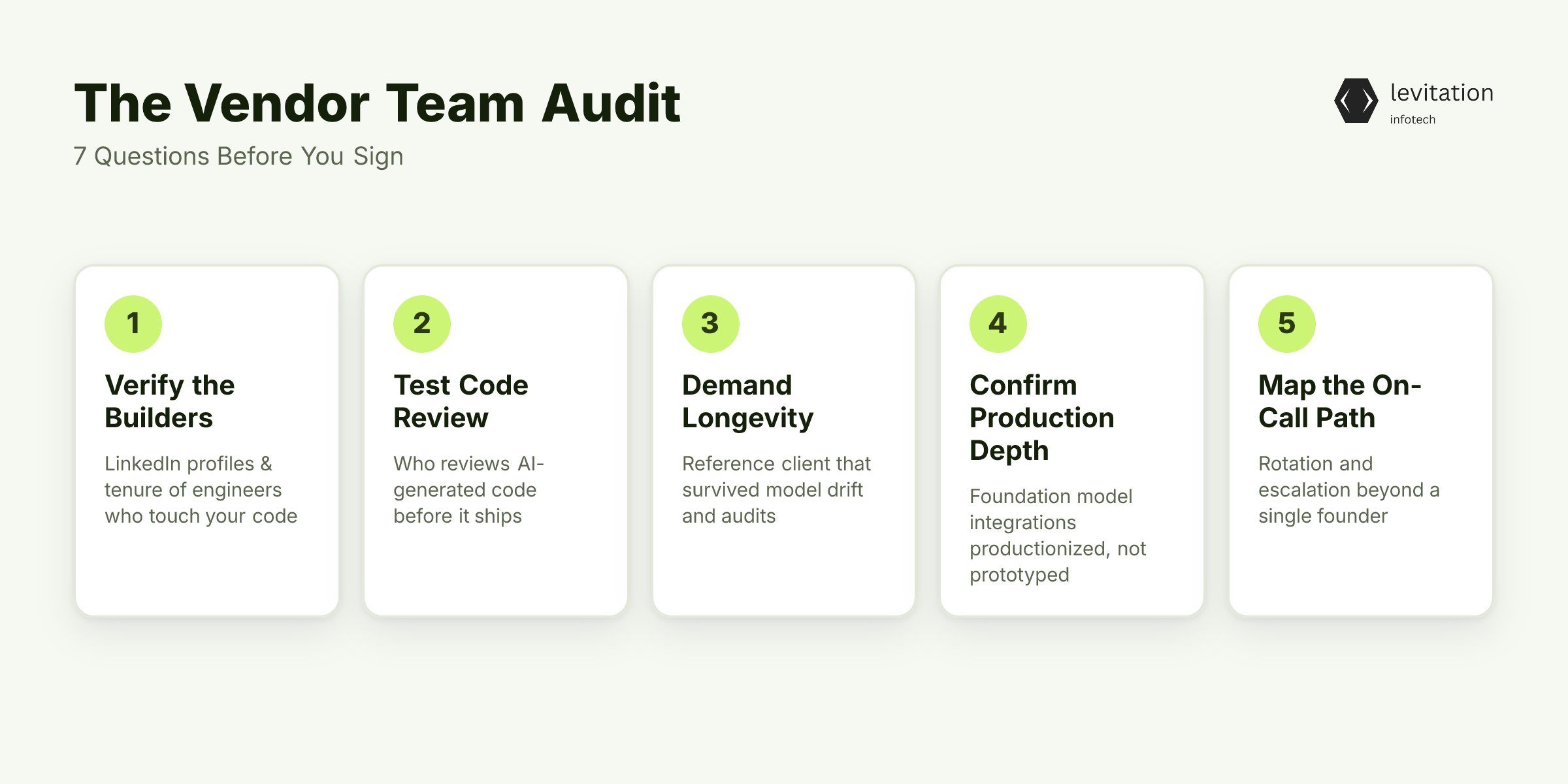
The audit is simple. Most CTOs skip it because the contract is half-signed by the time the conversation reaches "who is actually building this." Move the audit before the signature.
Here are the seven questions, in order of how much they reveal:
- Ask for the LinkedIn profiles and tenure of the engineers who will touch your codebase. Not the sales team. The engineers. If the vendor can only show you a sales bench and a founder, the engineering bench is thin.
- Ask: "Who reviews the AI-generated code before it ships?" If the answer is silence, or "the same person who wrote it," walk away. AI-assisted code without senior review is how production AI systems fail silently.
- Ask for a reference client whose system has been in production long enough to have survived model drift, real audits, and traffic shifts. Longevity is the only test that matters. Vendors with long-running production AI systems have survived real traffic, real audits, and real model drift. Vendors with recent references have survived a sales cycle. We have seen the reference deception pattern before: vendors showing you demos, not deployments.
- Ask how many foundation model integrations the team has productionized. Not prototyped. Productionized. The gap between a prototype and a system handling real traffic is wide. Production traffic comes with monitoring, rollback, and cost controls. Without those, the deployment sinks.
- Ask for an architecture review of your specific use case by a senior engineer before contract. Not a sales call. An engineering call. If they send a junior to the scoping call, the contract is junior-staffed.
- Ask about the typical deployment timeline. A senior-staffed vendor ships faster than a junior-staffed one. An in-house team without AI acceleration takes longer for equivalent scope. If the vendor claims a fast timeline but cannot name the senior doing the architecture, the timeline is fiction.
- Ask for the on-call rotation and escalation path. If the vendor's only on-call is the founder, your enterprise AI platform has a single point of failure the contract will not mention. We have tracked this pattern in other enterprise categories: the answer "our team" is the universal red flag.
The audit tells you who is building. Now you need to decode what you are actually paying for.
Decoding the Contract: What ₹2 Crore Should Actually Buy
A crore-level AI contract should buy four things, named separately in the SOW: discovery, implementation, production support, and model maintenance.
Ask who staffs each phase. If the answer is "a team," push back. Ask for names, tenure, and escalation paths.
Insist on named senior engineers in the statement of work. Not "a team of AI engineers." Specific people, with titles, with backup contacts.
If the vendor will not name them, the vendor does not have them.
Benchmark against market comparables. Enterprise AI contracts span a wide range depending on scope. If your ₹2 crore contract sits at the premium end, demand top-tier seniority.
If the vendor is quoting premium prices for junior-staffed delivery, the contract is mispriced. You are paying for a 40-person team's output and getting a 4-person team's output.
The math breaks when the rewrite starts.
Watch the layers in a hybrid contract. Each layer, subscription plus usage, plus outcome bonus, plus overage, is a place to hide scope creep and understaffing.
Read the overage clauses. Read the change-order terms. Read the exit clause.
Most teams skip this because the demo was good and the founder was convincing. That is the moment the contract stops protecting you.
Tie payment milestones to production uptime and model performance, not just delivery dates. A vendor that delivers a model in month 4 but cannot keep it accurate in month 14 has not delivered a platform.
They have delivered a launch. The contract should reward the regulated-industry deployment track record the vendor claims, and penalize the 4-person team they actually have.
When you buy the right way, the price tag stops being a mystery, and the outcomes start compounding.
What You Actually Get When You Buy Engineering, Not Headcount
When you buy engineering, not headcount, three things change. The vendor ships faster because senior engineers do not need ramp-up.
The system stays alive years beyond launch, not just at launch. The same people who built it know how to fix it.
The renewal conversation is about roadmap, not a rewrite.
Retention is the proxy. A vendor with strong client retention has engineering depth that survives the post-launch trough, which is where most AI implementations die.
That trough is when the model drifts, when traffic patterns shift, when the first audit lands. Senior teams stay because they are invested in the system they built.
Trust in regulated industries is earned through deployments where junior-staffed teams get filtered out by compliance audits.
A vendor trusted by regulated enterprises for AI systems in India has been through those filters. The systems are still operating in production because the engineering behind them was senior on day one.
Teams that have spent years productionizing AI for regulated enterprises have watched this pattern from the inside. They structure their delivery bench around failure modes most vendors never see.
The real cost of a junior-heavy vendor is not the ₹2 crore. It is the rewrite that comes when the system cannot handle production load.
We have seen this pattern repeat across vendor categories, not just AI. The cheapest contract is the one that survives year three.
Frequently Asked Questions
Q: How much should enterprise AI implementation cost in India?
A: Enterprise AI contracts in India vary widely depending on the pricing model: per-seat, usage-based, outcome-based, or hybrid. A ₹2 crore contract is at the premium end and should come with named senior engineers and production-proven systems, not a 4-person team with two juniors.
Q: How do I evaluate an AI vendor's actual team size and seniority?
A: Ask for LinkedIn profiles of the engineers assigned to your project, request a scoping call led by a senior engineer (not a salesperson), and demand at least one reference client with a system in production long enough to have survived model drift and real traffic. If the vendor cannot produce these three artifacts, the team is likely thin or junior-staffed.
Q: Are junior engineers good enough for AI projects in 2026?
A: Juniors with AI coding tools can produce code that passes review, but they lack the judgment to handle production failure modes, architecture decisions, and edge cases. Industry voices like Alex Kul have publicly warned that AI makes juniors "look senior" while masking their weak judgment, which is exactly when production AI systems break.
Q: What is hybrid AI pricing and why does it matter?
A: Hybrid pricing, a base subscription plus usage or outcome-based overage, is now a dominant AI vendor model, with industry surveys placing it at 31% to 43% of contracts depending on the source. It offers flexibility but also layers complexity, making it harder for CTOs to benchmark cost and easier for vendors to mask understaffing behind opaque usage charges.
Q: What is a fair price for an enterprise AI platform in India?
A: Fair pricing depends on seniority, longevity, and production track record, not the vendor's sales pitch. Vendors with regulated-industry deployment histories and systems still operating in production years after launch command a premium because the alternative (a rewrite when the system breaks) costs more than the price gap. A ₹2 crore contract with a proven senior team is cheaper than a ₹1 crore contract with two juniors.
The seven-question audit, in a one-page format, is in the resource library. Vendors with thin benches are counting on your procurement team to never pull it out at the negotiation table.
About the author
Mayank Singh is a software developer at Levitation Infotech, where he builds web and AI-powered applications across the company’s fintech, healthcare, and enterprise projects.