


TL;DR: A small Noida CRM vendor almost always means a tight team where one departure can stall your project. The $28,000 build quote is only Layer 1 of a three-layer cost structure that grows through maintenance, rework, and vendor-failure costs. The fix is not paying more. The fix is a pre-contract filter that proves the team, the code ownership, and the bench depth before you sign.
Key Takeaways: - A 3-developer shop cannot absorb attrition. Attrition is the default outcome, not the worst case. - The $28,000 quote is Layer 1 of a three-layer cost structure that most founders never see in full. - Five engineering markers and a pre-contract checklist filter out small-vendor risk before you wire the first invoice.
Your Noida CRM vendor quoted you $28,000 to build a custom CRM. Six months in, one of their three developers quits. The other two now hold your entire sales logic in their heads.
The research confirms this pattern. When a small vendor's single developer leaves, the remaining team carries knowledge no one else on the vendor side holds.
The math looks good on the spreadsheet. The build quote against a larger vendor's quote, and most founders sign on the strength of that number alone. What the spreadsheet does not show is what happens after a developer leaves, when the project timeline stops being a date and starts being a question.
The Three-Developer Shop Is the Norm in Noida, Not the Exception
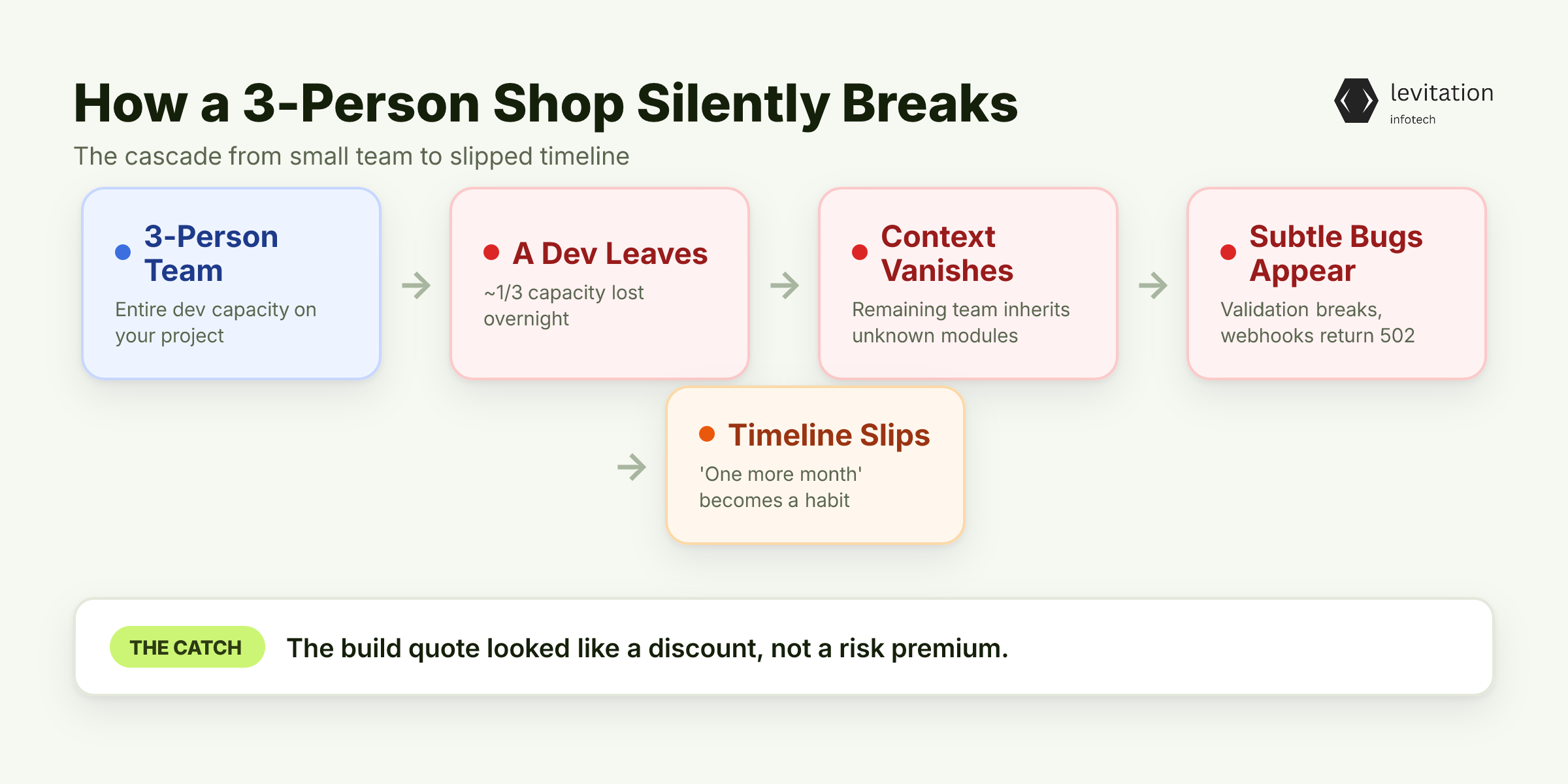
Small Noida CRM vendors run on teams where payroll cannot support more than a handful of full-time developers. The reason is structural, not personal. Margins on fixed-bid CRM projects cannot support a larger payroll, so the team stays small by design.
When you sign with a 3-person shop, you are not getting a discount on enterprise capacity. You are getting the entire team that will ever touch your code.
When one developer leaves, you lose roughly a third of capacity overnight. Worse, you lose the institutional knowledge they carried, not just the hours.
The remaining two developers must now switch onto modules they never wrote themselves. This is where the subtle bugs start.
A field validation that worked last Tuesday quietly breaks for users on a different browser. A webhook that fired reliably during development now returns 502s in production. The team is competent. The team is just overloaded by the loss of context.
This is why the founder's CRM timeline slips silently. There is no single dramatic failure. The vendor's "one more month" becomes a recurring line item in the sprint report. The system still has not seen a real load test.
But the price seemed right. The build quote against a larger shop. Surely a big discount justifies the team-size risk?
Why $35 an Hour Becomes $200 an Hour by Year Two
Geography drives a 3-4x rate spread. Indian developers bill between $25-55 per hour. Equivalent New York talent bills $130-210. The gap is real.
What the gap hides is the difference in shipped features per week. A junior at the low end produces fewer shippable features per week than a mid-level closer to the top. This erodes the cost advantage before the project starts.
Then comes the replacement cycle. When the junior leaves, you pay for recruiting, ramp-up, and rework on code the new hire does not yet understand. That is the bill your hourly-rate spreadsheet did not include.
The founder math is brutal. The "cheap" CRM build often grows in total cost once you add rework, missed deadlines, and the eventual migration when the vendor cannot fix the system.
A mid-level at $45/hour looks expensive in week one. By month twelve, that developer has shipped more, broken less, and stayed long enough to document the codebase.
The hourly rate is the easy number to compare. It is also the least useful one.
The actual cost to build a CRM sits in three layers, and most founders only price the first one.
The Real Cost to Build a CRM Has Three Hidden Layers
Layer 1 is the build quote. This is the number your vendor sends after the discovery call for a custom CRM in India. It is the only number most procurement teams negotiate. It is also the smallest number you will pay.
Layer 2 is steady-state maintenance. Bug fixes, browser compatibility patches, API version upgrades, security patches, and the small changes your sales team requests every quarter. Maintenance compounds annually based on a percentage of the build cost, which the small vendor rarely budgets honestly.
Layer 3 is the vendor-failure cost. This is the layer that kills the cheap-quote math.
Rebuilding modules after a key developer leaves. Migrating data into a new system when the vendor cannot fix the code. Retraining your sales team on a new interface.
The opportunity cost of stalled pipeline visibility while the rebuild happens. Off-the-shelf Zoho CRM alternatives look attractive. They push Layer 1 toward zero. But they shift the cost into per-seat licensing, customization limits, and integration workarounds. Those workarounds hit harder in year two.
The year-two bill is what kills most custom CRMs, not the build quote.
Teams that have built regulated-industry systems treat compliance as code, not paperwork. They build for audits, not for demos. That is a different vendor archetype than the 3-developer shop, and the cost structure shows it.
Five Engineering Markers That Separate a Vendor From a Body Shop
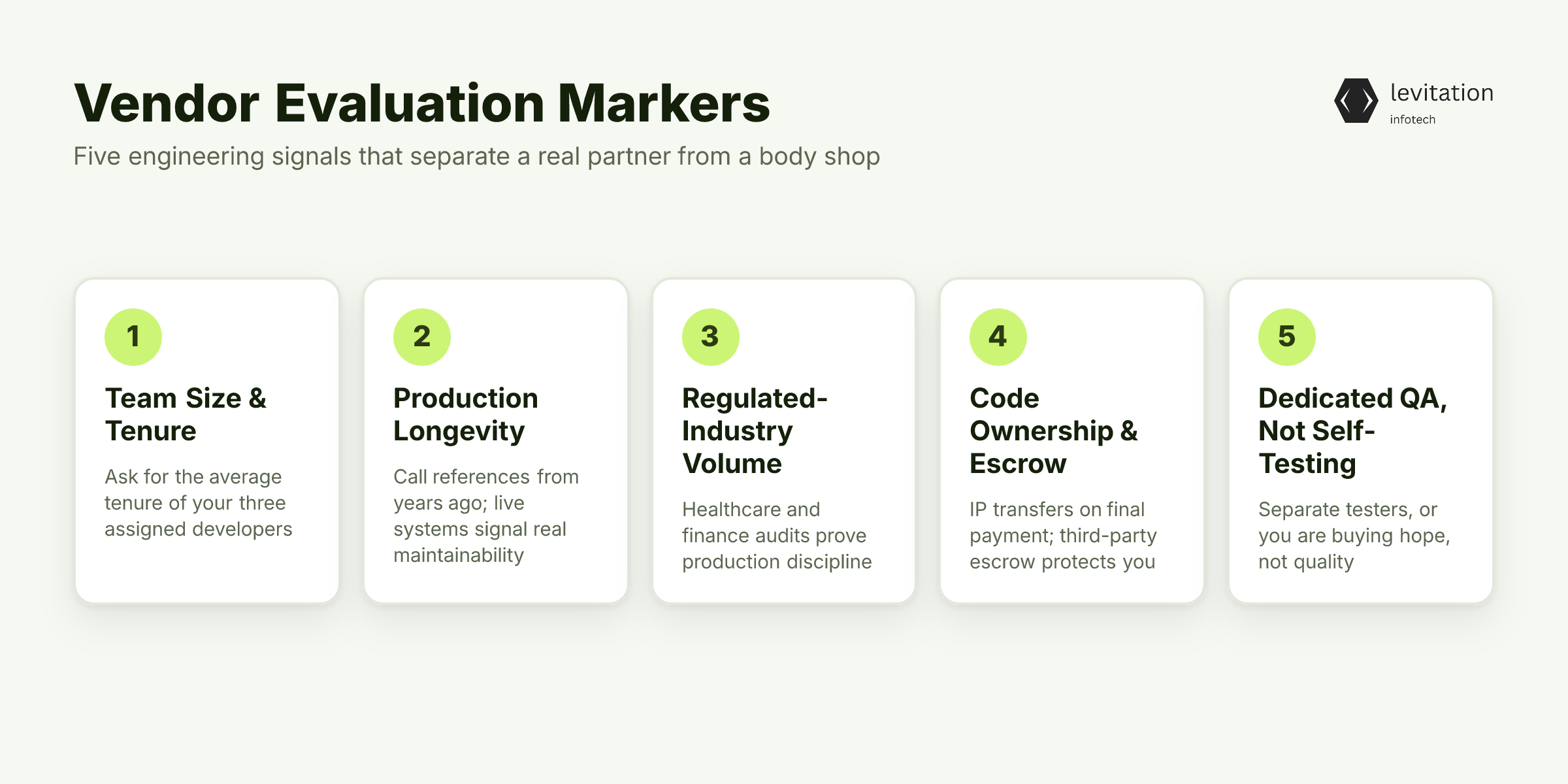
Marker 1 is team size and tenure. A credible CRM software development partner retains bench strength so no single departure blocks your sprint. Ask for the average tenure of the three developers who will work on your project. If tenure is short, the bench is thin.
Marker 2 is production longevity. Vendors whose systems are still running in production years after deployment have built for maintainability, not just for the demo.
This signal is easy to check. Ask for client references from several years back and call them. If their CRM is still live, the vendor built something that survived turnover.
Marker 3 is deployment volume across regulated industries. A vendor that has repeatedly delivered enterprise systems in healthcare and financial services knows what production discipline looks like. Regulated industries impose audit requirements that punish sloppy architecture. Each cleared audit proves the team can deliver under those constraints.
Marker 4 is source code ownership and escrow. The contract must transfer IP to you on final payment. The code must be escrowed with a third party so a vendor bankruptcy does not strand your business.
If the vendor resists escrow, they are telling you the code is not really yours until you threaten to leave.
Marker 5 is dedicated QA, not developer self-testing. If the same person writing the code is testing it, you are buying hope, not quality. The filters that catch this gap during vendor selection are simple, and most founders skip them.
The Pre-Contract Checklist That Filters Out Risk
Ask for the LinkedIn profiles of all three developers who will touch your project. Check they are full-time employees, not contracted freelancers the vendor will swap mid-build. The most common Noida vendor deception is selling you a senior in the sales call and assigning you a junior three weeks in.
Require a named technical lead with at least 3 years at the vendor. Turnover in the junior seats should not collapse the architectural decisions, and a tenured lead prevents that.
Insist on milestone-based payment tied to outputs you can test yourself, not hours logged. This forces the vendor to absorb the rework cost when their developer leaves. The hourly-billed Noida quote is the one that doubles, because the vendor has no skin in the schedule.
Lock source code release to a third-party escrow, with quarterly code drops from day one. Add ownership clauses in the contract that name the escrow agent and define release conditions. If the vendor walks, your business does not freeze.
Add a 90-day post-launch warranty clause where the vendor fixes defects at no charge. Include a knowledge-transfer clause that requires the outgoing developer to document their modules before exit. This is the single most important contract clause, and most founders never think to add it.
Check the vendor's quoted cost structure against the three-layer model. If their proposal only addresses Layer 1, they are either inexperienced or hiding the bill.
What a Five-Year-Old CRM Project Actually Looks Like
A stable custom CRM in year five is a compounding asset. Every workflow your team added taught the system something new about your business that an off-the-shelf tool would never capture. The CRM stops being a project and starts being infrastructure.
The founder stops thinking about the CRM. Sales, ops, and finance all log in without asking IT. That is the only metric that matters for a sales system.
When a developer at the vendor leaves, your project does not freeze. The codebase, the documentation, and the architecture were built by a team rather than carried in one person's head.
The cost to build the CRM was paid back through compounding use over time. Everything after that is margin your competitors are still spending on per-seat licenses for tools that almost fit.
Vendors whose CRMs are still running in production years after deployment are the reason this outcome is possible. They passed the five-marker test, which is why their systems outlive the sales cycle that built them.
Frequently Asked Questions
How much does it actually cost to build a custom CRM in India?
A custom CRM built by an Indian vendor varies in cost based on complexity, integrations, and data migration scope. The build cost covers Layer 1 only. Founders should budget an extra percentage of the build cost annually for maintenance. They should also add a contingency for the vendor-failure cost described above.
How long does it take to build a CRM from scratch?
A scoped custom CRM runs from kickoff to production over a multi-month timeline. The first usable module ships well before the full system goes live. Timelines slip when the vendor's team is small, because any single developer departure resets the context-building phase. Vendors with high deployment counts ship against a fixed sprint plan rather than stretching timelines.
What are the best Zoho CRM alternatives for Indian businesses?
For Indian SMBs and mid-market companies, the most common Zoho alternatives are HubSpot, Salesforce, and a custom CRM on a modern stack. The right choice depends on your workflows. If they are standard enough to fit a productized tool, go with one. If they are specific, you will pay for customizations and workarounds that exceed the cost of building once.
How do I check a Noida CRM vendor before signing the contract?
Ask for the LinkedIn profiles of the three specific developers assigned to your project. Request a client reference whose system has been live for multiple years. Confirm that source code will be escrowed from day one with quarterly drops. A vendor that resists any of these sends a signal: the team you are meeting is not the team that will build your CRM.
What is the difference between custom CRM development and Salesforce customization?
Salesforce customization configures and extends an existing platform. It is faster and cheaper upfront. But it binds you to Salesforce's pricing, release cycles, and data model. Custom CRM development builds the system to your exact workflow. It costs more and takes longer. But it kills per-seat licensing, removes third-party upgrade risk, and lets you own the source code outright.
Run the five-marker test on the next vendor call, before the next quote lands.
About the author
Mayank Singh is a software developer at Levitation Infotech, where he builds web and AI-powered applications across the company’s fintech, healthcare, and enterprise projects.