


TL;DR: Frontier model token prices have fallen dramatically over the past two years, but enterprise AI renewal quotes are climbing. The disconnect is not a market anomaly. It is the renewal model working exactly as vendors designed it. Buyers who treat the renewal as a procurement formality are funding vendor margin growth with their own budget. The fix is structural: benchmark, itemize, and build a real walk-away option before the call.
Key Takeaways: - Token unit costs and contract value are decoupling. Falling inference prices benefit vendor margin, not your invoice. - Vendors anchor renewals 10% above current spend, then layer hybrid pricing to make every line item re-negotiable. - Total cost of ownership grows well past the first-year license quote once usage, data, and compliance costs mature. - A credible alternative deployment, not a bluff, is the only negotiation tool that actually moves price.
Token Prices Collapsed. Your Renewal Climbed Anyway

Inference token prices have fallen by orders of magnitude over the past two years. The economics of running an LLM have collapsed. Yet the enterprise AI solutions renewal landing in your inbox this quarter is up year over year.
That is not a rounding error. It is the bill telling you something your engineering team already knows. Unit cost and contract value are no longer the same line.
The trend most firms will misread is the falling price of a token. Procurement teams see the headline rate drop, feel good about the trend, and walk into renewal unprepared. The vendor sees the same headline, knows the contract is anchored to committed spend, and prepares the opposite conversation.
The disconnect is not accidental. It is the renewal model working as designed, and it is now big enough to be board-level.
AI procurement has become the second-largest software line item after cloud for many enterprises. That makes the renewal no longer a procurement formality. It is a strategic line item. It is also the single largest opportunity for vendor margin extraction in your technology stack.
The credibility problem lands on the CTO. The engineering team is delivering more for less, and the finance team is staring at an escalating vendor bill. Both can be right at the same time, because the contract is built around committed spend, not unit cost.
But why do renewal quotes move in the opposite direction of underlying compute costs? The answer is in how vendors engineer the renewal itself.
The 10% Anchor: How Vendors Set Your Renewal Before You Sit Down
Salesforce-style vendors typically open renewal quotes around 10% above current spend. That number is not a market adjustment. It is an explicit anchoring tactic, designed so the eventual "concession" leaves the vendor ahead.
By the time the first call ends, the buyer feels they won. They shaved 5%. The actual outcome was a 5% increase. The anchor does the work before a single word is spoken.
The harder problem is that the contract itself is now impossible to benchmark. Many AI vendors layer hybrid pricing, which means subscription plus usage plus outcome charges sit inside the same document. When the same product can be sold as a seat, a credit bundle, or a per-conversation fee, no external reference price exists. The buyer is not negotiating against a market. They are negotiating against the vendor's internal margin model.
Salesforce Agentforce is the clearest case study. The product ships with three pricing models: per-conversation, Flex Credits, and per-user. The vendor could not settle on one. That ambiguity is not a product problem. It is a pricing strategy. When even the company building the product cannot agree on how to charge for it, the buyer has no defensible reference. Every AI solutions vendor in this category is benefiting from the same dollar of uncertainty.
This is what negotiation-as-design looks like in practice. When the price you pay depends more on negotiation skill than product value, the vendor is extracting rent on opacity. The skill to fight back is not a procurement function. It is an engineering strategy, because the only effective counter is real alternatives.
Even if you catch the anchor tactic, there is a second layer of inflation most buyers never audit.
Hybrid Pricing Is a Markup Machine Disguised as Flexibility
Hybrid pricing combines a fixed base with variable usage or outcome-based charges. The buyer thinks they are getting flexibility. The vendor knows they are getting two pricing structures per contract, not one. Each one can be re-quoted independently at renewal, which means twice the surface area to re-anchor.
The mechanism works like this. Token consumption spikes after launch as real usage patterns emerge. End users find the tool, adoption grows, and the variable leg of the bill expands even as the per-token unit price falls. The vendor's revenue grows while the buyer's "usage discount" story collapses in the next quarter forecast. The savings you thought you captured on per-token rates get quietly absorbed by the variable line, and finance never quite catches the swap.
Sound familiar? It is the same pattern that breaks Fintech AI Cost Forecasts by Month 4. It is just applied to enterprise procurement.
Vendors also bundle features at launch to win the deal, then unbundle them at renewal so each line item can be re-quoted. A feature that was free in year one becomes a paid module in year two. The product did not change. The packaging did. This is a classic re-anchoring move, and it is the most common reason a major renewal jump appears out of nowhere.
Intercom Fin's per-resolution pricing and Agentforce's per-conversation pricing sound predictable until you try to forecast next quarter's volume. That uncertainty is the product. The AI platform you are buying is not just the technology. It is the forecasting problem you now own. Your CFO is the one defending a number nobody on your team can validate.
Once you map the unbundling mechanics, the next question is: what does the vendor actually expect you to pay?
What the Pricing Page Will Never Tell You
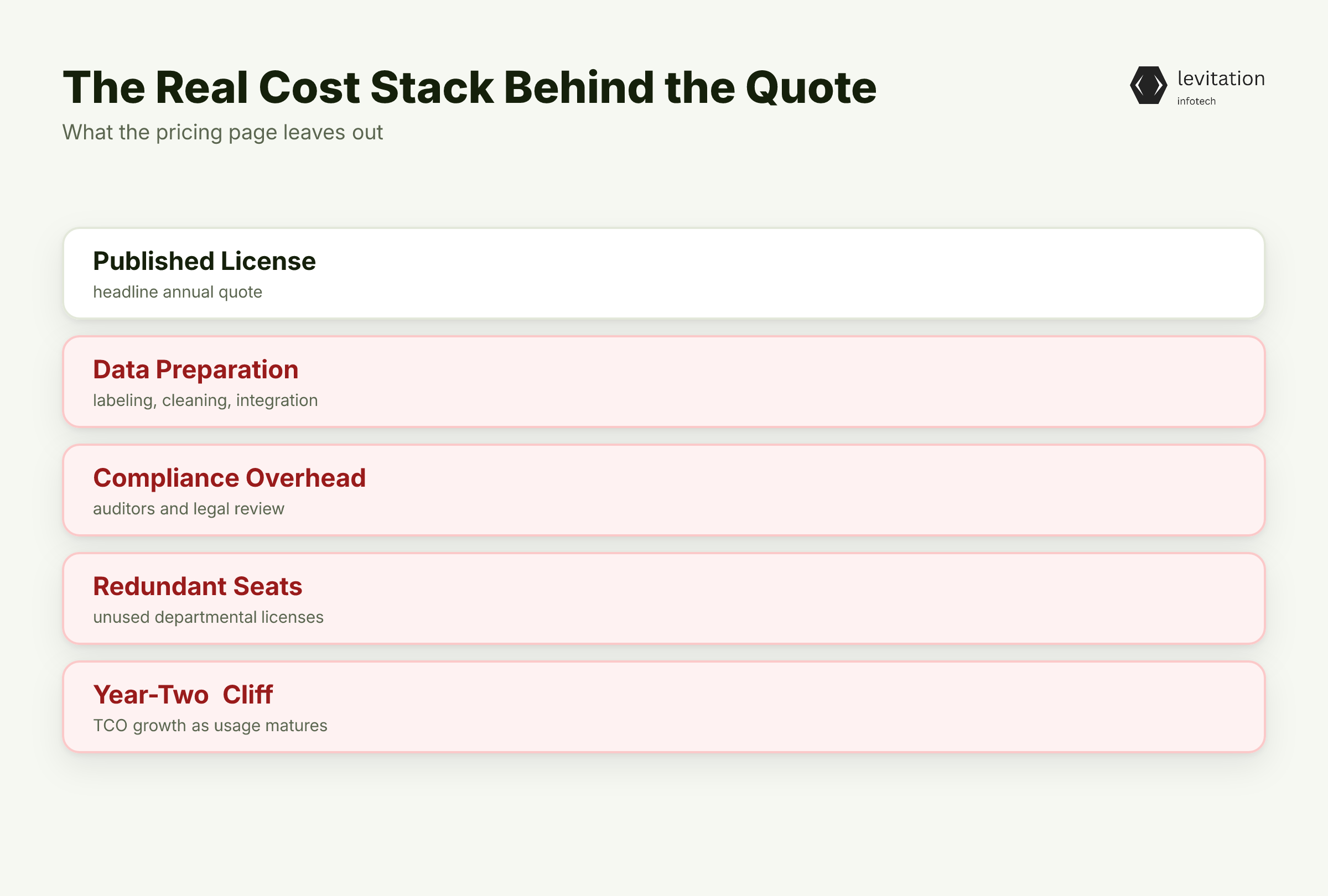
Most enterprise AI vendors refuse to publish prices. The reason is strategic. Custom pricing lets them charge different amounts based on company size, competitive situation, and how skilled your negotiator is. The price you pay depends more on your negotiation skill than the product's value. Mature procurement teams treat the published page as marketing, not data.
Third-party benchmarking platforms like Vendr track thousands of enterprise software purchases. Their data shows real variance in what buyers actually pay for the same product. Larger organizations get better rates, but that discount is only available if you know the median exists. The vendor's pricing page will not tell you any of this. The number surfaces only through third-party benchmarking, and most buyers never make that call.
The bigger cost is the invisible ecosystem around the license. Data labeling and preparation costs add up before the first model run. Compliance overhead layers on top, often through external auditors and legal review. Redundant departmental licenses and unused seats scattered across business units quietly inflate the headline number.
Across enterprise AI systems deployments in regulated industries, the pattern is consistent. Total cost of ownership grows well past the first-year license quote once usage, data, and compliance mature. The quote you signed was never the bill. It was the down payment.
The same year-two cliff that hits healthcare AI TCO hits every other vertical the same way.
Knowing the numbers is one thing. Turning that knowledge into a lower renewal is where most CTOs stall.
A CTO's Six-Step Renewal Playbook
Step one is benchmarking before the call. Pull median contract data from Vendr, Tropic, or Vertax for your seat count and tier. If you do not know the median before the vendor presents, you are negotiating from the anchor, not against it.
Step two is forcing itemization. Require the vendor to separate list price, usage charges, and add-on modules into distinct line items. A bundled quote is an obfuscated quote. The negotiation is over before it starts if you cannot see what each component costs.
Step three is using falling token prices to your advantage. Cite specific provider price drops from OpenAI, Anthropic, and Google during the negotiation. The vendor knows their inference cost has fallen. Make them acknowledge it on the record, then ask why your contract does not reflect it. This works most cleanly when the buyer frames it as a margin question the vendor's own CFO would ask.
Step four is anchoring against a credible alternative, not a bluff. Run an actual pilot with a competing vendor 90 days before renewal. A pilot that exists is real power. A threat with no pilot behind it is noise. An AI implementation partner who can deliver a working deployment in months makes the walk-away option real. An in-house team would need a year-plus to reach the same posture.
Step five is negotiating a multi-year cap with a fixed annual increase. The cap should reflect general economic conditions, not vendor margin targets. A flat renewal lets the vendor re-anchor every year. A capped multi-year deal takes that lever away. It shifts the vendor's incentive from next year's increase to protecting the contract's lifetime value.
Step six is building a real walk-away option. A deployment that can be ready in months with a partner changes the vendor's posture in ways no procurement script can. The moment the vendor believes you will switch, the quote moves. Until then, nothing else matters.
When the playbook works, the conversation with your vendor changes in ways most procurement teams never see, and the contracts that follow look fundamentally different from the ones that came before.
What Predictable AI Economics Actually Look Like
Stable AI pricing shifts away from seats and LLM transactions. It moves toward value-based or wallet models. The wallet approach gives the buyer flexibility on usage without forcing a commit, while giving the vendor enough revenue predictability to plan capacity. It is the closest thing the industry has to a fair default. Most enterprises have not adopted it because their existing contracts do not expire for another year.
Outcome-based contracts work when the outcome is narrowly defined. Resolutions, conversions, documents processed. They degrade into disputes when the definition is vague. That is why the negotiation around the outcome language matters more than the rate. A contract that says "20% productivity gain" is a contract you will fight about in month six. A contract that says "$X per resolved ticket" is a contract that runs itself.
The contracts that survive five or more years in production AI share three traits. They price compute, data, and change management as separate line items from day one. They cap usage with a transparent overage formula, not a "fair use" clause. And they survive vendor repricing because the buyer owns the integration layer, not the vendor. Levitation's track record across enterprise deployments comes almost entirely from this contract-design discipline.
Lock-in does not work anymore. Predictability does, and it is the single highest-impact thing a CTO can put in front of a CFO before the next renewal cycle.
For boards evaluating AI spend, the question is no longer whether the technology works. It is whether the contract will behave the same way in year three as it did in year one. That is a finance question, an engineering question, and a procurement question at the same time. Treat it like one.
Frequently Asked Questions
Why is my AI vendor renewal higher than my original contract?
Vendors typically anchor renewals 10% above current spend. They then add usage-based and outcome-based charges that grow as adoption matures. Falling token prices benefit the vendor's margin, not your invoice, because the contract is built around committed spend, not unit cost.
How do I negotiate an AI vendor renewal as a CTO?
Benchmark median contract data from Vendr or Tropic before the call. Force line-item separation of base and usage charges. Cite specific competitor token-price drops as pressure in the room. Run a parallel pilot with an alternative vendor 90 days before renewal so your walk-away option is real, not theoretical.
What is hybrid pricing in enterprise AI?
Hybrid pricing combines a fixed subscription fee with variable usage or outcome-based charges. Many AI vendors use it. The buyer is navigating two or more pricing structures per contract. That complexity is precisely why it benefits the vendor.
How much do enterprise AI platforms actually cost per user?
Third-party data from Vendr and similar platforms shows real variance in per-user costs by tier and deployment size. Larger organizations get meaningful discounts if they know the median contract value. Most enterprise AI vendors do not publish prices, so these numbers only surface through third-party benchmarking.
Should I switch AI vendors at renewal or renegotiate?
Renegotiate first if your switching cost is high and the product is delivering value. That only works if you have a credible alternative ready. A short deployment cycle with a partner or a parallel pilot with a competing vendor converts a renewal conversation from a price talk into a real negotiation.
Bring the contract terms to a second set of eyes before the next vendor call.
About the author
Mayank Singh is a software developer at Levitation Infotech, where he builds web and AI-powered applications across the company’s fintech, healthcare, and enterprise projects.