


TL;DR: A ₹25,000 pilot can look like a bargain, then expose a much larger production bill. The low entry fee is not the main risk. Compare Noida vendors through one scope ledger and a written acceptance gate before funding production.
Key Takeaways:
A cheap pilot is safe only when its production boundary is written down. Template, freelancer, and custom quotes buy different scopes and ownership rights. Delay the next payment until acceptance evidence, repository access, account ownership, and next-phase limits are all complete.
The ₹25,000 Pilot Is a Scope Test, Not a Price Tag
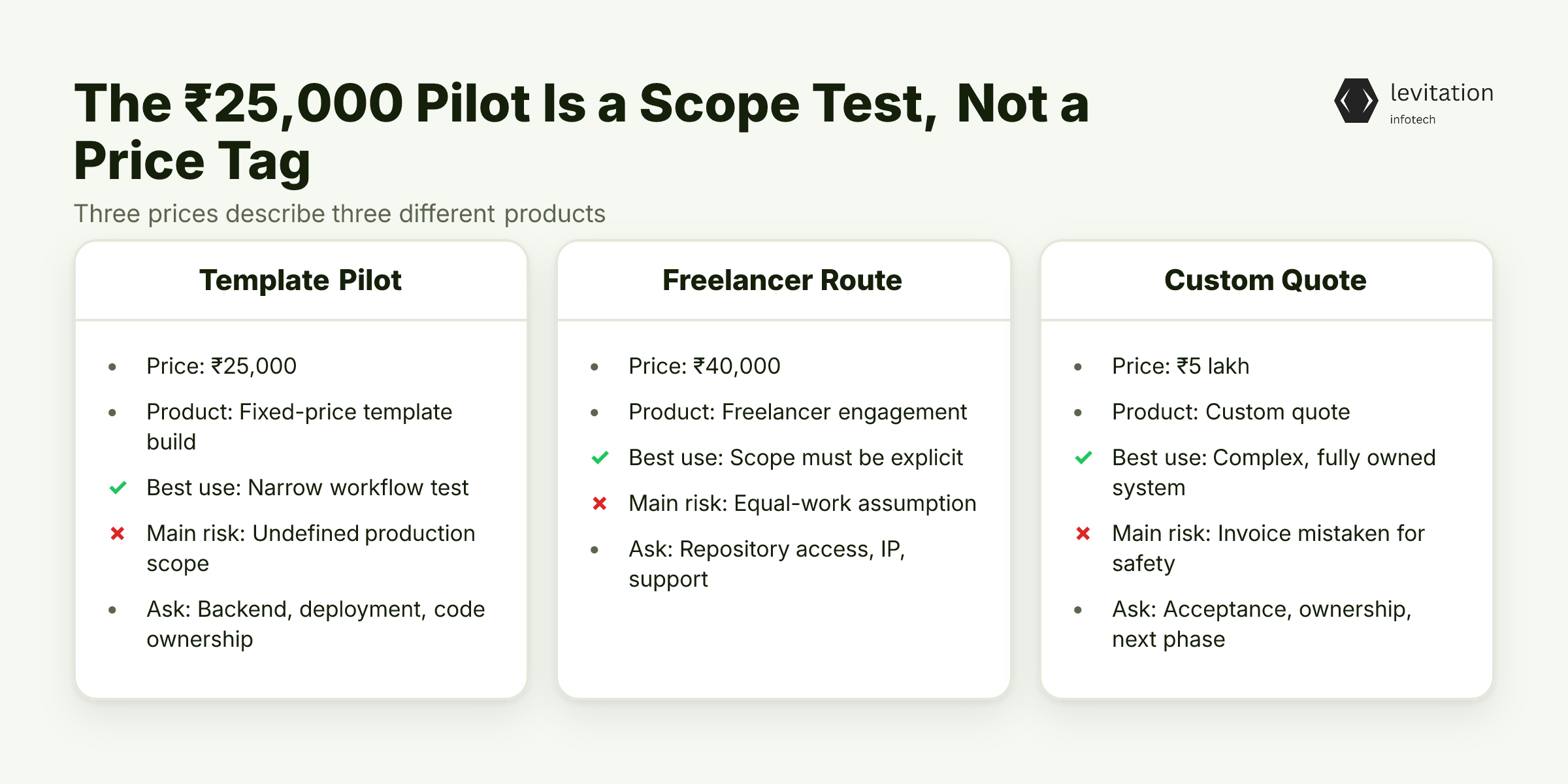
Three prices can describe three different products. That is where false economy begins.
Three prices, three different products
Roy Digital App Studio's 2026 comparison shows three buying routes. Each route has different cost and ownership terms. The first option is a fixed-price template build for ₹25,000. The second is a freelancer engagement for ₹40,000. The third is a custom quote of ₹5 lakh.
The same comparison places simple custom agency builds at about ₹2 lakh. Complex builds start at ₹30 lakh and above.
These are cited comparison points, not universal market rates or final cost promises. They show why headline prices cannot settle the buying decision.
A founder may treat these entry prices as covering equal work. That means the founder is comparing different products. When reviewing mobile app development cost in India, match the scope before you compare the numbers.
What production work hides behind each price?
The risk hiding in plain sight
The biggest cost risk is not the ₹25,000 pilot fee. It is the undefined production scope behind it.
A template pilot can work when it tests one narrow workflow. A custom quote can make sense when it funds a complex, fully owned system. Neither one becomes safe just because of its invoice.
The pilot becomes risky when nobody states what happens after the demo. Does it include backend work, deployment, source code, and integration ownership? Or does delivery end at a polished screen?
Which answers should every vendor give?
The first vendor test
Before you compare quotes, ask each vendor the same questions. The first is to determine which user flow and prototype screens are included. The second question addresses whether delivery includes source code and immediate repository access. The third is to establish which backend, data, integration, testing, and deployment needs are covered. The fourth must clarify what objective evidence marks each requirement as accepted. The fifth question identifies which code, accounts, intellectual property, and credentials the client will own. The final question asks what support and next-phase work are included or excluded.
Different answers mean the proposals do not price the same product. The cheaper quote can still suit a narrow test. It simply cannot be compared yet.
Where does the agreed scope break down when a cheap pilot becomes a production commitment?
Where the ₹25,000 Scope Quietly Becomes a Larger Production Commitment
A prototype can look finished. Its production boundary may still be untested. The gap appears when the founder asks what the pilot owns.
A prototype can look finished
Imagine a service-booking pilot. A customer selects a slot, confirms the booking, and receives a confirmation message.
A screen tour can make that journey look complete. It does not prove that bookings persist or duplicates are rejected. It also does not prove that expired slots are handled. It says nothing about whether the provider sees the booking.
A working product also needs authentication and secure data handling. It also needs backend services, integrations, testing, deployment, and support with clear responsibility. A pilot can exclude some items, but only if the next phase records their cost and ownership. Leaving them out without that record creates a hidden production bill.
Where does a template pilot's boundary start to fail?
Template limits become estimate changes
A fixed-price template suits a limited flow that already fits its structure and assumptions.
Extra custom work, unfamiliar integrations, or production needs can push work beyond the pilot boundary. The original quote can still be accurate. The founder assumed a different boundary.
This is how an apparently fixed pilot becomes an open-ended production phase. The feature list did not change. The definition of “working” did.
What happens when a freelancer takes over the handoff?
The freelancer handoff creates two prices
The cited comparison notes three freelancer risks: going quiet, partial delivery, and failure to transfer code.
That creates two prices. The founder pays the initial fee, then pays again to complete, repair, or replace the work. The second invoice covers new features, lost ownership, and basic production gaps.
Make repository access, delivery evidence, and intellectual-property transfer part of the pilot agreement. This avoids that outcome.
Does a custom quote buy a more complete system, or just a higher invoice?
A custom quote can still make sense
The ₹5 lakh quote should be compared with the researched custom-agency range. It should not be treated as an arbitrary premium.
Complexity and complete ownership can justify a larger number when the scope is explicit. A custom build with a backend, deployment documentation, source transfer, and defined support costs more. This is because it includes more usable work.
Any estimate for mobile app development cost in India becomes meaningful only under one condition. It must separate the pilot from that production scope.
The expensive part is not merely a feature left out. It is a founder who cannot see that omission before committing the next rupee.
How can one ledger expose the difference before another quote wins?
Build a Scope Ledger Before You Compare Any Quote
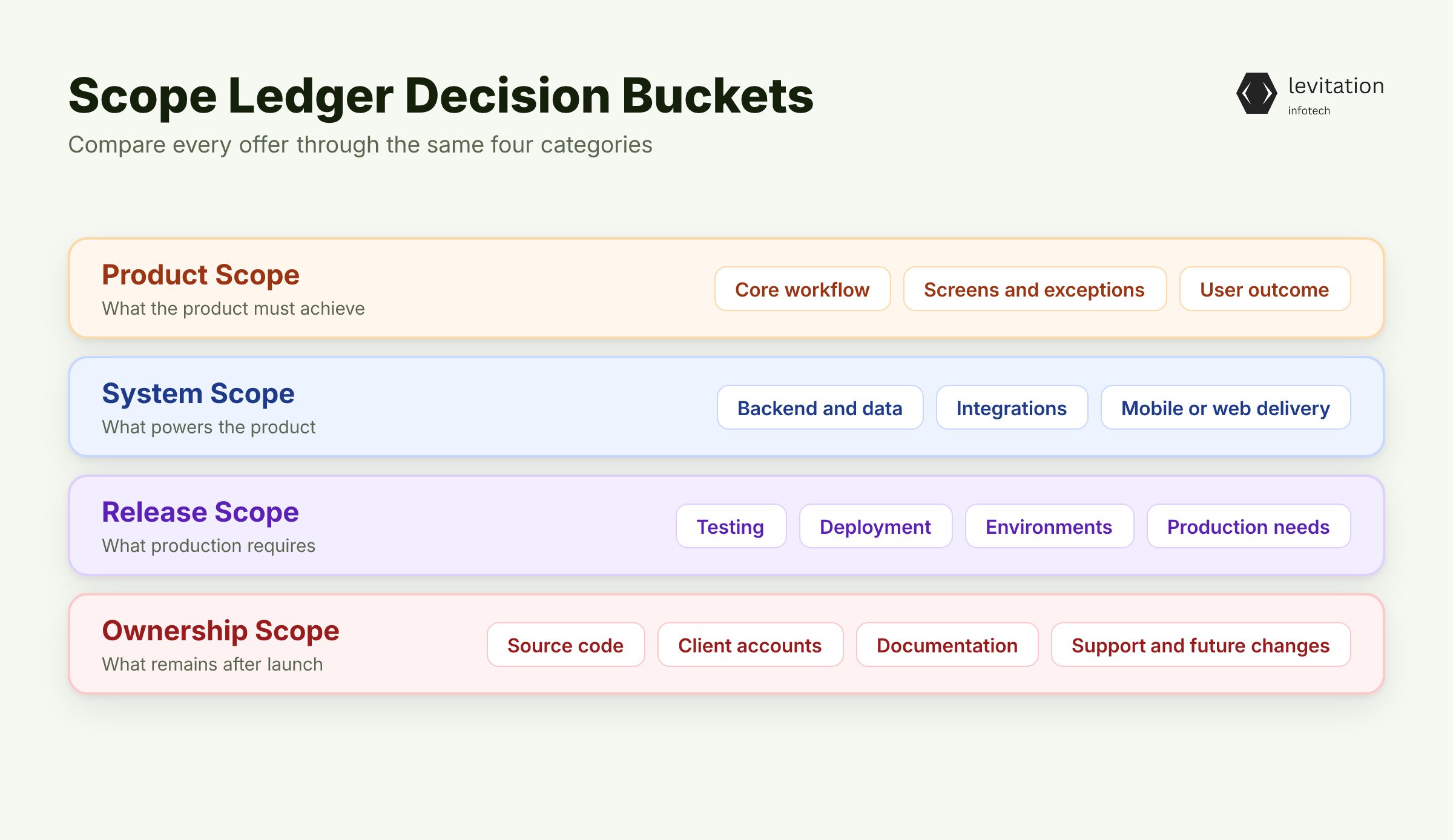
Quote comparisons fail when each vendor counts different work. One scope ledger removes the confusion.
Put every offer in one grid
A scope ledger forces every proposal into the same comparison structure. Give each offer these columns. First, list the proposed outcome and the included deliverables. Next, write down the explicit exclusions and any assumptions. The grid should also include the acceptance evidence. It should list code and account ownership details too. Finally, note the support period, the next-phase estimate, and any third-party or commercial dependencies.
The exact layout does not matter. Consistency does. A founder should see which offer leaves less work unresolved.
How should the ledger group these differences for a clear decision?
Group scope into decision buckets
Organise the ledger around decisions, not vendor terms. The product bucket covers the core workflow, screens, exceptions, and user outcome. The system bucket includes the backend, data, integrations, and mobile or web delivery. The release bucket tracks testing, deployment, environments, and production needs. Finally, the ownership bucket defines the source code, client accounts, documentation, support, and future changes.
Put every disputed item into one of these buckets. “We'll handle it later” is not a scope decision. It is a cost that nobody manages, waiting to appear.
Which platform choice makes the scope more expensive?
Separate platform bets
Compare mobile app development and web app development pilots by the behaviour they validate. Do not use invoice totals for this comparison.
A web pilot can test a browser-based workflow well. A mobile pilot becomes necessary when device permissions, sensors, push notifications, or store distribution matter.
Document every platform-specific feature that was left untested. This is the same failure described in why Indian web app quotes break at sprint three. The estimate changes when the tested platform stops matching the intended product.
How should you compare each offer's full cost?
Calculate the full cost
Each proposal needs the same planning period. Add the pilot fee and the estimated cost of the next production phase to the calculation. Also include every unresolved scope item and the required third-party services. Finally, add the post-launch obligations and support costs.
Keep third-party charges separate from agency fees, but do not hide them. A complete ledger should show who pays each obligation and when the cost becomes due.
Which vague promises should block the next payment?
Flag vague answers
Treat these phrases as unresolved assumptions: “everything included,” “code after launch,” “integrations on request,” and “support excluded.”
Turn each phrase into a deliverable, exclusion, estimate, or acceptance condition. If a vendor will not clarify it, do not fund it.
What should the pilot prove before production starts?
Make the Pilot Pass a Written Acceptance Gate
Even a clear scope is unsafe without a written acceptance gate. The gate turns opinions into evidence.
Require a pilot output packet
A completed pilot should produce one handover package. The package must include the agreed brief, the screen map, and the user flow. It should also contain the working prototype and an accessible source repository. Finally, include the environment setup instructions and the third-party dependency and credential list. Also include the known limitations and an itemised next-phase estimate.
A presentation is not a handover packet. Neither is a repository link without setup instructions.
What evidence shows that the pilot works beyond a guided tour?
Test one meaningful flow end to end
Choose a realistic journey and complete it yourself. Include its primary result and at least one failure, empty, or exception state.
For the booking example, test a successful reservation and a duplicate or expired request. Polished screens show only the happy path. Failure states reveal whether the product actually works.
Does that working flow also give the client control?
Verify ownership and repeatability
Ownership must work beyond the vendor's laptop. Confirm that your team can access the source repository. Also confirm that a new environment can be configured from the documentation. Also verify that required client accounts belong to your company. Make sure secrets are not embedded in the code. Finally, test a clean deployment to prove that the pilot can move forward without vendor access.
Until that is proven, a successful demo remains an expensive assumption.
About the author
Mayank Singh is a software developer at Levitation Infotech, where he builds web and AI-powered applications across the company’s fintech, healthcare, and enterprise projects.