


TL;DR: Three quotes for the same app brief at ₹3L, ₹8L, and ₹20L don't reflect markup or quality differences. They reflect three different products being scoped. The ₹3L quote is a throwaway prototype. ₹8L is a real MVP for validation. ₹20L is product infrastructure. The mistake is treating "app development cost in India" as one number. It's a tiered decision based on your scope, team, and definition of "done."
Key Takeaways: - The 6x gap between quotes comes from hidden variables. These include team seniority, what "done" means, tech stack, and vendor type. - ₹3 lakh buys a clickable prototype. It breaks the moment real users log in. - ₹8 lakh is the honest MVP budget for pre-seed startups ready to validate. - ₹20 lakh is the floor for building real product infrastructure, not just a project. - Post-launch maintenance adds a recurring annual cost. The cheapest quote is almost never the cheapest product over time.
You sent the same app brief to five vendors. Two quoted ₹3 lakh. One quoted ₹8 lakh. Two quoted ₹20 lakh. The worst thing you can do at this point is pick the middle one. None of them are quoting the same product.
The Quote Gap Is Not a Pricing Problem
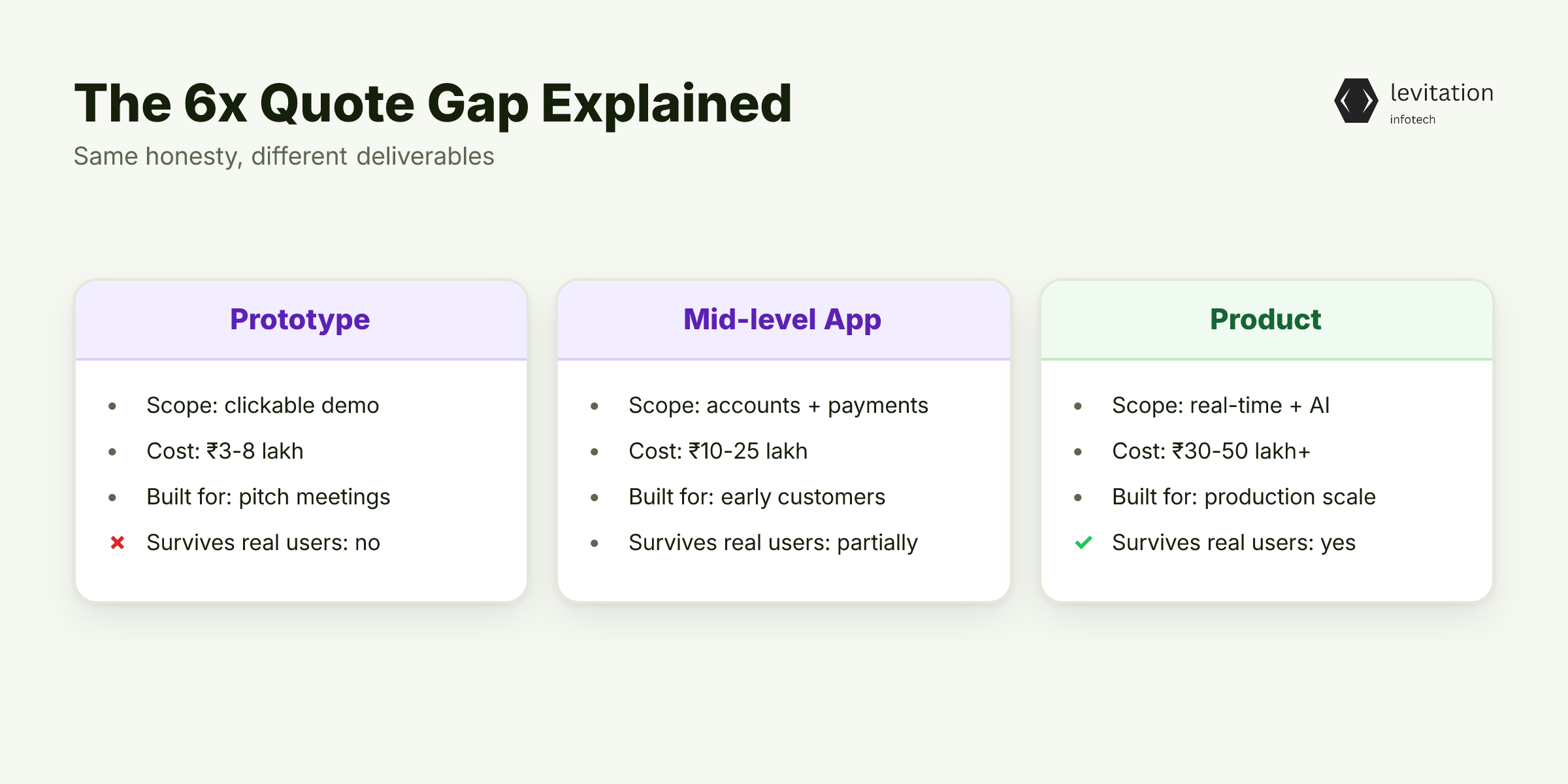
Founders see a 6x spread and assume the highest vendor is overcharging. Or they assume the lowest quote is cutting corners. Both reads are wrong. Both can be accurate, just for different deliverables.
Industry data backs this up. Simple apps in India run ₹3-8 lakh. Mid-level apps with user accounts, payments, and custom features run ₹10-25 lakh. Complex apps with real-time, AI, or heavy backend systems run ₹30-50 lakh+.
Questions about app development cost in India rarely have a single number as an answer. It is a tiered decision.
The real mistake is treating the cost question as "how much does an app cost." The better question is "what tier of product am I buying."
Vendors at the low end aren't hiding something. They are scoping down to a prototype. Vendors at the high end aren't padding. They are scoping to a product that survives real users.
If all three quotes are honest, something else drives the 6x gap. It has nothing to do with markup.
What the Quote Doesn't Tell You
Four hidden variables explain the spread. None of them show up in a price line.
First, team composition. A junior developer costs less per hour than a senior. The seniority gap multiplies the same build's price several times over.
You can see the spread in custom software development cost in India breakdowns. The hourly rate is where the real money hides.
Second, what "done" means. Does the quote include QA, deployment, code ownership, and documentation? Or just a working prototype on one device? Most briefs never define this, so each vendor fills the gap with their own assumption.
Third, tech stack and code quality. Template UI versus custom components. No backend versus a scalable API architecture. These choices compound across every screen and every integration.
Fourth, vendor type. Freelancers charge less per hour than mid-sized agencies. Mid-sized agencies charge less than enterprise firms in Noida or Bangalore with full overhead. The same brief gets priced very differently by each.
The brief itself is usually the real problem. "Build me an app" is not a scope. It is a wish.
Once you know what each tier delivers, the price stops looking arbitrary.
₹3 Lakh: The Prototype That Won't Survive Real Users
What you get: 3-5 screens, template-based UI, hardcoded content, no real authentication, no backend. Think of it as a clickable mockup with native feel. It looks real in a demo room and falls apart the moment someone tries to use it.
The team that builds it: one junior developer, a shared or no designer, zero dedicated QA. Cross-platform frameworks compress the work. That is how the price stays low. You can see the same pattern in our guide to app development cost in India.
Real examples this budget covers include a calculator app, a static to-do list, a basic business card app, a single-screen utility tool. None of these need a database, user accounts, or a server.
Where it breaks: the moment you need user logins, data persistence, payments, or any meaningful concurrent user load. The prototype isn't designed to handle any of that. It is closer to a demo than a product.
The honest take: this is a throwaway prototype for investor demos, not a startup product. The MVP cost in India for something real sits well above this band.
If ₹3 lakh is a mockup, the question is what an actual startup-ready MVP costs. Is the answer ₹8 lakh, or something else entirely?
₹8 Lakh: The Real MVP Most Founders Underestimate
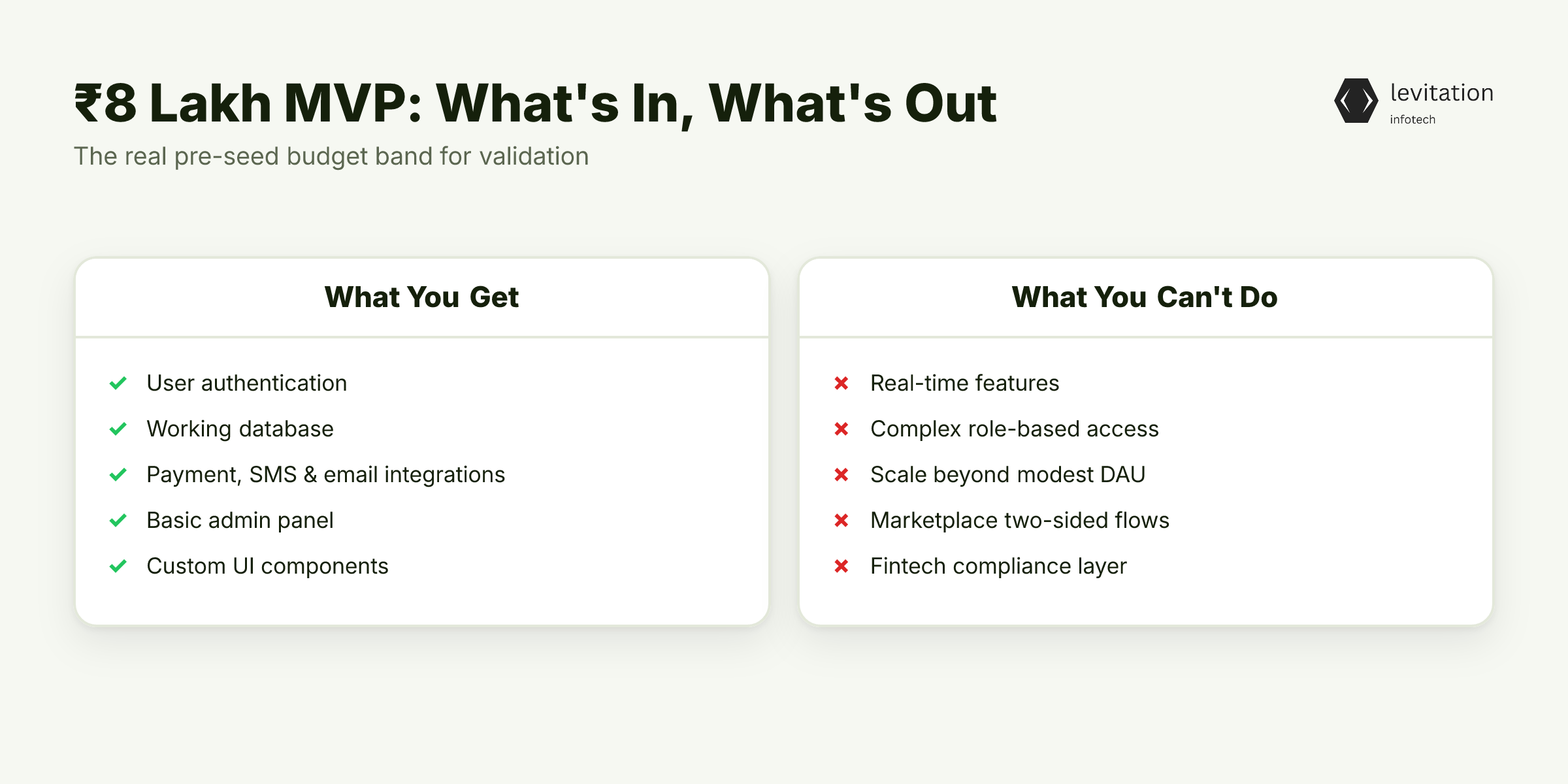
What you get: user authentication, a working database, and a couple of third-party integrations. These include payment, SMS, and email. You also get a basic admin panel and custom UI components. Enough to put in front of real users and see if the product hypothesis holds.
The team that builds it: one mid-level developer plus one junior, a dedicated designer, basic QA, and occasional project management. The structure is lean but functional. This is the MVP cost band where most pre-seed startups should be operating.
What it can't do: handle real-time features, complex role-based access, or scale past modest daily active user counts without re-architecting. Don't expect a marketplace's two-sided flow or a fintech app's compliance layer at this budget.
The honest take: this is the budget where most pre-seed startups should be operating. Enough to validate, not enough to over-engineer. The discipline of cutting features that don't serve the validation question is what makes this tier work.
But what if your idea is a marketplace, a fintech tool, or anything that needs a real backend? That is where the quote jumps again.
₹20 Lakh: When You're Building a Product, Not a Project
What you get: full backend architecture, real-time data sync, payment gateway integration, role-based access, admin dashboards, proper testing across devices, and CI/CD setup. This is the tier where you stop shipping a build and start shipping a system.
The team that builds it: a senior tech lead, multiple mid-to-senior developers, a designer, dedicated QA, and a project manager. You can see the software development cost India breakdown for this tier to understand where the hours go.
Real examples include a single-vendor marketplace, a booking platform, a fintech lite app, a healthtech app with compliance basics. Each one needs a real backend, not a mocked one.
The honest take: this is where you stop being a founder with a prototype and start being a founder with infrastructure. The cost is higher because the deliverable is a product, not a project. Anything below this tier that promises the same scope is either under-scoping or under-staffing.
Knowing the tiers is half the battle. The other half is making sure your brief lands in the right one. The cost of misjudging that fit shows up in the rebuild that follows.
How to Scope Your Project Into the Right Tier
Step 1: Write a feature audit. List every must-have for launch and every nice-to-have. Cut anything that does not directly validate your hypothesis.
The audit forces clarity. It shrinks the scope to the right tier.
Step 2: Define "done" explicitly. Does it include App Store deployment, a defined bug-fix window, source code handover, and documentation? If the vendor does not put this in writing, you will pay for it later.
This is the most common gap in cost to build software estimates.
Step 3: Ask vendors for a team breakdown, not just a price. Name the developers, their experience, and how many hours they are allocating. A vendor that cannot produce this is either inexperienced or hiding something.
Compare the breakdown across app cost in India quotes. The price gap will start to make sense.
Red flag #1: a quote that skips QA, deployment, or code ownership. You will pay for it later, usually in a rebuild.
Red flag #2: a quote well below ₹3 lakh for anything beyond a calculator. It is either template reselling or offshore outsourcing without your knowledge.
A vendor that has built the scoping discipline to push back on bad briefs protects both sides from the scope-creep trap. But even the right tier hides a cost most founders only see after launch.
The Real Cost Is the One That Comes After Launch
Post-launch maintenance adds a recurring annual cost that scales with the original build. A ₹3 lakh prototype rewritten to production quality often costs more than the original ₹20 lakh build would have. The shortcut is the most expensive line item on the year-two bill.
The cheapest quote is almost never the cheapest product. It is the most expensive prototype.
The right tier is not the cheapest one or the most expensive one. It is the one whose scope matches what you are actually trying to learn from users. Get the tier wrong, and you will pay for it twice.
Frequently Asked Questions
Is ₹3 lakh enough to build a startup app in India?
Only if your startup app is a static utility like a calculator or to-do list. For anything involving user logins, payments, or a database, ₹3 lakh buys a prototype that will need to be rebuilt before launch.
What is a realistic MVP cost in India for a funded startup?
For a pre-seed or seed-stage startup, ₹8-12 lakh covers a properly scoped MVP. It comes with authentication, one or two integrations, and a basic admin panel. This range lets you validate with real users without over-investing in features they may not need.
Why do app development quotes vary so much for the same brief?
Quotes vary because vendors price different things under the same brief. These include team seniority, definitions of "done," tech stacks, and assumptions about which features are in scope. A ₹3L quote and a ₹20L quote may both be accurate for fundamentally different products.
Should I hire a freelancer or an agency in Noida for app development?
Freelancers charge less per hour than agencies. They work well for tightly-scoped, single-feature tasks. Mid-sized agencies in Noida are more expensive. They are better for full MVP builds where you need design, development, and QA coordinated. For complex products, the agency overhead pays for itself in fewer rebuilds.
How much does it cost to maintain an app after launch in India?
Maintenance scales with the original build cost. It covers bug fixes, OS updates, server costs, and minor feature additions. A ₹20 lakh app carries a much larger annual maintenance load than a prototype-tier build.
About the author
Mayank Singh is a software developer at Levitation Infotech, where he builds web and AI-powered applications across the company’s fintech, healthcare, and enterprise projects.