


TL;DR: A 30-day AI MVP shipped from Noida can cost 3x the original build price to refactor in year two, not because the sprint is bad, but because the architecture decisions buried inside it force a rewrite. The fix is to treat the sprint as the first version, not the only one, and to refuse architectural shortcuts that look cheap on day 30 and expensive on day 365.
Key Takeaways: - The 30-day MVP pitch sells demo readiness, not scale readiness, and the gap between them is the year-two bill. - Year-two refactoring costs roughly 3x the original MVP invoice, driven by data layer, auth, AI pipeline, and platform migration work that compound together. - "Boring tech" stacks (PostgreSQL, containers, a single backend framework) win the sprint and survive the scale test. Low-code wins the sprint and loses the scale test.
The 30-Day MVP Promise Everyone Sells, Nobody Audits
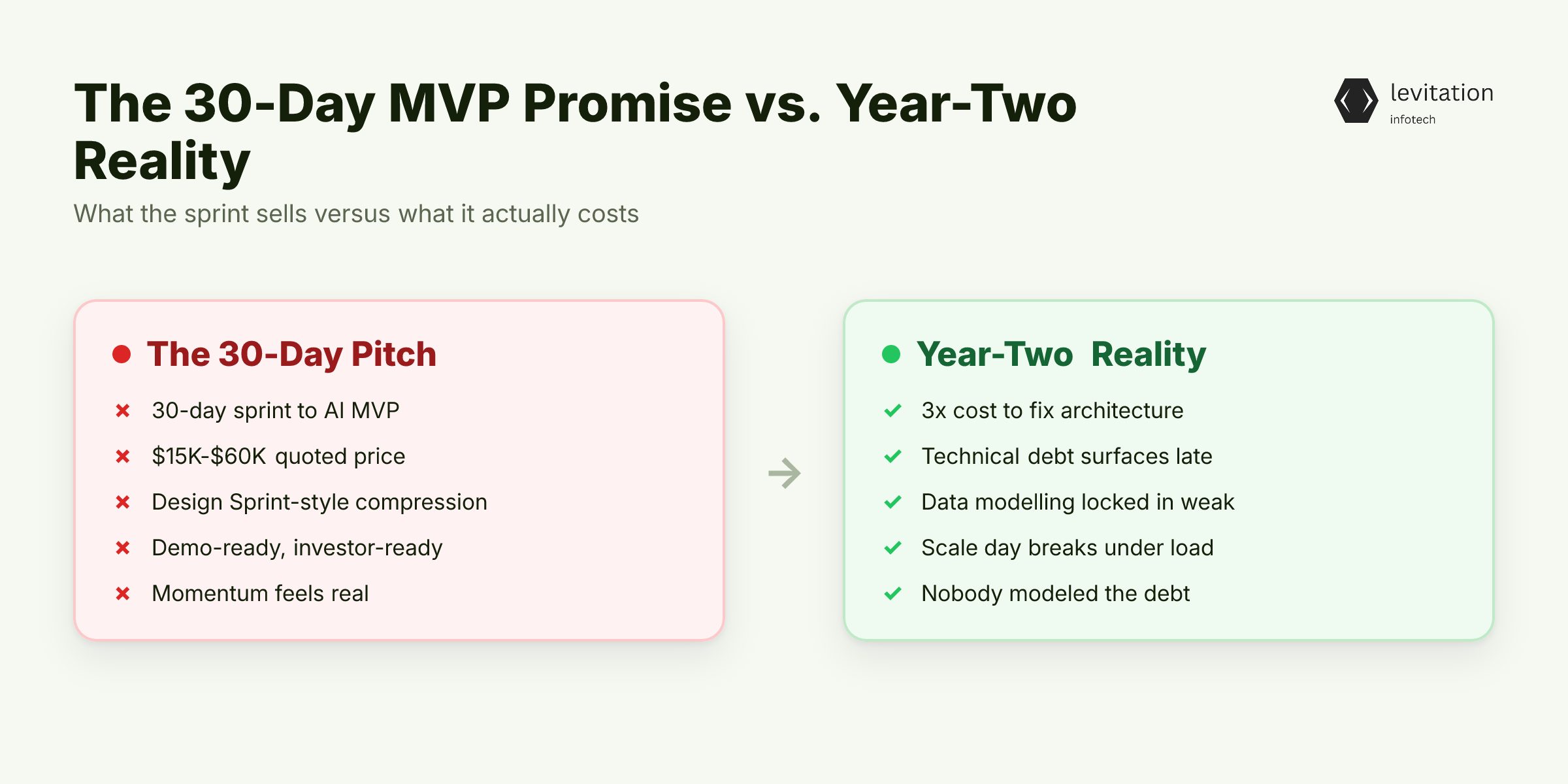
Every Noida app development agency will tell you they can ship your AI MVP in 30 days. What they won't tell you is that the architecture decisions made in that sprint will cost you three times the original build price to fix in year two. Most founders don't see it coming until the invoices arrive.
The pitch has become the default. AI MVPs in India are commonly quoted between $15,000 and $60,000, with timelines of 4 to 16 weeks. The 30-day sprint is the marketing promise that wins the deal, especially when a competitor is quoting 90 days. Design Sprint-style methods compress ideation, prototyping, and full-stack build into one aggressive cycle. Founders see speed, sign the contract, and feel momentum.
But the sprint compresses the wrong things. Architecture decisions, data modelling, and infrastructure planning get squeezed. These are exactly the items that determine year-two cost. The disconnect is structural: founders evaluate the 30-day deliverable, demo to investors, and celebrate. Nobody models the technical debt the deliverable carries. At agencies that quote the year-two number first, the pricing discussion sounds different.
The sprint gets you to demo day. It doesn't get you to scale day. Here's where the shortcuts hide.
What 'MVP' Actually Means Inside a 30-Day Sprint
"MVP" has become a marketing word. Inside a 30-day sprint, it usually means a clickable demo. One that survives a five-minute investor walkthrough. That is a very different object than a product a paying user will rely on at 9am on a Monday.
The mechanics explain why. Low-code platforms and pre-built integrations get the MVP live fast. They also create vendor lock-in that costs more to escape than the original build. A team can wire real company data from SAP, Salesforce, SharePoint, Excel, and Azure into the prototype in days. The connectors used are often shallow, not production-grade. They pass the demo. They fail under sustained user load.
AI features get treated the same way. Integration concepts are "tested" using wrapper APIs and prompt chains that work in a notebook and break when traffic arrives. Authentication, error handling, logging, and monitoring are typically stubbed. They work for the demo, but a single production incident at 2am exposes the gap.
The typical cost to build an app inside this sprint falls within the $15,000 to $60,000 range commonly quoted for AI MVPs. What that number excludes is the year-two retrofit of every item above. The same pattern shows up in adjacent build cycles, from Your ₹6 Lakh App Costs ₹8 Lakh in Year Two to the broader market in Why 7 of 10 Indian AI Builds Quietly Double in Cost by Day 90.
Each of these shortcuts is rational in isolation. Together, they compound into something worse than the sum of their parts.
The 3x Refactor Math: Where the Year-Two Bill Comes From
The cost arbitrage that draws founders to Noida is real. Indian full-cycle agencies operate at rate structures well below comparable US vendors, which is what makes the 30-day sprint financially attractive.
The bill arrives in year two, not year one. The 3x multiplier comes from compounding rewrites across four layers. Each layer requires its own rebuild. The coordination overhead between them pushes the total toward the 3x mark. - Data layer: built for demo volumes, not user volumes. The rewrite is a full rebuild. - Platform: replatforming off the low-code stack used during the sprint. Low-code connectors are not designed for high-throughput production traffic. - Auth and observability: rebuilding stubs into production-grade systems. Sprint versions were never designed for real user populations. - AI pipeline: model retraining and pipeline rework. Notebook-tested prompts and wrapper APIs break under real traffic.
The math makes this concrete. A multi-month rebuild effort, even at the lower end of Indian agency rate structures, can exceed the original MVP cost. You also have to factor in scoping, testing, and migration overhead. If your MVP cost $20,000, the year-two investment to keep the lights on will hurt.
What founders miss on the invoice: - Parallel-run costs while old and new systems coexist - Data migration scripts that nobody budgeted - Retraining users on a new interface - Downtime during cutover, paid for in customer trust
MLOps work can extend year-two spend, as documented across the vendor landscape. The pattern recurs across the market. If your headline number feels too good, the second invoice is the one that matters.
But the 3x figure isn't inevitable. It only shows up when the MVP was architected to be thrown away rather than grown.
Why Noida's Agencies Are Uniquely Positioned to Solve This
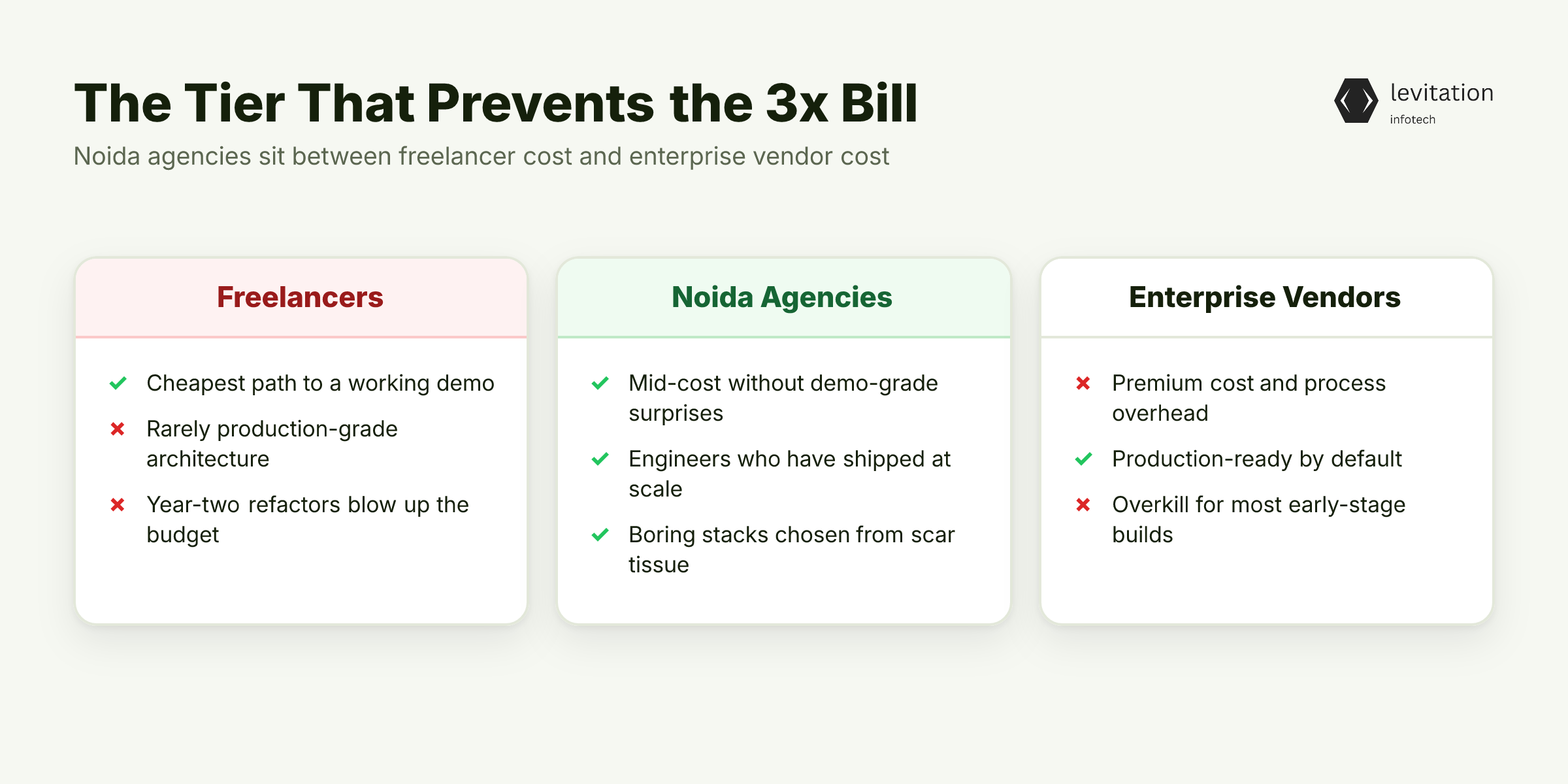
The arbitrage that creates the 3x bill is the same arbitrage that, used right, prevents it. Noida's mid-sized and top-tier agencies sit between freelancer cost and enterprise vendor cost. That is the right tier for founders who need production-grade architecture, not just a demo.
The talent mix matters. Noida's enterprise AI talent pool gives agencies experience with systems that must survive scale. Engineers there have built systems that handle production traffic. They have also lived through year-two refactors on the client side. That experience changes what they put into day-one architecture. They have already paid to learn the lesson.
The local ecosystem amplifies this. Noida's proximity to enterprise clients means the agencies have battle scars from refactors. They know which shortcuts survive contact with production traffic. When an app development company Noida team proposes a boring PostgreSQL stack with containerised deployment, they are not being conservative. They are being accurate about what survives. Founders stay because year two does not blow up.
The question isn't whether to use a Noida app development company. It's which engagement model avoids the 3x bill.
How to Architect a 30-Day MVP That Doesn't Need a Rewrite
The fix is architectural discipline in the sprint, not more time. Six rules, applied in the 30 days, prevent the 3x multiplier from materialising.
1. Demand a "boring tech" stack. PostgreSQL for data, a single backend framework, containerised deployment. Boring tech wins both the sprint and the scale test. We unpacked why abstraction-heavy stacks fail in Your AI Architecture Has 6 Abstraction Layers. You Own None.
2. Insist on a data layer that can be migrated. Abstract every integration behind an interface, not hardcoded into the app surface. When the day comes to swap Salesforce for a different CRM, the change touches one file, not 200.
3. Build auth, logging, and error handling as production code from day one. These are the items that always get stubbed in the sprint, and cost the most to retrofit. They also decide whether your mobile app development cost in India doubles between year one and year two.
4. Cap the MVP scope ruthlessly. Three core user flows, not fifteen. Feature creep in the sprint is the main driver of architectural debt. If the scope fits on one whiteboard, the architecture can survive contact with reality.
5. Contract for a 12-month architecture runway. Define scale targets upfront: users, data volume, integrations. The MVP should be built to be grown, not replaced. This is where the 3x math dies.
6. Separate the AI experimentation layer from the core application. Swap models and prompts without touching the product surface. The 30-day sprint is the worst time to entrench AI dependencies in your application code.
When you do this, the year-two number changes from a 3x shock to a manageable scaling investment. The pattern shows up across the market. Budget overruns recur on Indian CRM projects (see Why 6 of 10 Indian CRM Projects Hit 2x Budget). The same dynamic drives the Year-Two Bill That Kills Custom CRMs pattern. The fix is upstream, in the sprint, not downstream in the rescue project.
What Changes When You Build for Year Two on Day One
The compounding effect of day-one discipline shows up fast. Total cost of ownership over three years drops sharply compared to throwaway-MVP-then-rebuild patterns. The math is structural, not marginal. Time to market for new features after launch compresses because the architecture supports extension rather than replacement.
Fundraising shifts too. Investors with technical diligence see the difference. They spot an MVP versus a prototype wearing a suit. The compressed deployment window becomes a real advantage, not a marketing line. Why? The output survives investor and user scrutiny at scale. Teams that build this way by default see client retention follow. That window stops being a sales pitch when month-four code still works in month fourteen. That is the app development price you want to pay, with no second invoice in year two.
Levitation ships AI products this way, with production-grade architecture from sprint one, so the year-two bill is a fraction, not a multiple.
Frequently Asked Questions
Q: What is the actual MVP development cost in India for an AI product in 2026?
A: AI MVPs in India typically run $15,000 to $60,000 depending on complexity, with timelines of 4 to 16 weeks. A 30-day sprint sits at the aggressive end. It is achievable for well-scoped products, but the 30-day price is only the first invoice. Year-two scaling investment is where the real cost lives.
Q: Why does year-two refactoring cost 3x the original MVP build?
A: The 3x figure comes from compounding rewrites across the data layer, authentication, AI pipelines, and platform migration off low-code tools. A multi-month rebuild effort alone can exceed the original MVP cost. Each layer requires its own rework. Then you add migration overhead, parallel-run costs, and retraining.
Q: How do I choose a Noida app development company that won't leave me with a rewrite?
A: Look for agencies that propose a boring, production-grade stack from day one. PostgreSQL, containerised deployment, abstracted integrations. They should also contract for a 12-month scale runway. Avoid vendors who lead with low-code or no-code platforms. These create lock-in that costs more to undo than the original build.
Q: Is a 30-day AI MVP realistic for a startup with no technical co-founder?
A: Yes, but only with ruthless scope discipline. Limit the MVP to three core user flows, one AI feature with measurable output, and production-grade auth and data handling. Anything beyond that in 30 days means architectural shortcuts that will cost you in year two.
Q: How much does it cost to build an app in India compared to the US in 2026?
A: Indian full-cycle agencies operate at rate structures well below comparable US agencies. This is the main cost arbitrage that makes Noida development attractive. The savings only compound when the architecture survives scaling.
About the author
Mayank Singh is a software developer at Levitation Infotech, where he builds web and AI-powered applications across the company’s fintech, healthcare, and enterprise projects.