


TL;DR: India app quotes price features, not change. By Sprint 5, that blind spot delivers a predictable 40% budget overrun, and no clause in the contract warned you. The fix is locking scope before Sprint 1, not writing tighter requirements.
Key Takeaways: - Scope creep in Agile arrives through informal channels (Slack, standup nods, "while you're at it" requests), never formal change tickets. This is why quotes never see it coming. - The compounding is predictable: Sprints 1 and 2 stay clean. Sprint 3 absorbs small additions. Sprint 4 expands existing stories. Sprint 5 is where the 40% headline lands. - A quote that lists features without defining what counts as a change request is built to overrun. Read for process, not just line items.
The 40% Blind Spot in India App Quotes
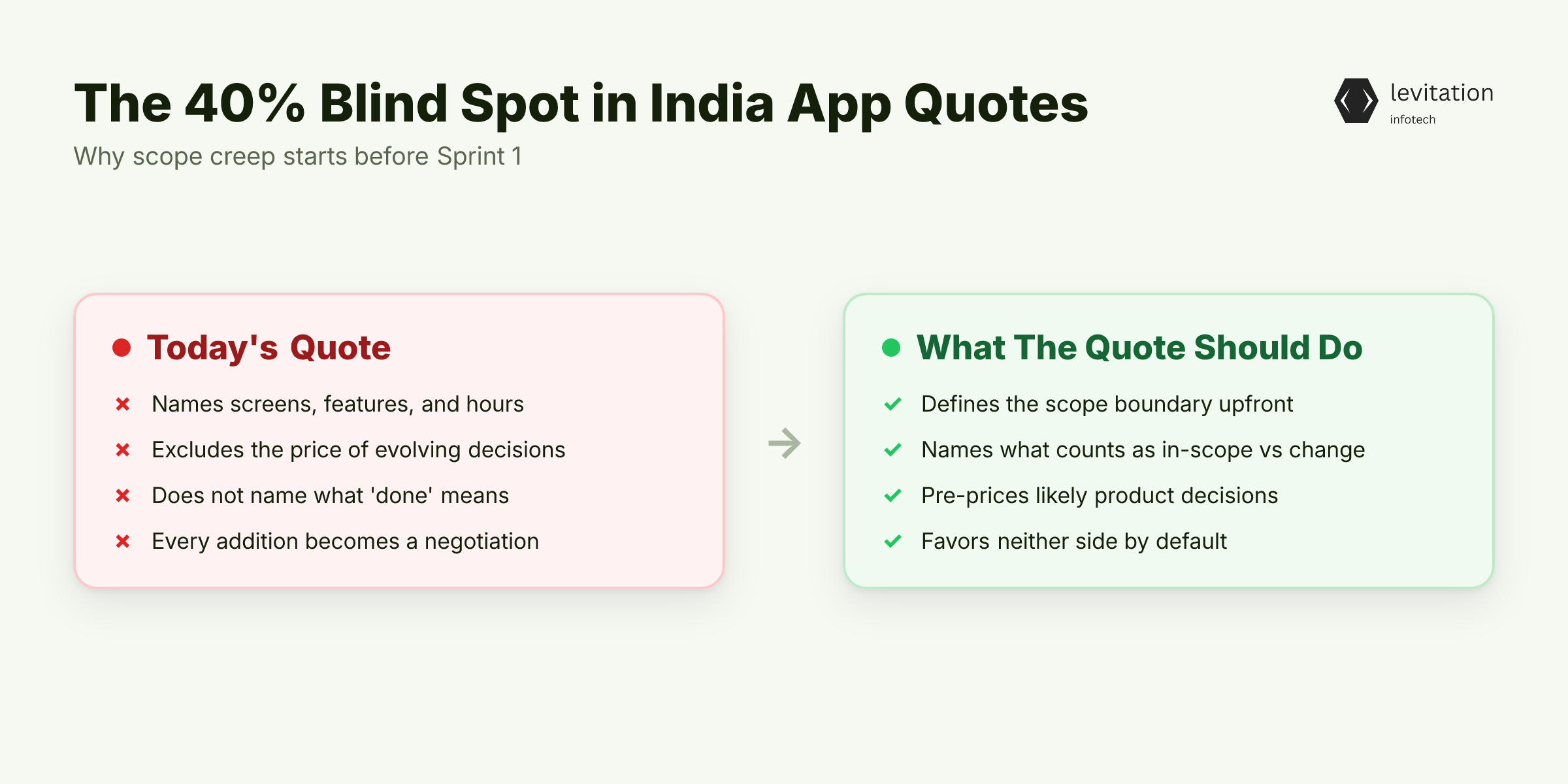
The 40% creep is not a vendor scam. It is a structural blind spot baked into how Indian app quotes get written.
Most app development cost in India guides focus on hourly rates and feature checklists. Almost none warn you about the cost of your own changing mind.
Fixed-bid quotes out of Noida, Gurgaon, and Bangalore typically exclude the price of evolving product decisions. The quote names screens, features, and hours. It does not name what "done" means.
So when a product manager asks for a third login option in Sprint 3, nobody on either side has a clear answer. Is that included, or is that a change? When the CEO sees a competitor's dashboard in Sprint 4 and wants the same chart, the same gap appears.
Founders blame the agency when scope explodes. The agencies blame unclear requirements. Both are partly right, and both miss the point. The quote itself never defined the boundary. Without that boundary, every addition is a negotiation. Negotiations favor whoever is doing the work that day.
But the agency does not add features out of malice. Scope creep in Agile has a very specific mechanism, and it starts before Sprint 1.
What Scope Creep Actually Looks Like in Sprint Terms
Scope creep is not a single big change request. It is the gradual, unauthorized expansion of project deliverables after kickoff. There is no matching adjustment to timeline or budget.
In a Waterfall project, it shows up as a long email thread. In Agile, it shows up as a quiet rebalancing of the sprint board.
Two patterns dominate. The first is new user stories landing in a sprint without removing equivalent work. The team commits to a planned capacity, then absorbs additions, and velocity stays flat. Nobody calls it a problem because the burndown chart still looks healthy.
The second pattern is more dangerous: existing acceptance criteria quietly expand. A story for "user profile page" grows into "user profile page with activity timeline, export to CSV, and share via link." Same story, several times the work.
The channel is always informal. A Slack message at 11 PM. A verbal nod in the daily standup. A "while you're at it" request after a demo. The work gets done because the team is mid-sprint, and momentum is cheaper than friction.
A formal change ticket never gets raised. Raising one would mean admitting the original estimate was wrong.
If you are sizing how much does an app cost using a quote that ignores this mechanism, you are budgeting for the wrong project. You plan for the project you described on Day 1, not the one you will ship on Day 90.
If scope creep is just a series of small conversations, the obvious fix is to write better requirements. That is where the second trap opens.
Why Your Quote Never Warns You About It
Indian app quotes list features, screens, and hours. They almost never define what counts as a change request versus an included tweak.
A typical fixed-bid quote from Noida assumes the spec you sent on Day 1 is the spec on Day 90. Reality disagrees. Every product evolves once real users (or real executives) see it.
Agencies competing on price strip out the "change management" line item because it scares founders away. A quote that prices a formal process for handling scope changes loses to one that does not. So the line gets cut, and the cost gets billed later under the label "additional scope."
The cost to build an app gets distorted not by what is in the quote but by what is missing from it.
This is why healthcare platforms built for Indian hospital chains are priced so differently from consumer apps. Every additional field carries regulatory weight. Teams shipping HIPAA-compliant systems have learned the hard way that an unstated assumption is a future invoice. The consumer app world has not yet learned that lesson.
The quote is blind by design. The agencies know it. The founders do not.
The next question is the one that actually hurts: how does that blindness turn into 40% by Sprint 5 specifically?
The 40% Math: How Creep Compounds Sprint by Sprint
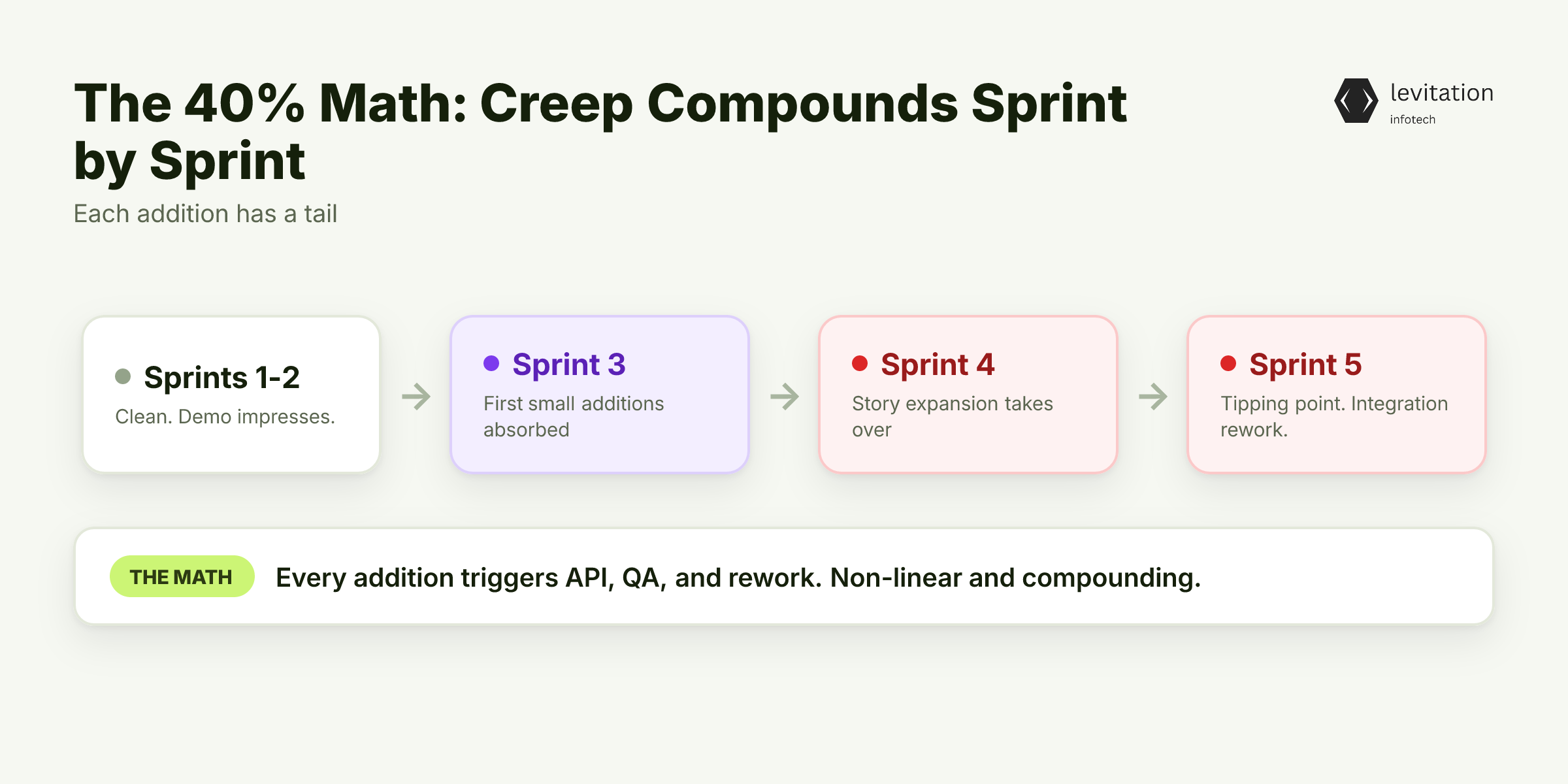
Sprints 1 and 2 are clean. Standups are short. The demo impresses. The founder feels good about the app development cost India they signed up for. Then Sprint 3 lands the first "small" addition. Nobody flags it as a change. The team absorbs it because saying no feels riskier than working late.
Sprint 3 also brings a new filter, an extra field on a form, a third login option. Each feels like a five-minute conversation. The cumulative impact on the sprint commitment is modest in any single sprint, even though the work is real.
Sprint 4 is where story expansion takes over. Existing acceptance criteria grow. A dashboard that was supposed to show daily totals now needs weekly trends, monthly comparisons, and an export button. A search that returned simple matches now needs fuzzy matching, recent items, and saved searches.
By Sprint 4, the cumulative creep has grown. The team is operating on the original velocity against a backlog that has expanded well beyond what they planned for.
Sprint 5 is the tipping point. New stories keep landing, and expanded stories need regression testing. Integration rework piles up because each new feature forces the team to revisit testing, edge cases, and old dependencies. That is where the 40% headline lives.
The math is not linear because every addition has a tail. A new field on a form triggers API changes, QA cycles, and rework on anything that depended on the old schema. The request itself sounded trivial.
This compounding pattern shows up across project types. That is why India's Software Is Still Cheap. Your Bill Isn't. hits so hard the moment you stop measuring by the hour and start measuring by what actually ships.
If the math is this predictable, prevention should be straightforward. It is, but only if you know what to look for in the quote itself.
How to Read a Quote for Scope Protections
Most founders read a quote like a menu. They scan features, compare prices, and pick the cheapest credible option. That is the wrong document to read.
A quote is a contract about how disagreements will be resolved. Read it for process, not for line items.
Four checks matter more than the price tag: - Demand a written definition of "change request." Anything not in the original backlog should trigger a time and cost estimate before work starts. If the quote does not contain this definition, the agency has reserved the right to call anything a change. - Look for an explicit "in scope" and "out of scope" list, not just a feature checklist. Out-of-scope is where the real boundary lives. If it is missing, the quote is built to blow up. - Check whether the pricing is fixed-bid or velocity-based. Pure fixed-bid on Agile work is a mismatch. Scope and price cannot both be locked at the same time. One has to give. A quote that locks both is lying about one of them. - Ask how many rounds of feedback per screen are included. "Unlimited revisions" is another name for unpaid scope creep. A reasonable revision cap is part of a healthy quote. Unlimited is a trap.
A Noida fixed-price quote that skips the hourly rate cannot even tell you what the change would cost, because the underlying cost model is hidden. That is not a feature. It is a liability. The same logic applies to six hidden costs that quietly inflate Noida software quotes, where scope is just one of several.
Even with the best quote, requirements will shift. That is product reality. The question is whether you have a recovery move.
The Scope Reset Exercise: Reversing Creep Mid-Project
Scope creep can be reversed. The mechanism is a formal scope reset. It is a single meeting where stakeholders agree to remove added requirements and return to the original project boundaries.
It works best when run as a single decision meeting, not a Slack thread that drags on for a week.
The format is simple. List every addition made since Sprint 1, no matter how small. Force-rank the list by current business value. The top items stay. The bottom items get cut, deferred to phase two, or costed as a separate change order.
The point is to make the trade-off visible, because in a creeping project, the trade-off has been happening invisibly for weeks.
Not all scope evolution is bad. Controlled changes through proper change management can improve a product when they are properly resourced. The signal of a healthy project is not "no changes." It is "every change has a paper trail." Projects that follow this discipline protect the original scope instead of abandoning it halfway through a redesign.
Recovery is possible. But the cheaper win is never needing the reset in the first place. So what does a well-locked project actually look like in practice?
What Changes When Scope Is Locked Before Sprint 1
Scope locked before Sprint 1 changes three things. Timelines hold, because every new request goes through a costed change order, not a hallway conversation. Budgets hold, because the original estimate is defended by a process, not by goodwill. And the product that ships is the product that was planned, not a halfway house of every idea that landed in a standup.
The same discipline that protects a founder's budget is what lets experienced teams ship HIPAA-compliant healthcare platforms and enterprise AI systems. The cost discipline is the same. The stakes are just higher.
When a platform cannot be casually rescoped, the same rigor that protects a startup budget also protects patient data and enterprise contracts.
Teams that build with this lock-first mindset, like Levitation, treat the scope boundary as a feature, not a constraint.
Predictable delivery is a process choice you make before signing anything.
Frequently Asked Questions
How much does app development cost in India for a startup MVP?
A basic MVP in India varies based on features, team location, and complexity. Anything quoted well below typical market range is either incomplete scope or a teaser rate that climbs once Sprint 1 begins.
What is scope creep in Agile app development?
In Agile, scope creep happens when new user stories are added to sprints without removing equivalent work, or when existing story requirements expand beyond the original acceptance criteria. It travels through informal requests, not change tickets.
Can scope creep be reversed once a project is already over budget?
Yes. A scope reset exercise brings stakeholders together to remove added requirements and return to the original project boundaries. It works best when run as a single decision meeting with a ranked list of every addition since Sprint 1.
What is the difference between scope creep and a legitimate change request?
A change request is a formal, costed, and timeline-adjusted addition approved by both sides before work starts. Scope creep is the same kind of addition, a new screen, a new field, a new flow, but delivered through informal channels with no adjustment to budget or timeline.
Should I choose fixed-bid or time-and-materials for my India app project?
Pure fixed-bid pricing on Agile work is risky because scope and price cannot both be locked at the same time. Time-and-materials with a capped velocity, or a hybrid with a defined change-request process, gives you more predictable outcomes without inviting the 40% creep.
About the author
Mayank Singh is a software developer at Levitation Infotech, where he builds web and AI-powered applications across the company’s fintech, healthcare, and enterprise projects.