


TL;DR: Most Noida founders treat the ₹3L/month developer vs ₹80K agency question as a budget call. It is not. It is a project-shape call. The right answer depends on your data readiness, production deadline, and compliance surface. Pick the wrong engagement model and you pay more in hidden costs than the salary gap ever justified.
Key Takeaways: - A ₹3L senior developer becomes a bottleneck by month four because AI work needs four roles, not one - The ₹80K agency rate usually covers discovery or junior output, not a full production team - Three filters (data readiness, deadline, compliance) predict the right engagement model better than price - Hidden costs (data prep, MLOps, infra) inflate both options once those line items sit on top of the quoted retainer - The path is reversible: an agency-built MVP can be handed to in-house engineers once revenue justifies it
The ₹3L Developer Who Delivered a Demo, Not a Product
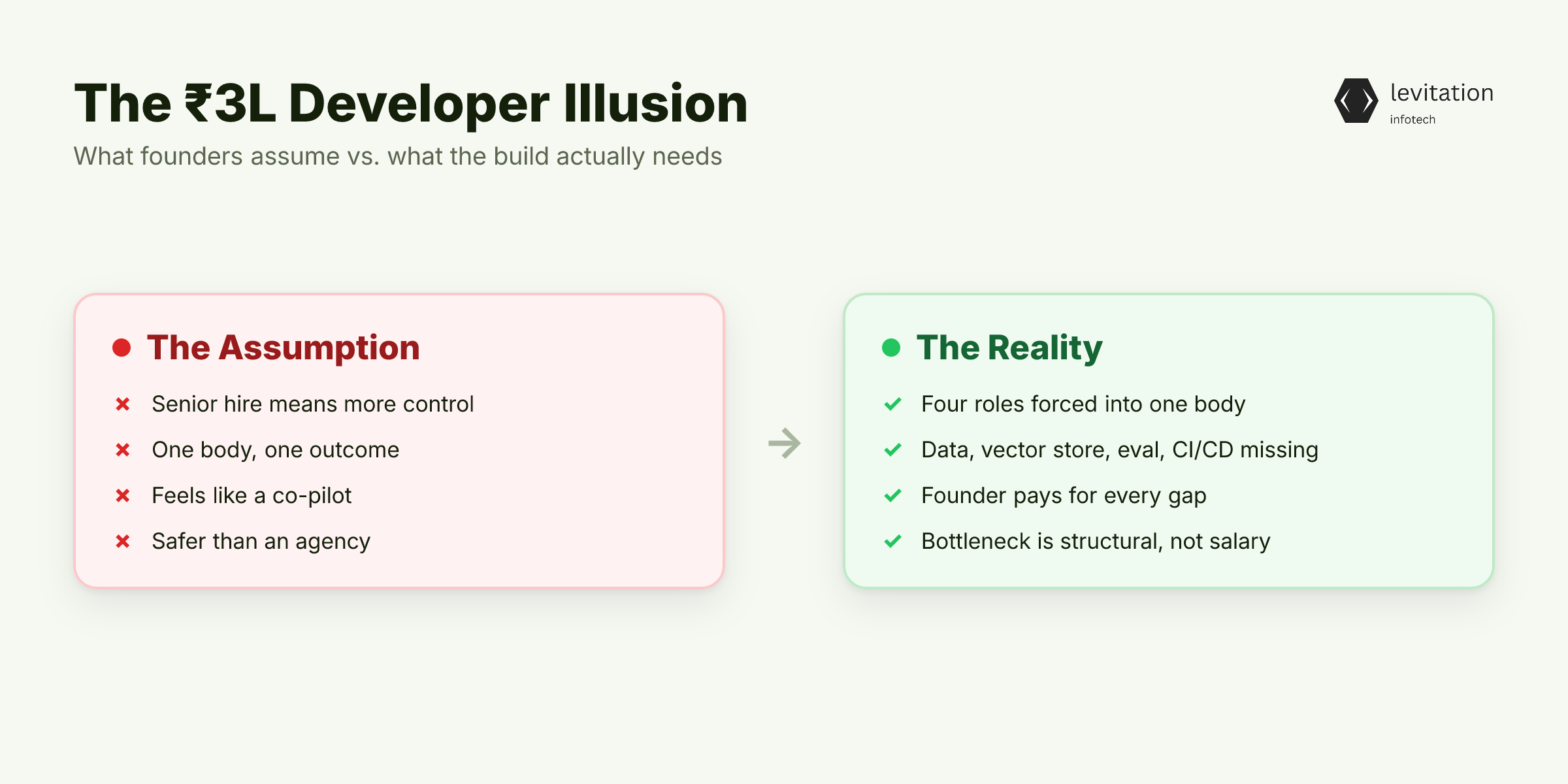
The assumption goes like this. A senior engineer costs more, so they are more invested, more accountable, closer to your control. A dedicated AI developer feels like hiring a co-pilot. An agency feels like renting a taxi.
Here is the problem. "Control" over a single person is not the same as control over outcomes. A solo developer cannot ship a production AI system alone. They need data pipelines, a vector store, an evaluation harness, model monitoring, and a CI/CD setup that understands retraining. The founder is paying ₹3L for one body, but the work needs four.
By month four, the same pattern shows up in every stalled Noida build. The developer is not slow. They are blocked. The data is not labelled. The infra is not provisioned. The evaluation framework is a spreadsheet.
The founder is now writing cheques for data labelling tools and GPU credits. They bring in a second contractor. All because the original scope was "build me AI."
The bottleneck was never the developer's salary. It was everything around them that nobody budgeted for. The "safe" hire turns out to be the riskier bet, because the founder owns every gap. And the math behind that decision is more fragile than the salary line suggests. The real failure is structural: a four-role job forced into one body.
Why Dedicated AI Developers Hit a Ceiling by Month Four
A senior AI developer is part data engineer, part MLOps engineer, part backend engineer, part prompt engineer. India has very few people who are all four at a senior level. The ones who exist command ₹3L-plus, and they are still only one person.
Here is what month four looks like for a solo hire: - Data ingestion pipeline: not started - Vector store: half configured, no chunking strategy - Evaluation harness: a folder of ad-hoc test prompts - Monitoring: nothing - Retraining cadence: undefined
The founder is waiting. The developer is honest about the gaps but cannot fix them in parallel. The ₹3L salary is a fixed line item. The founder is now also paying for data labelling tools, GPU credits, and a second contractor to plug the holes.
That "second contractor" is usually a freelancer found on LinkedIn, and they are learning the codebase as they go.
Compare that to a competent AI development company running a parallel four-person team: tech lead, data engineer, MLOps, QA.
The agency is not faster because its engineers are better. It is faster because the role gaps are already filled. Work runs in parallel streams instead of serially behind one calendar.
The ceiling is not about talent. It is about a single person's bandwidth against a four-role problem.
So agencies are the obvious win? Not quite. The ₹80K number masks a set of costs that usually surface around month three.
The ₹80K Agency Number Is a Lie (Sort Of)
Here is the trick. ₹80K/month is the discovery or junior-engineer rate, not the production rate. A real production-grade AI engagement needs a tech lead, a data engineer, an MLOps person, and a QA layer. The all-in number for that team sits well above the quoted retainer. Nobody quotes that on the first call.
The agencies that do quote ₹40K-80K retainers are usually doing one of three things: - Running the discovery phase (fine, but it is not a build) - Subcontracting the actual custom AI development to junior freelancers, creating a quality lottery - Selling a fixed-scope pilot that balloons the moment "make it smarter" enters the conversation
And "make it smarter" always enters the conversation. AI requirements are inherently fuzzy. "Reduce ticket resolution time" is not a spec. "Match my brand voice" is not a spec.
The agency absorbs the scope creep, then bills for the change orders. The founder absorbs the surprise.
Then there is the communication tax. Daily standups, async updates, context-switching, demo prep. None of that appears on an invoice, but it eats founder time. A solo in-house developer is "in the next room." An agency is a scheduled meeting.
The real question is not which option is cheaper. It is which one matches the actual shape of your project. Most founders skip that step entirely.
The Three Filters That Decide the Real Winner
Three questions, honestly answered, beat any vendor pitch. Here is the filter set.
Filter 1: Data readiness. If you have clean, labelled data sitting in a queryable warehouse, a senior developer can move fast. If your data lives across spreadsheets, CRM exports, and one engineer's laptop, you need an agency with data engineering depth. Most Noida founders overestimate their data readiness.
Be honest.
Filter 2: Production deadline. Under 3 months: you need an existing team, which usually means an agency. Over 9 months: in-house starts to make sense because the agency margin compounds. The 3-6 month window is the genuine grey zone, and that is where the filters below carry the most weight.
Filter 3: Compliance surface. Anything touching finance, health, or personal data needs a vendor with a track record. A solo hire cannot replicate the audit history that regulated buyers require. The parallel in healthcare is HIPAA-compliant deployments for hospital chains. That is the kind of regulated-system work that takes years of audit history to win.
The rule of thumb: if you answer "no / urgent / regulated" to more than one filter, agency wins. If you answer "yes / relaxed / non-regulated" across the board, in-house is defensible. Everything in between needs a closer look at the AI solution development scope, not the price.
Once you apply the filters, the math shifts. Here is where most Noida founders miscalculate the true cost of both paths.
Hidden Costs That Inflate Both Options Once You Add the Real Line Items
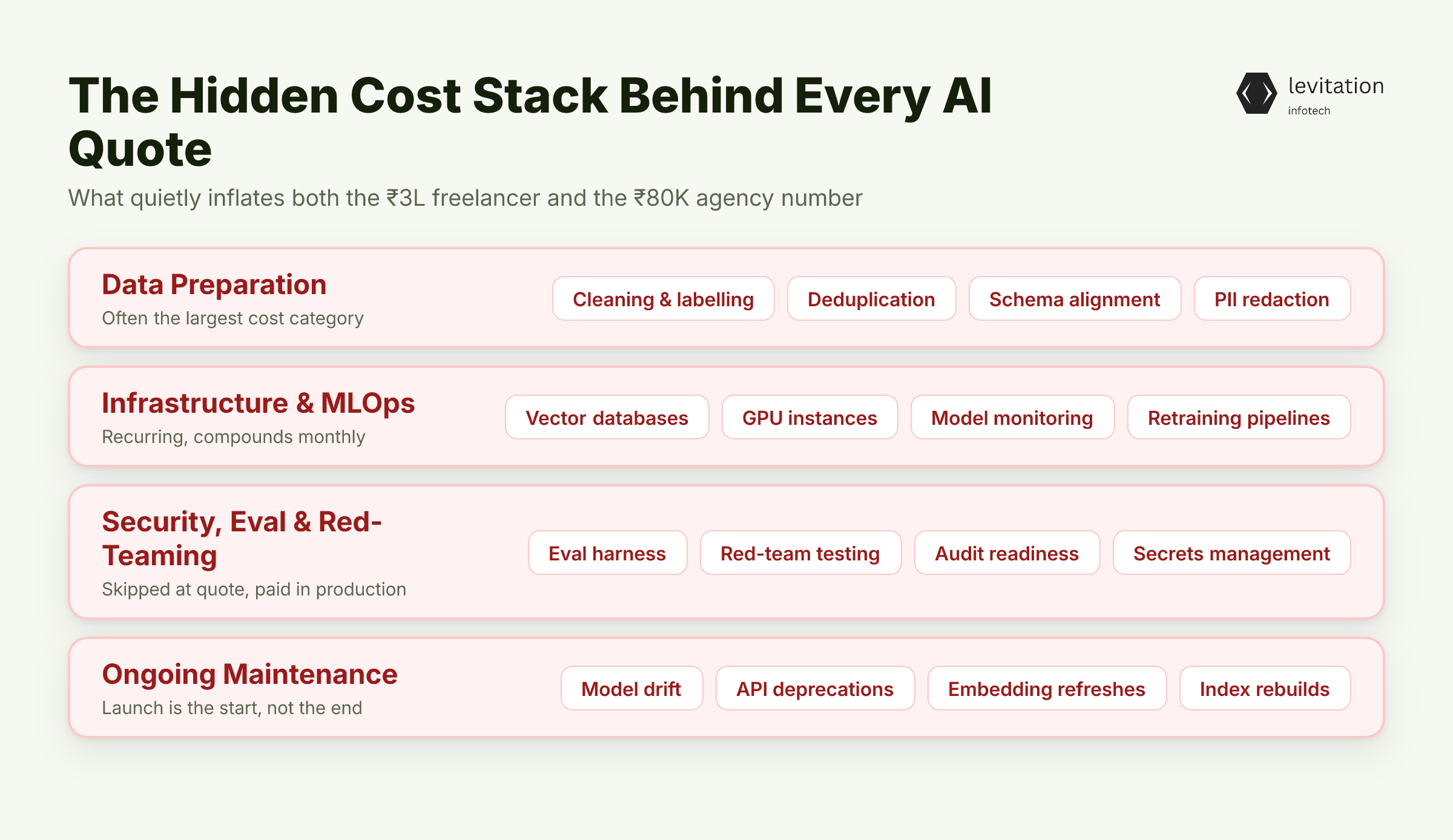
Neither the ₹3L dev nor the ₹80K agency quote usually includes the work that decides whether the project ships. Here is what shows up in month three on every honest AI project.
The data preparation tax. Data work covers cleaning, labelling, deduplication, schema alignment, and PII redaction. It routinely becomes the largest cost category in any real AI build. Raw enterprise data almost never arrives ready for model consumption. If your quote does not have a line item for this, it is missing the largest cost category in the build. The hidden costs in Noida software quotes pattern holds for AI work too.
Infrastructure and MLOps overhead. Vector databases, GPU instances, model monitoring, retraining pipelines, secrets management. Each of these carries a recurring cost that compounds month over month. Skipping this layer means you will rebuild it under pressure after the first production incident.
Security, eval, and red-teaming. Skipped at quote time, paid for in production incidents. Founders who skip the eval layer have either rolled back almost immediately or shipped a model that failed its first external audit. Eval is not a polish step. It is the difference between a demo and a deployable system.
Maintenance is not optional. Models drift. APIs deprecate. Embedding models get superseded and your vector index quietly breaks. The "done" date is closer to the "start of ongoing cost" date. Plan for a build AI engagement that includes a maintenance runway, not just a launch.
Forget vendor pitches for a minute. You can run this decision in your own head in fifteen minutes using just the three filters and a calculator.
The 15-Minute Decision Framework for Noida Founders
You do not need a consultant. You need a pen and four numbers.
Step 1: Rate your data readiness on a 1-5 scale. Score 1-2: agency. Score 3: depends on the other filters. Score 4-5: in-house is defensible. Be ruthless.
If your data lives in five places and no one owns the schema, it is a 2.
Step 2: Write down your production deadline in months. Under 4: agency. 4-9: depends on compliance and data. Over 9: in-house starts to make financial sense. This is especially true if cycle time, not salary, is your real constraint.
Step 3: Identify your compliance surface. Anything touching finance or health should default to a vetted AI development company in India with named, auditable references. Do not negotiate on this. A budget pilot that balloons to reach production usually signals a compliance gap, not a vendor problem.
Step 4: Add the hidden-cost line items. Data prep, infra, MLOps, eval, maintenance. Add them to both options and compare the all-in 6-month number. That is the real AI development cost India calculation. The salary gap shrinks once you do this honestly.
And when the framework points to an agency, here is what a clean outcome looks like six months in.
What 'Right' Looks Like Six Months Later
Right-decision founders ship a production model in a compressed window instead of burning a year on a solo ramp-up. Capital is preserved for sales and distribution rather than sunk into a long in-house build cycle.
The path stays reversible. An agency-built MVP can be handed to a small in-house team for iteration once revenue justifies the salary line.
If you are still unsure, a low-cost AI consulting engagement is cheaper than a 6-month commitment in either direction. It also pressure-tests the filters above with real data. The gap between a cheap pilot and a production build is almost always discovered in those first few weeks.
The Noida founders who ship are not the ones who picked the cheaper option. They are the ones who picked the option that matched the shape of their problem: data readiness, deadline, and compliance. They accepted that the gap between the quote and the invoice is where the real decision lives. A credible partner compresses the deployment window by running already-formed teams in parallel, while an in-house cycle from a blank slate pays the ramp-up cost in serial handoffs. Pick the engagement model that matches your project shape and the rest will follow.
Frequently Asked Questions
Is it cheaper to hire AI developers or an agency in India?
On paper, a dedicated developer at ₹3L/month is cheaper than a full agency team. Once you add data preparation, MLOps, and infrastructure, the all-in cost gap closes. The agency ships faster.
How much do AI development services cost in Noida for a startup?
Production-grade MVPs through credible agencies are priced for the full four-role team, not the quoted retainer. Timelines are dictated by data readiness and compliance surface. In-house setups pay the same line items but stretch the calendar because the work runs serially behind one hire.
When does it actually make sense to hire a dedicated AI developer instead of an agency?
Hire in-house when you have clean data, a relaxed timeline (9+ months), and no regulated use case. A senior engineer should also be ready to mentor the new hire. In every other case, an agency is the lower-risk path.
What should I look for in an AI development company in India?
Look for prior production deployments, not just demos. Ask for named-team transparency, a fixed-scope pilot before a retainer, and evidence of work in your compliance domain. Fintech and health buyers should specifically ask for regulated-system references.
How long does it take to build an AI product with an Indian agency?
A focused MVP ships faster with a competent agency. Parallel workstreams are already staffed. A solo in-house team pays the ramp-up cost in serial handoffs from a blank slate.
Sources
Research and references cited in this article:
- AI Development Cost: A Complete Pricing Guide (2026)
- How Much AI Development Cost in 2026: Prices & Key Factors
- 07 Key Factors Influencing AI Development Costs in 2026 - Deha Global
- AI Development Cost in 2026: Key Factors and Insights
- AI Development Cost in 2026: Complete Pricing Guide
- Why India Has an “Unfair Advantage” in the AI Startup Race | ft. Antler
- Medium
- Should You Build In-House or Hire an AI Software ...
- I won't hire a developer who uses AI. (especially a Junior developer) After years of building my own Software and hiring many developers, I can with 100% confidence say that AI makes you a worse… | Igor Kudryk | 38 comments
- #Podcast: #AI #Hiring Explained: How to Choose the Right AI ...
- How? Vs What? : r/ENGLISH
- HOW Definition & Meaning
About the author
Mayank Singh is a software developer at Levitation Infotech, where he builds web and AI-powered applications across the company’s fintech, healthcare, and enterprise projects.