


TL;DR: Custom CRM builds for Indian mid-market SMEs land in the ₹5-20 lakh range, with ₹6 lakh at the lower end. But the quote most vendors hand over only lists half the work. Data cleanup, compliance configuration, workflow re-engineering, and integration wiring arrive as change orders after the contract signs. What the hidden half contains, how to budget for it before signing, and when a custom CRM actually beats Zoho on three-year TCO.
Key Takeaways: - The ₹6 lakh figure covers visible line items (UI, core modules, hosting). The hidden half (data migration, compliance, training, integrations) adds real cost on top. - Zoho's $14-$52 per-user-per-month range creates a wide pricing spectrum. At 50 users on Enterprise tier, three-year subscription cost far exceeds a custom build. - Vendor quotes under ₹4 lakh for a 50-user migration always push the hidden half into post-signing change orders. - Custom CRM wins past 30 users, with compliance burden, or deep Tally/WhatsApp/IndiaMART integration. It loses under 20 users with commodity sales processes.
The ₹6 Lakh Figure Is Real. The Math Behind It Isn't.
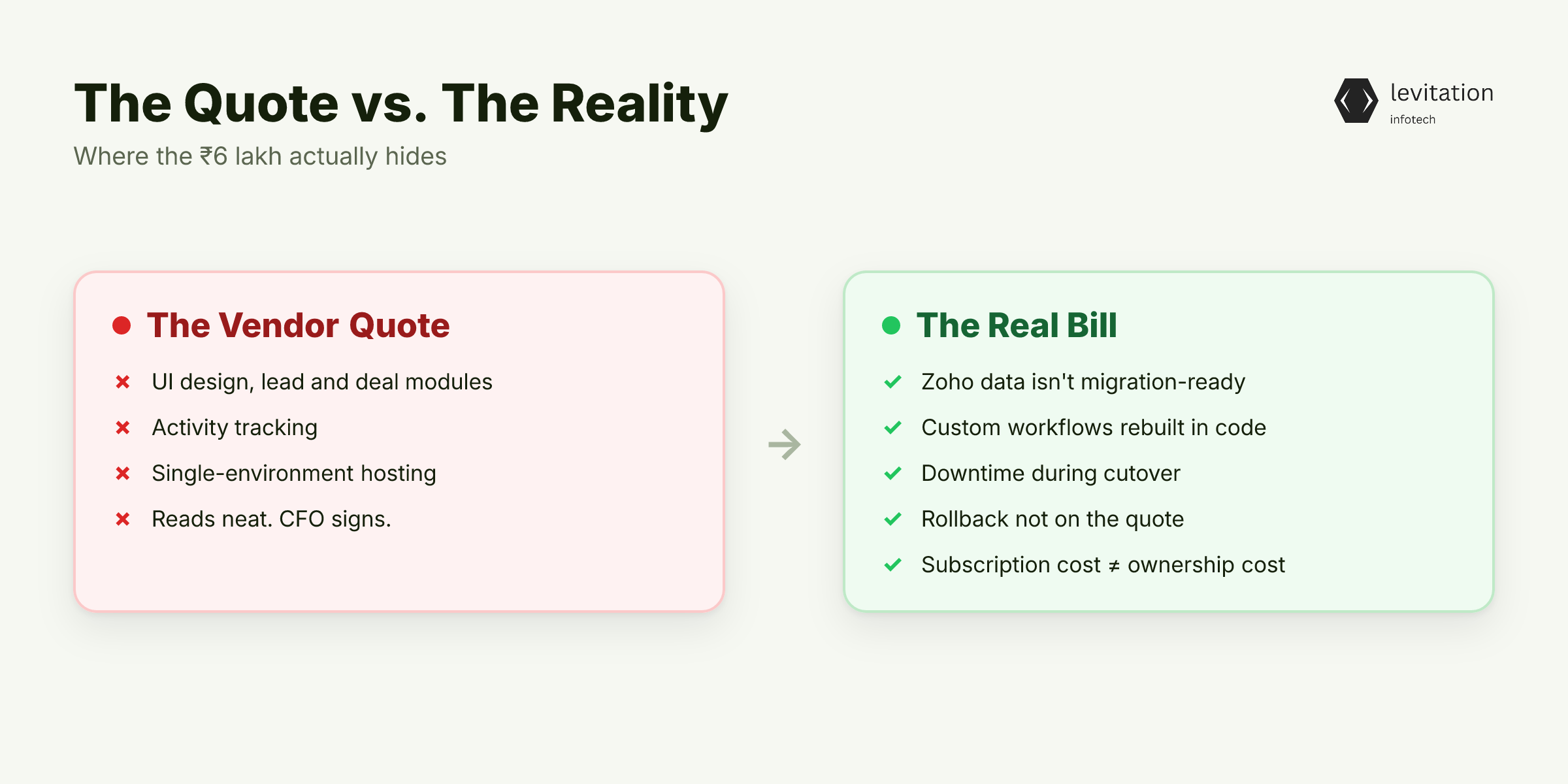
Zoho's ₹1,400-per-user sticker price at the low end looks like a bargain. Then you try to force it to handle GST workflows, Tally syncs, and your sales team's actual quote-to-cash process. The real bill arrives: ₹6 lakh to leave, with half of it unbudgeted.
The ₹6 lakh figure isn't a scare number. It sits in the lower portion of the real range for custom CRM builds in India. The spread runs from ₹5 lakh for a lean 30-user system to ₹20 lakh for a fully integrated mid-market deployment with compliance layers.
What makes it dangerous is what isn't in the number. Most vendor proposals break the visible work into clean line items: UI design, lead and deal modules, activity tracking, single-environment hosting. The invoice reads neat. The CFO signs.
Then the project starts, and the real work surfaces. The invisible work lives in three places.
Your Zoho data isn't migration-ready. CSVs export with broken relationships, custom-module records get orphaned, and attachments vanish. Your 18-stage approval flow built in Zoho Blueprint doesn't port. Canvas layouts don't transfer. You rebuild the workflow in code.
Downtime during cutover isn't on the quote either. Neither is the rollback when something breaks at go-live.
The trap is psychological. Zoho's $14-$52 per-user-per-month subscription feels cheap. You budget against that monthly line, and the custom build quote feels like a step-change.
But subscription and ownership aren't the same thing. The typical CRM development cost in India includes things Zoho billing never covers: data ownership, workflow fit, and integration depth.
Most articles answering "Zoho alternatives" push you toward another SaaS: HubSpot, Salesforce, Pipedrive, Freshsales. That's the wrong debate for the Indian SMEs paying that hidden bill.
Why Every 'Zoho Alternatives' List Gets the Indian SME Wrong
Search "Zoho alternatives" and you get the same five names: HubSpot, Salesforce, monday.com, Pipedrive, Freshsales. They're all built for Western RevOps teams.
None of them solve what actually breaks the Indian mid-market CRM rollout. The pain points look different here.
Your sales team works leads out of IndiaMART and WhatsApp, not LinkedIn sequences. Your finance team reconciles every deal against Tally Prime and GST field mappings. Your support team takes calls in Hindi, Tamil, and Marathi.
Your pipeline reports need to roll up by region, not just by stage. Western SaaS was designed for none of this.
Per-user licensing makes the math worse. Zoho Enterprise at $52 per user per month, multiplied by 50 seats, hits $31,200 a year. That's before you add Campaigns, Desk, or Books. Over three years, that subscription cost far exceeds a custom CRM development project.
You still don't own the data, the workflow logic, or the integration layer.
The real issue is the framing. Switching SaaS doesn't remove the customization bill. It relocates it. Each SaaS platform has its own enterprise customization tier that carries a similar hidden migration layer underneath.
HubSpot and Pipedrive, like most Western SaaS, weren't designed for GST or Tally sync, so those integrations require middleware or custom work that adds recurring cost.
If swapping SaaS doesn't remove the hidden half, what is that hidden half actually made of?
The Hidden Half: 5 Costs That Never Make the Quote
Five items consistently show up after the contract signs, not before. Knowing them in advance is the difference between a ₹6 lakh project and one that lands closer to twice that.
1. Data migration and deduplication. Zoho exports CSVs with broken relationships, custom-module orphans, and lost attachments. Your Contacts table has duplicates from three different lead sources. Cleaning this takes a large share of total project hours and rarely appears as a separate line item. Vendors price it as "data setup" and lump it into discovery.
2. Workflow re-engineering. Zoho's Blueprint automations and Canvas layouts don't transfer. Your 18-stage approval flow, with its conditional branches and SLA timers, must be rebuilt in code. Drag-and-drop doesn't survive the migration. This is the single biggest source of scope creep in full cost of CRM development in India projects.
3. Compliance configuration. Healthcare and finance teams add 20-30% on top of base cost for HIPAA field masking, audit logs, and RBAC. This is non-negotiable for regulated industries. Vendors who skip this in the quote aren't being generous. They're planning a change order.
4. Training and change management. A new CRM with familiar data breaks rep muscle memory. Budget for a supervised adoption window measured in weeks, not days. Without it, expect sharp utilization drops in month one as reps revert to spreadsheets.
The CRM software development vendor's job isn't done at go-live. It's done when adoption holds.
5. Integration debt. Tally Prime sync, payment gateways, WhatsApp Business, IndiaMART, and email tools each add integration work. Cost scales with the number of systems and the depth of two-way data sync required. The quote rarely lists all of them. By month two, "one more integration" is the most expensive sentence in the build.
For finance SMEs, the cost of getting compliance wrong isn't a fine. It's a license. That asymmetry shows up in how the partner prices the audit-log and RBAC work in the first proposal, not the third.
Once you know what's hiding inside the quote, the next question is: what does a clean ₹6 lakh project actually include?
What ₹6 Lakh Actually Buys (And What It Doesn't)
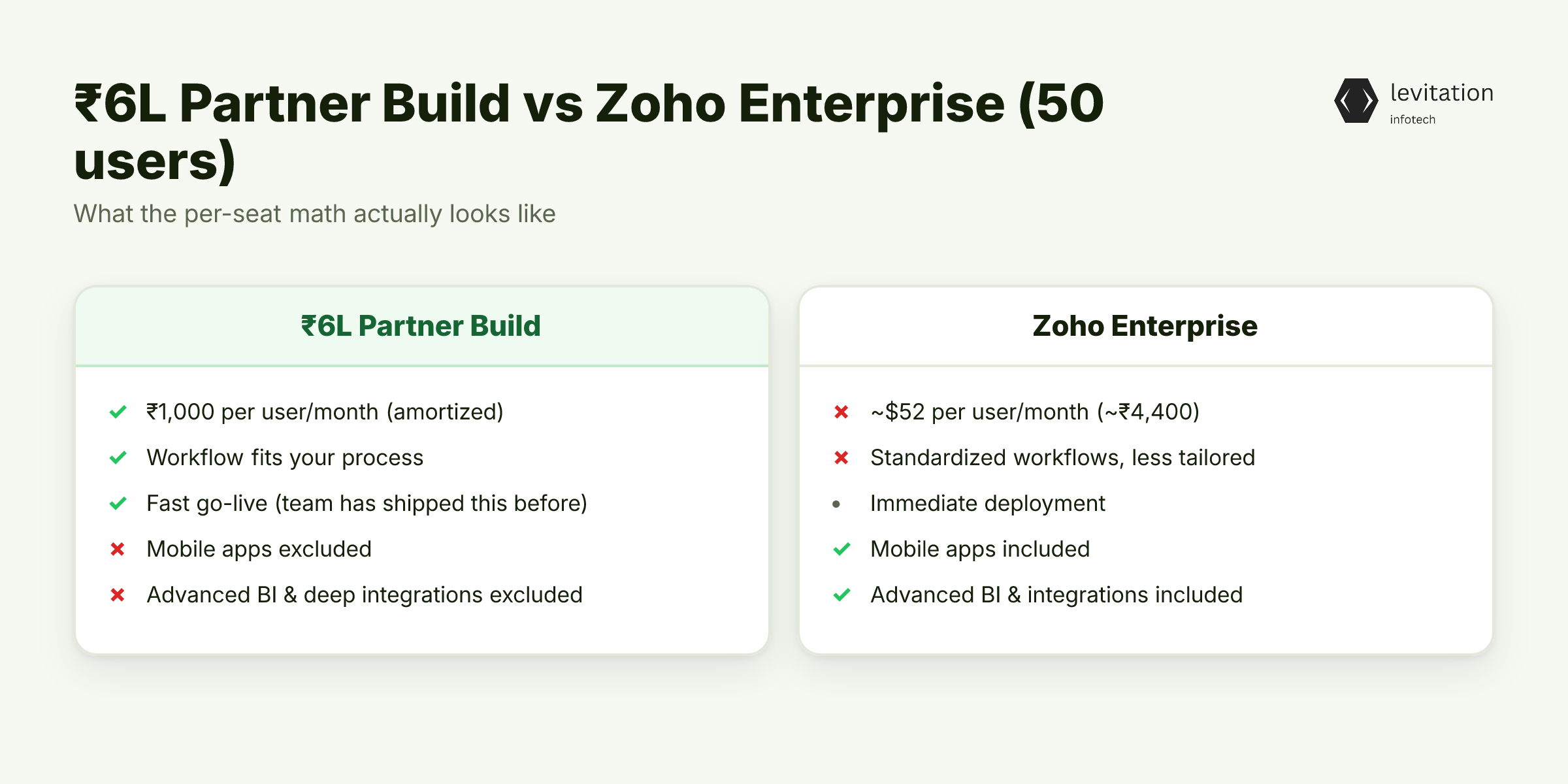
A clean ₹6 lakh project at a partner-led delivery shop buys you the visible work: discovery, UI build, core modules (leads, deals, contacts, activities), basic reporting, and single-environment hosting. The build lands fast because the team has shipped this scope before.
What it typically excludes: mobile apps, advanced BI dashboards, custom integrations beyond 2-3 systems, and any post-launch SLA beyond 30 days. Quotes that promise all of this for ₹6 lakh are either cutting corners or planning to renegotiate mid-build.
The speed line item is the one most SMEs undervalue. Partner-led delivery compresses the timeline from discovery to go-live because the team has solved the same problems before.
In-house teams building from scratch typically take far longer because they underestimate data migration and workflow re-engineering. The difference isn't cosmetic. It's the cost of carrying your old CRM and losing sales velocity during the overlap.
Run the per-seat math. At 50 users, a ₹6 lakh build amortizes to ₹1,000 per user per month over 12 months. Zoho Enterprise at $52 per user per month is about ₹4,400 per user per month at current rates. The custom build undercuts Zoho Enterprise within year one, even before you count recovered staff hours from a workflow that actually fits.
The top CRM development companies in India will itemize the visible work. The CRM implementation partners worth hiring will itemize the hidden half in the same proposal. Quotes under ₹4 lakh for a 50-user mid-market migration usually mean the hidden work is being pushed into a change order after the contract signs.
That isn't a discount. It's deferred billing with a premium. The pattern is consistent enough that under-₹4 lakh quotes are a reliable warning sign for budget overruns in Indian CRM projects.
A quote that itemizes the hidden half is only useful if the vendor can actually deliver it.
How to Read a CRM Migration Quote Like an Auditor
Three red flags separate a real proposal from a sales document.
Red flag 1: Fixed-price quote with no discovery phase. Real migration scope can't be priced before data is sampled and workflows are mapped. A vendor who quotes ₹6 lakh flat without seeing your Zoho instance, your Tally schema, or your approval flow is guessing. Guesses become change orders.
Red flag 2: "Data migration" as one line item. No mention of deduplication, attachment handling, or rollback strategy. Data migration is where the project lives or dies. One line item means the vendor hasn't thought it through, or they have and don't want you to see the number.
Red flag 3: No mention of compliance artifacts. For finance and healthcare deals, explicit reference to audit logs, role matrices, and field-level masking should be in the proposal. Their absence means compliance is a future conversation, and future conversations cost more.
Three green flags to look for instead. Phased delivery with UAT gates, where the vendor commits to a working slice before the next payment triggers. Explicit compliance artifacts listed with named deliverables. A post-launch warranty clause that defines what's covered and what isn't.
The question to ask every vendor: "What does the warranty cover, and what is your average post-launch change-order rate?" If the vendor hedges, the original scope was under-scoped. The CRM development companies in India who've survived compliance audits will answer this in percentages. Those who haven't will hedge.
The signal worth looking for is depth of regulated-industry deployments. Vendors with a long track record of enterprise rollouts under compliance audit have a pricing reflex that surfaces audit logs and RBAC work in the first proposal. It's muscle memory from surviving the audits, not a marketing claim.
When evaluating Zoho implementation partners, the difference between a vendor who's done the work and one who just claims it is visible in the first three pages of the proposal.
After filtering on those signals, only the math remains: does a custom build actually beat Zoho over three years?
When Custom CRM Beats Zoho - and When It Doesn't
Custom CRM wins when you cross three thresholds at once. First, headcount past 30 users, where per-seat SaaS licensing starts compounding faster than build cost. Second, a compliance burden. Finance, healthcare, or any workflow that needs audit-grade traceability. Third, integration depth that SaaS can't reach: Tally Prime, IndiaMART ingestion, WhatsApp Business API workflows, regional language support.
Custom CRM loses when you sit under 20 users, carry no compliance burden, and run a commodity sales process with no in-house technical owner for the build. In that case, Zoho Enterprise is the right tool and building custom is a waste of capital.
The break-even math is straightforward. At 30+ users with regulated workflows, professional services fees recover in 6-9 months through recovered staff hours and reduced per-seat licensing. The math to pressure-test: take your current per-seat spend, multiply by 36 months, and compare that to a custom build plus three years of hosting and maintenance.
If the gap is wider than 40% in favor of custom, the build wins on TCO. If it's narrower, SaaS is the cheaper call.
What changes when you get this right: data ownership, workflow fit, no per-seat tax, and a system that improves as your process does. Not one that fights it. The CRM application development decision isn't about features. It's about whether your sales process gets a system shaped to it, or whether your process gets squeezed into someone else's template.
The year-two bill that kills custom CRMs is real, but only when the original scope was under-scoped, not when the build was sized right from day one.
Frequently Asked Questions
How much does it cost to migrate from Zoho to a custom CRM in India?
For Indian SMEs in the 30-100 user range, a custom CRM migration typically lands between ₹5 lakh and ₹20 lakh. The ₹6 lakh figure covers core modules, basic integrations, and partner-led delivery, but the real total reaches twice that once data cleanup, compliance configuration, and training are added in.
Is a custom CRM actually cheaper than Zoho over 3 years?
At 50 users on Zoho Enterprise at $52 per user per month, licensing runs about ₹26-27 lakh per year. A custom build in the ₹10-15 lakh range plus annual hosting and maintenance breaks even within the first year and cuts costs by year three. The math flips against custom CRM below 20 users, where subscription cost per seat is the dominant line item.
How long does a Zoho-to-custom-CRM migration take?
Most partner-led migrations run 10-16 weeks from discovery to go-live, assuming clean data on the source side. Add 4-8 weeks when the Zoho instance has heavy customization or high attachment volume. The phase that always runs long is data cleanup, not the build itself.
What are the hidden costs of CRM migration that vendors don't quote upfront?
Five items rarely appear in the initial quote: data deduplication and migration cleanup, workflow re-engineering (Zoho's Blueprint and Canvas don't port), compliance configuration (20-30% extra for healthcare/finance), rep training and change management, and integration wiring for Tally, WhatsApp Business, payment gateways, and IndiaMART. Together these add real cost to the visible line items.
Should an Indian SME pick a custom CRM or a Zoho alternative like HubSpot?
It depends on workflow complexity and compliance exposure. If your sales process is a standard pipeline with no GST, Tally, or regulatory layer, a SaaS alternative like HubSpot or Pipedrive is faster and cheaper. If you need deep workflow customization, regional integrations, or audit-grade compliance, a custom CRM built by a CRM development company in India usually wins on total cost of ownership within 24 months.
Run the TCO math with a partner who has shipped under compliance audit, and the right call usually surfaces on its own.
About the author
Mayank Singh is a software developer at Levitation Infotech, where he builds web and AI-powered applications across the company’s fintech, healthcare, and enterprise projects.