


TL;DR: Most ₹5 lakh "AI agent" builds are Zapier workflows in disguise. They have a trigger, an LLM call, a fixed sequence, and a Slack ping sold as intelligence. There's one architectural test that separates a workflow from an agent. After a tool returns output, does the system choose its next step, or is the next step already wired? Real agents reason, carry memory across calls, and pause for human approval. A budget that funds that looks very different from one that pays for three workflow nodes.
Key Takeaways: - The "AI agent" you bought is probably trigger -> LLM call -> next step, with the path fixed before runtime. - A real agent decides its next action based on the previous tool's output, not a predetermined DAG. - Memory across tool calls, human-in-the-loop approval, and an evaluation harness are what separate a production agent from a Zap with an AI node.
The ₹5 Lakh Agent That's Actually Three Zapier Steps
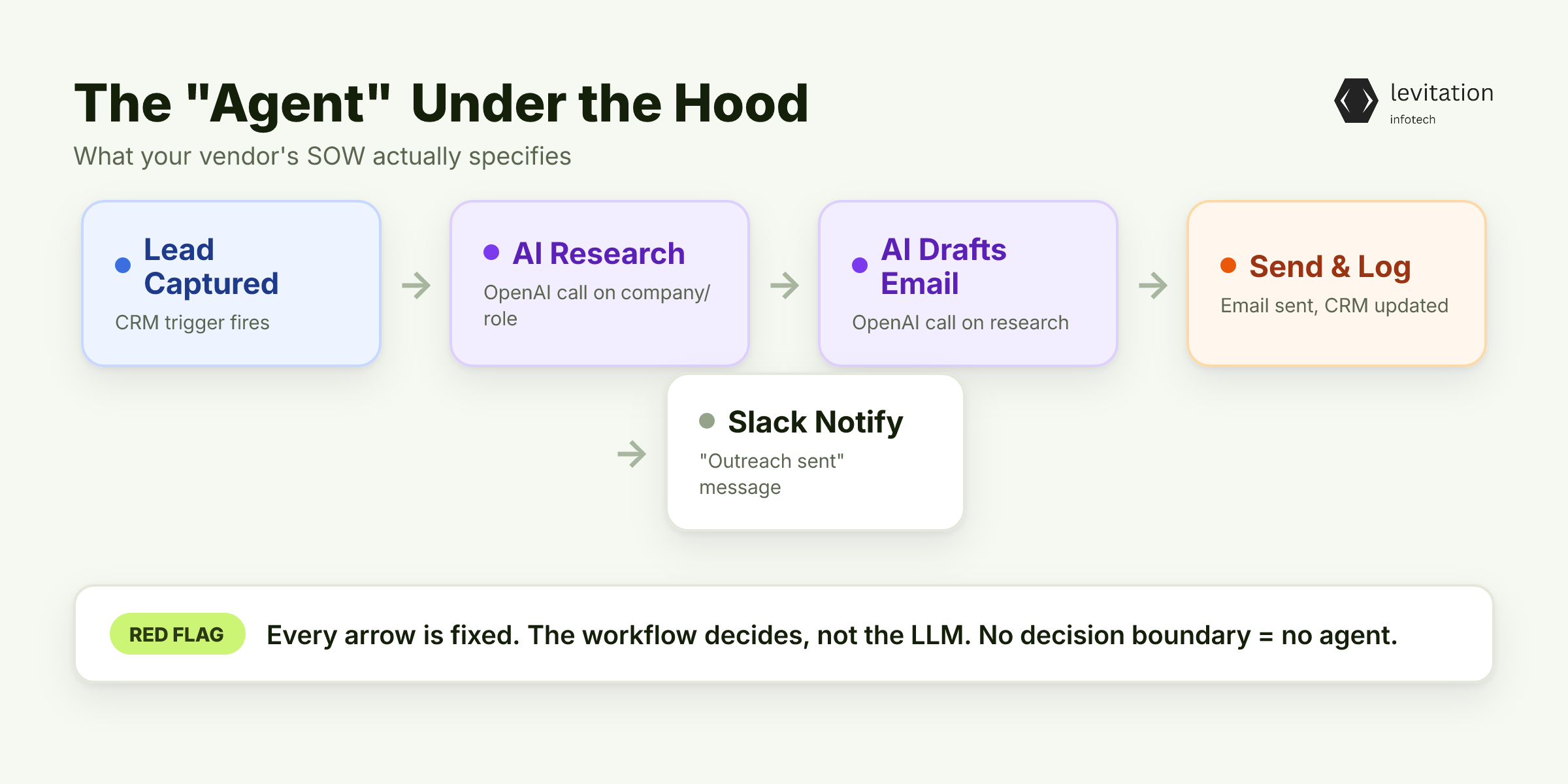
Your vendor signed an SOW for an AI agent. The deliverable is a Zapier zap with an OpenAI call in the middle and a Slack notification tacked on for "intelligence."
That's the pattern flooding the AI development services market right now.
Lead source fires. AI researches the prospect. AI drafts personalised outreach.
Zapier pushes email and updates the CRM. The vendor's deck says "autonomous." The implementation says trigger, step, step, step.
The Zapier community itself documents this exact pattern. A community thread titled "How are builders combining AI agents with Zapier workflows" lists lead source to AI research to AI outreach to email to CRM updates as the first example. The post notes that "building a Zap with an AI step in between is the way to go."
The AI agent pitch your CTO signed off on is a documented workflow pattern, not a new architecture.
Here's the implementation in plain English:
Every arrow is fixed. The LLM writes text, but the workflow decides what to do next. There's no decision boundary.
The intelligence is cosmetic. The same pattern keeps showing up across chatbot-quote-as-agent proposals.
For CTOs evaluating AI development services, the first red flag is when the deliverable list contains workflow steps instead of decision boundaries.
If your vendor's SOW reads "set up triggers, wire up OpenAI, configure CRM update step, add Slack notification," that's an automation. You paid for an automation, not an AI agent.
The obvious instinct is to blame the tool. But switching to a "more powerful" platform is exactly where the second trap lies.
Why 'Just Switch to n8n or Make' Is a Trap
The tool isn't the problem. The architecture is.
A linear sequence of steps, where the LLM is one step among many and not the decision-maker, fails the same way no matter the platform. It fails on Zapier, on n8n, on Make, on Power Automate.
Move the same flow to n8n. Move it to Make. Move it to a custom Python DAG.
The AI call is still sandwiched between deterministic triggers. The platform doesn't change the fact that the next step is wired before the model ever runs.
These platforms all market "AI agent" features now. n8n has AI nodes, Make has AI modules, and Power Automate has AI Builder.
But the AI steps are still bounded. They call a model, return text, and hand control back to the next node.
The LLM doesn't pick the next action. The developer did, in the canvas.
The top generative AI companies in India have flooded the market. Vendors rebrand deterministic flows and call them agentic systems.
The slide deck says "agentic AI." The code says "if response, then update CRM."
Those are two different things. The gap between them is where your five lakh rupees quietly disappears.
A real workflow tool is fine for what it does. Trigger to step to step to step. The problem starts when someone sells you a workflow and calls it a decision-making system.
That mismatch is the trap. The vendor's stack isn't broken. Their architecture never matched the claim.
The Single Test That Separates a Workflow From an Agent
The test: after a tool returns output, what happens next? Does the system choose its next step based on that output, or is the next step already fixed?
A workflow has a predetermined path. A to B to C, always, in that order, regardless of what B returns.
An AI agent receives tool output, reasons about it, and decides what to do next. It can call another tool, ask for clarification, or stop.
1# Workflow: path is fixed at build time2def run(lead):3 research = call_tool("research", lead)4 draft = call_tool("draft_email", research)5 send_email(draft)6 update_crm(lead)78# Agent: path is decided at runtime9def run(lead):10 research = call_tool("research", lead)11 if not research["found_role"]:12 return ask_human("Role unclear. Confirm?")13 tone = "executive" if research["seniority"] == "C-suite" else "standard"14 draft = call_tool("draft_email", research, tone=tone)15 approval = post_to_slack(draft, research)16 if not approval["approved"]:17 return revise(approval["feedback"])18 send_email(draft)
The difference is the if-statements. In a workflow, the developer wrote them. In an agent, the model reasons about them at runtime.
Same tools, same APIs, completely different architecture.
Memory is the second tell. Agents carry state across tool calls. They remember what the CRM returned when the email tool runs.
Workflows pass tokens between steps and forget.
Approval gates are the third tell. A real agent pauses for human review when uncertain. A workflow fires and forgets, then alerts you after the damage is done.
The agent decides when to ask. The workflow sends the email and pings Slack to say it did.
This is why the audit trail goes dark on workflow "agents". The LLM wrote text, but nothing about the decision is replayable.
Run these three checks against any AI development services proposal and the gap shows immediately. The vendor's pitch deck rarely survives contact with this test.
Anatomy of a Real Agent: The Lead-Research Build
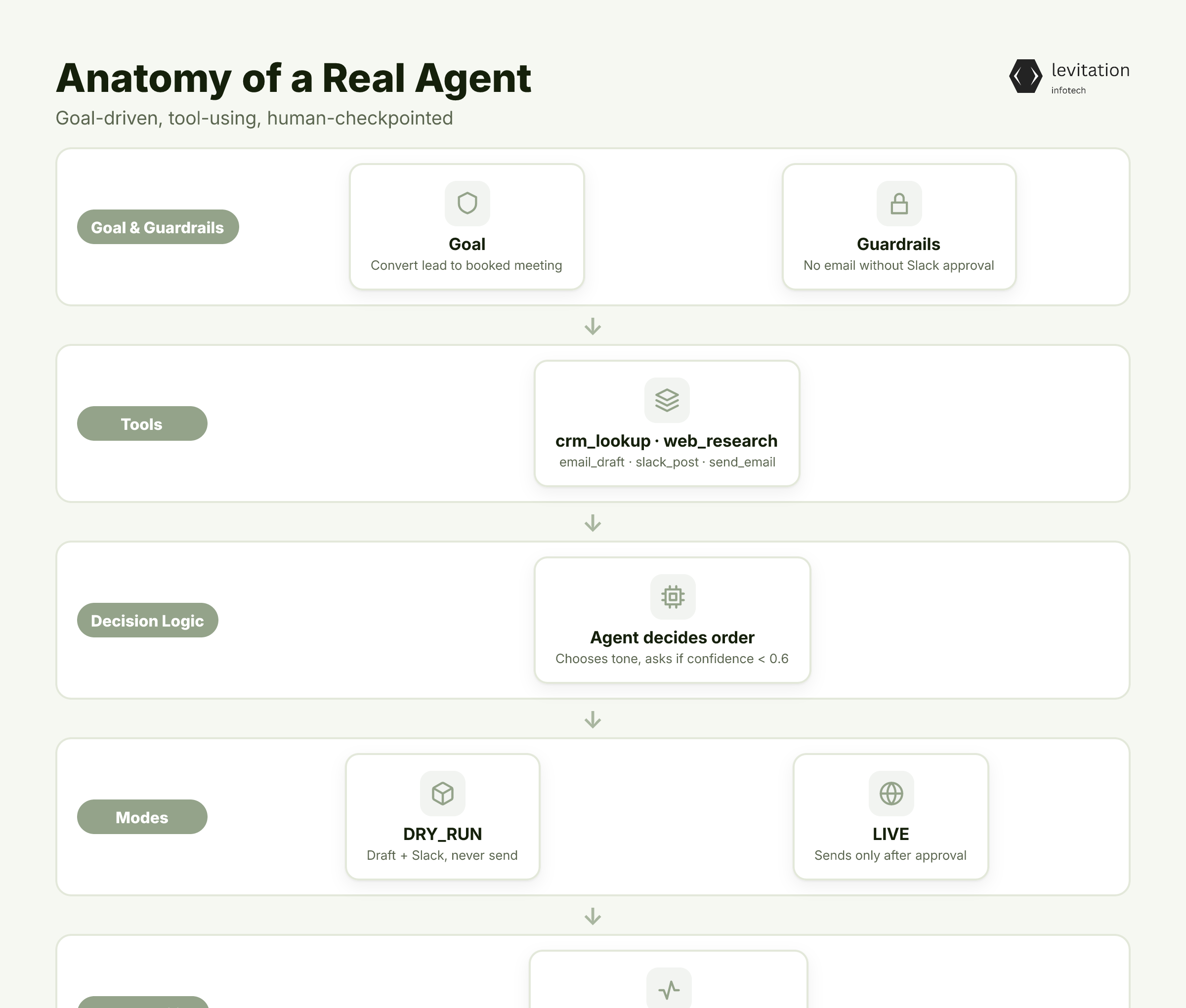
The actual instruction to a real agent: "When a new lead arrives, research the prospect and draft personalised outreach. Then post to Slack for approval before sending any email."
Notice the structure. One goal, one instruction set, multiple tools, and a hard human checkpoint before any external action.
The Slack post must include the company, role, and research summary. The approver gets full context, not a "Sent!" notification after the fact.
The architecture:
1agent:2 goal: "Convert new lead to booked meeting"3 tools: - crm_lookup - web_research - email_draft - slack_post - send_email4 guardrails: - "Never send email without Slack approval" - "Stop and ask if research confidence < 0.6"5 memory: persistent across session and across leads6 observability: log every tool call, decision, prompt, response7 modes: - DRY_RUN: draft, post to Slack, never send - LIVE: same flow, sends after approval
Tools are connected. CRM, email, Slack, web research. But the agent, not the workflow, decides when to call each one.
The agent also decides the order, based on what it learned in the previous step. If the research returns a C-suite contact, the agent picks an executive tone. If the research is thin, the agent asks the human instead of guessing.
A DRY_RUN mode is built in from day one. The agent drafts and posts for review but never sends. You graduate to live mode only after the quality holds up across hundreds of runs.
No vendor "launches" a real agent into live mode on day one. The companies shipping custom AI development for production treat DRY_RUN as the default state, not an afterthought.
Every tool call, every decision, every prompt, every response is logged. This is what makes the system auditable. You can replay any lead's journey through the agent and see exactly why it sent or didn't send.
That replay trail is what production-grade AI agents require. It's the deliverable that separates an AI agent development company from a workflow reseller.
Which raises the question the SOW never answers: where does the five lakh actually go, and where should it?
What Your ₹5 Lakh Should Actually Buy
A real agent build takes time. The engineering that separates it from a workflow doesn't compress into a single sprint. That work includes the evaluation harness, tool integration with retry logic and idempotency, observability wiring, and human-in-the-loop design.
The AI development cost reflects that engineering depth. Vendors shipping production agents price accordingly.
Workflow packages advertise a two-week timeline. Production agent builds don't fit that box.
Where the budget should go: - Scoping the decision boundaries: what the agent decides, what requires human approval, what it must never do. - Tool integration with proper auth, retry logic, and idempotency so a Slack timeout doesn't double-send an email. - Evaluation harness: a test suite that runs hundreds of lead scenarios through the agent and scores the output. - Observability wiring: structured logs, traces, decision replays. - Human-in-the-loop approval flow: Slack integration, review UI, rollback path.
Where the five lakh usually goes wrong: - A "build" with no evaluation harness. - No observability. - No rollback path. - No post-launch support contract. - A "delivery" that hands over a Zapier flow with three extra steps.
When a workflow "agent" hits its first edge case, the vendor opens a change request. The fixed bid gives way to hourly rates that the original quote never mentioned.
The differentiator among vendors isn't headline price. It's whether the proposal names the decision boundaries, the evaluation criteria, and the human-in-the-loop checkpoints up front. It's also whether those line items appear later as scope creep. If the proposal doesn't name them, the build will surface them as change requests later.
What Changes When You Get This Right
The architecture shift: from "AI step inside a workflow" to "agent deciding which workflow to run." That's the difference between a demo and a system that survives contact with real data.
Real agents handle edge cases by design. They escalate when uncertain. They log every decision.
They can be audited, replayed, and rolled back.
That engineering discipline underpins AI development services for systems still running in production long after deployment.
For the CTO, the practical payoff is a system you can explain to your board, to your security team, and to your auditor without a demo script.
The AI agents you ship stay in production because the architecture supports evaluation, rollback, and human-in-the-loop. They don't rely on a chain of LLM calls alone.
That's the bet. Architecture, not workflow.
Frequently Asked Questions
What is the actual cost of building a real AI agent in India?
A production-grade AI agent build takes longer than a workflow automation. It includes tool integration, an evaluation harness, observability, and human-in-the-loop approval.
The depth of work drives the cost above what a workflow package charges. The engineering involves reasoning loops, not fixed steps.
How do I tell if my vendor's 'AI agent' is actually a Zapier workflow?
Ask one question: after the AI step returns output, what happens next? Does the system choose its next action based on that output, or is the next step already fixed?
If the path is predetermined, it's a workflow. If the system reasons and calls tools in a non-fixed order, it's an agent.
Is Zapier with an AI step an AI agent?
No. Zapier itself documents this pattern as "adding AI to your workflows." The AI is one node in a fixed sequence.
A real agent decides which tool to call next based on prior tool output. It carries memory across calls and includes human-in-the-loop approval before taking external actions.
What is the difference between workflow automation and an AI agent?
Workflow automation follows a predetermined path: trigger, step, step, step. An AI agent receives a goal, reasons about which tools to call, and decides the order dynamically. It handles failures and pauses for human approval when uncertain.
The LLM is the decision-maker in an agent, not a step in a chain.
How long does a real AI agent build take?
A properly scoped production agent takes long enough that the engineering dominates the timeline. Evaluation harness design, tool integration, approval-flow design, and observability wiring all take time. The coding itself is a smaller part of the build.
If a proposal can't pass the runtime decision test, the fix isn't a different tool. It's a different build.
About the author
Mayank Singh is a software developer at Levitation Infotech, where he builds web and AI-powered applications across the company’s fintech, healthcare, and enterprise projects.