


TL;DR: Most "AI agent" quotes from Noida vendors describe chatbots with function calling, not real agents. The difference shows up the moment a workflow deviates from the happy path. CTOs who run three architectural tests during vendor demos will filter out rebranded chatbot quotes before signing anything.
Key Takeaways: - A chatbot with function calling takes a prompt, calls a tool, returns a result. An agent decomposes goals, iterates on failures, maintains state across turns. - Vendors rebrand chatbot builds as agents because the "agent" label commands higher pricing in a market that rewards the term. - Three tests, autonomy, iteration, and state, separate real agents from dressed-up chatbots in under an hour of demo time.
You asked for an AI agent. You got a chatbot with function calling bolted on. Here's how CTOs across Indian delivery hubs are getting pitched the same dressed-up script, and paying agent prices for it.
The Quote That Should've Been a Red Flag
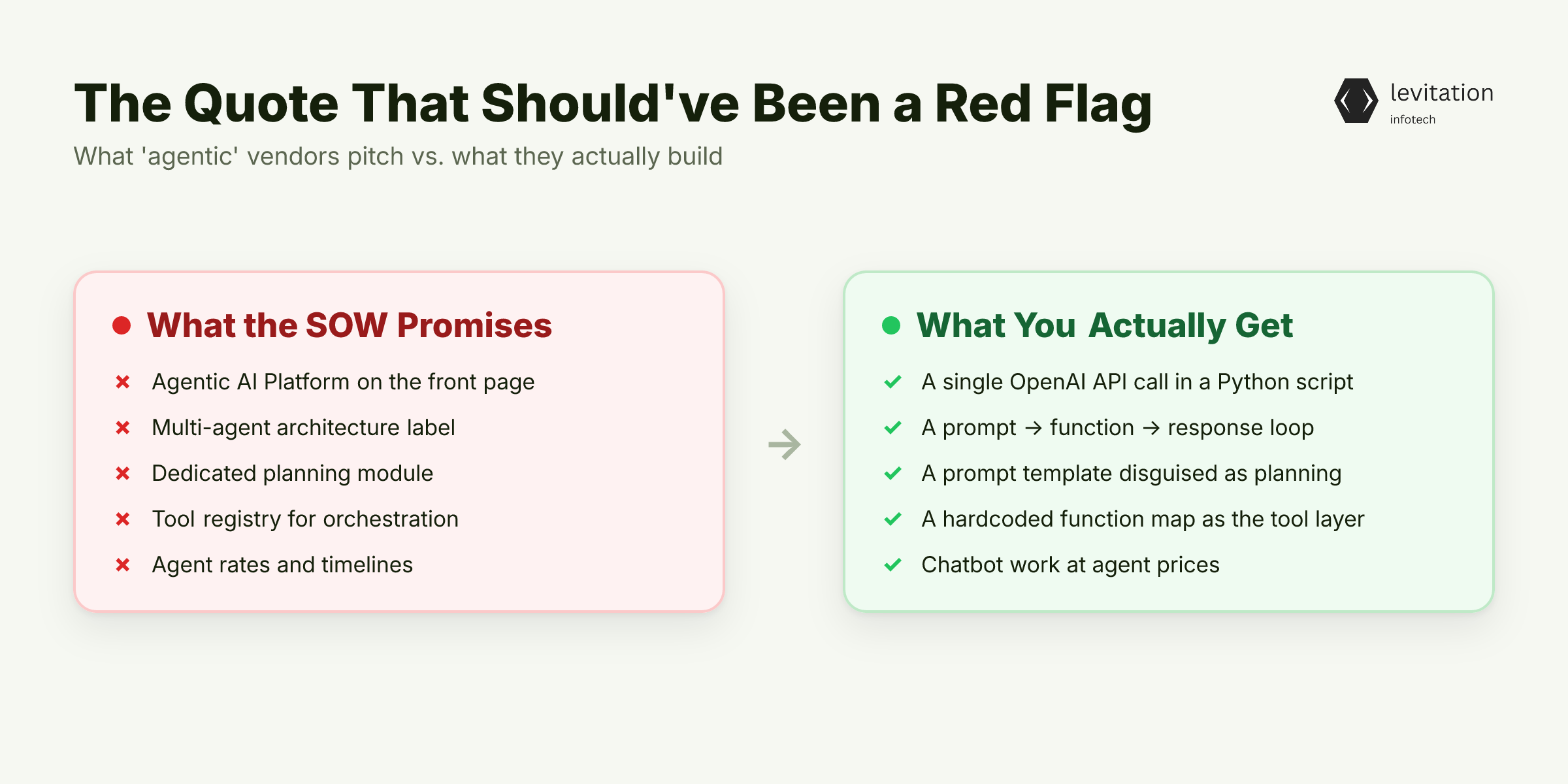
The SOW lands in your inbox at 11 PM. The front page says "Agentic AI Platform." Deeper in, the document says "function calling integration with LLM." Later pages list a single OpenAI API call wrapped in a Python script. You just agreed to pay agent rates for chatbot work.
This pattern shows up in the majority of AI agent quotes from Indian vendors. The pitch deck says "agent." The architecture diagram shows a prompt, a function, and a response loop. That's a chatbot with extra steps.
CTOs sign these SOWs expecting planning, iteration, and stateful reasoning. What they get is a deterministic if/else chain dressed in LLM clothing. The vendor calls it an agent because the term sells. The buyer calls it a win because the term signals innovation. Both are wrong.
The AI development services market has commodified the word "agent" faster than the technology itself has matured. Every mid-size delivery shop now has an "agentic practice." Most of those practices were chatbot teams a short while ago that updated their LinkedIn headline.
The pitch almost always includes the same tells: a "multi-agent" label applied to a single LLM, a "planning module" that's really a prompt template, and a "tool registry" that's a hardcoded function map. None of these survive five minutes of architecture review.
The vendors aren't lying. They believe what they built is an agent. That's the actual problem. So how do you spot one before you sign the SOW?
What 'Chatbot With Function Calling' Actually Means
Strip away the marketing. Here's what runs in production. The system receives a user prompt. It calls a function, maybe an API, maybe a database query, maybe a search. It returns the result.
That's the entire control flow. One input, one decision, one exit. There's no autonomous planning. No iteration on results. No meaningful state across turns.
The system takes your question, picks from a pre-defined function list, and answers. When the function fails, it surfaces the error.
Function calling is real progress over retrieval-only chatbots. It lets a language model interact with external tools, which matters. But it's a tool, not agency. The LLM chooses between pre-defined functions the way a switchboard operator routes calls. It doesn't reflect on whether the chosen tool was the right one.
A true agent decomposes goals, selects tools dynamically, evaluates outcomes, and loops until the task satisfies a defined objective. When evaluating enterprise AI solutions, the distinction matters because production systems fail differently.
Agents need observability for plans, not just for prompts. Chatbots need conversation logs. The infrastructure is different. The on-call rotation is different. The cost model is different.
The deeper trap is that chatbot-with-function-calling demos look impressive. They handle single-step lookups, form fills, and FAQ queries with high accuracy. Buyers see the demo. They assume the architecture will scale to multi-step workflows.
Months later, they discover the system breaks the moment a user steps outside the script. For a sharper breakdown of why demos and production diverge, see how AI agents differ from chatbots in practice.
If the difference is this clear in theory, why does almost every vendor get it wrong in practice?
The Three Tests That Separate Agents From Chatbots
The tests exist. They're diagnosable in a single demo. Run them. - Test 1 - Autonomy. Does the system decompose a high-level goal into sub-tasks without a human writing the decomposition? If a developer hard-coded the task list, it's a chatbot with extra steps. Real agents generate their own plans from a stated objective. - Test 2 - Iteration. When a tool call returns an ambiguous or failed result, does the system reformulate and try again? Chatbots surface the error to the user. Agents recover by selecting a different tool, adjusting parameters, or revising the plan. Recovery is the test. - Test 3 - State. Does the system maintain a working memory that informs later decisions? Or does it reset between turns? Real agents carry context across multi-step workflows. A vector store retrieval is not state. It's a lookup. State implies structured, queryable memory the agent writes to and reads from as it works.
Most systems fail Test 1. Many fail Test 2. Almost all fail Test 3 because developers confuse retrieval with memory.
They point to the vector database and call it state. It's a search index, not a working memory.
If the top generative AI companies in India can't pass these three tests live, walk away. The firms that pass will show you the architecture without being asked.
You also need to look at observability. A chatbot logs prompts and responses. An agent must log plans, tool selections, intermediate state, and recovery decisions. If the vendor's dashboard only shows conversation threads, the system isn't an agent.
The gap between these two observability surfaces is the gap between a demo and a production system. For what production observability actually requires, see why agent audit trails go dark the moment a tool is called.
So the tests exist. The pattern is diagnosable. Why are delivery hubs flooded with disguised chatbots?
Why the Market Is Drowning in Fake Agents
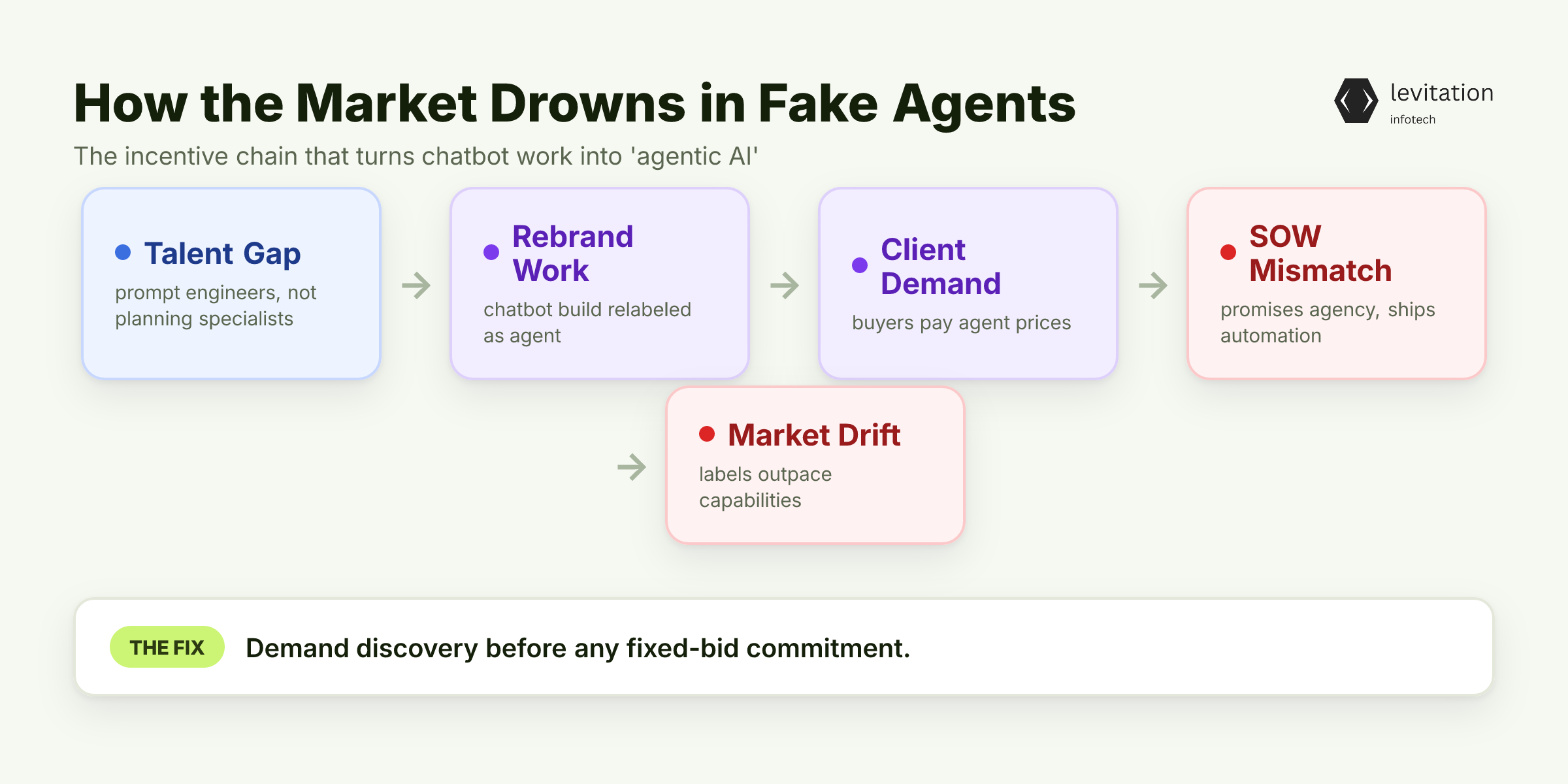
Chatbot development has a multi-year head start in Indian delivery shops. The muscle memory is built around prompt-response architectures. Every team has shipped a RAG chatbot. Few have shipped an agent.
Hiring for true AI agent development company talent requires engineers who understand planning algorithms, tool orchestration, and state machines. That's a different hiring pool. Most shops don't have it.
They have prompt engineers and full-stack developers who learned LangChain in a weekend.
Vendors rebrand existing chatbot projects as "agent" work because clients will pay agent prices for work labeled "agentic AI." The architecture often matches last year's chatbot build. The work doesn't change. The label does. The invoice does. The pitch deck gets a new cover slide.
Clients ask for agents because the term signals innovation. Vendors deliver chatbots because that's what their teams can ship in sprint cycles. Nobody is acting in bad faith. Everyone is responding to incentives.
The result: a quote document that says "agentic AI" on page one and "function calling integration" on page seven. Both pages are technically accurate. Neither page describes what the client actually needs.
There's also a structural reason. Fixed-bid SOWs signed before architecture is finalized reward vendors who scope low and rebadge later. A genuine agent project needs discovery before commitment. Most buyers skip this phase because procurement wants a number on paper. The result is a quote that promises agency and delivers automation.
Understanding the market pathology is useful. What you need is a way to filter it before you sign anything. So where do you start?
How to Evaluate an AI Agent Quote Like an Engineer
Stop reading SOWs like a buyer. Read them like an engineer.
Demand the architecture diagram before pricing. If the diagram shows a single LLM call with tool routing, it's a chatbot. If it shows a planning module, tool registry, state store, and evaluation harness, it's worth a conversation. No diagram, no deal.
Ask: "What happens when the API returns an error mid-workflow?" A chatbot surfaces the error. An agent has retry logic, alternative tool selection, and a fallback plan.
The answer reveals everything about the team's depth. Silence, or a vague "we'll add that," means you're talking to a chatbot shop.
Ask: "How does the system maintain state across a ten-step workflow?" Look for explicit state management, not just conversation history. A real system uses a structured store the agent can read, write, and query. Chatbots use message logs. The difference is architectural, not cosmetic.
Ask: "Show me a logging dashboard where I can inspect the agent's plan at each step." If the team doesn't have one, they haven't built it. Plan inspection is how you debug agentic systems. Without it, you're flying blind in production.
Request a two-week paid pilot with a defined success metric. The cost of a pilot is trivial compared to a multi-month rebuild. A pilot forces the vendor to show working code, not slideware. It also surfaces whether the team can iterate when reality breaks their assumptions, which it will.
Verify the team has shipped multi-step autonomous systems before, not just RAG chatbots. Ask for references. Call them. Ask what broke in production. Ask how long it took to fix.
Once you've filtered the quote, the next question is the one every CFO will ask: why does the real thing cost more?
The Real Cost Gap: Why Agents Cost More Than Chatbots
Chatbot work in India is commodified. Prompt engineering, one LLM integration, basic tool calls, a web widget. Standard delivery. The work is well-understood because the architecture is well-understood.
A genuine agent system requires a planning layer, tool orchestration, state management, an evaluation harness, and observability. Each is a separate engineering surface. Each needs design, testing, and production hardening.
Agent work costs more because the evaluation infrastructure and the engineering talent required differ from chatbot work. The engineers think in terms of state machines and planning algorithms, not just prompt templates.
In regulated industries, healthcare, finance, insurance, the bar is higher. Audit trails for agent decisions, compliance-ready observability, and recovery from ambiguous tool results aren't optional. They decide whether the system passes production review or sits in a drawer.
If a vendor quotes you agent-scope work at chatbot prices, the scope will quietly shrink during delivery. You'll get the prompt-response version, not the planning version. The vendor didn't lie. They just delivered what you paid for.
The hidden cost isn't the build. It's the production failure. When a chatbot-with-tools can't handle a multi-step edge case the demo never showed, you pay the real price.
A KYC workflow that breaks on ambiguous identity data fails the audit. An agent that recovers from ambiguous results and retries with different tools is the difference between a demo and a production system. For a detailed breakdown of why multi-agent architectures cost more than initial quotes suggest, see this cost analysis of multi-agent systems.
Budget for evaluation as a first-class line item. It's the difference between a demo that works once and a system that works in production. Skip it and you'll pay for it in incident response, not in the build phase.
So what does a real engagement actually look like once you've separated the chatbots from the agents?
What a Real Agent Engagement Looks Like
Real agent work follows four phases. None of them are "wire up a prompt and call an API." - Phase 1 - Scoping. Define the agent's goal, the tools it can access, the success criteria, and the failure boundaries. What does success look like? What does the agent do when it can't succeed? Most chatbot projects skip this phase entirely. Agent projects can't. - Phase 2 - Architecture. Planning module, tool registry, state store, evaluation harness, observability layer. Each is a separate engineering surface. Each needs design before code. Rushing this phase is how chatbots get relabeled as agents. - Phase 3 - Iterative build. Ship the simplest agent that completes one workflow end-to-end, then expand. One workflow done correctly teaches you more than five workflows done superficially. The system gets smarter with each cycle. - Phase 4 - Production hardening. Generative AI development work shifts from feature building to evaluation, regression testing, and failure-mode analysis. The interesting problems all live here. For what production-grade agent systems actually demand under load, this analysis of agentic codebases maps the debt that accumulates when these phases get skipped.
The payoff: a system that handles ambiguity, recovers from tool failures, and improves through structured feedback. Not a chatbot that breaks the moment a user steps outside the script.
Frequently Asked Questions
Q: What's the difference between an AI agent and a chatbot with function calling?
A: A chatbot with function calling takes a prompt, calls a tool, and returns a result. A real AI agent decomposes a high-level goal into sub-tasks. It selects tools on its own, iterates when results fail, and maintains state across multi-step workflows. The difference shows up the moment the workflow deviates from the happy path.
Q: Why is agent development more expensive than chatbot development in India?
A: Agent systems require planning infrastructure, state management, evaluation harnesses, and observability. These are separate engineering surfaces beyond what a chatbot project demands. The work needs engineers who can design state machines, recovery logic, and compliance-ready audit trails, not just LLM calls with tool routing.
Q: How do I verify a vendor's AI agent quote isn't a chatbot in disguise?
A: Ask for the architecture diagram, the failure-recovery logic, the state management approach, and a live demo where you interrupt the workflow mid-task. If the team can't show autonomous replanning when a tool fails, you're looking at a chatbot with a function-calling wrapper.
Q: Why are so many Indian AI companies selling chatbots as agents?
A: Chatbot delivery has a multi-year head start in Indian IT shops. Vendors rebrand existing chatbot work as "agentic AI" because clients will pay more for the label, even when the underlying architecture matches last year's chatbot build.
Q: Can a chatbot with function calling ever be the right choice over a true agent?
A: Yes, when the workflow is linear, the tools are deterministic, and the user prompt maps directly to a known tool call. For single-step lookups, form fills, or FAQ-style interactions, a chatbot is faster and cheaper. Agents earn their cost when the task needs multi-step planning and recovery from ambiguity.
Filter hard before you sign.
About the author
Mayank Singh is a software developer at Levitation Infotech, where he builds web and AI-powered applications across the company’s fintech, healthcare, and enterprise projects.