


TL;DR: Most enterprise chatbots in India are built and demoed in English. They then fail in production because Indian customers code-mix languages. A real multilingual bot needs LLM-native architecture. It must detect and respond in the customer's actual language, not a translation layer bolted onto an English bot. Operations leaders who pin down the architecture gap before signing a contract save weeks of timeline. They also avoid scope-creep cost overruns.
Key Takeaways: - English-only demos hide the real failure. Customers walk away when the bot cannot speak their language. - Code-mixing (Hinglish, Tanglish, Benglish) breaks naive translation. The meaning lives in the mix, not the parts. - LLM-native multilingual architecture handles all Indian languages including code-mixing out of the box. It also runs at lower cost than per-language model approaches.
The ₹5 Lakh Problem Nobody Warned You About
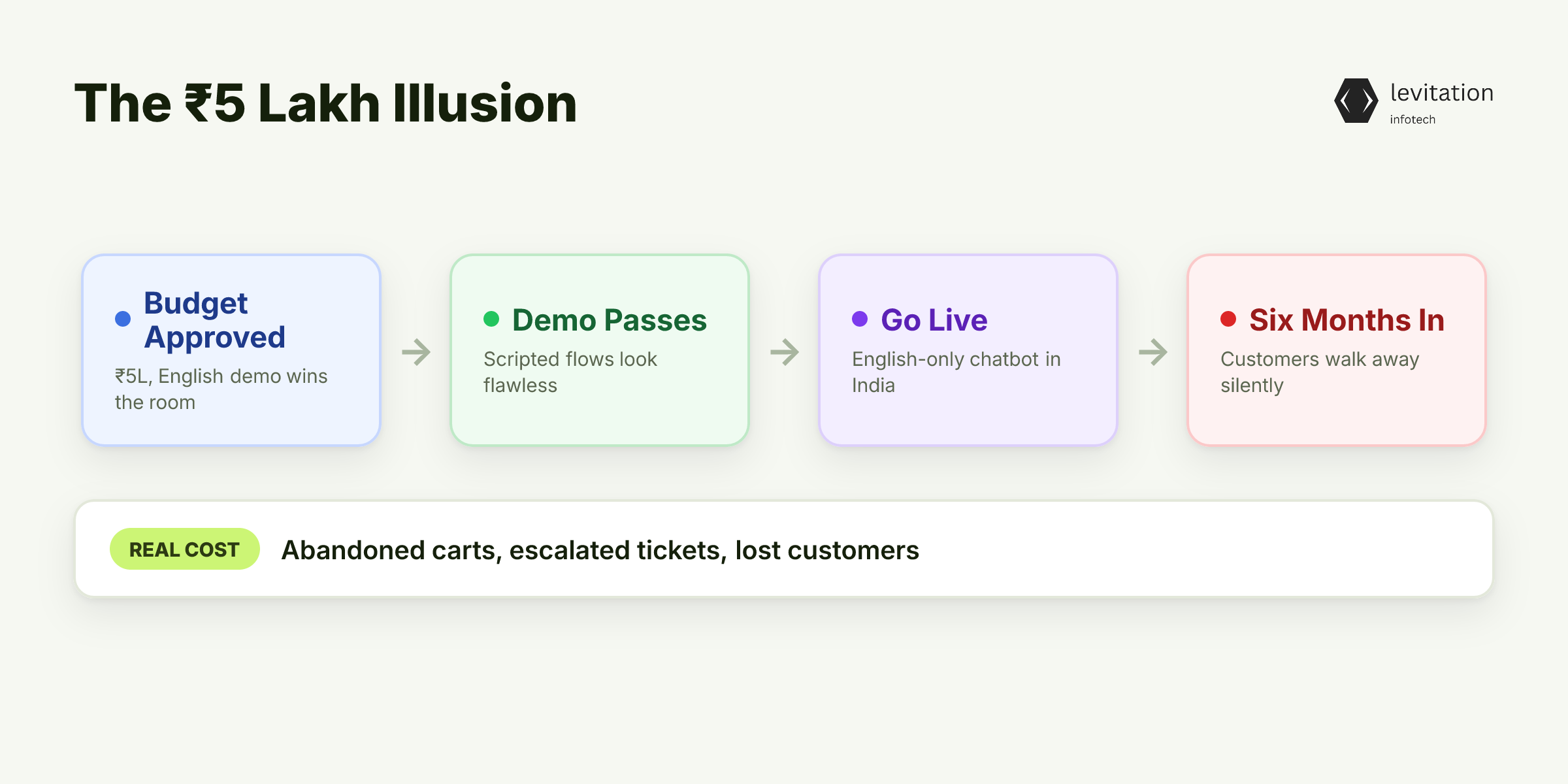
You approved a ₹5 lakh budget. You watched the demo, and went live. Six months later, your support dashboard shows the real failure. Customers who walk away from a language barrier do not return.
The reason is not your product. Your chatbot greets a customer in Hyderabad in English. Then the customer walks away.
Most enterprise AI chatbot development cost in India budgets are approved based on English-language demos. These demos look impressive in boardrooms. The bot handles every scripted flow. It answers FAQs and a few edge cases.
Operations heads then inherit a chatbot that worked perfectly in pilot. It fails the moment a customer types "mera order cancel karo" or "delivery kab hoga." The real cost is not the build.
It shows up as abandoned carts. It shows up as unresolved tickets escalated to humans. It also shows up as customers who simply never return. An English-only chatbot in an Indian market is a storefront with no sign, no staff, and a locked door.
The demo passes. The dashboard looks green. Six months in, the support team is drowning.
The vendor calls it a "language coverage" issue and quotes a phase two. The obvious fix, "just add Hindi", makes the problem worse, not better.
Why 'Just Add Hindi' Makes Everything Worse
Indian customers do not speak Hindi in isolation. They speak Hinglish, Tanglish, Benglish, and dozens of code-mixed variants. No translation layer handles them.
A customer in Lucknow might type "bhaiya, ye product ka price kya hai aur cash on delivery available hai kya" in one breath. That single sentence carries two questions. They are woven together in three languages.
Naive multilingual setups translate message-by-message. This destroys context. It breaks intent detection. It produces robotic replies that customers instantly recognize as machine-generated.
The bot that confidently responded in English now confidently responds in wrong Hindi. The 12 languages you actually need are not a list of tongues. They include Hindi, Tamil, Telugu, Bengali, Marathi, Gujarati, Kannada, Malayalam, Punjabi, Odia, Assamese, and Urdu.
Each language carries formal and informal registers. Each has regional slang, its own script, and Roman variants. Script detection alone is unsolved by most off-the-shelf platforms. A message written in Roman script with Tamil vocabulary like "epdi iruka price" confuses standard NLU pipelines. These pipelines are trained on monolingual corpora.
Vendors quote a chatbot cost in India based on "12 languages". They deliver 12 monolingual bots that cannot talk to each other. The same pattern shows up in Why Your ₹4 Lakh Chatbot Handles Only 12% of Inquiries.
So what does "multilingual" actually mean when the bot works in the wild?
What Real Multilingual Means in 2026
Modern multilingual AI chatbots support automatic language detection. The bot identifies what the customer is typing. It responds in the same language and same script.
No language selector. No "press 1 for Hindi" menu.
The current state of the art handles code-mixing. You can see this in platforms like Bolna's Voice AI. It can detect that a caller is mixing Hindi and English. It replies in that same mixed style. It does not force a single language.
This is the difference between a bot that translates and a bot that understands.
Top-tier systems now support 30 to 80+ languages. Indian language coverage is growing on LLM-backed architectures from Azure, AWS, and Google. A genuine multilingual AI chatbot India deployment treats all languages as first-class citizens.
Real multilingual means the bot preserves intent across language switches. This happens mid-conversation. A customer can start in English. They can drop a Hindi phrase, then switch to Hinglish. The bot keeps the thread intact.
The underlying mechanism is no longer translation. It is models trained on multilingual data that understand meaning directly.
This is what enterprise buyers should demand in 2026. A bot should meet customers where they are. It should not meet them where the training data is cleanest. The architecture choice you make early decides whether your bot survives its first month in production.
Three Architecture Choices for Indian Language Support
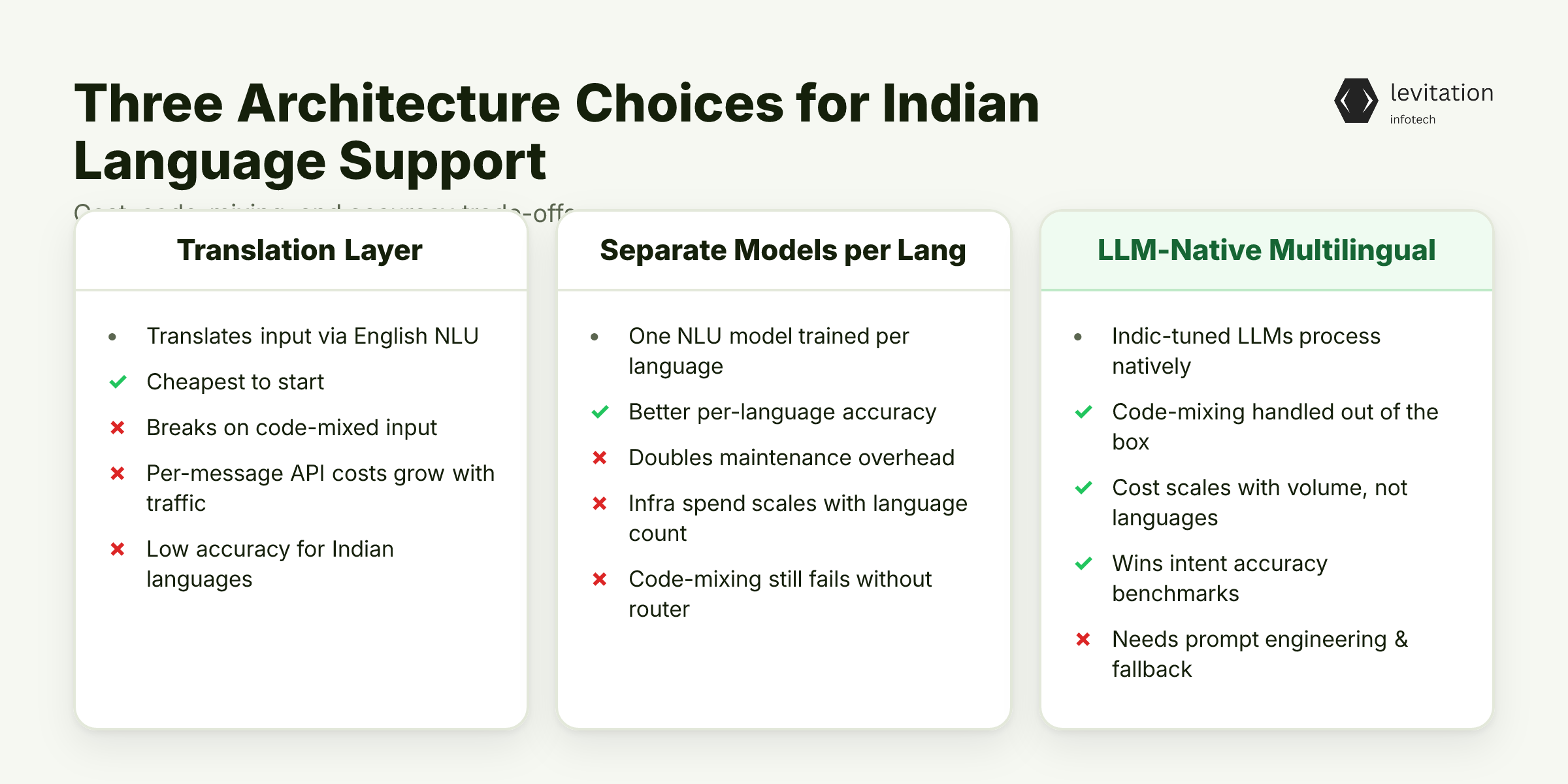
Choice 1: Translation Layer on Top of an English Bot. This is the cheapest and fastest option. It is also the most common shortcut in low-budget AI chatbot development projects.
The bot detects the input language. It translates to English, runs NLU, then translates the response back. This breaks on code-mixing.
Translation engines treat each sentence as a unit. The meaning of code-mixed text lives in the mix, not the parts.
Choice 2: Multilingual NLU with Separate Models per Language. This delivers better accuracy per language but doubles your maintenance overhead.
Each model needs its own training data. Each model needs its own testing. Each model needs its own retraining cycle.
Code-mixing still fails without a custom routing layer that decides which model to call when.
Choice 3: LLM-Native Multilingual. This uses models like GPT-4, Claude, or Indic-tuned models such as Airavata and OpenHathi. These process all Indian languages natively.
Code-mixing is handled out of the box. This is because the model was trained on multilingual and code-mixed data. For Hindi chatbot development specifically, the picture is clear. Indic-focused models trained on IndicCorp and similar datasets tend to outperform general models. They win on intent accuracy benchmarks for Indian languages.
Each choice has different implications for the cost to build a chatbot. Translation layers add per-message API costs. These costs balloon with traffic. Separate models multiply infrastructure spend linearly with language count.
LLM-native scales with conversation volume. It still needs careful prompt engineering and a fallback layer for the long tail of low-resource languages.
The architecture choice also decides whether you fall into the generalist LLM cost trap. A bot built on GPT-4 for "Hindi support" burns inference budget. It processes English-shaped prompts in a model that was not optimized for Indic scripts.
The wrong architecture costs you twice. Once in build, once in run.
Most operations heads get blindsided by how different the final numbers look from the original quote. The timeline surprises are worse. What does a realistic 12-language build actually cost in hours and rupees?
The Realistic Cost and Timeline for a 12-Language Chatbot
Industry benchmarks show a proper AI-powered chatbot takes months to build, not weeks. It needs NLP and integrations. Adding genuine multilingual support for 10+ Indian languages adds weeks of additional timeline. Most vendors quote a much smaller scope.
A Hindi-only addition to an existing English bot is a short project. A full 12-language rollout is a months-long engagement. It needs Indic-language training data, dialect testing, and code-mixing validation.
The gap between these two scopes is where most procurement talks go wrong. Vendors quoting a low price for a 12-language bot are cutting scope. Or they plan to bill you for the gaps later. The same pattern appears in How Your ₹2 Lakh AI Chatbot Becomes ₹8 Lakh.
Ongoing costs include per-message API fees. These fees are large on LLM architectures. They also include translation review for regulated industries and monthly retraining as customers' language patterns evolve.
The hidden cost most vendors do not budget for is testing. You need native speakers validating responses in each language. You need them across each dialect, and across each script variant. This is real engineering work, not an afterthought.
The WhatsApp chatbot cost conversation has the same hidden structure. Channel is cheap. Language coverage and quality assurance are where budgets double.
Contracts that include proper multilingual QA from the start tend to ship on time and on budget. This holds regardless of how fast the bot was built.
The real numbers make vendor evaluation possible. The contract clause list matters more than the demo.
What to Demand Before You Sign the Contract
Demand a live demo in your top three Indian languages with code-mixed inputs. It should not be a pre-recorded English demo with a "multilingual coming soon" slide. The bot must respond in real time. It should reply in the customer's actual mixed style. Use a sample query from your own support logs.
Require language coverage in writing. Include specific dialects in the contract. "Hindi support" should list whether it includes Hinglish, formal Hindi, and regional variants like Awadhi or Bhojpuri. If the contract does not list the dialects, the vendor will define them after the deposit clears.
Ask for the data pipeline. Where does the training data come from? How is code-mixing handled?
What happens when the model encounters a phrase it has not seen? The right answer involves IndicCorp, AI4Bharat datasets, or equivalent. The wrong answer is "we will figure it out in pilot."
Insist on a pilot with 50-100 real customer conversations in each target language. Run this pilot before full rollout. This is where most projects prove themselves or fail visibly. The chatbot price does not matter if the pilot shows low intent accuracy on real traffic.
Clarify escalation logic. When the bot does not understand, does it fall back to English, which confuses the customer further? Or does it fall back to a human agent, which is expensive but correct?
Get this decision in writing. Contracts with these five clauses ship on time. Contracts without them double in scope by month four.
The right setup changes what shows up in the dashboard.
What Changes When Your Bot Finally Speaks Their Language
First-contact resolution rates improve measurably. This happens when customers interact in their preferred language instead of being forced into English. The deflection rate drops. The deflection rate is the share of customers who walk away from the bot. The bot finally understands what the customer is asking.
Escalation-to-human rates drop sharply. Code-mixed queries that previously failed intent detection now resolve at the bot layer.
Your human agents handle fewer "the bot did not understand me" tickets. They handle more genuine edge cases.
Customer satisfaction scores for support interactions rise measurably. This is clear in Tier 2 and Tier 3 city markets where English fluency is lower. You unlock a customer segment that was previously invisible to your support analytics.
Your chatbot stops being a cost center. It becomes a real customer acquisition channel for non-English-speaking segments you were underserving. The same multilingual setup that handles support also enables outbound engagement.
Chatbot development cost pays off across WhatsApp commerce, vernacular marketing, and voice AI. It multiplies ROI on the original build. The shift is not subtle. It shows up in the dashboard within the first quarter.
Teams that get this right treat their bot as a customer-facing surface, not a support cost line. That is where Levitation works. They build the architecture and operations layer that turns multilingual models into production systems. These systems deflect traffic without lying to customers.
Frequently Asked Questions
How much does AI chatbot development cost in India for a multilingual bot?
A genuinely multilingual enterprise chatbot costs more than an English-only build. It needs to support 8-12 Indian languages. The premium depends on integration depth, custom model training, and whether you use existing LLM APIs. A basic Hindi-only addition to an existing English bot starts at a fraction of the full multilingual price. It will not handle code-mixing, though.
Which Indian languages should my chatbot support first?
Prioritize based on your customer data, not population statistics. Most Indian enterprises see their non-English volume concentrated in five languages. These are Hindi, Tamil, Telugu, Bengali, and Marathi. Start with these five. Then measure adoption. Then expand to Gujarati, Kannada, and Malayalam in phase two.
Can a single chatbot handle code-mixing like Hinglish?
Yes, but only if it is built on LLM-native multilingual models. Translation layers do not work. Platforms like Bolna and Indic-tuned LLMs such as Airavata and OpenHathi handle code-mixing natively. Translation-based approaches fail. They translate sentence-by-sentence, which destroys the code-mixed context.
How long does it take to add Hindi support to an existing English chatbot?
A focused Hindi chatbot development project on an existing bot takes weeks for basic intent coverage. True Hinglish and code-mixing support adds more weeks of testing. A full 12-language rollout is a months-long engagement. It is not a quick add-on, as most vendors suggest.
Should I use Azure, AWS, or Google for multilingual AI chatbot development?
All three offer production-grade multilingual support. The choice depends on your existing setup. Azure leads in enterprise integration depth. AWS leads in custom model training flexibility. Google leads in Indic language model quality. Most Indian enterprises choose based on which cloud their ERP and CRM already run on.
About the author
Mayank Singh is a software developer at Levitation Infotech, where he builds web and AI-powered applications across the company’s fintech, healthcare, and enterprise projects.