


TL;DR: The cheapest way to cut your LLM bill is to stop paying frontier prices. Stop paying for commodity work that does not need a frontier model. About 70% of production LLM calls are low-complexity tasks. A much cheaper model handles them just as well. Routing those calls to the right tier recovers 30-70% of your spend with no quality loss. The fix is an infrastructure problem, not a prompt problem.
Key Takeaways: - Most enterprise LLM spend goes to the wrong model tier, not the wrong prompt. - Routing, caching, compaction, prompt optimization, and batching compound into 70-85% savings. - A centralized AI gateway is the only way to make cost governance work across teams.
The $8.4 Billion Wake-Up Call No One Saw Coming
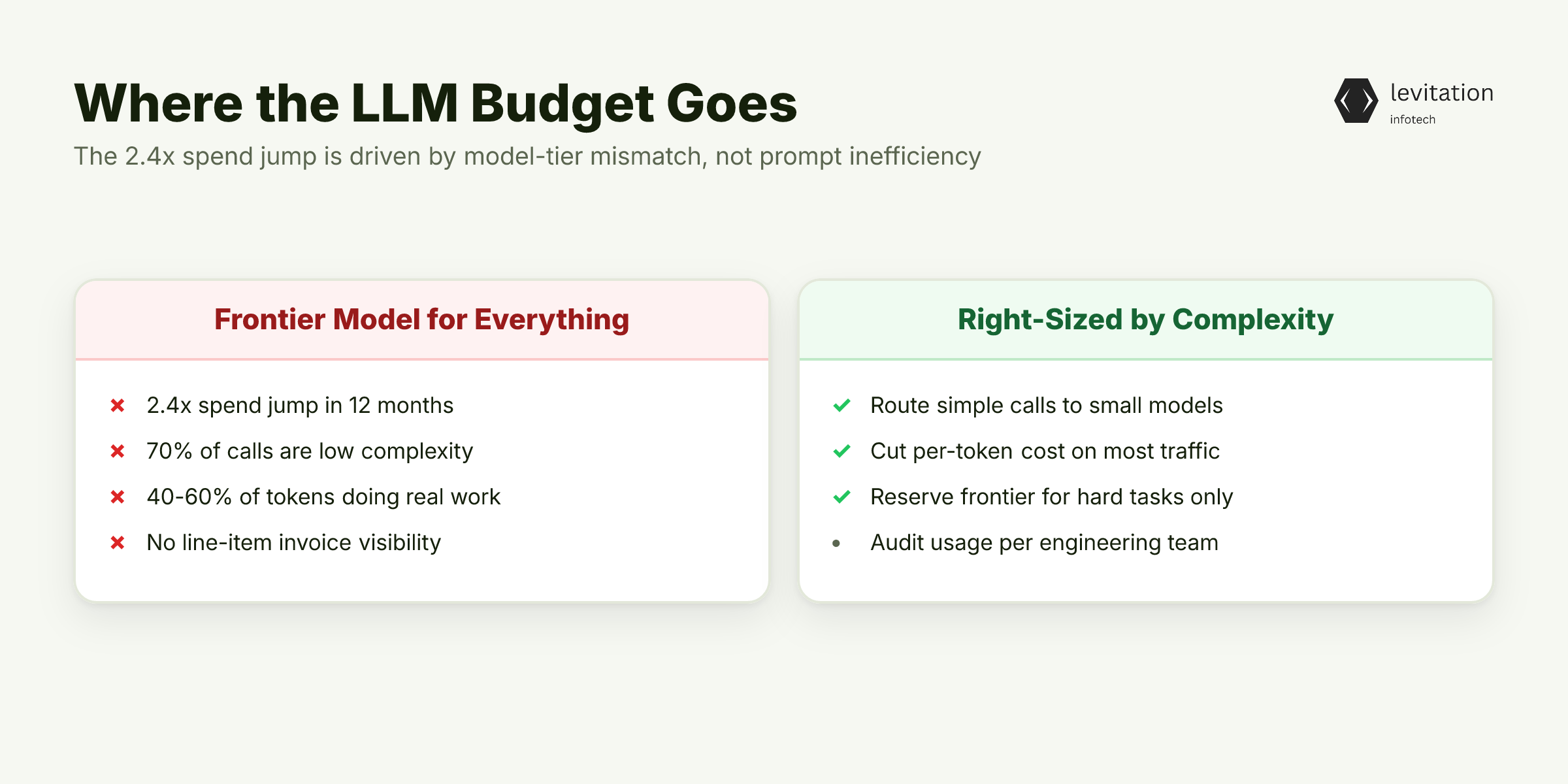
Enterprise LLM spending hit $8.4 billion in 2025. That is up from $3.5 billion the year before. It is a 2.4x jump in twelve months. McKinsey reports enterprises are blowing through AI budgets at an accelerating rate. The uncomfortable truth is that 40-60% of those tokens are doing work. A much cheaper model could handle that work just as well.
Look at any production LLM application. About 70% of its calls fall into the low or low-medium complexity tier. Classification. Extraction. Formatting. Simple rewriting. These are tasks a small, fast model handles at a fraction of the per-token cost of a frontier model.
The bill keeps climbing. Most CTOs have no visibility into where the waste lives. The reason is structural. Each engineering team owns its own usage. Providers send monthly bills. Nobody audits them line by line. The waste stays invisible until the invoice arrives.
Most of the public conversation treats this as a general efficiency problem. The real story is sharper. The spend is concentrated in the wrong model tier, not the wrong prompt. This pattern repeats across every vertical we serve.
Across enterprise AI solutions deployed in regulated industries, the cost shape is almost identical. If 70% of your calls are simple, the problem is not your prompts. It is that you are renting a sports car to drive to the corner store.
Why Your 'Smartest' Model Is Your Most Expensive Mistake
Most engineering teams default to a single frontier model for every task. They do this because it is simpler to ship. They do not do it because it is cheaper to run. The temptation is rational in week one. By month six, the invoice is not.
The price gap is wide. Frontier models carry a steep per-token cost compared to smaller open-weight alternatives. Routinely using a top-tier model for classification, extraction, or formatting means paying for reasoning capability. The workload never uses that capability. You are renting a Ferrari to commute two miles.
Agentic workflows compound the damage. A coding agent that runs many sequential API calls on a premium model can rack up heavy per-session costs. Most teams discover their monthly LLM spend far exceeds what they budgeted. This happens only after moving past prototyping into production.
Tasks that almost never need a frontier model: - Intent classification and routing labels - Named entity extraction from structured input - JSON normalization and schema enforcement - Short reformatting, summarization, and translation - Embedding generation for retrieval pipelines
The obvious answer is "use a cheaper model." But that breaks quality on the calls that actually need a frontier model. The real answer is more precise. Match the model to the task, on a per-call basis, in real time. This is what AI/ML training and model training and inference pipelines infrastructure should be designed to do. Almost never does it do this. The fix is small, mechanical, and ready to deploy in days, not quarters.
The Router Pattern: How a Tiny Classifier Saves 30-70% Without Losing Quality
A lightweight routing classifier examines incoming request metadata. It assigns each call to the appropriate model tier. Simple calls go to cheap models. Complex reasoning goes to premium models.
The classifier itself can run on a micro-model like GPT-4o-mini. As a result, the routing overhead is negligible against the savings. The numbers from production deployments are stark. Organizations using routers report 30-70% cost reductions while maintaining quality. Some workloads achieve up to 98% savings on specific task types.
For domain-heavy work like legal, medical, or financial, domain-specific AI models and fine-tuned variants outperform generalists. They win on the relevant slice of tasks at a fraction of the cost. The same logic applies. Pay for capability you actually use, not for capability you might need. Fine-tuning and embedding strategies are what make this practical at enterprise scale.
A note on multi-agent systems specifically. A multi-agent LLM architecture that costs far more than you modeled at the start often collapses to budget. This happens once routing is applied. Most of the agent-to-agent chatter is low-complexity. The architecture stays the same. The bill does not. (See our analysis of why multi-agent LLM architectures cost 4x more than you modeled for the full picture.)
Routing is the first of five compounding levers. Caching, compaction, prompt optimization, and batching stack on top of it.
The Five Levers That Cut API Spend 70-85% (and How to Stack Them)
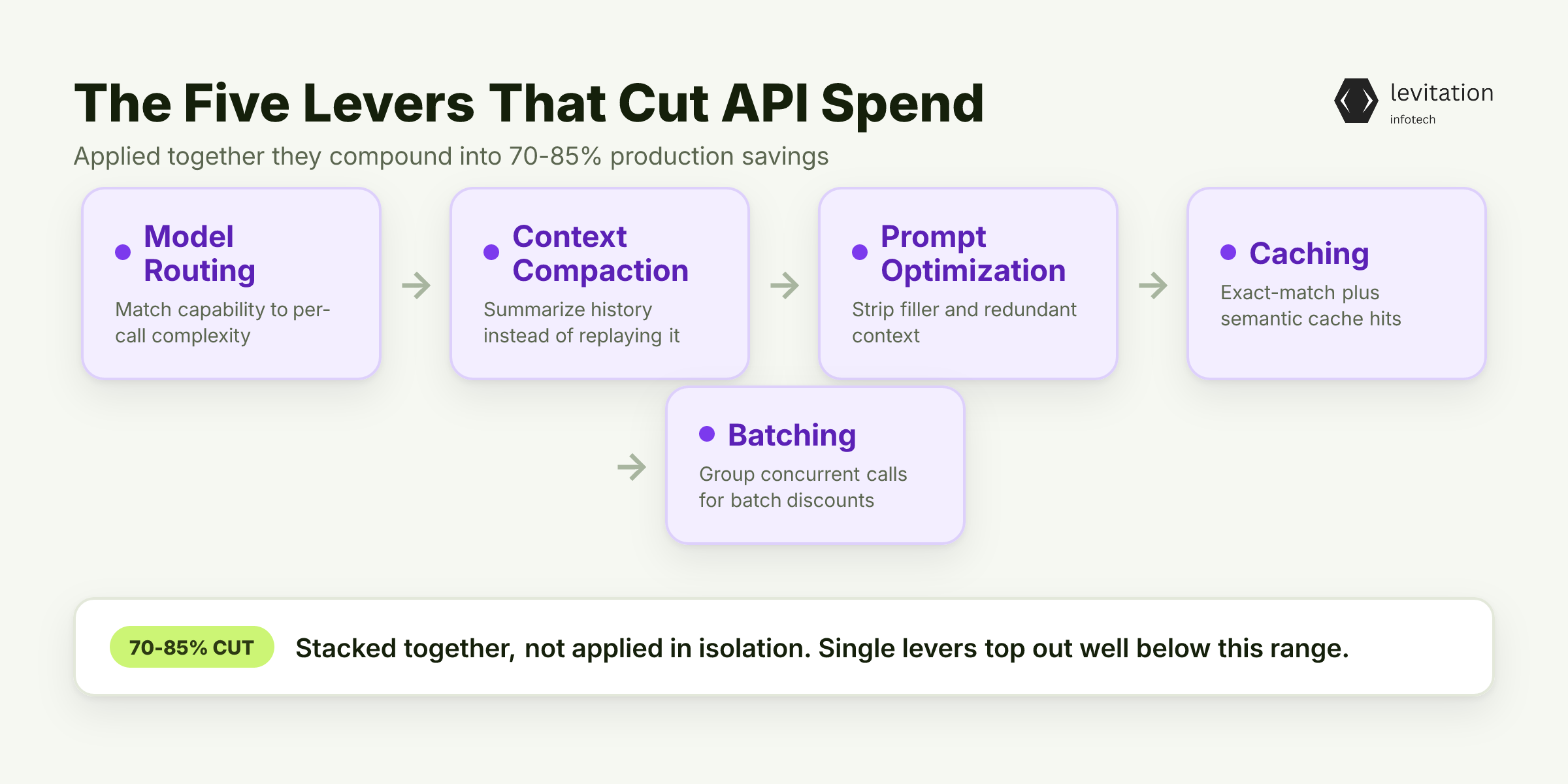
These five levers stack. Applied together, they cut production LLM spend by 70-85% without changing what the application produces. - Model routing delivers 30-70% savings by matching capability to complexity on a per-call basis. - Context compaction shrinks input tokens. It does this by summarizing prior conversation state instead of replaying full history on every turn. That reduces the cost of each subsequent call. - Prompt optimization tightens input. It removes redundant words, filler, and unnecessary context. That directly reduces both input and output token counts. - Caching eliminates repeat work. Traditional caching plus semantic caching together deliver major savings on cache hits. The latter handles paraphrased queries that exact-match would miss. - Batching groups concurrent calls to providers that offer batch discounts. It reduces the per-call cost on eligible workloads.
The compounding is real, not theoretical. Our cost tracking from 100K to 100M tokens shows the curve is brutal without these levers. The curve is far more forgiving with them. The detailed breakdown is in we tracked LLM costs from 100K to 100M tokens.
This is why inference and transformer optimization and production AI governance are not separate disciplines. They are two sides of the same cost problem. You cannot govern what you have not instrumented. You cannot optimize what you cannot attribute. Levers only work if you can see where the money is going. Blind optimization targets the wrong calls.
Stop Asking Teams to Be Frugal: Build the AI Gateway
The cost problem is an infrastructure problem, not an application problem. Asking each engineering team to police its own prompt efficiency is structurally broken. Teams optimize locally. The bill arrives globally. Finance gets the surprise. Nobody can answer the question "which workflow is driving our spend?" That is because the data is not in one place.
A centralized AI gateway like LiteLLM sits in front of every LLM call. It captures request metadata, enforces routing rules, and applies caching. It provides unified cost attribution before the token is consumed, not after the bill arrives. The "meter before you manage" framework works in three steps: - Instrument every call with a unified gateway so no LLM traffic is invisible. - Attribute spend to a feature, workflow, or team, not just a model. - Apply optimizations to the actual cost drivers, not the calls that happen to be easiest to cache.
Without this control layer, caching might save money on trivial queries. It might leave the workflows that actually drive cost completely untouched. Worse, teams cannot compare their cost-per-workflow against each other. So nobody knows whose agent is the expensive one. (For a deeper look at where the waste hides, see your AI cost doubled. Half the workloads are if-checks.)
Gateway-level cost governance ships inside the same engagement window as the rest of the AI platform. The architecture is durable at the infrastructure layer, not in application code. The infrastructure is in place. The levers are wired up. Now the real question: what does the business actually look like when this works?
What Changes When Your Budget Comes Back
AI spend reduction at this scale is not a line-item tweak. It reopens the budget envelope for new use cases, more users, and workloads. Those workloads were previously too expensive to consider. FinOps stops bracing for the quarterly surprise where finance asks engineering to explain a bill. The bill exploded between quarters.
What changes in practice: - Predictable monthly cost-per-workflow replaces the surprise invoice. - Latency improves on cache-hit paths because prompt caching reduces both cost and time-to-first-token simultaneously. - Engineering velocity increases because cost is no longer a blocker on experimentation. - Teams ship more agentic features because the unit economics actually work. - Forecasting models become more reliable once the cost curve is understood per-workflow rather than per-vendor.
The organizations getting this right treat LLM spend as managed infrastructure with dashboards. They do not treat it as an opaque line item reviewed once a year. Domain-specific AI implementations and LLM and RAG production systems are designed around this principle. The cost architecture is visible, attributable, and tunable.
The LLM bill stops being a tax. It becomes a controllable input. Levitation's enterprise AI solutions team builds the gateway, routing, caching, and cost attribution stack for regulated enterprises.
Frequently Asked Questions
What is LLM cost optimization?
LLM cost optimization is the discipline of reducing inference spend, measured in tokens processed. It does this without degrading output quality. It spans prompt design, caching strategies, model routing, and gateway-level governance. Applied systematically, it can reduce production LLM costs by 70-85%.
How much can model routing actually save?
Organizations using routing report 30-70% cost reductions while maintaining quality. Some specific task types achieve up to 98% savings. The savings come from using routing on the 70% of calls. Those calls don't need a frontier model. Send them to a much cheaper tier instead.
What is semantic caching and how is it different from regular caching?
Traditional caching only returns a hit on exact-match queries. Semantic caching embeds the query, finds semantically similar prior queries, and returns the cached response. Paraphrased requests still hit the cache. So similar questions get answered without re-running the model.
Do smaller or cheaper models hurt output quality?
Not for the majority of calls in most applications. About 70% of LLM calls in a typical app fall into the low or low-medium complexity tier. These include classification, extraction, formatting, and simple rewriting. A smaller model produces equivalent output at a fraction of the cost on these.
Quality matters on the 30% of calls that involve complex reasoning. That is why routing, not blanket downgrading, is the right approach.
How long does it take to build LLM cost optimization?
A properly scoped optimization engagement covers gateway setup, routing logic, caching layer, and team-level cost attribution. It typically deploys over multiple quarters. Building the same capability in-house takes far longer. Teams underestimate the work required to instrument, attribute, and govern spend across multiple teams and model providers.
About the author
Mayank Singh is a software developer at Levitation Infotech, where he builds web and AI-powered applications across the company’s fintech, healthcare, and enterprise projects.