


TL;DR: Your CRM and Tally don't talk. That gap costs Indian operations heads about ₹3.2 lakh every year in manual re-entry, reconciliation errors, and missed credits. The fix isn't a setting you forgot to flip. It's a Tally integration project that most vendors don't sell and most buyers don't price in.
Key Takeaways: - Manual data entry costs Indian businesses ₹3-5 lakh per year in labour, errors, and missed credits. - Tally's REST API works, but only with a Windows bridge server and per-user licensing most teams forget to budget. - A focused CRM-Tally integration pays back once manual re-entry and reconciliation are removed from the finance team's workload.
The ₹3.2 Lakh Hole in Your ₹5 Lakh CRM
You bought a CRM for five lakhs. The vendor showed a 360-degree customer view, real-time dashboards, and a sales pipeline that updates itself. Then Monday morning arrived.
Your accounts executive opened Tally on one screen, the CRM on another, and started retyping every invoice, receipt, and customer payment by hand. Day after working day, that pattern runs through every business week.
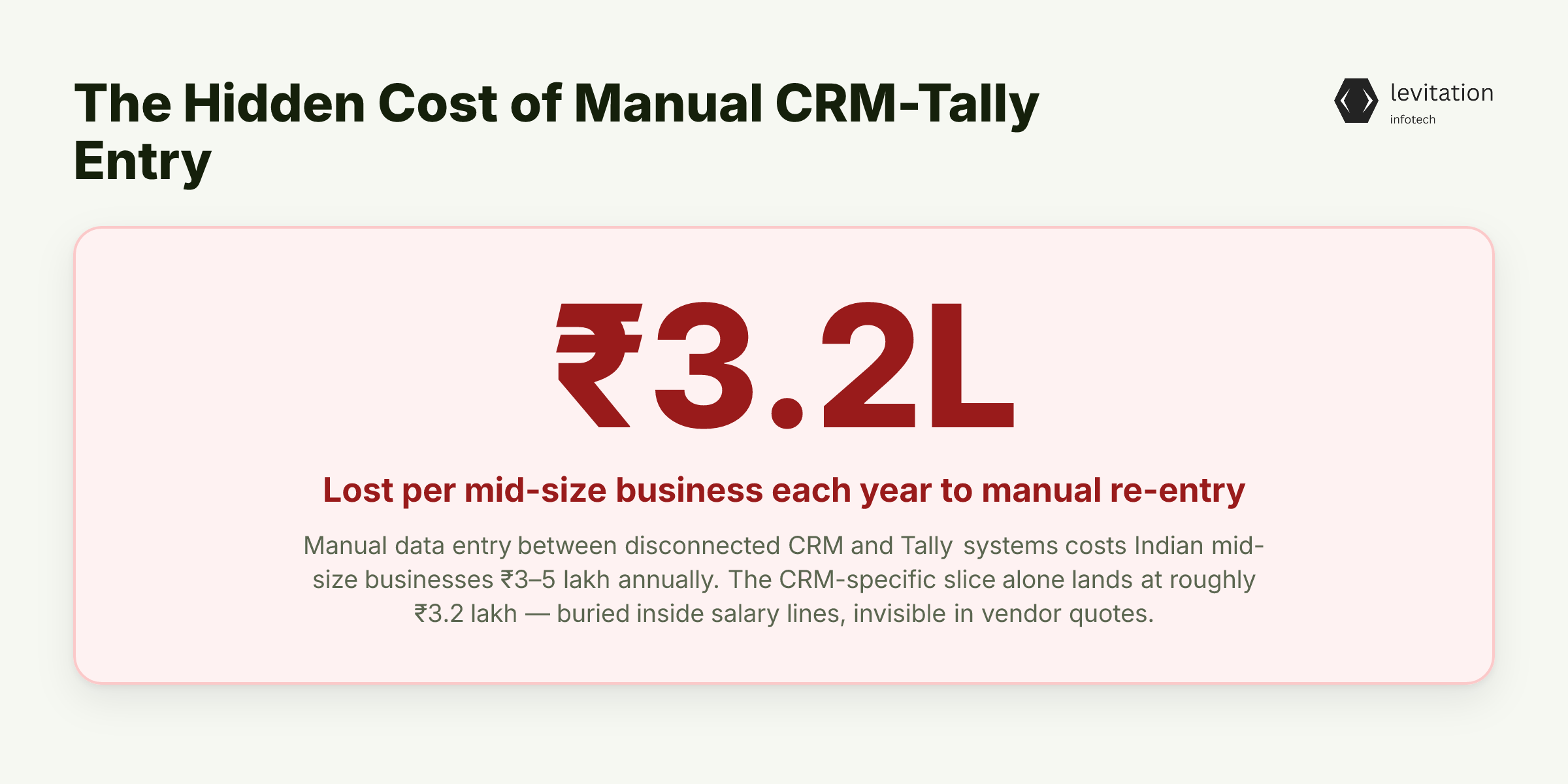
That is the invisible tax of a disconnected CRM-Tally stack. Verified data from Indian automation providers puts manual data entry losses at ₹3-5 lakh a year per mid-size business, with the CRM-specific slice landing at roughly ₹3.2 lakh. The number hides inside salary lines, so it never shows up in a vendor quote.
The math is plain once you see it. An accounts executive at industry salary, who spends the workday copying payment data between systems, costs more than the Tally licence itself.
Add the cost of reconciliation disputes when an invoice number doesn't match. Add the missed input-tax credits when a manual entry slips past GST review. The total compounds quietly.
CRM vendors know this. They sell the dashboard dream and leave the plumbing to your finance team.
If the savings are this obvious, why hasn't your CRM vendor already built the connector? The answer is more cynical than you think, and it lives in how Tally is sold and supported.
Custom CRM development shops that actually understand Indian accounting workflows have spent years solving this exact gap. But blaming vendors misses the real constraint, and it lives in the API itself.
Why Off-the-Shelf CRMs Ship Without Tally Connectors
The problem isn't laziness. It's geography and economics.
Tally is an India-specific accounting product. Global CRMs like Salesforce, Dynamics 365, and HubSpot treat it as a long-tail integration.
Their connector catalogues favour Stripe, QuickBooks, and NetSuite. Tally doesn't even appear in most of their first-party lists.
Zoho CRM is the closest thing to a native option. Zoho Flow offers a Tally connector, and certified partners sell implementations.
But the native path is shallow. It pushes invoices one way and skips payment reconciliation entirely.
Two-way sync, credit notes, TDS entries, and advance receipts all need custom work.
Local SaaS CRMs run into a different wall. Tally Silver starts at ₹18,000 per year for a single-user licence, and Tally defaults to on-premise deployment.
Every cloud connector has to bridge a desktop product running on someone's office Windows machine.
Maintaining that bridge across customer upgrades, licence server outages, and Windows patches is expensive per customer. Small SaaS vendors skip it because the support burden eats the margin.
This is why most Indian operations heads end up hiring a custom CRM development shop or accepting manual re-entry as a cost of doing business. Both choices have hidden bills.
The manual path compounds at ₹3.2 lakh a year. The build path needs careful vetting, because the difference between a Tally integration that runs clean for years and one that breaks every quarter comes down to engineering depth.
The shops with systems still running in production five years after deployment are the ones who learned Tally's quirks the hard way. The API itself is where most projects quietly die.
How Tally Actually Exposes Its Data (And Why Integrations Break)
Tally offers four integration surfaces. XML is the legacy path, brittle and undocumented in places. JSON is cleaner but still depends on Tally running locally.
ODBC requires Tally on a Windows server with a configured data source. REST is the modern path on TallyPrime, and it is the one most CRM integration services teams target.
REST sounds simple. In practice, three constraints catch every first-time builder.
First, Tally runs on a local machine, so any cloud CRM needs an always-on bridge server. Second, Tally.NET licences each concurrent user, which most teams forget to factor in. Third, the REST API rate-limits aggressive callers, and the licence server itself can refuse connections during peak hours.
The failure modes are predictable once you have seen them. Tally locked at night because the accounts team shut the machine. Licence server down on a Saturday when sales tries to check payment status. Voucher numbers that don't match because the CRM created a placeholder invoice Tally never saw.
GST fields that don't align because Tally expects HSN-wise breakup and the CRM only stores a flat tax rate. Duplicate ledgers created by a sync that didn't check for existing masters.
Cheap DIY tools exist. Tally Connector pricing runs from ₹2,900 to ₹5,900 per year, and for a single-branch business with low voucher volume, it works.
It breaks the moment you add a second branch, push past a few thousand vouchers a month, or need two-way reconciliation. The connector was built for one-way push, not the messy bidirectional sync a real sales-finance workflow demands.
Knowing the surface is one thing. Wiring it to a CRM your sales team actually uses is where most projects collapse.
Vendors who have stayed in this space long enough have absorbed those failure modes into their default architecture. What that pattern looks like in production separates the shops that ship demos from the shops that ship systems still running quietly in year three.
The Integration Architecture That Actually Works
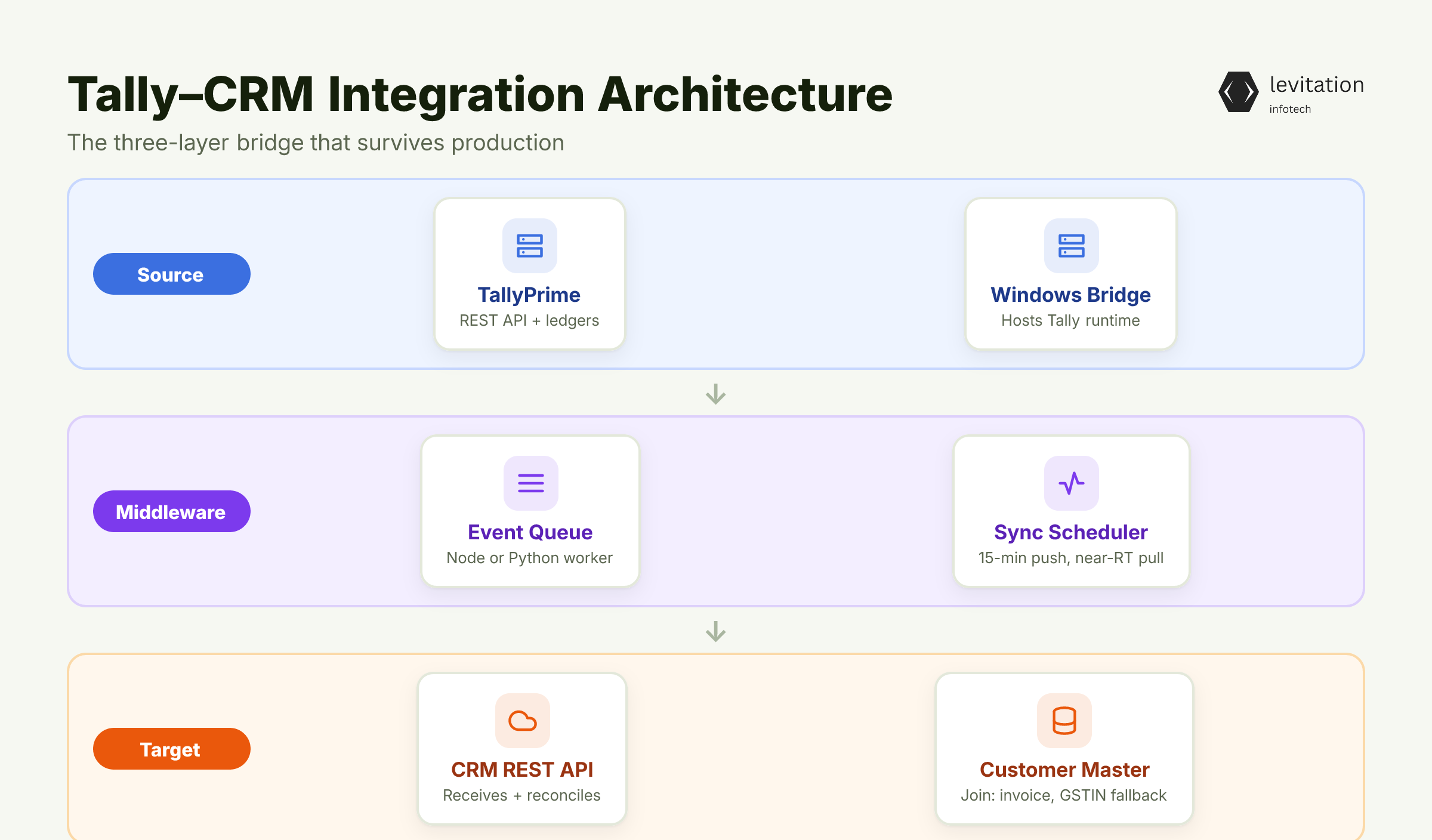
The pattern that survives production is a three-layer bridge. TallyPrime REST API on a Windows bridge server sits at the source.
A middleware queue, typically in Node or Python, polls Tally on a schedule and pushes events downstream. Your CRM's REST API receives the events and reconciles them against its own data.
The sync model matters more than the code. Vouchers and receipts push from Tally to the CRM every fifteen minutes. Customer master data and payment status pull from the CRM into Tally in near-real-time, so finance always sees the same customer record sales is using.
The join key is the invoice number, with a fallback fuzzy match on customer GSTIN and amount. That fallback kicks in when invoices get reissued or split.
The data contract is where most projects leak time. Which Tally ledger maps to which CRM deal stage? How are credit notes, advances, and TDS deductions handled? What happens when a customer pays part of an invoice in Tally but the CRM still shows the full balance?
These decisions need a written contract before code, not after.
For mid-size operations teams, this custom CRM system approach is the difference between a sync that runs quietly for years and one that pages your finance team at 2 a.m. on month-end. Architecture on paper is cheap. What this costs to build, run, and maintain across three years, and whether the savings actually beat the spend, is where the procurement conversation usually dies.
The Real 3-Year Cost: Where the Savings Actually Land
Stack the costs honestly and the choice gets easy. A custom CRM-Tally integration project requires upfront development work, plus ongoing maintenance and Tally licence top-ups each year.
Tally Connector SaaS runs ₹2,900-5,900 a year but caps at low volumes and breaks for multi-branch setups.
Compare that against the verified ₹3.2 lakh a year manual entry cost. Over three years, that is ₹9.6 lakh in pure recurring drag on your finance team.
A mid-size operations team that replaces manual entry with a working integration keeps most of that three-year drag. That drag becomes recovered finance capacity once the project is live. The Tally Connector option is cheaper upfront but stops scaling the moment volume grows.
The hidden savings are where CFOs start paying attention. Zero reconciliation disputes between sales and finance. Faster month-close because payment matching is automated.
Accurate sales-team commission based on collections, not invoices, which reduces the gap between billed and collected commission. None of these show up in a vendor quote, and all of them compound across three years.
If the math is this clear, the conversation shifts from whether to integrate to who you trust to build it. Most CRM implementation in India projects that fail do so on vendor selection, not architecture. The shop with systems running five years later is the one whose Tally integration still works.
What Operations Heads Should Demand Before Signing the Contract
Five things separate a CRM-Tally integration that runs for a decade from one that needs a rebuild at year two. Demand them in writing. - A working demo using your own company data, not a sandbox with cleaned-up ledgers. Real Tally data has GST mismatches, legacy voucher numbers, and merged customers. - Written SLAs covering sync latency, reconciliation accuracy, and Tally server uptime. Vague promises become Monday-morning arguments. - Source code escrow and full architecture documentation. This is non-negotiable for any custom CRM application build, because vendor lock-in on a sync layer is a future hostage situation. - Proof the vendor has systems in production five years later. Longevity is the only honest proxy for CRM-accounting integration quality. - Reference customers with long-running production integrations you can actually call, not just logos.
If a vendor cannot produce all five, the ₹3.2 lakh annual tax is the least of your worries. Teams that build durable CRM-Tally bridges, like the ones in our own CRM application development practice, have learned that the first demo matters less than the third-year renewal.
For operations heads evaluating the build-versus-buy decision, the right question isn't whether the ₹3.2 lakh manual tax is real. It is whether your vendor can keep the integration alive when Tally upgrades, your sales team changes CRM modules, and your finance team adds a new branch.
Frequently Asked Questions
Q: How much does CRM Tally integration cost in India?
A: A custom CRM Tally integration requires upfront development plus ongoing maintenance; the exact cost depends on data complexity, branch count, and the depth of two-way reconciliation required. SaaS options like Tally Connector run ₹2,900-5,900/year but are limited in volume and customization.
Q: Can Zoho CRM or Salesforce integrate with Tally?
A: Zoho offers Tally integration through Zoho Flow and certified partners, usually one-way invoice push. Salesforce and Dynamics 365 require third-party middleware or a custom bridge because Tally is not in their native connector catalog.
Q: Does Tally have a REST API for CRM sync?
A: Yes, TallyPrime supports REST APIs alongside XML, JSON, and ODBC. REST is the modern path, but it requires a Windows bridge server and per-user Tally.NET licensing, which most teams underestimate.
Q: How long does a Tally CRM integration project take?
A: A focused CRM Tally integration project takes 4-8 weeks for a mid-size operations team: 1-2 weeks for data mapping, 2-3 weeks for build, 1-2 weeks for UAT and go-live. Add buffer for GST field mismatches and Tally licence provisioning.
Q: What is the ROI of automating CRM Tally sync?
A: Based on verified manual entry cost data, Indian businesses lose ₹3-5 lakh/year in labour, errors, and missed credits. Automating CRM Tally sync eliminates the recurring ₹3.2 lakh annual manual entry cost, turning three years of that drag into recovered finance capacity.
About the author
Mayank Singh is a software developer at Levitation Infotech, where he builds web and AI-powered applications across the company’s fintech, healthcare, and enterprise projects.