

TL;DR: A custom CRM's build quote tells you roughly a third of the five-year story. By year three, the cost of leaving a custom system often reaches 200-300% of the original build. Custom data, undocumented workflows, and proprietary integrations don't port cleanly. The fix isn't "build better" or "buy Salesforce." It's negotiating exit terms before the first line of code gets written.
Key Takeaways: - The lock-in is invisible at signing. It's only fully visible at exit. That asymmetry is the trap. - CRMs are uniquely sticky because they touch every revenue system you have. - Exit terms written into the build contract can dramatically reduce the cost of leaving later.
The ₹5 Lakh Build That Quietly Became a ₹14 Lakh Exit
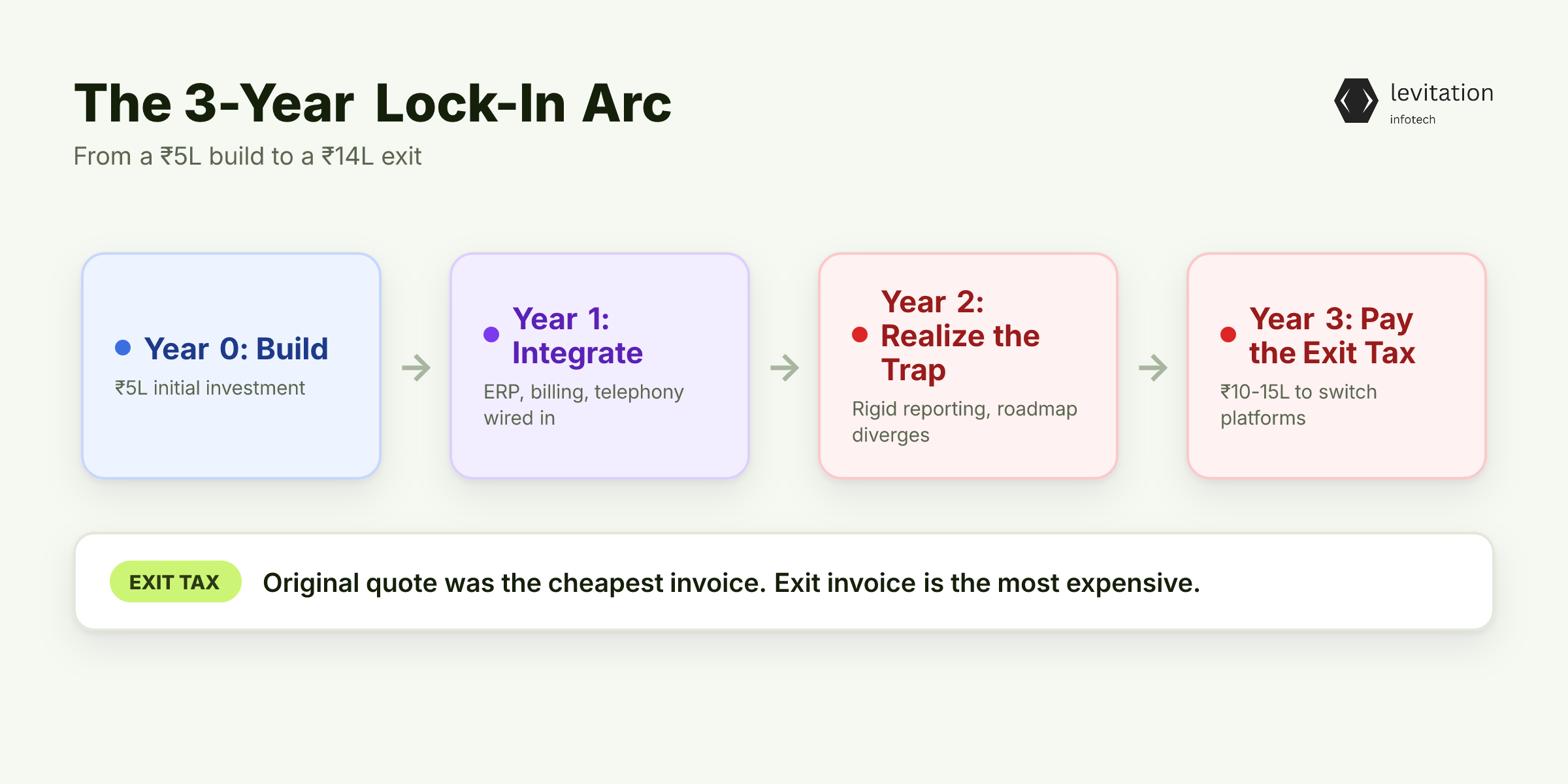
You didn't buy a custom CRM to escape vendor lock-in. You built the most expensive lock-in of all. The exit fee triples your original investment within three years.
The math is brutal. A typical Indian SMB spends ₹5 lakh to build a custom CRM. By year three, when that system no longer scales, switching platforms costs ₹10-15 lakh. The original quote was the cheapest invoice you will ever see. The exit invoice is the most expensive.
Founders who chose custom specifically to avoid lock-in are the most exposed. They paid a premium for ownership and got the opposite: code they own, but data shape, workflows, and integrations locked inside a vendor's design.
The three-year arc follows a pattern: - Year zero: build - Year one: integrate (ERP, billing, telephony, WhatsApp, marketing tools wired to the new CRM) - Year two: realize the trap (reporting is rigid, new features cost change orders, the vendor's roadmap diverges) - Year three: pay the exit tax
The illusion of ownership is the deepest cut. You own the source code. You do not own the data shape, the workflow logic, or the integration map. Those live inside the vendor's design decisions. Reconstructing them is what makes the migration expensive. custom CRM development projects that don't address exit terms upfront quietly compound this exposure over 36 months.
Why CRMs Are the Worst Category for Vendor Lock-In
Most software is replaceable. A marketing tool fails, you switch in a quarter. An HR system disappoints, you migrate in two.
A CRM is different. It's the connective tissue of revenue. It touches customer data, sales, marketing, support, and reporting.
The deeper that integration goes, the harder the exit. Your sales team has muscle memory around the pipeline view. Your support agents route tickets through its automation. Your finance team reconciles invoices against its custom objects. Every workflow now depends on a system nobody fully understands from the outside. Vendors know this asymmetry.
Their pricing power grows as your switching costs grow. That 7% annual list price increase looks unreasonable. That changes when you price the alternative.
The math always favors staying.
Three traps make the lock-in concrete.
The Data Trap. Your CRM holds custom fields and custom objects in a vendor-designed schema you don't control. Standard contacts and accounts come out clean. Anything custom needs schema transformation work. The kind of work that takes weeks, not hours.
The Integration Trap. Every API connection to your ERP, billing system, WhatsApp, telephony provider, and marketing tools is custom glue written against the vendor's API. None of it ports to a new platform. Rebuilding integration code is the most fragile part of your stack, and it costs more than the original build did.
The Workflow Trap. Automations, approval chains, and triggers live as rules inside the vendor's engine. These rules were often written by developers who left the company. Nobody documented them. To migrate, you first reverse-engineer logic nobody can explain. Your Noida CRM Vendor Has 3 Developers. One Will Leave In 6 Months is the rule, not the exception.
The Anatomy of a ₹14 Lakh Migration
The migration quote breaks into five cost buckets, and only one of them is "moving data."
Data export. Standard contacts, accounts, and opportunities come out of most CRMs in clean CSV or JSON. The cost here is low.
Custom fields, custom objects, and custom relationships are a different story. They need schema transformation: mapping your bespoke structures onto a target system's data model. This work is tedious, error-prone, and almost always done by hand.
Workflow reconstruction. Automations, approval chains, triggers, and notifications live as rules inside the original platform. They were built by developers who often left the company. They were rarely documented.
You can't port logic you don't understand. The first migration phase is reverse-engineering what the old CRM did, then rebuilding it inside the new one. This is where most of the time goes.
Integration rebuild. Every platform-specific connection must be rewired against the new system's API. That includes Zoho, Salesforce, Dynamics 365, your ERP, and your billing system.
Each connection is a small project. Three or four integrations add up fast. Ten integrations add up faster.
Testing and parallel run. You don't switch over cold. You run both systems side by side to catch silent failures: duplicate records, missed triggers, broken approvals.
This is a hidden cost. You pay for two CRMs and double the admin time during the transition.
User retraining. Even a "similar" CRM has a different UX. Your sales team loses productivity during the transition while they adapt to a new interface and workflow. That lost output is real money, and it rarely shows up in the migration quote.
The line item that surprises founders most: data cleansing, not data moving, is the largest migration cost. CRM software development work has shown that migration is a pattern, not a one-off. The data almost always moves. The customizations need surgery.
What the Build Quote Never Told You: The True TCO
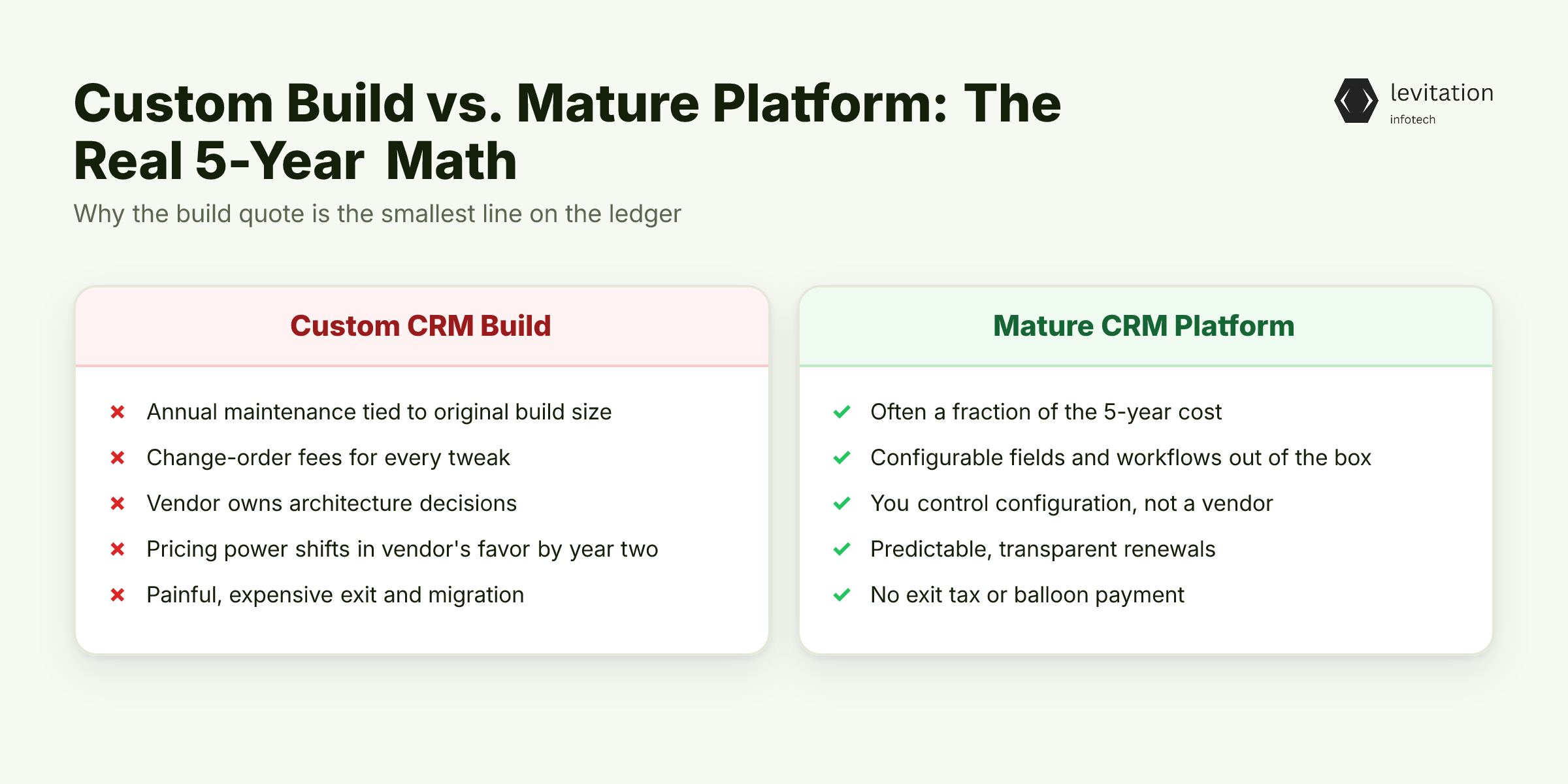
The build quote is the smallest line on the five-year ledger. Annual maintenance is recurring and tied to the size of the original build. A ₹5 lakh CRM needs ongoing bug fixes, patches, upgrades, and hosting.
That maintenance keeps accruing whether the system works perfectly or not. Every new feature request becomes a change order. The vendor owns the architecture decisions.
Adding a field, integrating a new tool, or tweaking a workflow costs money. That's because the vendor controls how the change gets implemented. You're not running software. You're renting a team.
Pricing power shifts after year two. You can't leave without a painful, expensive migration. The vendor knows the renewal will close regardless of what the price increase looks like.
Without a credible exit threat, pricing power keeps compounding in the vendor's favor.
Compare that to a small firm buying a mature CRM platform. Industry data shows that the off-the-shelf alternative often costs a fraction of a custom build. Add the maintenance. Add the eventual exit tax. The custom math stops looking like ownership. It looks like a five-year lease with a balloon payment.
The TCO over five years (build plus maintenance plus exit plus new system) often exceeds buying a mature platform outright. The Year-Two Bill That Kills Custom CRMs is what most founders don't see coming.
5 Contract Clauses That Prevent the Lock-In Before It Starts
The fix is legal before it's technical. Five clauses in the build contract change the entire math. - Data portability clause. Require all data exportable in open formats: CSV, JSON, SQL dump. Not vendor-proprietary exports that require their tool to read. Open formats mean anyone (including your future vendor) can ingest the data without paying the original vendor a cent. - API access clause. Full REST or GraphQL access with documented endpoints, rate limits, and no per-call fees after handover. The API is your lifeline for any future migration. If the vendor charges per call after build, you have a toll road to your own data. - Source code escrow. Code held by a neutral third party. It becomes releasable to you if the vendor goes dark, breaches contract, or you exit under defined conditions. Escrow is cheap. It costs a few thousand rupees per year. It turns vendor bankruptcy from a crisis into a transfer. - Documentation deliverable. Architecture diagrams, schema definitions, workflow logic, and integration maps all become contract deliverables. Not "nice to haves" that get skipped under deadline pressure. If the vendor won't commit to documentation in writing, the project is not done when they say it is. - Exit assistance clause. The vendor is obligated to provide migration support at a defined day-rate, not open-ended billing. "We'll help you migrate" is a promise. "We'll help you migrate at ₹X per day for up to 60 days" is a contract.
These clauses cost nothing extra to negotiate. They're the difference between a ₹14L exit and a ₹2L one. Founders who ask for them upfront signal a sophistication that makes vendors price more honestly. custom CRM solutions are only as portable as the contract you sign.
The Build-vs-Buy Decision That Actually Saves Founders Money
The build-vs-buy question has a false binary. The real answer is hybrid.
Custom is justified when three or more off-the-shelf CRMs fail to match a core workflow. And when that workflow is your revenue engine. A quoting system with regulatory logic, a compliance approval chain, a partner onboarding flow no packaged product covers. If the workflow is what makes you money, custom is defensible.
Buy is justified when standard sales pipeline plus reporting covers 80% of your needs. The remaining 20% can be handled by integrations and configuration, not custom code. Most CRMs are not the differentiator. Your sales process is.
The hybrid that wins: buy the core CRM (contacts, pipeline, reporting, mobile app, basic automation) and custom-build only the differentiated layer on top of open APIs. A quoting engine. A compliance workflow. A custom dashboard for a specific industry. The core CRM gets maintained by the vendor. The custom layer is small, well-scoped, and easy to replace.
The phased build rule prevents the feature bloat pattern that sinks enterprise CRM projects. Ship phase one (contacts, pipeline, basic reporting) early and validate with real users before committing to phase two. Most Indian SMEs Need Six Features, Not ₹15 Lakh Software is the data point most founders miss.
For regulated industries, the hybrid also reduces compliance scope. You audit the custom layer, not the entire CRM stack. CRM application development scoped to a small layer costs less to build, less to document, and far less to exit.
What Changes When You Design for Exit From Day One
Exit cost drops when data is portable, workflows are documented, and the schema is clean. A ₹14L exit becomes a small fraction of that figure. That's not a negotiation tactic. It's the math of portable data, documented workflows, and a clean schema.
Vendor pricing power evaporates. When switching is cheap, the 7% annual increase gets negotiated, not absorbed. Every renewal conversation starts from "we can leave" instead of "we can't." Your bargaining position improves across the relationship. Not just on price. Also on roadmap, on support response time, and on feature prioritization. Vendors price honestly when they know you have a credible alternative.
The mental shift is the bigger win. You stop treating your CRM as a moat and start treating it as a component. That's how mature founders run every piece of their stack. CRM development services designed for portability make that mindset operationally real.
At Levitation, we call it designing for the day you leave. The founders who plan for that day tend to stay longer. They exit on better terms when the time comes. The compounding effect of that design choice shows up at every renewal conversation, starting with the first one you didn't have to accept on the vendor's terms.
Frequently Asked Questions
Q: What is the real cost to build a CRM in India for a small business?
A: A custom CRM for a small Indian business costs around ₹5 lakh for a basic build. It scales up depending on features, integrations, and compliance scope. The build cost is only part of the true 5-year cost. The rest comes from annual maintenance and the exit tax if you switch. Always budget the TCO, not just the build quote.
Q: How much does CRM migration cost in India if the original CRM was custom-built?
A: Migrating from a custom CRM costs ₹10-15 lakh for a mid-sized business. The largest cost drivers are data transformation (custom fields and objects don't map cleanly to standard schemas), undocumented workflow reconstruction, integration rebuilds, and parallel-run testing. Standard data migrates cheaply. Customizations are where the cost lives.
Q: How do I avoid custom CRM vendor lock-in?
A: Lock in exit terms before signing. Require open-format data exports, full API access with documentation, source code escrow, and a defined exit-assistance clause with capped day-rates. Build on open standards, document every workflow decision, and prefer a hybrid model (buy the core, build only the differentiated layer) over a fully custom CRM.
Q: Is it cheaper to build a CRM or buy one like Salesforce or Zoho?
A: For most Indian SMBs, buying is cheaper over a 5-year horizon once you factor in build cost, annual maintenance, and the exit tax of a custom system.
About the author
Mayank Singh is a software developer at Levitation Infotech, where he builds web and AI-powered applications across the company’s fintech, healthcare, and enterprise projects.