


Two Noida vendors sit across the table. One quotes ₹4 lakh. The other quotes ₹12 lakh. The cheaper one feels like a win. Then 18% GST arrives. Then onboarding. Then the AI add-on your sales lead saw in a demo last quarter. Your "cheap" project balloons once GST, implementation, and add-on line items are counted. And it still ships half the features the higher quote included on day one.
TL;DR: The ₹4 lakh CRM quote is almost always a prototype, not a production system. Once GST (18%), implementation overhead (20-40%), AI add-ons, and missing line items are counted, the "cheap" quote typically inflates 40-70% or more. The ₹12 lakh quote earns its keep by scoping multi-role permissions, integrations, data migration, and post-launch support up front. Founders should demand itemized breakdowns, compare recurring costs, and force a phased build before signing.
Key Takeaways: - A ₹4 lakh headline price is a build or license estimate, never a delivered-system estimate. - 18% GST, 20-40% implementation overhead, and separately billed AI features are the three line items that make "cheap" quotes balloon. - At 25+ users, off-the-shelf platforms cross ₹30 lakh while custom holds near ₹6 lakh, which is the real gap the ₹12 lakh quote is buying you. - A phased build (contact management, pipeline, reporting first; AI and integrations later) is the most effective cost control in any CRM deal.
The ₹4 Lakh Quote Is a Demo, Not a CRM
Most founders treat the lowest quote as a win. That instinct is wrong. The lowest quote is almost always a working prototype, not a system your sales team will live in for the next three years.
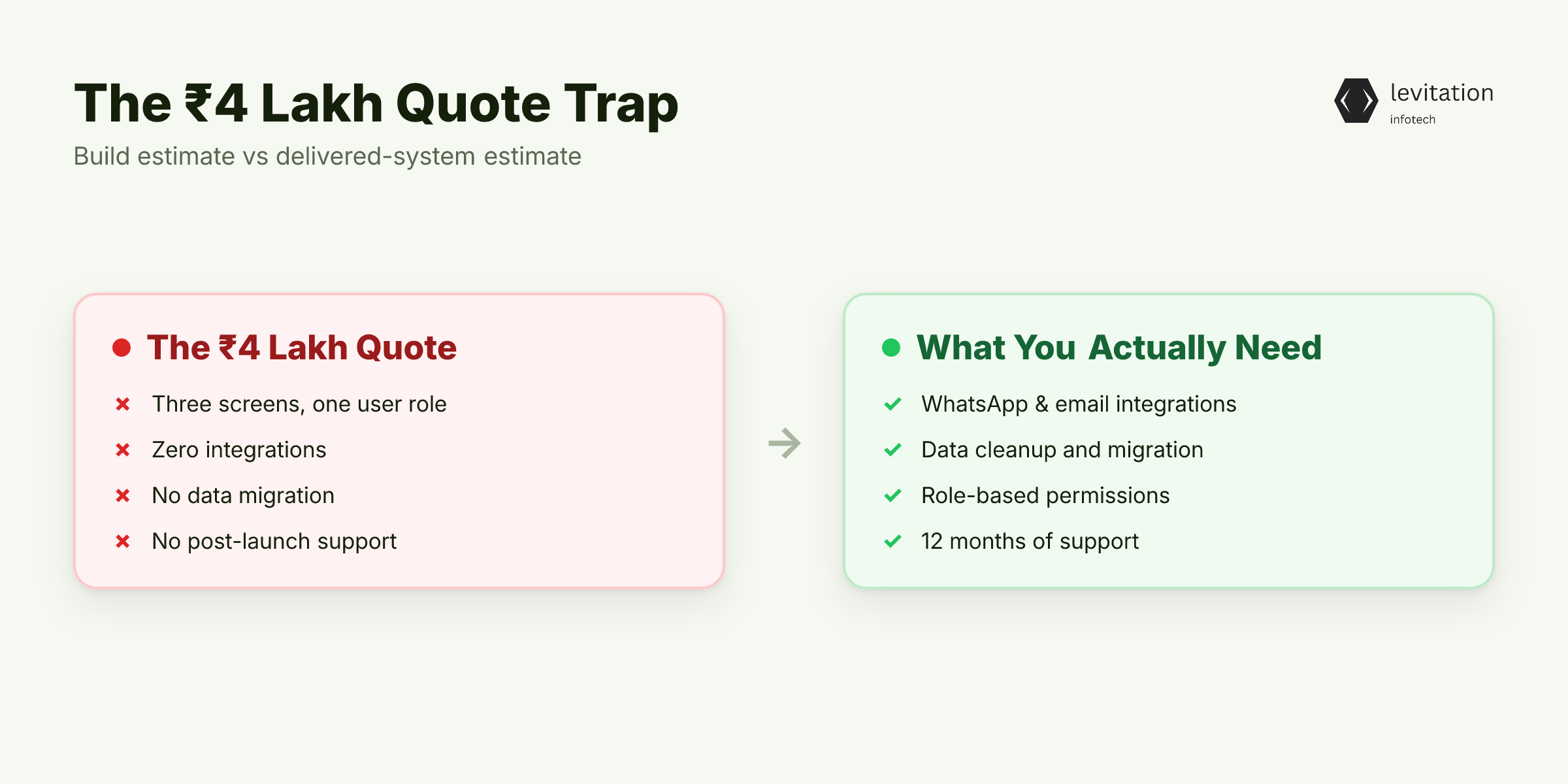
Vendors who quote low scope the happy path. Three screens. One user role. Zero integrations.
No data migration. No post-launch support. What they are selling is a demo, dressed up as a project.
You will get something that works in a sales meeting. You will not get something your reps will use on a Monday morning.
The first cost of CRM development quote you receive is rarely a delivered-system estimate. It is a build estimate. The difference between the two is where most of the budget leak happens.
Build estimates skip integrations, skip data cleanup, skip role-based permissions, and skip the 12 months of support your system needs after go-live.
Here is the trap in plain language. A vendor quotes ₹4 lakh to build three modules. You sign.
By month two, you need WhatsApp integration, email sync, and a fourth user role. Each of these becomes a change request.
Change requests are billed hourly. The ₹4 lakh project becomes a ₹9 lakh project. The vendor's margin on the change orders is higher than the margin on the original build.
This is also why so many Indian CRM projects hit 2x budget by month six. The scope was never real in the first place.
The price gap between ₹4 lakh and ₹12 lakh is not arbitrary. It is a mirror of scope. And the scope gap hides in line items most founders never ask about.
Where Cheap Quotes Collapse: GST, Onboarding, and the AI Surprise
Three line items make cheap CRM quotes collapse. Every one of them shows up after the contract is signed.
First, GST. Every Indian CRM subscription carries 18% GST on top of the listed price. This applies whether the vendor is Indian or global. The ₹4 lakh quote becomes ₹4.72 lakh the moment the invoice is raised. The ₹12 lakh quote becomes ₹14.16 lakh. The percentage is identical. The absolute gap just got wider.
Second, implementation and onboarding. Add-ons and integrations alone can inflate total investment by 20-40% above the subscription price. This includes data migration from spreadsheets and third-party API integrations. It also includes user training and the project management overhead that nobody prices into the headline number. The CRM development cost line is rarely the line you actually pay.
Third, AI features billed separately. AI is the most common demo-to-invoice surprise in CRM deals today. Vendors quote a base price that covers contact management, deal pipeline, and basic reporting. The moment you ask for lead scoring, sentiment analysis, or AI-generated email drafts, the quote balloons. AI is sold as a separate add-on, often priced per user each month. Usage tiers sit in the fine print, hidden until the first invoice arrives.
Once you add these three line items, the custom CRM cost on the cheap quote lands between ₹5.5 lakh and ₹7 lakh. That is after GST and implementation are counted, and before AI features are priced in.
The pattern that separates vendors who deliver from vendors who demo is straightforward. Long-running production systems share one trait: the original quote priced maintenance, hosting, and integrations up front. The vendors who price those as extras are the vendors who disappear in year two.
So what exactly is the ₹12 lakh vendor charging you for?
What a ₹12 Lakh Quote Actually Buys You
The ₹12 lakh quote is not a higher price for the same thing. It is a different thing entirely. Here is what the higher number is actually buying.
At the small end, a 3-user custom CRM starts around ₹1.5 lakh plus hosting. For a 10-user build with growing needs, ₹3 lakh plus hosting is the realistic floor. Payback arrives in about 1.5 years. At 25+ users with unique processes, custom CRM software development starts at ₹6 lakh plus hosting.
The numbers that flip the conversation are at 25+ users. Off-the-shelf platforms cross ₹30 lakh once you stack per-user licensing, AI add-ons, and integration work. A custom build holds at ₹6 lakh plus hosting. The gap between ₹6 lakh and ₹30 lakh is where the ₹12 lakh quote earns its keep. The higher vendor has priced for a system that will not buckle when the user count doubles or the workflow gets specific.
The higher quote typically bundles line items the cheap quote treats as extras: - Multi-role permissions for sales, ops, finance, and admin teams - ERP, WhatsApp, and email integrations as core scope, not change requests - Data migration from spreadsheets or legacy tools, including cleanup - 12 months of post-launch support covering bug fixes and minor changes - Hosting, SSL, and basic monitoring on a managed infrastructure stack
The distinction that matters is that enterprise CRM development scoped for production includes the unglamorous plumbing. Audit trails. Role-based access. Backup policies. Disaster recovery. These are the line items that decide whether your system is usable in year three, or abandoned for spreadsheets by month eight.
Vendors who treat every line item like an auditor share one trait. Every recurring cost is named, and every scope boundary is on paper.
The ₹4 lakh quote is a handshake. The ₹12 lakh quote is a contract you can hold the vendor to.
Numbers without a checklist are noise. Here is the line-by-line framework to read any CRM quote in under ten minutes.
How to Decode Any CRM Quote Before You Sign
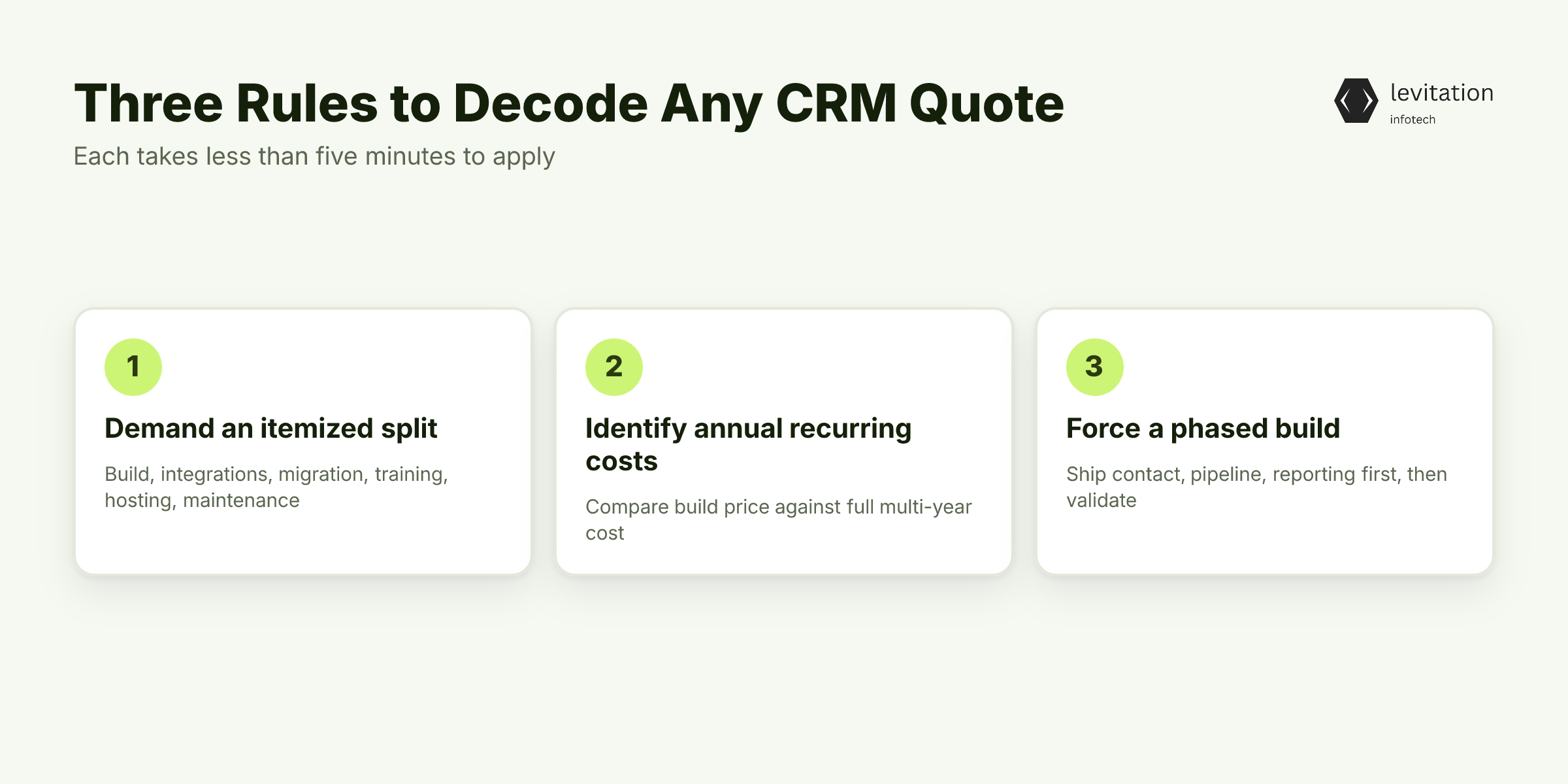
Three rules will save you from signing the wrong quote. Each one takes less than five minutes to apply.
Rule one: demand an itemized split. Every quote should break out build cost, integrations, data migration, training, hosting, and annual maintenance as separate line items. If the vendor cannot produce this breakdown, the quote is a sales tool, not a project estimate. An itemized split lets you compare custom CRM vendors on the same axis. You stop comparing one vendor's bundled price against another's unbundled price.
Rule two: identify what recurs annually. A quote with high annual maintenance can quickly exceed a higher build quote with lower annual costs over three years. Most founders only look at the build cost. The vendors know this. The vendors price accordingly. When you compare CRM pricing, weigh the build cost against the full multi-year cost. That is the real number.
Rule three: force a phased build. Phase one should ship contact management, deal pipeline, and basic reporting. Nothing else. Validate with real users before phase two begins. This pattern is the single most effective cost control in any CRM project. It stops you from paying for features nobody uses. It also gives the vendor real production feedback before they commit to phase two scope.
The compliance angle is the one most founders miss. Production-grade compliance work treats audit trails, role-based access, and data residency as line items, not optional extras.
Cheap vendors skip them entirely. When your first compliance review arrives, those omissions become change requests priced at emergency rates. And the vendor who quoted low at the start will quote highest at the moment you have no leverage to walk away.
Phasing changes the conversation from "can we afford ₹12 lakh?" to "can we afford to skip validation and rebuild in 18 months?"
The Phased Build That Beats Both Extremes
The phased build is the only pattern that consistently works at Indian scale. Here is what the two phases actually look like.
Phase 1: contact management, deal pipeline, basic reporting. This is the minimum that a sales team will actually use daily. It is also the minimum that proves whether the vendor can deliver before you commit more budget.
Phase 1 should ship quickly. If the vendor cannot ship phase 1 in a short window, they will not ship phase 2 on a longer one.
Phase 2: automation, integrations, AI features. Add these only after the team has generated six months of real usage data. Real usage data tells you which integrations matter, which AI features get used, and which workflows need rework. Data from a conference room cannot do that.
This pattern avoids the common failure mode where enterprise CRM projects ship features nobody touches. The failure happens because scope was decided in a meeting, not on the floor.
When your reps log into the system daily, you know which features to fund. When your reps still use WhatsApp and Excel, you know the system failed.
The connection to long-term system health is direct. Long-running production systems almost always followed a phased delivery.
Vendors who push you to commit to all 12 features in one go are the same vendors whose CRM systems get replaced in year two. The vendors who accept a phased build are the vendors who will still answer your call in year three.
For CRM application work, the same logic applies. Phase 1 proves the vendor. Phase 2 proves the system.
Skip the validation step and you end up rebuilding 18 months later.
Run the math this way and the choice stops being about price. It becomes about which vendor will still answer your call in year three.
What Changes When You Stop Optimizing for the Cheapest Number
Three things change when founders stop chasing the lowest quote.
Total cost of ownership drops. Founders paying ₹12 lakh up front often spend less over three years than founders paying ₹4 lakh plus three rounds of fix-it change requests. The math is simple once you include maintenance, support, and the opportunity cost of an abandoned system.
The CRM integration work, the data migration, and the role-based permissions are paid for once. They are not patched in over 18 months.
Adoption rises. A CRM that matches your actual sales motion gets used. A CRM built to a generic spec gets abandoned for spreadsheets within six months.
Vendors who scope to your workflow deliver systems your team opens every morning. Vendors who quote from a template deliver systems your team avoids.
Decision-making gets faster. A single source of truth means your sales, ops, and finance teams stop arguing over whose numbers are right. When CRM development price is treated as an investment in clarity, the ROI shows up in every weekly review.
This is what disciplined scoping looks like in practice. Vendors who price line by line, not by template, understand that operational clarity at scale is a direct output of how the original quote was structured. It is not an output of how aggressive the discount was.
Founders who stop optimizing for the cheapest number also stop replacing systems in 18 months. They also stop watching CRM budgets sabotage delivery. The pattern repeats across industries because the cause is the same. The quote was never real.
The right vendor surfaces once you compare line items, three-year totals, and the phased plan.
Frequently Asked Questions
Q: How much does it actually cost to build a CRM in India in 2026?
A: A custom CRM for 3 users starts around ₹1.5 lakh plus hosting. For 10 users, expect ₹3 lakh plus hosting. For 25+ users with unique workflows, ₹6 lakh plus hosting is the realistic floor. Add 18% GST, integrations, and data migration on top.
Q: Why do two Noida vendors give quotes that differ by ₹8 lakh for the same CRM?
A: The cheaper quote typically scopes a prototype: three screens, one role, no integrations, no data migration, and no post-launch support. The higher quote covers a production system with multi-role permissions, integrations, onboarding, and a 12-month support window.
Q: Is it cheaper to buy Salesforce or Zoho than to build a custom CRM?
A: Only at very small scale. For 25+ users with unique processes, off-the-shelf platforms cross ₹30 lakh once you add per-user licensing, AI add-ons, and integration work. A custom CRM holds around ₹6 lakh plus hosting at the same scale.
Q: What hidden costs do CRM vendors rarely put in the headline quote?
A: Three line items: 18% GST, 20-40% implementation and onboarding overhead above the listed price, and AI features billed as a separate add-on. Together they routinely push a cheap quote up by 40-70% or more.
Q: What is the smartest way to scope a custom CRM to control cost?
A: Build in two phases. Phase one ships contact management, deal pipeline, and basic reporting, the minimum your team will actually use. Phase two adds automation, integrations, and AI only after six months of real usage data. This avoids the common failure mode of enterprise CRM projects shipping features nobody touches.
About the author
Mayank Singh is a software developer at Levitation Infotech, where he builds web and AI-powered applications across the company’s fintech, healthcare, and enterprise projects.