


TL;DR: A ₹50,000 chatbot quote and an ₹8 lakh quote look like they're pricing the same product, but they're actually selling different scopes. The cheap one prices the demo. The expensive one prices deployment, integration, multilingual NLP, retraining, and compliance. Founders who compare sticker prices get exactly the bot those prices describe: a demo or a system.
Key Takeaways: - Two quotes at 16x the price can both be honest if they cover different scopes. The conflict is in what's missing, not what's marked up. - The bot itself is a fraction of the real cost. Integrations, language work, training data, and maintenance drive the rest. - Six cost drivers compound, which is why the Indian market clusters into three tiers, not a smooth curve.
Two Quotes, One Bot: The ₹50,000 vs ₹8 Lakh Illusion
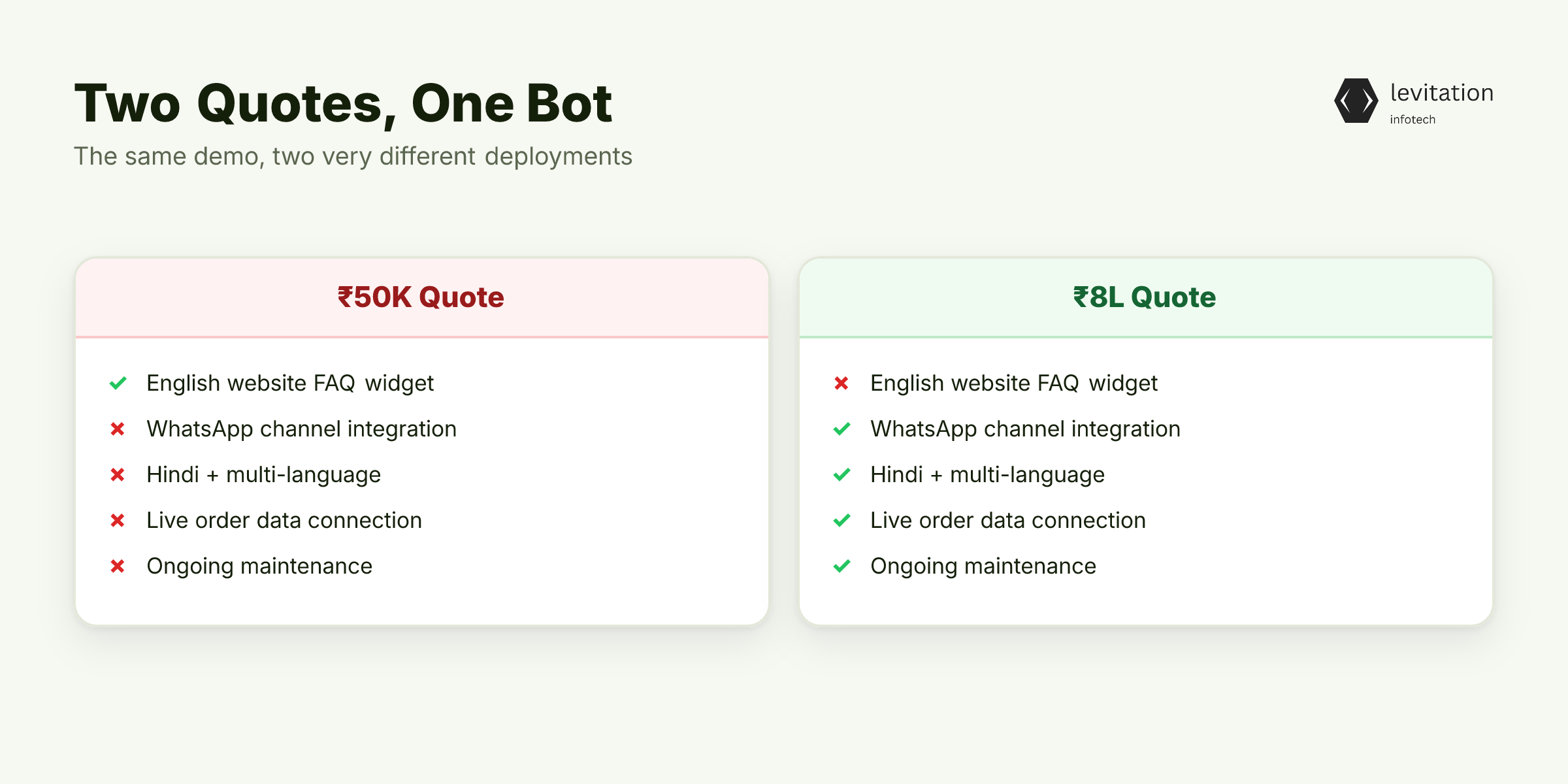
Two Indian chatbot vendors quoted a founder ₹50,000 and ₹8,00,000 for what looked like the same bot. Both were telling the truth.
Both were also hiding something, just in different ways. The cheaper quote omitted the work. The expensive one absorbed it.
This is the pricing math no vendor puts in the proposal. Founders see two numbers on a page, pick the lower one, and never ask the only question that matters: what's not in this line item?
The default reaction is human. ₹50K feels safe. ₹8 lakh feels like someone is padding the invoice.
So the founder picks the lower one, signs the contract, and watches the same vendor return in month three with a change request for unbudgeted WhatsApp integration work. By month six, the total has crossed the higher quote, and the bot still doesn't speak Hindi.
The trap isn't fraud. The trap is that the cheap quote is pricing the demo, not the deployment.
It's covering a bot that answers a small set of FAQs in English on a website widget. The ₹8 lakh quote is covering a system that handles real conversations on WhatsApp, in two languages, against live order data, with someone on the other end maintaining it.
The right question isn't "which is cheaper." It's "which quote is complete." That single reframe separates founders who ship bots from founders who rebuild them. For a detailed breakdown of what fills that gap, see the guide on AI chatbot development cost in India.
The reason the gap is so wide isn't markup or dishonesty. The two quotes are selling different things, and the cheap one skips four line items that surface later as change orders in month three.
Why Cheap Quotes Aren't Cheaper: The Hidden Cost Stack
Indian vendor pitches start at ₹50K. Real deployments at meaningful scale run 6-20x that figure once you add integration, multilingual support, training, and ongoing operations.
That gap isn't vendor greed. It's the cost of work the proposal never mentioned.
Four line items appear in almost every low quote, then never get built: - CRM and API integration. Your bot has to read order history, check inventory, or create support tickets. Every system it touches is integration work, and most estimates skip it. - Indian language support. Hindi plus a regional language isn't a translation toggle. Each additional language requires its own training corpus, evaluation set, and fallback rules. Most low quotes treat multilingual work as a "phase two" line. - Model training on your data. Your 50,000 support tickets, product docs, and policy pages are the corpus. Cleaning, structuring, and versioning that data is unbillable hours the cheap quote absorbs into "training." - Monthly maintenance and retraining. Every model drifts. Someone has to monitor it, retrain it, and fix the queries it gets wrong. Cheap quotes assume you'll figure that out later.
A ₹3 lakh "student communication chatbot" often lands at ₹8-15 lakh in year one once WhatsApp Business API fees, regional language NLP, and retraining cycles are added. The bot itself is a fraction of the real cost. The rest is plumbing nobody quotes upfront.
This pattern is the same one Levitation's research into the three hidden costs that triple AI development in India documents for broader AI projects. Chatbots just compress the curve.
The full picture of what drives these numbers is covered in AI development services and detailed in the chatbot development cost breakdown.
What actually drives the final number? Six variables. Every quote you've received is a different combination of them.
The Six Cost Drivers That Decide Your Final Invoice
These six drivers don't move independently. Each one multiplies the work for the others, which is why quotes cluster into tight bands rather than spreading evenly.
Driver 1: Conversation design depth. A rule-based decision tree with a handful of branches is a weekend build. An LLM-powered multi-intent flow that handles refunds, complaints, and product discovery in the same conversation is a multi-week build.
This is the single biggest cost swing.
Driver 2: Training data and corpus. A vendor with no proprietary data on your business builds a generic bot. Uploading support tickets, product specs, and policy docs means data cleaning, embedding work, and retrieval tuning.
The corpus is the moat, and building it costs real money.
Driver 3: Channel surface. A website widget is one integration. WhatsApp, Instagram, mobile app, and IVR are four, each with its own message format, rate limits, and authentication quirks. Channel count compounds integration cost as each new surface brings its own integration burden.
Driver 4: Language scope. English only is one NLP pipeline. Hindi plus regional languages adds separate training corpora, evaluation sets, and fallback rules per language, and the work scales with each language you add.
Driver 5: Backend integration depth. A read-only FAQ bot touches nothing. A bot that pulls live order status, processes payments, and creates CRM tickets touches everything. Each integration is a failure mode waiting to happen.
Driver 6: Compliance and security. Standard SaaS hosting is one cost. Regulated-industry requirements like audit trails, encryption at rest, and on-prem hosting for sensitive data represent a different cost stack.
This driver alone can dominate the baseline. The controls, documentation, and hosting overhead stack on top of every other driver and apply across the whole engagement.
The compounding matters because vendors don't price drivers independently. They price the bundle.
When you ask for a quote, you're asking "which combination of these six did this vendor assume?" The conversational AI cost data shows the assumption mix varies wildly.
These six drivers don't move independently. They compound. That compounding produces a narrow band of real outcomes, which is why the Indian market has settled into three distinct budget tiers rather than a smooth pricing curve.
The Three Real Budget Tiers for Indian Businesses in 2026
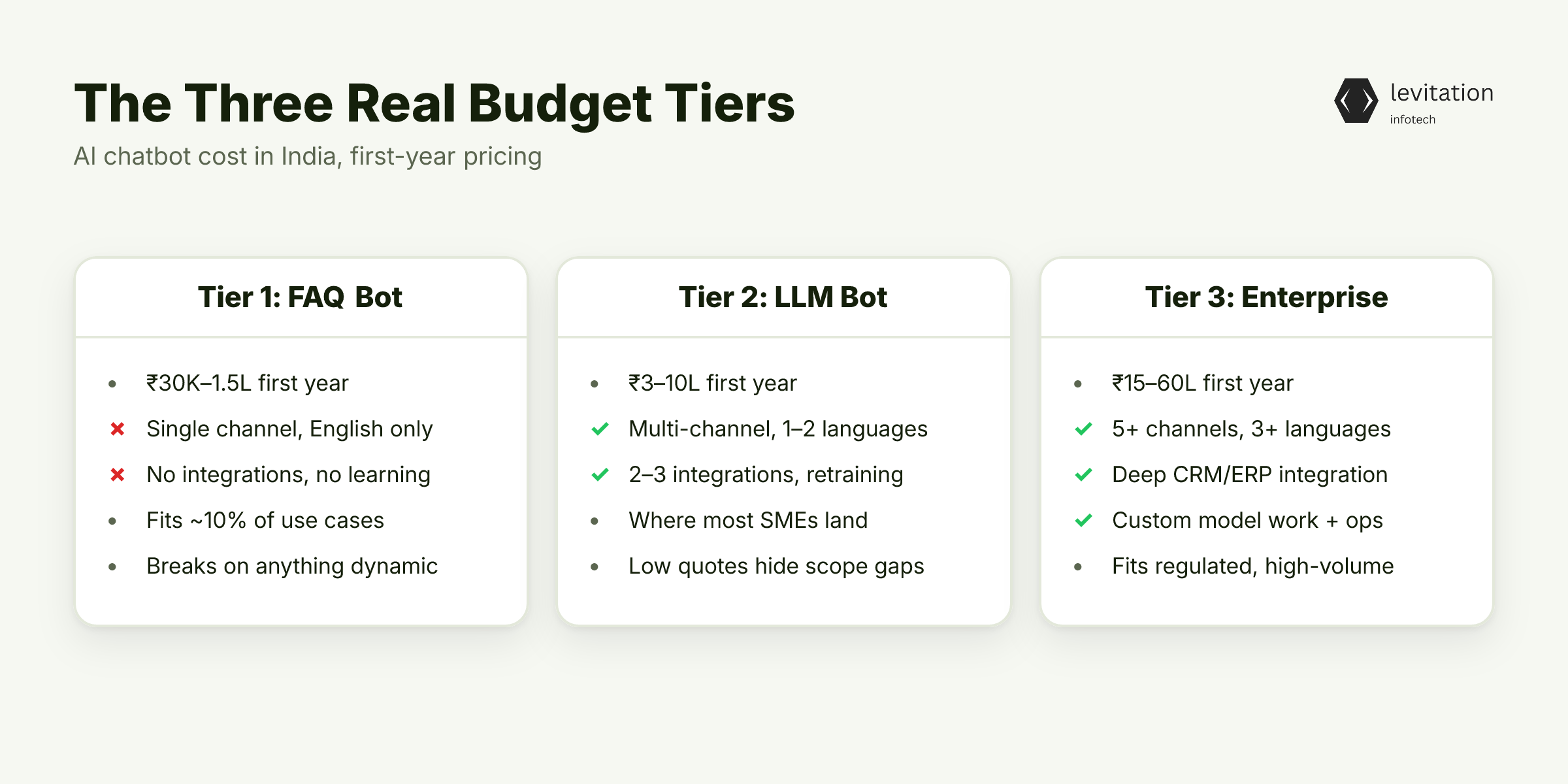
Forget the smooth pricing curve. The Indian market has settled into three tiers, and knowing which one your project actually needs is the difference between a working bot and a write-off.
Tier 1: Rule-based FAQ bot, ₹30K-1.5 lakh first year. Single channel, English, no integrations, no learning. This works for maybe 10% of use cases: a static help center for a SaaS product, an after-hours website widget, a one-page lead capture flow.
Anything dynamic breaks it.
Tier 2: Smart LLM-backed bot, ₹3-10 lakh first year. Multi-channel, one to two languages, two to three integrations, monthly retraining. This is where most Indian SMEs actually need to land.
It handles WhatsApp, understands Hindi, pulls order data, and gets smarter every month. A quote at the low end of this tier that promises the full scope is a common pattern in vendor pitches, and the gap is almost always filled by change orders for omitted work.
Tier 3: Enterprise conversational AI, ₹15-60 lakh first year. Five or more channels, three or more languages, deep CRM and ERP integration, custom model work, dedicated ops. This is what the ₹8 lakh quote is actually describing when it's honest.
It matches regulated industries, high-volume customer support, and bots that touch payment or health data.
The common mistake is quoting a Tier 1 budget for Tier 2 work. The vendor wins the deal, then sends change orders for every line item the original scope left out.
The chatbot cost in India tier comparison shows how often this exact bait-and-switch plays out. For projects that need real custom work, custom AI development engagements typically price closer to Tier 2 or 3 from day one.
Knowing the tiers is useless if you can't tell which tier a vendor is actually quoting you. Here's the 15-minute evaluation framework that separates real proposals from sales decks.
How to Decode Any Chatbot Quote in 15 Minutes
Most founders take 30 days to evaluate a chatbot quote. They should take 15 minutes. The right questions expose the scope in one call.
Seven questions to ask before signing anything: - What channels does this cover, and is each one priced separately or bundled? - Which languages, and what happens when a user switches mid-conversation? - Which systems does the bot read from and write to? - What training data are you using, and who prepares it? - Where is it hosted, and who owns the data? - How often is the model retrained, and what's the trigger? - What's the support SLA after launch, and what does it cost monthly?
Three red flags tell you to walk away: - No LLM or framework named. If the quote doesn't specify the model, vector store, or orchestration layer, the vendor is reselling a third-party SaaS at a markup you cannot evaluate without knowing the underlying product, and you have no way to compare what you're actually buying. - Custom pricing with no line items. Every legitimate proposal from an AI development company breaks down by the six drivers. A single number with "includes everything" is a scope you'll discover the hard way. - No mention of retraining or model drift. Any proposal that doesn't address ongoing model degradation is selling you a launch, not a system.
Build a one-page comparison matrix. Email it to every vendor before the second call. The one who fills it out honestly is the one worth meeting.
When is the ₹8 lakh quote genuinely the right one, and when is it vendor overreach? It depends on your use case.
When the ₹8 Lakh Quote Is the Right One (and When It Isn't)
The expensive quote isn't always right. But it's always a signal. The signal is either "this vendor knows what it costs to do this properly" or "this vendor wants to bill you for capacity you'll never use." The trick is reading the signal correctly.
It's justified when the bot touches regulated data. Healthcare bots handling patient triage, banking bots touching KYC or payment flows, and insurance bots processing claims all need audit trails, encryption at rest, and on-prem hosting options.
Compliance work alone can dominate the baseline. Audit trails, encryption, documentation, and hosting reviews are separate workstreams that apply across the entire build, not as optional add-ons.
There is no honest way to price regulated data handling at the same rate as a read-only FAQ widget.
It's oversold when the use case is simple. A D2C brand wanting a WhatsApp order-status bot doesn't need Tier 3 architecture.
The ₹8 lakh quote is selling multi-language, multi-channel, custom-model capacity for a bot that only needs to answer "where's my order?" in Hindi. That's Tier 2 work, priced as Tier 3.
The founder test is simple: if your bot handles money, health data, or legal commitments, pay for the higher tier. The compliance work, audit trails, and security reviews are non-negotiable.
If it handles product discovery and FAQs, a properly scoped Tier 2 with good training will outperform the overbuilt version. For a clear-eyed look at enterprise AI development requirements, the scope signal matters more than the vendor's portfolio.
For WhatsApp-specific deployments, the WhatsApp chatbot cost breakdown shows where Tier 2 ends and Tier 3 begins.
Pick the right tier, negotiate the right scope, and what you actually get is something the cheap-quote crowd never sees: a chatbot that still works 18 months later.
What a Properly Priced Chatbot Actually Buys You
The cheap chatbot stops working when your first product change ships. A properly scoped one keeps learning from real conversations and adapting to the queries you didn't anticipate.
That difference isn't visible at launch. It's visible at month 12.
Long-term partnership quality matters more than launch speed. Vendors who price for the long term build retraining discipline into the engagement.
Vendors who price for launch day do not. Their bots drift into uselessness by month 18 and get replaced before the next product cycle.
The right framing is this: you're not buying a bot. You're buying 24 months of conversation quality, integration maintenance, and retraining discipline.
The AI consulting engagement that prices for the long term is the one that survives the long term. The quote that prices for launch day is the one that needs replacing by month 18.
Founders who get this right stop asking "how cheap can this be?" and start asking "what does month 18 look like?" The first question gets you a demo. The second gets you a system.
Frequently Asked Questions
Why do AI chatbot development quotes in India vary so much?
Quotes vary because vendors are pricing different scopes. A ₹50K proposal typically covers a rule-based English FAQ bot on one channel, while an ₹8 lakh proposal covers an LLM-backed multilingual bot with CRM integration, retraining, and compliance work. Same word, completely different product.
Is a ₹50,000 AI chatbot worth it for a startup?
Only if your use case is genuinely simple: a small FAQ set, one channel, English only, no payment or account data. For anything that touches orders, bookings, or patient data, a ₹50K bot will need a rebuild once the first product change or integration requirement lands, making the real lifetime cost much higher than a properly scoped Tier 2 build.
What is a realistic chatbot development cost for an Indian SME in 2026?
For a serious SME deployment, realistic first-year costs cluster between ₹3 lakh and ₹10 lakh. That range covers WhatsApp plus web, Hindi plus English, two backend integrations, and monthly retraining. Anything quoted far below this is either a template resell or a quote missing four of the six cost drivers.
What is usually missing from cheap chatbot quotes?
Four items appear in almost every low quote. WhatsApp Business API fees, regional language NLP training, integration with your CRM or order system, and any mention of model retraining.
Each of those four items has its own cost structure that the original scope omitted. Together, they push the year-one total well past the original quote.
How long does a ₹5-8 lakh chatbot project take from kickoff to launch?
For a properly scoped Tier 2 deployment, expect a multi-month build: time for discovery and conversation design, a longer build and integration phase, UAT and language tuning, and a final production launch with monitoring setup. Quotes promising delivery in a couple of weeks for this scope are either cutting corners or quoting a much smaller build.
About the author
Mayank Singh is a software developer at Levitation Infotech, where he builds web and AI-powered applications across the company’s fintech, healthcare, and enterprise projects.