


TL;DR: Most Indian AI quotes under ₹10 lakh aren't projects. They're three items: a UI, an API key, and a deploy. Real AI projects need line items for data work, evaluation, MLOps, and retraining that vendors silently drop. Once founders learn to read quotes like engineering leads, the "cheapest" option becomes the most expensive mistake.
Key Takeaways: - A ₹6 lakh AI quote is a feature price, not a project price. It covers three items, not a system. - Real AI projects carry annual operating costs on top of build costs. No Year 2 line means the quote is incomplete. - Comparing AI quotes without normalizing scope across Discovery, Build, and Operate phases is like comparing a bicycle to a motorcycle.
The ₹6 Lakh Quote Is a Frontend, an API Key, and a Login Screen
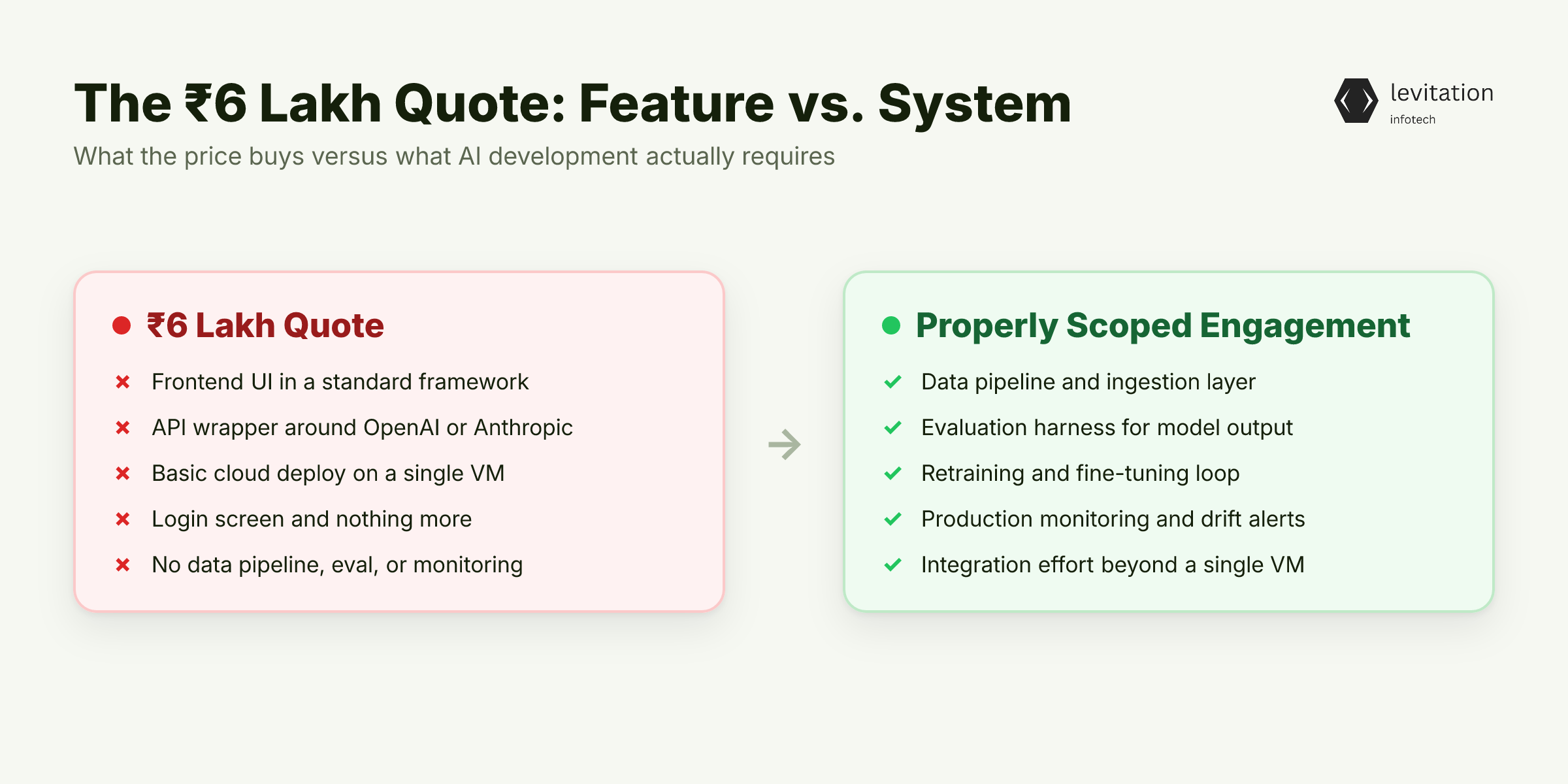
The pattern repeats across Noida's AI vendor market. Quotes at the ₹6 lakh level cover a frontend, an API wrapper, and a login screen. The ₹6 lakh didn't include the data pipeline, the evaluation harness, the retraining loop, or the production monitoring.
That's a feature, not a system. Vendors sell it as "AI development" because the word unlocks budget. What you're buying in an AI development services engagement at that price is three concrete deliverables: - A user interface built in a standard framework - An API integration with OpenAI, Anthropic, or an open-source model - A basic cloud deploy on a single VM or managed service
None of those is AI development in any meaningful sense. None requires a data pipeline, a fine-tuning loop, or an evaluation harness. None survives the first month of real production traffic without silent failures that nobody catches.
Most founders read "₹6 lakh for AI app" as a project price. It was a feature price. The same gap exists across the Indian vendor market. Most founders never see it until the project breaks.
A properly scoped AI development services engagement reflects the data work, evaluation harness, and integration effort that a lump-sum quote skips. That's why the ₹6 lakh price point should signal missing scope, not a bargain.
The dangerous part isn't the price tag. It's that the quote looks complete, with line items, GST, and a delivery date. So why does the project still fail six months later?
Why the Cheapest Quote Is the Most Expensive Mistake in AI
Because a delivery date in AI isn't a finish line. It's a starting gun. The model is a living component that drifts, degrades, and hallucinates differently every quarter.
A "delivered" AI system that's never been evaluated against production traffic is a liability wearing a launch-day costume.
This is where the cheap quote dies in silence. There's no Year 2 line, because the vendor stopped counting. Annual operating costs grow with each quarter the system stays in production, since models drift, data shifts, and infrastructure scales.
No lump-sum quote acknowledges this compounding cost.
Founders compare three Noida quotes the wrong way. They line up the headline numbers and pick the lowest. That's like comparing a bicycle to a motorcycle because both have two wheels.
One carries a passenger to the next village. The other carries a system to production and keeps it there for years.
Custom AI development is sold in deliverables, not durations. The deliverables that compound over time are the boring ones: the evaluation harness, the monitoring stack, the retraining loop, the integration glue. Skip them, and the system you launch in month three is the system that breaks in month nine.
Well-scoped systems survive in production for years. They were scoped as systems from day one, with line items for the work that doesn't show up in a demo.
If a ₹6 lakh quote isn't a real project, then what is? And what should a real one look like?
What Actually Goes Into a Production AI Project
A real AI project starts before code. It starts with a question most vendors skip to get to the build faster: what does success look like, and how will we know we hit it?
Problem framing and success metrics
No vendor quotes this. Every founder assumes it. The cost is hidden inside "discovery," if discovery even happens.
Without a sharp problem statement and measurable success criteria, every downstream decision is a guess.
Data pipeline and labeling
This is the silent cost driver. In real ai software development engagements, data work routinely consumes the largest share of the budget. Labeling, cleaning, schema design, and pipeline reliability all compound across the project lifecycle.
The model itself is rarely the most expensive part. The data feeding it is. Cheap quotes skip this line because the founder doesn't ask about it.
Model selection, fine-tuning, and evaluation harness
A demo proves the model can answer one question. A system proves the model answers ten thousand questions without breaking the contract. The evaluation harness makes the difference by catching regressions before users do.
No ₹6 lakh quote builds one.
MLOps, monitoring, and retraining
Retraining budgets grow with model complexity and data volume. Monitoring, drift detection, and pipeline maintenance add costs that match the scale of the original build.
Cheap quotes treat this as "later." Later is a 12-month-old project that no one on the team owns anymore.
Change management
The least visible line item. Getting the organization to actually use the system, through training, process redesign, and internal adoption, can run a large share of total program cost. These efforts require sustained attention over months.
This is the work vendors never quote because founders never ask for it.
Properly scoped enterprise deployments go through a breakdown before a single line of code is written. That breakdown is what makes the rest of the project survive.
Now you know what's missing. The deeper problem is that most Indian AI vendors don't even break out these items. They hand you a single lump sum and call it a day. So which line items get quietly dropped?
The Cost Line Items No Indian Vendor Quotes First
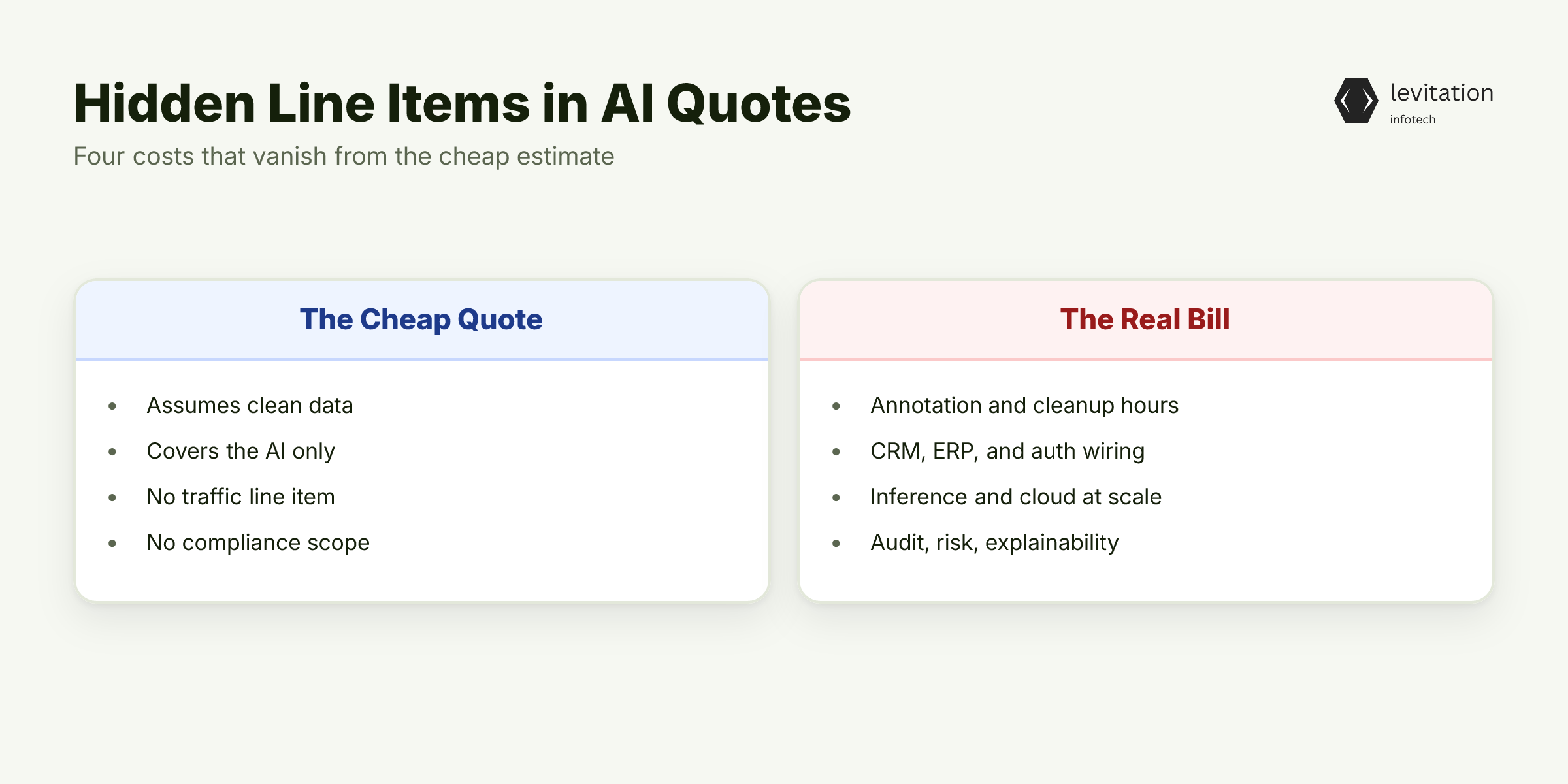
The pattern is consistent across the Noida vendor market. Four line items disappear from almost every cheap quote.
Data preparation and annotation
The vendor assumes you have clean data. You don't. Every founder discovers this in week three of the project, when the vendor sends a bill for "data readiness work" that was never in the original scope.
The real cost is the hundreds of engineering hours to structure, clean, and label what you thought was already structured.
Integration with existing systems
The quote covered the AI. It didn't cover connecting the AI to your CRM, your ERP, your payment rails, or your auth layer.
Enterprise AI development estimates routinely multiply the original number once integration scope becomes real. Every system has its own auth model, its own data shape, and its own opinions about latency. None of that fits into a frontend-API-deploy package.
Post-deployment inference and cloud costs
Production AI infrastructure costs scale with traffic and inference volume. This is the line where the ₹6 lakh quote dies. The founder launches the system, sees the AWS bill, and discovers that real traffic costs real money.
There's no line for this in the original quote because the vendor never planned for production scale. We have written before about how Noida's ₹6 lakh apps quietly become down payments for the real system that follows.
Security, compliance, and audit trails
Banks don't deploy AI without model risk management, audit logs, and explainability hooks. Security-critical deployments in regulated industries only happen because security, compliance, and audit are first-class line items in every quote. They are not afterthoughts added in week eleven.
If your quote doesn't carry these, the project isn't ready for any regulated environment.
The missing line items are predictable. How do you spot a quote that has them versus one that doesn't, in the five minutes you actually have to evaluate?
How to Read an AI Quote Like an Engineering Lead
You don't need to be technical. You need a checklist. Eight line items should appear in any serious AI proposal: - Problem framing and success metrics - Data preparation and labeling work - Model development or selection rationale - Evaluation harness with measurable thresholds - Integration with existing systems - MLOps and monitoring stack - Retraining cadence and ownership - Change management and adoption support
If three of those are missing, the quote is selling three items, not a project. The quote you sign in month one determines whether you pay once or twice.
The "three-bucket" test is faster. Read the quote, then ask one question: does it separate Discovery, Build, and Operate phases? A real project phases work because each phase carries different risk profiles.
Discovery is cheap and high-uncertainty. Build is expensive and high-uncertainty. Operate is predictable and ongoing.
A single lump sum collapses three different cost structures into one number. That's why it almost always undersells the project.
The single question that exposes incomplete quotes: "What does the system need to keep working in month 13?" If the vendor can't answer that with specific line items for retraining, monitoring, and support, the quote is incomplete by definition. Similar patterns appear in Noida quotes that exclude critical APIs entirely.
Now that you can read a quote, you can push vendors to write one in the format you actually need. The structure that separates real AI consulting from feature shops has a recognizable shape.
The Quote Format That Signals a Real AI Company
A legitimate ai solution development proposal has four phases, not one.
Discovery
Two to four weeks of problem framing, data assessment, and success metrics. Output: a one-page spec that the vendor signs against. No build starts until this is approved.
Build
The actual engineering work. Model development, integration, evaluation harness, deploy. Output: a system that passes the metrics defined in Discovery.
Harden
Production readiness. Load testing, security review, monitoring setup, retraining pipeline. Output: a system that survives real traffic without silent failures.
Operate
Ongoing. Monitoring, retraining, support, model updates. Output: a system that gets better over time instead of degrading.
The same pattern shows up in tools like QuoteIQ's AI Estimator, which breaks work into individual service line items, confidence scores, and market-accurate pricing. That structure exists because the work itself has structure. A quote that ignores the structure is a quote that ignores the work.
Confidence scores and assumption lists are non-negotiable. They expose what the vendor isn't sure about, which is the part of the project most likely to cost you.
Vendors who don't include them are either inexperienced or hiding risk. Either way, walk away.
The red flag: any vendor who quotes a fixed price for an AI system without a discovery phase is selling three items, not a project. Lump-sum quoting is the norm across most of the Indian vendor market. Scope is artificial, and the second invoice arrives faster than expected.
The vendors who write quotes this way are rarer, and more expensive on paper. What do you actually get 12-18 months later if you sign with one?
What a Properly Scoped AI Project Looks Like at 18 Months
The difference is not subtle. At month 18, a properly scoped system is still in production. The model has been retrained as user behavior shifted.
The evaluation harness has caught regressions before they reached users. The monitoring stack alerted the team to drift events that would have gone silent in a cheaper setup. The system is a compounding asset.
A ₹6 lakh system at month 18 is a frontend wrapper abandoned because inference costs killed unit economics. The login screen still works, and the model still hallucinates. Nobody owns the retraining loop, and the vendor has moved on to the next quote.
The long production lifespan of well-scoped systems isn't a marketing claim. It's the math of compounding engineering. Every evaluation, every retraining cycle, and every integration hardening pass makes the system more valuable.
Cheap systems skip the compounding work and age out in 18 months.
A real ai development company is selling longevity, not launch day. That's the lens founders should use when comparing quotes.
Stop comparing prices. Start comparing structures. The higher quote that carries Discovery, Build, Harden, and Operate is cheaper than the ₹6 lakh quote that delivers three items and a year of firefighting.
If your vendor treats the quote as a sales artifact rather than an engineering artifact, the project will behave the same way. Demand the breakdown. Reject the lump sum.
Annual operating costs are not optional. They're the price of keeping the system alive.
Frequently Asked Questions
How much does AI development actually cost in India?
For a properly scoped project, covering data pipeline, model work, integration, MLOps, and 12 months of operations, costs scale with the depth of data work, the breadth of integration, and the length of operational commitment. A focused feature costs less than a production system. Anything quoted below the threshold of full project scope is almost certainly a subset, not a project.
Why do AI quotes in Noida vary so wildly in price?
Because vendors aren't quoting the same thing. A ₹6 lakh quote typically covers a UI, an API key, and a deploy. A comprehensive quote covers the data layer, evaluation, MLOps, and post-launch retraining. The variance isn't profit margin. It's scope.
What should be included in a real AI development project quote?
Eight line items at minimum: problem framing, data preparation, model development, evaluation harness, integration, MLOps/monitoring, retraining, and change management. If any of these are missing from the quote, they're missing from the project.
Is a ₹6 lakh AI project quote ever legitimate?
Only if it's scoped as a single feature with a hard boundary: a prototype, an internal tool, or a wrapper around a third-party model with no production SLA. For anything customer-facing or revenue-critical, ₹6 lakh buys you three items, not a system.
How do I compare AI quotes from different companies fairly?
Normalize the scope first. Send every vendor the same RFP asking for line items across Discovery, Build, Harden, and Operate phases. Reject any quote that comes back as a single lump sum. You can't compare prices until you're comparing the same list of deliverables.
When the quote reads like an engineering spec, you've found a vendor worth talking to.
About the author
Mayank Singh is a software developer at Levitation Infotech, where he builds web and AI-powered applications across the company’s fintech, healthcare, and enterprise projects.