


TL;DR: A ₹6 lakh Noida app quote covers launch day, not the three years after it. Annual maintenance runs 15-20% of build cost, and change orders push real three-year spend to 1.6× to 1.9× the original quote. Founders who control maintenance clauses before signing control the real bill. The ones who do not fund year two out of operating cash.
Key Takeaways: - The build quote is the smallest cheque you will ever write for that app. Annual maintenance adds 15-20% on top, every year. - A ₹6 lakh Noida app typically carries ₹9.6L-₹11.4L in three-year TCO, not the ₹6L the founder budgeted for. - Six contract clauses (SLA, scope, rate, cap, IP, and exit) decide whether year two is a conversation or a crisis. - Negotiating maintenance before signing the build contract is where founders keep their power. After signing, it is gone.
A ₹6 lakh quote in Noida looks like a win. The same founders who celebrated the build price are quietly signing year-two cheques for ₹1.2 lakh on a product they thought was finished. The build was the easy part.
The ₹6 Lakh Quote Is a Headline Price, Not a Budget
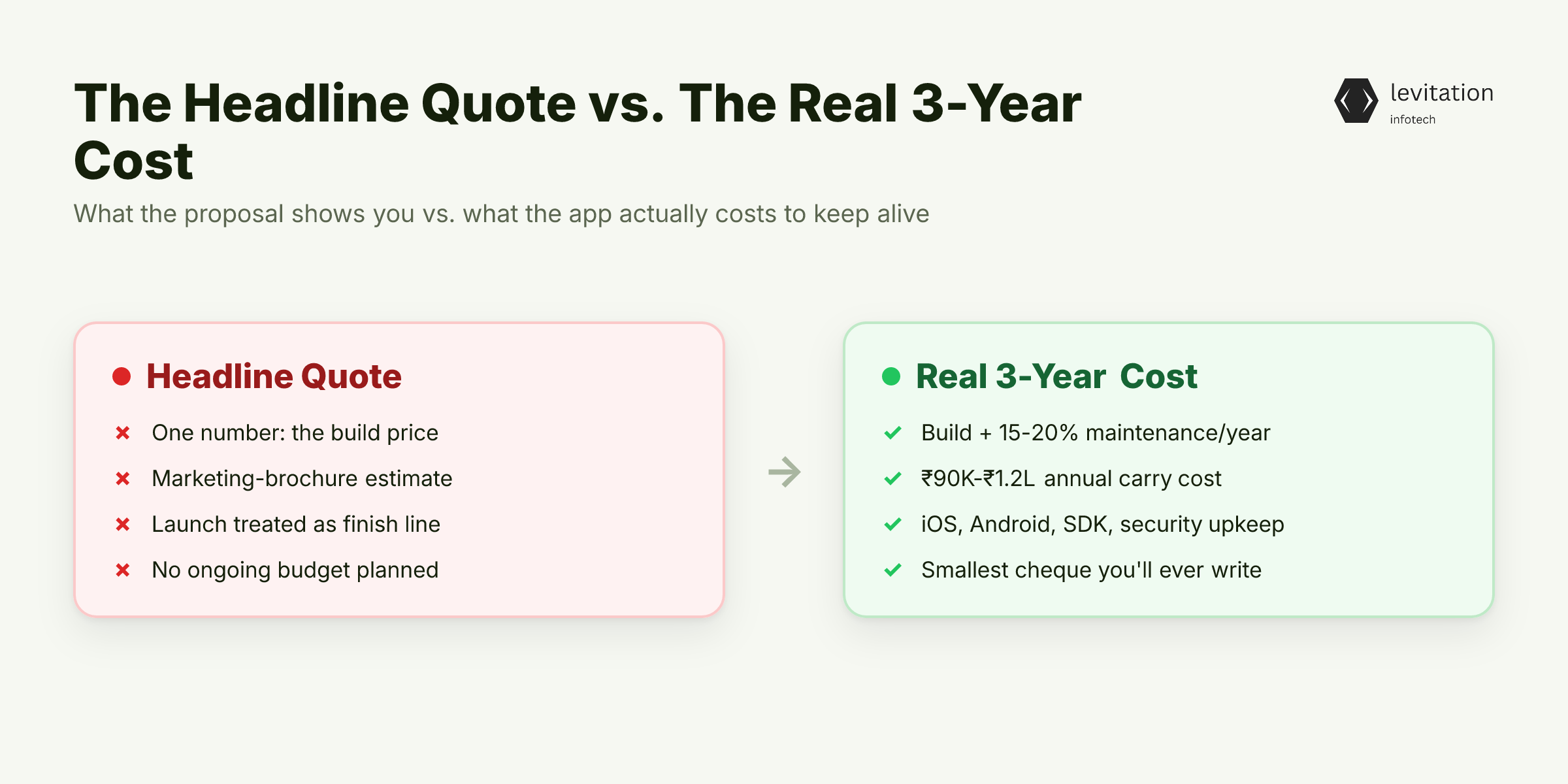
Most Noida agencies quote one number: the build price. That is what gets handed over on launch day.
It is not what it costs to keep the app alive for the next three years. The two figures share a marketing brochure, nothing more.
Industry data puts post-launch maintenance at 15-20% of the original build cost every year. For a ₹6 lakh app, that means an annual carry cost of ₹90,000-₹1.2 lakh. That number is rarely in the proposal that won you the project. It shows up twelve months later, when the first iOS upgrade breaks your checkout screen.
Founders treat launch as the finish line. It is not. The app is just becoming a live system that has to keep up with iOS, Android releases, SDK changes, and security advisories. The headline price buys you a starting point. Everything after is operating cost, the same way a car needs fuel after the showroom.
The quote that won you the project is the smallest number you will ever write for that app. Founders who plan for the full app development cost in India over three years, not just the build month, are the ones still operating in year four. Everyone else is hunting for a new vendor, a new budget, or both.
That percentage is a useful anchor, but it hides the work it has to cover, and the work it quietly does not.
What Year-Two Maintenance Actually Funds (and What It Doesn't)
The 15-20% figure is a bucket. Inside that bucket sit six very different line items, and at least one of them is missing from most contracts. - OS upgrades. Apple and Android ship major versions every year. Compatibility testing, deprecated API migrations, and UI regressions all eat engineering hours. A button that worked in iOS 17 can vanish in iOS 18. Someone has to fix it. - Dependency rot. Node packages, Flutter plugins, and third-party SDKs release breaking changes quarterly. Payment gateways, auth providers, and analytics tools all push updates that ripple through your code. Stale dependencies are how apps get breached. - Security patching. SSL renewals, vulnerability CVE fixes, and penetration-test fixes. For fintech and health apps, this is non-negotiable. A single missed patch can take your app off the Play Store. - Server and infra. Cloud bills, database scaling, CDN costs, and monitoring. These costs scale with usage and user base growth, and represent a separate line from code work. - Bug fixes versus new features. Most contracts only fund bug fixes. A new payment flow, a redesigned onboarding screen, or a compliance change is a change order at hourly rates. The 15% does not cover these. - Compliance drift. If your app touches payments, health data, or any regulated surface, the rules change yearly. The code has to follow.
The other lever agencies use is speed. Faster delivery means the app hits market sooner, and that velocity is part of why founders sign the cheaper quote.
But speed on day one just means maintenance starts sooner, not that the total cost over three years drops. The full mobile app development cost in India is the curve, not the line.
So if 15-20% is supposed to cover all of that, what does the three-year bill actually look like when you stop hand-waving and do the math?
The Real Three-Year Cost of a Noida App
The math is not complicated. It is just ignored.
Year 0 (build): ₹6,00,000. Year 1 maintenance: ₹90,000-₹1,20,000.
Year 2: same range, often higher because the app is now in production with real users and real failure modes. Year 3: same again, with the added cost of any SDK or platform sunset.
If the agency quotes only 15% and you accept change requests every quarter, year-two spend often lands at 20-25% of build cost. The compounding is what kills budgets.
The cost to build an app in India is the wrong frame. The cost to run it for three years is the right one.
For a basic ₹6 lakh Noida build, the three-year total typically lands between ₹9.6 lakh and ₹11.4 lakh. That is 1.6× to 1.9× the original quote. The same math on a mid-complexity app, say a ₹15L-₹25L build with payments, dashboards, and real-time features, pushes three-year TCO into the ₹24L-₹40L range once maintenance, infra, and change orders stack.
The founder trap is simple: budgeting 100% of capital for the build and 0% for the run. This is the single most common reason promising apps go dark by month eighteen.
Founders run out of money, not ideas. The cross-platform build trap in Noida shows the same year-two pattern when the cheap headline is taken at face value.
Knowing the number is one thing. What the contract actually says about that number is where most founders get ambushed.
Six Clauses Your Maintenance Contract Must Include
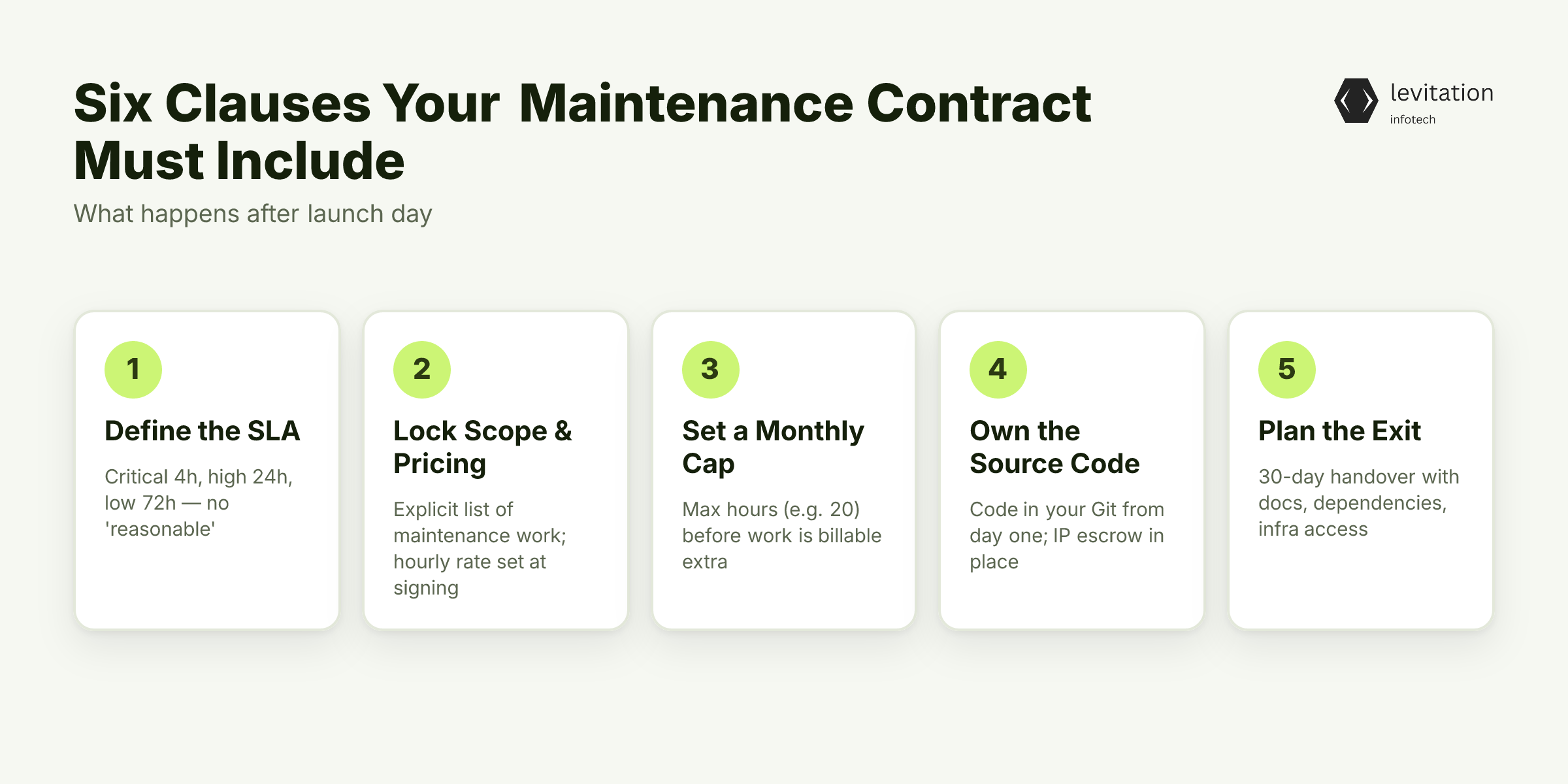
A good build contract without a maintenance contract is a hand grenade with the pin still in. These six clauses decide what happens after launch day. - Defined SLA. Response time on critical bugs (under 4 hours), high (under 24 hours), low (under 72 hours). Vague "reasonable" language is a trap. "Reasonable" means whatever the agency decides it means that month. - Scope of "maintenance". An explicit list: OS upgrades, dependency updates, security patches, server monitoring, minor UI fixes. Anything outside that list is a change order with a written quote. No surprises in month fourteen. - Hourly rate for change orders. Lock the rate at signing. Rates agreed during the build phase are typically lower than the same scope renegotiated after launch, when switching vendors has become expensive. Get the number on paper now, not when you are desperate in month ten. - Annual maintenance cap or ceiling. Agree on a max number of hours per month (say 20) before work becomes billable as extra. Without a cap, a "small fix" can quietly burn a month of retainer. - Source code and IP escrow. The code sits in your Git repository from day one. If the agency disappears, you can hand the codebase to anyone. This is the clause that keeps you free. Without it, you can lose control of what you paid for. - Exit clause. A 30-day handover with documentation, dependency list, and infrastructure access. This is your insurance against vendor lock-in. No founder plans to fire their agency. The smart ones plan for what happens if they have to.
Clarity on how much does an app cost in India over its full life is what separates these clauses from the boilerplate most agencies offer.
The clauses matter, but only if you push for them before signing. Once the build is done, your power drops to near zero.
How to Negotiate Maintenance Before You Sign the Build Contract
Power lives in the build contract. Once you sign, the agency knows you are not walking away. Use that window. - Bundle maintenance into the build quote. Ask for a 12-month maintenance window included. Many Noida agencies will include the first year free to win the deal. That gives you time to find a better long-term partner, or to learn the codebase yourself. - Lock the first-year maintenance rate for two years. This protects you from a 30% rate hike the moment you are locked in. A rate locked today is typically cheaper than the same rate renegotiated after the build is complete and switching costs have climbed. - Push for quarterly maintenance reviews. A written report of what was patched, what dependencies were updated, and what is coming next quarter. If your agency cannot produce this, they are not doing maintenance. They are answering tickets. - Negotiate a retainer over hourly billing. A fixed monthly retainer is more predictable than hourly billing once usage crosses a normal threshold. It also removes the agency's incentive to drag out small tasks. Predictable cost beats surprise cost every time. - Use a competing quote. Get two Noida agencies to bid on the same scope. Maintenance is the easiest line item to shave when there is competition. The dynamic that turns a ₹15 lakh quote into a ₹40-₹75 lakh reality works in reverse. Agencies cut maintenance to win the bid.
The full app development price in India is negotiable, but only if you treat maintenance as a line item, not a footnote.
When the numbers and the contract are both clean, year two stops being a fire drill, and the real question is what that discipline actually looks like day to day.
What Three-Year TCO Discipline Looks Like in Practice
The payoff is not a spreadsheet. It is a different posture. - You stop treating maintenance as a surprise and start treating it as a known line item, the same as cloud or payroll. - You can model runway properly. A founder raising a seed round knows exactly how much to earmark for the app line. Three-year maintenance becomes a known number, say ₹2.7L-₹3.6L for a ₹6L build. - You can fire your agency without panic. Clean source code, documentation, and an exit clause mean you are not a hostage. The same scrutiny that exposes hidden line items in Noida software quotes protects you from vendor lock-in later. - You can price features honestly. A feature is not free just because the build is "done." Every screen has a maintenance tail.
This is the same three-year view production engineering teams use when scoping AI and platform work for regulated clients. Treat the app cost India as a multi-year line item, not a one-shot expense.
Frequently Asked Questions
How much does app maintenance cost in India annually?
Annual maintenance in India typically runs 15-20% of the original build cost. For a ₹6 lakh app, that is ₹90,000-₹1.2 lakh per year. Apps with frequent change requests or complex compliance needs often land closer to 25% by year two.
What does year-two app maintenance actually include?
OS upgrades (iOS and Android ship new versions yearly), third-party SDK updates, security patches, server and database upkeep, bug fixes, and dependency upgrades. Most contracts do not include new features. Those are billed separately as change orders at hourly rates.
Is ₹6 lakh enough to build a mobile app in Noida?
Yes, ₹6 lakh covers a basic or MVP-grade app in Noida. Simple features, single platform or basic cross-platform, limited integrations. Mid-complexity apps (custom dashboards, payments, real-time features) typically land in the ₹12L-₹18L range, with complex builds going beyond ₹18L-₹40L+.
How do I negotiate maintenance costs with a Noida app development company?
Ask for the first 12 months of maintenance bundled into the build quote. Lock the hourly change-order rate at signing. Request a fixed monthly retainer instead of hourly billing once usage exceeds a normal threshold. Insist on quarterly maintenance reports with a defined SLA for bug response.
What is the three-year total cost of ownership for a ₹6 lakh app?
For a basic ₹6 lakh Noida build, three-year TCO typically lands between ₹9.6L and ₹11.4L, factoring in 15-20% annual maintenance plus minor change orders. Mid-complexity builds (₹15L-₹25L) push three-year TCO into the ₹24L-₹40L range once maintenance, infra, and feature work compound.
About the author
Mayank Singh is a software developer at Levitation Infotech, where he builds web and AI-powered applications across the company’s fintech, healthcare, and enterprise projects.