


TL;DR: Your app's year-two cost comes from ecosystem changes. New OS versions, third-party SDK upgrades, security patches, and infrastructure re-tuning drive it, not bug fixes. The "it'll be cheaper after launch" myth hides the real budget problem. Plan 15-20% of build cost each year for maintenance. Lock scope in writing. Demand a dependency audit before signing.
Key Takeaways: - Year-two costs come from platform shifts, not bug fixes - 15-20% of build cost is the realistic annual maintenance benchmark - OS upgrades, SDK migrations, and dependency patching are the three largest line items - Negotiate a dependency audit and quarterly OS-readiness review before signing anything - Founders who budget for year two from day one avoid the 3am crash cycle
The ₹2 Lakh Gap Nobody Warns You About
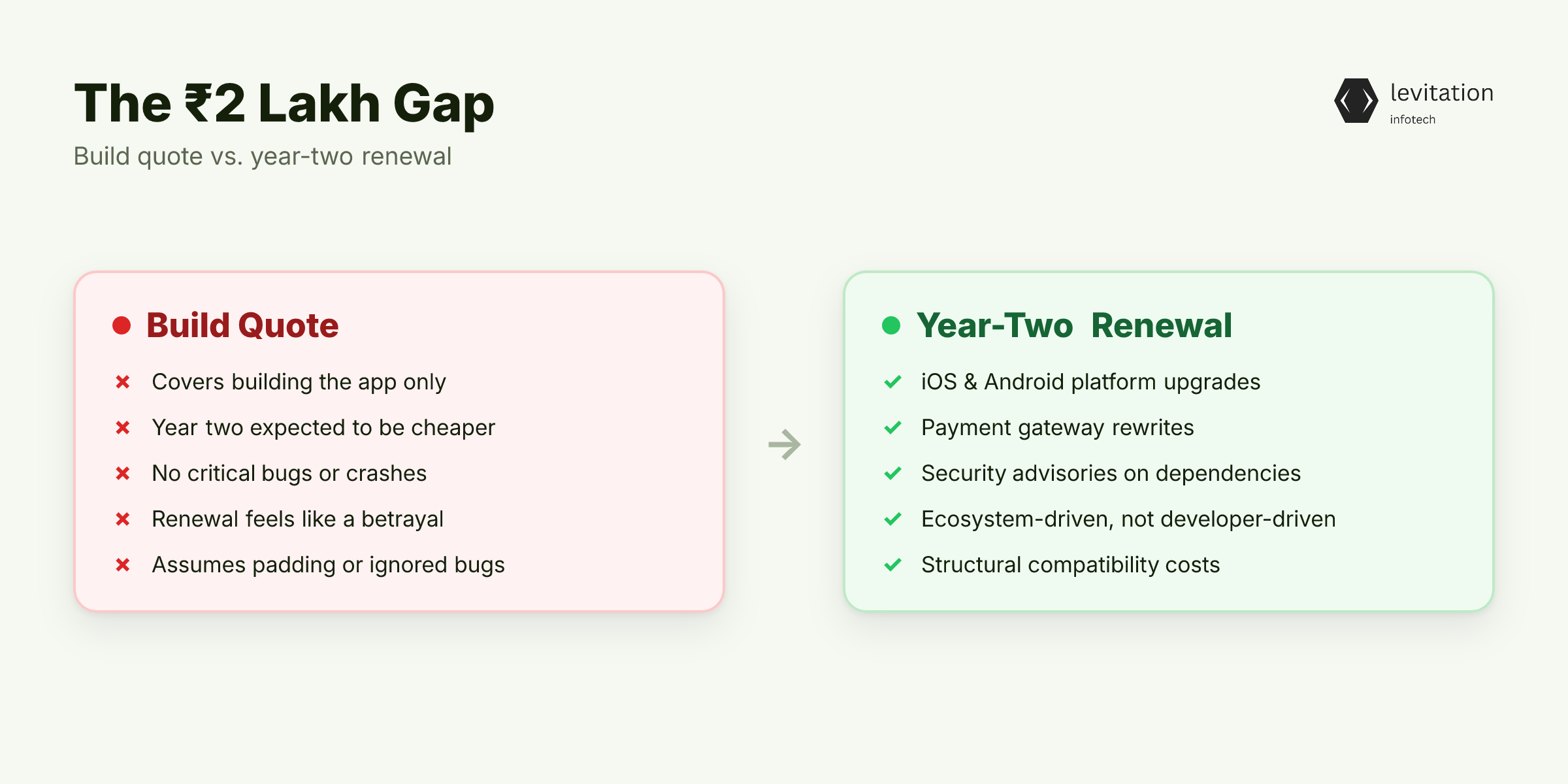
You budgeted ₹6 lakh to build your app in Noida. Twelve months after launch, your developer sends a renewal quote for ₹8 lakh. There are no critical bugs. Your server isn't crashing. Users haven't revolted. So where did the money actually go?
The natural reaction is suspicion. Founders assume the agency is padding the bill. They assume bugs were ignored and scope creep finally surfaced. Almost every founder in this position is wrong.
The app development cost in India you signed off on covered one thing: building the app. It rarely covers the cost of keeping it alive on platforms that change underneath you.
Most hidden items that surface in year two are ecosystem-driven, not developer-driven. They are the cost of staying compatible with an iOS upgrade or a payment gateway rewrite. They include security advisories on a library you did not know you depended on. The gap between the build quote and the year-two renewal reflects these structural costs, not padding.
The "it will be cheaper after launch" myth needs to die. Year two is not cheaper. It is different.
If you did not budget for the difference, the renewal quote will feel like a betrayal. Even when every line item is legitimate.
If bugs are not the reason, and server costs are only a sliver of the jump, then what is driving that ₹2 lakh delta?
What Founders Blame (and Why It's Mostly Wrong)
When the renewal lands, founders almost always blame the same three suspects. Each one is a smaller driver than the quote suggests. - Bug fixes are a routine line item, not the dominant cost. The bigger bug-fix bills come from apps built without automated testing or with fragile third-party code. That is a build-quality issue, not a year-two inevitability. If your team is charging heavily to fix bugs you did not have, the real story is a build problem. It is not a maintenance problem. - Cloud hosting and server costs are the easiest line item to verify. A basic MVP on AWS or GCP runs at a modest monthly infrastructure cost that scales with traffic. Even at scale, infrastructure is the most predictable line on the budget. If your hosting bill is driving the spike, the answer is usually a re-architecture, not a bigger retainer. - App store fees, domain renewals, and SSL are line items most founders already know about. These are real costs, but they are small and recurring. They are not the cause of a 33% jump.
So if the obvious suspects are not guilty, where is the ₹2 lakh delta hiding?
The Five Real Culprits Behind Your Year-Two Bill
Five forces drive the year-two delta. None of them appear on your original build quote.
Third-party SDK and API upgrades. Razorpay, Stripe, Google Maps, Firebase, and Twilio push breaking changes on their own release cycles. Some are minor. Others force code rewrites that touch every screen where the SDK appears. If your agency is not tracking these roadmaps, you will learn about them when a payment fails or a map goes blank.
OS version compatibility. Apple and Google release new OS versions each year and deprecate APIs your app was built on. Each new iOS and Android release ships API changes that force engineering work, even on apps that were stable the year before. The result: even a "stable" app needs a real engineering pass every September. This category alone often becomes the single largest line item in year two.
Security and dependency patching. Outdated npm and CocoaPods libraries are an active liability, especially for apps handling payments or user data. A single high-severity CVE on a library you depend on can trigger an emergency sprint. Treat the dependency audit cycle as non-negotiable, not optional.
Infrastructure scaling. As user count grows from launch to meaningful scale, your database queries slow. Your caching layer bottlenecks. Your CDN configuration drifts. None of this shows up on day one. All of it shows up in year two.
The cost of re-architecting is far higher than the cost of monitoring would have been.
Regulatory and compliance shifts. India's DPDP Act and sector-specific rules for healthcare and fintech require ongoing updates. Even teams that have shipped compliant systems treat compliance as a continuous obligation, not a one-time checkbox.
Knowing the culprits is only half the battle. The contract you sign in month one decides the renewal you negotiate in month twelve.
How to Budget for Year Two Before You Sign Anything
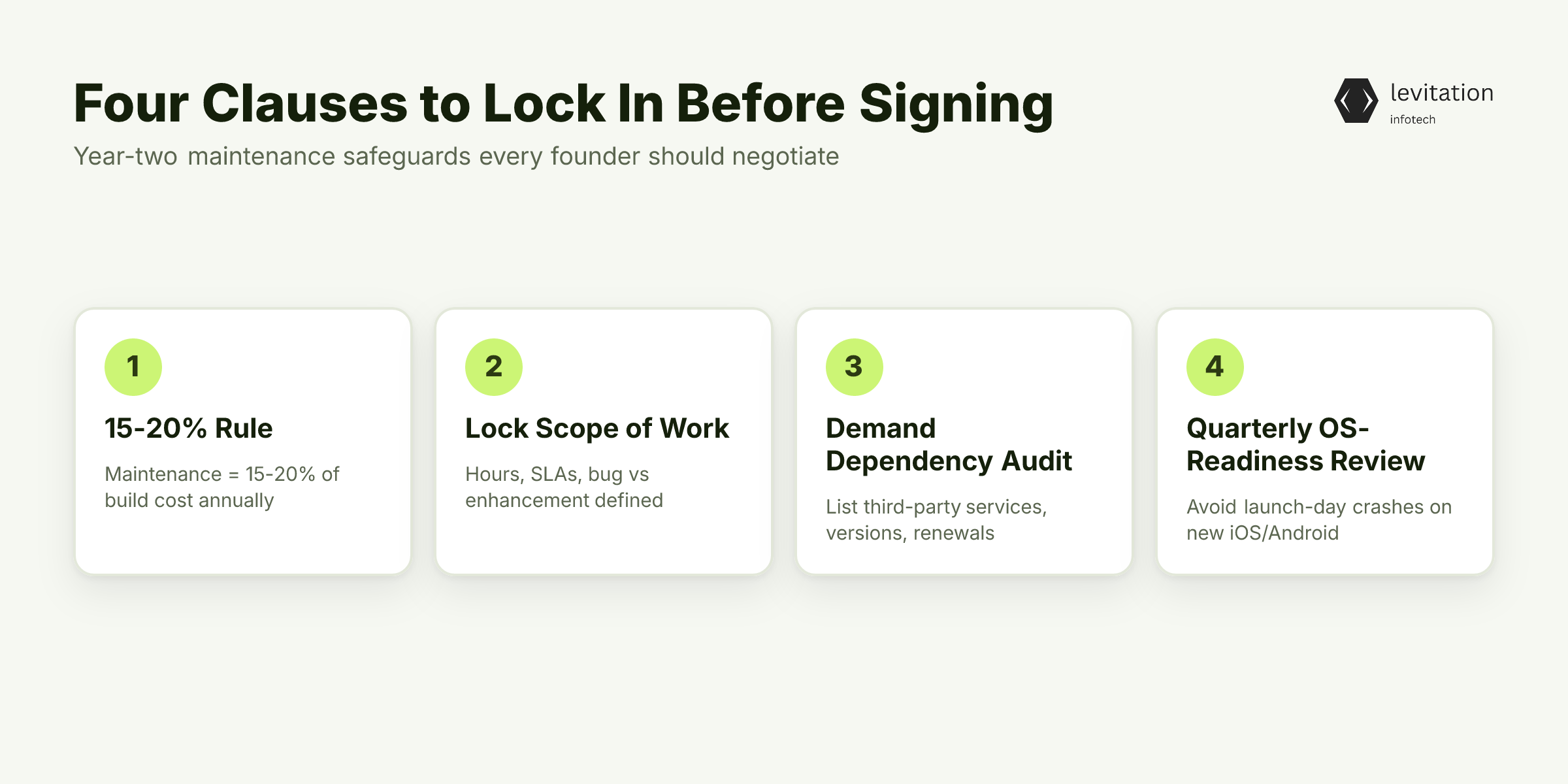
Four clauses decide whether that month-twelve conversation goes well. - The 15-20% rule. A well-structured maintenance contract runs 15-20% of the original build cost each year. For a ₹6 lakh app, that works out to ₹90K to ₹1.2L per month. Anything quoted well below that should raise a red flag. Either the scope is hollow, or the work is being deferred to a bigger surprise later. The cost to build an app is the baseline, not the maintenance anchor. - Lock a scope of work. Define monthly hours, response SLAs, and what counts as "enhancement" versus "maintenance" before signing. The single most common dispute in year two is the agency calling something an enhancement and the founder calling it a bug. Resolve the definition in writing. - Demand a dependency audit at month 11. Every third-party service your app relies on should be listed with renewal dates, version compatibility, and migration risk. If the agency does not know what your app depends on, they cannot price the maintenance honestly. - Negotiate a quarterly OS-readiness review. This one clause can prevent the September panic when a new iOS drops and your app crashes on launch day. A short review each quarter is trivial in cost. The protection it offers is huge.
Anatomy of a Realistic ₹8 Lakh Year-Two Budget
A well-planned ₹8 lakh year-two budget has five line items. Each ties to a specific ecosystem driver. - OS version upgrades and device compatibility. This is usually the single largest line item and the one most often underestimated. Every September, expect a sprint to address new API deprecations and device-specific bugs. - Third-party API migration and SDK upgrades. Payment gateway swaps, analytics migrations, and map provider changes fall here. Each breaking change in a critical SDK can ripple across multiple features. - Security patching and dependency updates. CVE-driven work, library upgrades, and dependency cleanup. A single high-severity vulnerability disclosure can absorb an entire month's allocation. - Infrastructure optimization and scaling. Database indexing, CDN tuning, and cloud cost reduction. As user count grows, query performance and caching strategy need active tuning. - Compliance, analytics, and minor feature additions. Buffer for regulatory shifts, analytics tool migrations, and small UX wins driven by user feedback.
These ranges are illustrative, not universal. The exact split depends on your app's stack, user count, and regulatory surface. But the shape of the budget is consistent across most mid-complexity apps.
Even the cleanest breakdown fails when the development partner treats your app as a delivered project, not a living system.
What Changes When You Plan Year Two From Day One
Planning for year two before launch changes three things.
First, the "surprise" ₹2 lakh delta becomes a planned line item in your runway forecast. CFO conversations get easier. Investor updates do not need to explain a 33% cost jump. Budget discipline replaces reactive spending.
Second, app stability improves. Teams that budget for proactive OS and SDK work avoid the 3am crash cycles that burn runway and user trust. The pattern is consistent across sectors. The systems still running in production years after deployment share one trait. They treated maintenance as a feature, not an afterthought.
Third, your app survives its third, fourth, and fifth year. The compounding cost of unplanned rewrites drops over time. Long-term partnership quality matters. Agencies that absorb these costs into how they work, not into surprise invoices, have made maintenance a discipline. That is a signal worth weighing when you choose a build partner.
At Levitation, we treat the year-two conversation as part of the year-zero build, not a separate engagement.
Frequently Asked Questions
What is the average mobile app maintenance cost in India for year two?
For a mid-complexity app built for ₹6-12 lakh, year-two maintenance in India varies based on OS upgrades, third-party API changes, and infrastructure scaling. A 15-20% annual maintenance contract relative to the original build cost is the industry benchmark.
Why does an app cost more in year two than year one if there are no bugs?
Year-two costs come from ecosystem changes. New iOS and Android OS versions, third-party SDK and payment gateway upgrades, security patching of dependencies, and infrastructure re-tuning as your user base grows. These are structural costs, not bug fixes.
How much should a Noida app development agency charge for annual maintenance?
Reputable Noida and NCR agencies typically quote 15-20% of the original build cost per year for maintenance. For a ₹6 lakh MVP, that works out to ₹90K to ₹1.2L per month, depending on included hours, SLA terms, and whether minor enhancements are bundled in.
What should an MVP post-launch budget include beyond hosting?
Beyond hosting, an MVP post-launch budget should reserve funds for several items. OS compatibility updates. Third-party API upgrades. Security patches. Analytics and monitoring tools. Compliance updates under India's DPDP Act. A small buffer for user-feedback-driven enhancements.
Can I negotiate year-two app costs down?
You can reduce year-two costs by locking a fixed monthly retainer, bundling minor enhancements into the maintenance scope, and requiring the agency to use long-term-support versions of frameworks. Cutting maintenance far below the 15-20% benchmark usually means deferred work, not eliminated work.
About the author
Mayank Singh is a software developer at Levitation Infotech, where he builds web and AI-powered applications across the company’s fintech, healthcare, and enterprise projects.