


TL;DR: A ₹4 lakh web app that works in demos typically collapses at 500 concurrent users, and the rescue engineering costs 2-4x the original build. The crash isn't a bug. It's the bill for architecture decisions that were never budgeted. A realistic MVP budget for an app that survives real traffic is ₹14-18 lakh, with 15-20% reserved for non-feature engineering from day one.
Key Takeaways: - The ₹4 lakh MVP quote covers features. It does not cover database indexing, connection pooling, caching, load balancing, or error handling, which is why the app breaks at 500 users. - Rescue engineering costs 2-4x the original build because you must preserve broken architecture while retrofitting the missing infrastructure. - A production-ready MVP in India costs ₹14-18 lakh total, with 15-20% reserved for testing, infrastructure, monitoring, and contingency. - A pre-build architecture review at ₹30,000-50,000 prevents the ₹10-14 lakh rescue. The math is straightforward.
The ₹4 Lakh App That Worked Until It Didn't
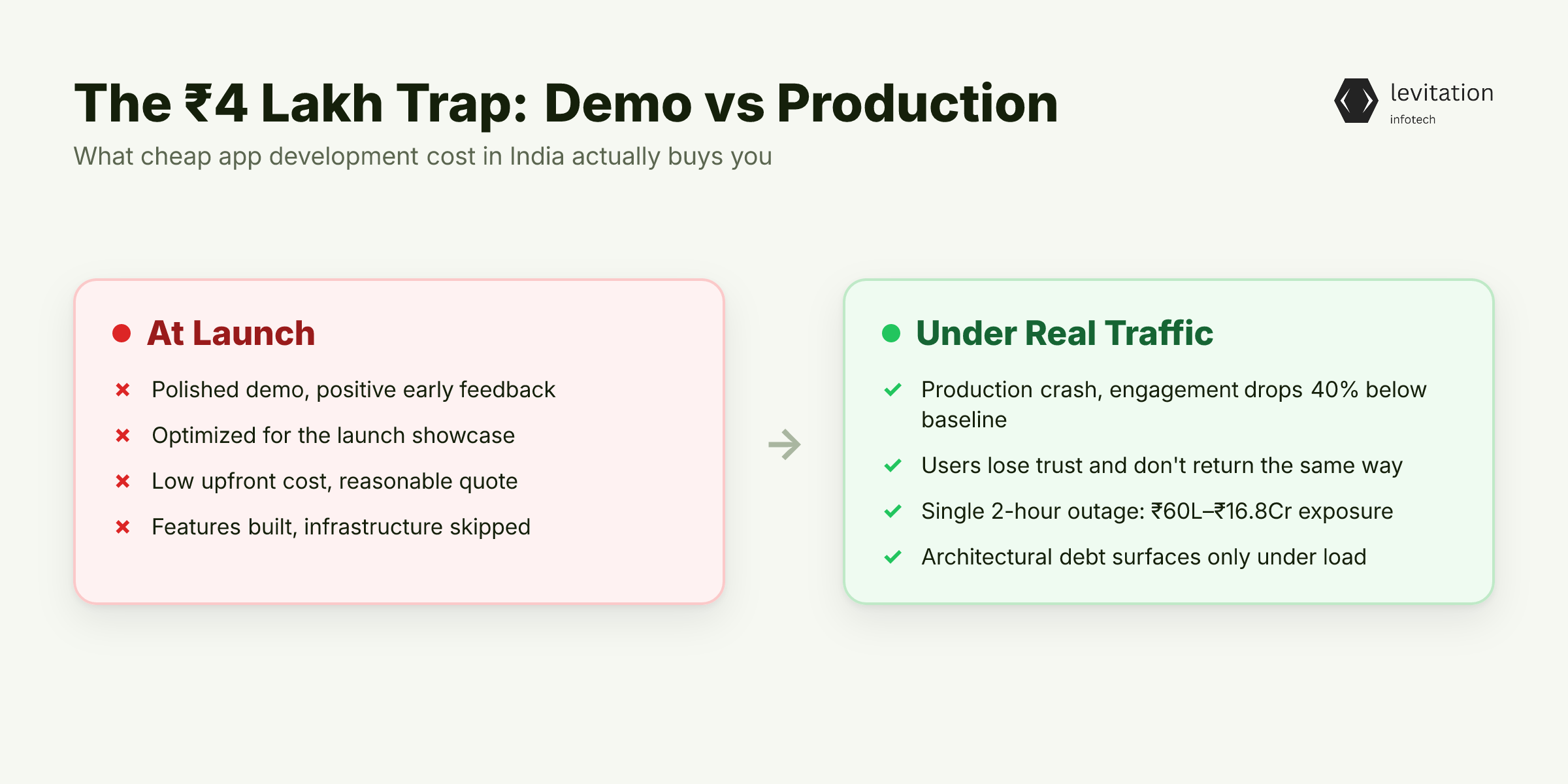
This is the default outcome when app development cost in India gets optimized for the launch demo, not production reality. The pattern repeats every quarter across India. A team compares quotes, picks the most reasonable one, and ships. The app looks polished. Demos go well. Early users give positive feedback. Then real traffic arrives.
Wayfair's engineering team has published data on what happens after a production crash. Before the incident, user engagement was 50% above steady state (30 screen views per user versus a baseline of 21). After the crash, engagement dropped to 40% below that baseline. It stayed depressed for days. Users don't just leave during the outage. They lose trust. They don't come back the same way.
For a mid-sized Indian business, the math is brutal. Enterprise incident data pegs a single 2-hour outage between ₹60 lakh and ₹16.8 crore. The final cost depends on revenue scale, lost transactions, and recovery effort. Even a fraction of that window can kill a startup's runway.
The founder's assumption: cheap web app development India equals low risk. The reality: low initial cost masked architectural debt that surfaced only under real load. The ₹4 lakh was spent on features, not on the infrastructure that lets features survive traffic.
The obvious response is "just hire better developers next time." That's exactly wrong, and it explains why most founders end up in the same trap twice.
Why Cheap Web App Development India Fails at the 500-User Mark
The crash is almost never about bad code. It's about missing architecture.
At 50 users, a single-server deployment with synchronous database calls and no caching layer feels instant. At 500 users, every one of those decisions becomes a bottleneck. Connections to the database pile up because nothing pools them.
Queries run full table scans because nothing is indexed. Pages load slowly because nothing is cached at the edge. The server runs out of memory and the app stops responding.
These aren't exotic engineering problems. They are basic production-readiness decisions. A senior architect would have caught them before launch.
A junior team building to a fixed ₹4 lakh budget had no time to think about them.
Here's the math the quote didn't show you. At Indian agency rates of ₹1,200 to ₹2,500 per hour for mid-level developers, ₹4 lakh buys roughly 200 to 300 hours. That sounds like a lot until you subtract UI design, frontend code, backend code, basic testing, and deployment.
What's left for load testing, infrastructure hardening, caching strategy, connection pooling, error boundaries, and failover design? Usually nothing.
The crash isn't a bug. It's the absence of engineering decisions that were never budgeted for. When a similar build hit a 40-user wall, the same pattern showed up. Architecture decisions that worked at small scale became the failure mode at production scale.
This is why custom software development cost in India varies so wildly between vendors quoting ₹4 lakh and vendors quoting ₹14 lakh. They're not charging more for the same thing. They're including the work that prevents the crash.
If ₹4 lakh wasn't enough, and ₹14 lakh for the rescue feels punitive, where does the actual MVP web app cost India land for founders who want both stability and budget sanity?
The True MVP Web App Cost India Founders Underestimate
Every competitor article quotes ₹3 to ₹12 lakh for an MVP. That number is technically correct but practically misleading. It covers the build. It does not cover survival.
What ₹4 lakh actually buys: - User interface design - Core CRUD features (login, dashboard, basic data entry) - Single-server deployment - Minimal testing
What ₹4 lakh does not buy: - Load balancing - Database indexing and query optimization - Connection pooling - Caching layer (Redis, Cloudflare, or equivalent) - Error handling and graceful degradation - Monitoring and observability - Auto-scaling configuration - Disaster recovery setup
A realistic breakdown for an MVP that won't collapse at 500 users: - ₹6-8 lakh for the build itself - ₹2-4 lakh for infrastructure and DevOps setup - ₹1-2 lakh for pre-launch load testing and hardening
That's ₹9-14 lakh before you acquire your first 1,000 users. Add a 20% contingency and you land at ₹11-17 lakh.
Indian developer rates explain why this gap exists. Junior developers charge ₹500-1,000 per hour. Mid-level agencies charge ₹1,200-2,500 per hour.
Top firms with senior architects charge more. Those architects are the ones who build systems still running in production five years later.
You're not paying for the same hours. You're paying for the decisions made during those hours. As our analysis of Noida software quotes showed, the hourly rate hidden inside a quote is the single best predictor of whether the project will stay on budget.
Knowing the number isn't the same as understanding what drives it, and the 3.5x cost multiplier that follows is where every rupee in that gap actually goes.
The 3.5x Cost Multiplier: What Actually Drives Web App Development Cost
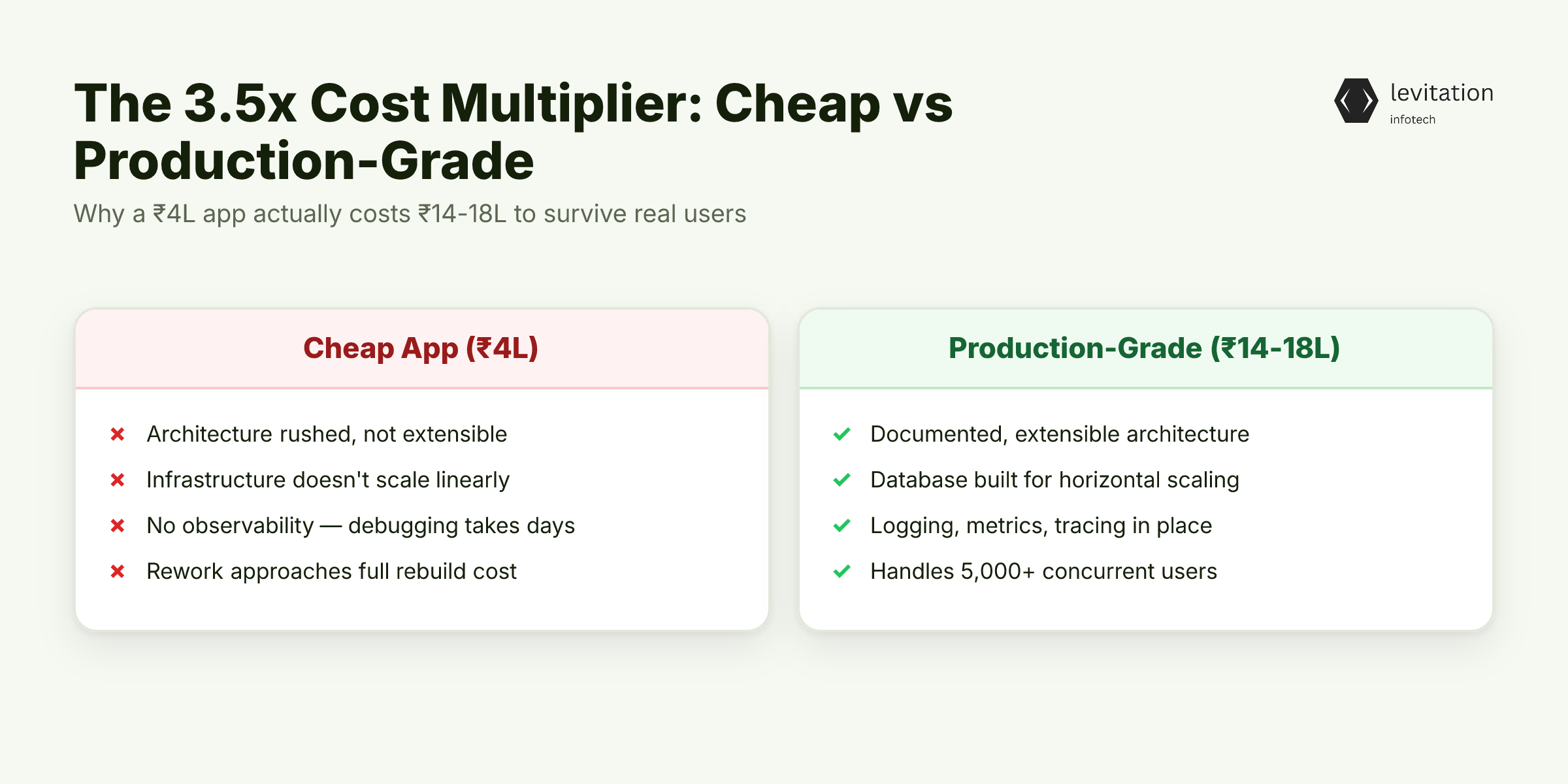
The multiplier isn't arbitrary. It comes from four categories of cost that pile up the moment a ₹4 lakh app needs to survive real users.
- Architecture decisions made under time pressure. The original team was racing to ship. They made choices that were fast but not extensible. Now every change requires dismantling something that wasn't designed to be changed.
- Infrastructure choices that don't scale linearly. Adding a second server doesn't double your capacity if your database wasn't built for horizontal scaling. It adds coordination overhead, and the system still falls over.
- Missing observability that turns debugging into archaeology. Without proper logging, metrics, and tracing, finding the actual failure point takes days instead of hours. That time shows up in the rescue invoice.
- Rework cost when the original architecture can't be extended. Adding user authentication to a ₹4 lakh app that wasn't designed for it requires restructuring the data model, API layer, and session management. Each layer was built without authentication in mind.
Each layer requires rework that approaches the cost of a full rebuild. You're paying for the original shortcuts.
The real cost to build an app in India for production-grade quality is ₹14-18 lakh for an MVP that handles 5,000+ concurrent users. This budget includes CI/CD, monitoring, and documented architecture. It is the minimum viable engineering budget for something that doesn't collapse at 500 users.
This isn't premium pricing. It's what the work actually costs when done right. The custom software cost in India at this level reflects systems designed to survive, not just to demo.
That number still feels high if you've been comparing it to the ₹3-12 lakh ranges in competitor articles. The difference is those articles aren't telling you what gets cut to hit those numbers.
How to Budget for Cheap Web App Development India That Doesn't Collapse
A framework that prevents the crash costs far less than the rescue.
Step 1: Allocate 15-20% of your total budget to non-feature work. Testing, infrastructure, monitoring, and documentation. If your budget is ₹10 lakh, ₹1.5-2 lakh goes to engineering hygiene. Not a "nice to have." A line item.
Step 2: Insist on a load test before launch. Budget ₹50,000-1,00,000 for simulated traffic that pushes 2-3x your expected user count. This single line item prevents the ₹14 lakh rescue. It's the cheapest insurance you'll ever buy.
Step 3: Choose managed services for infrastructure. AWS RDS, Cloudflare, Vercel, and equivalents cost 20-30% more than self-hosting, but the failure modes are dramatically fewer. Your team isn't waking up at 3 AM to patch a database server. As covered in our analysis of observability costs, the hidden tax of self-managed infrastructure eats more budget than the managed premium.
Step 4: Get an architecture review from a senior engineer before signing the build contract. ₹30,000-50,000 spent here typically saves lakhs in rework. This is the highest-ROI line item in the entire project.
Engineering firms whose systems survive year five all start with this conversation.
Step 5: Budget a 20% contingency for the unexpected. If you can't afford this, you can't afford the project. Period.
The total software development cost India for founders who follow this framework lands at ₹14-18 lakh for an MVP. Higher than the mvp cost quoted in competitor articles. Dramatically lower than the rescue.
What changes when founders get this right: they stop optimizing for launch date and start optimizing for month 6, when real users hit real edge cases.
What ₹14 Lakh Actually Buys: The Engineering Standards That Separate Prototypes from Products
The rescue wasn't a rewrite from scratch. It was about adding what was missing: connection pooling, read replicas, proper indexing, horizontal scaling, error boundaries, graceful degradation. Engineering hygiene that was absent from the original build.
The cost to build software in India spans a wide range. The bottom of that range buys a prototype, not a product. Most startups learn it through a crash instead.
Frequently Asked Questions
What is the real app development cost in India for a web app that handles 1,000+ users?
For a web app that handles 1,000+ concurrent users without performance issues, the realistic budget in India is ₹14-18 lakh. This includes architecture design, build, infrastructure setup, load testing, and monitoring. Anything below ₹10 lakh is a prototype, not a production system.
Why do cheap web app development India projects fail at scale?
Low-cost projects skip the engineering decisions that don't show up in demos: database indexing, connection pooling, caching, load balancing, and error handling. These don't matter at 50 users. They matter catastrophically at 500. The crash is not a bug; it's the bill for work that was never budgeted.
How much does it cost to fix a crashed web app in India?
Post-crash rescue engineering in India typically costs 2-4x the original build price, because the existing architecture must be preserved while critical infrastructure is retrofitted. A ₹4 lakh app that crashes at 500 users commonly costs ₹10-14 lakh to stabilize, plus additional revenue loss from downtime.
What is the MVP web app cost India for a startup that plans to scale?
For a startup planning to scale to 1,000+ users, budget ₹14-18 lakh total: ₹8-10 lakh for the build, ₹3-4 lakh for infrastructure and DevOps, ₹2-3 lakh for load testing and pre-launch hardening, and a 15-20% contingency. The ₹3-6 lakh MVP quotes in the market assume you'll fix it later.
How do I avoid the ₹4 lakh crash scenario when budgeting app development cost in India?
Three things: (1) Allocate 15-20% of budget to non-feature engineering (testing, infra, monitoring), (2) require a load test simulating 2-3x your expected traffic before launch, and (3) hire a senior architect for a pre-build review. The ₹30,000-50,000 spent on the review typically prevents the ₹10-14 lakh rescue.
A pre-build architecture review at ₹30,000-50,000 is the cheapest line item that prevents the most expensive line item in your invoice.
About the author
Mayank Singh is a software developer at Levitation Infotech, where he builds web and AI-powered applications across the company’s fintech, healthcare, and enterprise projects.