


TL;DR: Most Indian founders budget for the CRM build quote and miss the year-two renewal trap. After the 90-day warranty ends, vendors move clients onto an Annual Maintenance Contract. With priority support, integration upkeep, and storage expansion, it quietly reaches ₹3.6 lakh per year. The fix is contract language, not vendor selection. A three-year TCO on day one, a locked AMC rate, source-code escrow, and a clean exit clause.
Key Takeaways: - The 90-day "free support" window is standard across most Indian custom CRM vendors. The AMC that replaces it is where the real money lives. - A custom CRM only beats Salesforce or HubSpot for Indian teams of 20+ users if the AMC stays flat. That is a contract problem, not a vendor problem. - Four hidden line items (integrations, storage, training, and support tier) routinely inflate the build quote by year two.
Your vendor quoted ₹8 lakh for a custom CRM. Ninety days after go-live, the support contract arrives at ₹3.6 lakh per year. It's for the same system you already paid to build. The shock isn't the number. It's the fact that nobody put that number in the original proposal.
The 90-Day Support Cliff: How 'Free' Becomes Your Most Expensive Line Item
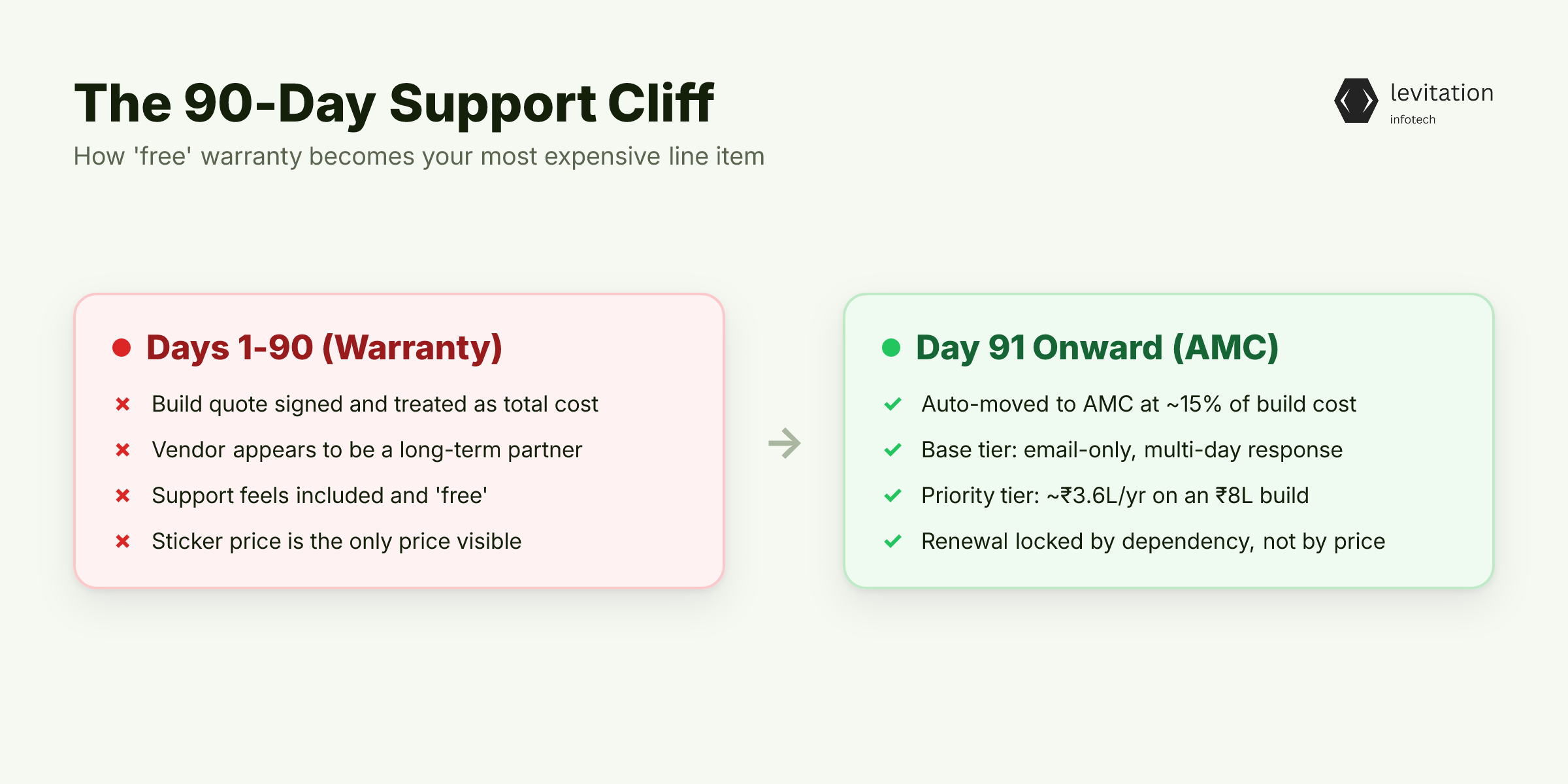
The 90-day post-launch warranty is standard across most Indian custom CRM vendors, and it's where the visible cost ends and the invisible one begins. Most founders read the build quote, sign the contract, and walk into month four assuming the vendor relationship is stable. It isn't.
After day 91, vendors typically move clients onto an Annual Maintenance Contract priced as a recurring percentage of the original build cost. On a mid-sized ₹8 lakh build, the base AMC lands at roughly ₹1.2 lakh per year. Add the "priority support" tier most vendors push during the warranty period, and you reach the ₹3.6 lakh scenario the title describes.
The mechanism is simple: - The base AMC covers bug fixes and email-only support with multi-day response times. - The "priority" tier adds same-day SLA, a dedicated account manager, and quarterly reviews. - The priority tier is what you actually need once the CRM runs your sales pipeline.
The result: founders treat the build quote as the total. The vendor treats the AMC as the real business model. custom CRM development is sold on sticker price. It's renewed on dependency.
Before blaming the vendor, look at why the standard comparison (custom build versus Salesforce subscription) is broken for most Indian businesses.
Why Salesforce and HubSpot Comparisons Mislead Indian Founders
Every CRM proposal arrives with a "why not just use Salesforce?" slide. The slide is wrong, but not for the reasons most founders assume.
Salesforce offers a free CRM tier with no expiration, but that tier caps at very limited users and contacts. The moment a 10-person Indian sales team exceeds the cap, per-seat pricing kicks in at the global $25-$165 per user per month range. That looks affordable. Until you do the math for a 25-person field sales team running territory-based quotas.
The deeper problem is operational: - Data residency: Indian sales data leaving Indian shores creates DPDP exposure and procurement friction. - GST invoicing workflows: these are not native to most Western SaaS CRMs. They require paid AppExchange add-ons or Zapier glue. - WhatsApp Business API integration, the operational backbone of Indian SMB sales, sits outside Salesforce's native stack.
Off-the-shelf tools like the Indian CRM vendor offering a ₹1,999/month Enterprise plan solve some of this. But they force you onto their feature roadmap and storage limits (5GB on that tier). You're trading one lock-in for another.
The real comparison isn't "custom vs. SaaS." It's "predictable ownership vs. escalating subscription plus integration overhead." CRM implementation cost India is a three-year question, not a build-vs-subscribe question.
Even a custom build hides a second cost layer. Most founders don't see it until the renewal notice arrives.
The Hidden Fee Stack: What Indian CRM Vendors Don't Put in the Proposal
The 90-day cliff is the headline cost. The real bill comes from four line items that don't appear in the build proposal.
API and Integration Tiers. Most vendors quote a base build. They treat third-party integrations (Tally, payment gateways, WhatsApp API, biometric devices) as scope additions. Each one is billed separately. Costs scale with integration complexity and the number of connected systems. A CRM that needs to talk to Tally, Razorpay, and WhatsApp Business carries an integration bill that multiplies with each additional system connected, on top of the quoted build.
Storage and User Expansion. Once your team grows past the initial 10 users, per-user charges are added at renewal. The same happens when you exceed the included storage tier. This mirrors how SaaS vendors like The Indian CRM tier their plans around employees and storage. The custom-build version of the same trap looks like "your AMC now includes a storage uplift clause."
Training and Change Management. Post-launch user training is rarely included beyond a single walkthrough. Structured training for new hires or new modules is billed as a separate engagement, often at daily consulting rates. The first time a new sales head joins and needs onboarding, the invoice arrives.
"Priority" Support Upsell. The base AMC gets you email-only response with multi-day turnaround. The SLA-backed tier with same-day response, a dedicated account manager, and quarterly reviews is where the ₹3.6 lakh figure lives. Vendors push this tier during the warranty period, when any downtime feels catastrophic, and lock you in just as the warranty expires.
These four layers together produce the year-two invoice that catches founders off guard. The pattern shows up across custom CRM migrations cost Indian SMEs more often than founders expect.
Stack them up and the second-year invoice stops being a surprise. The real three-year TCO reveals exactly where the math lands.
Real CRM Implementation Cost India: A Three-Year TCO Breakdown
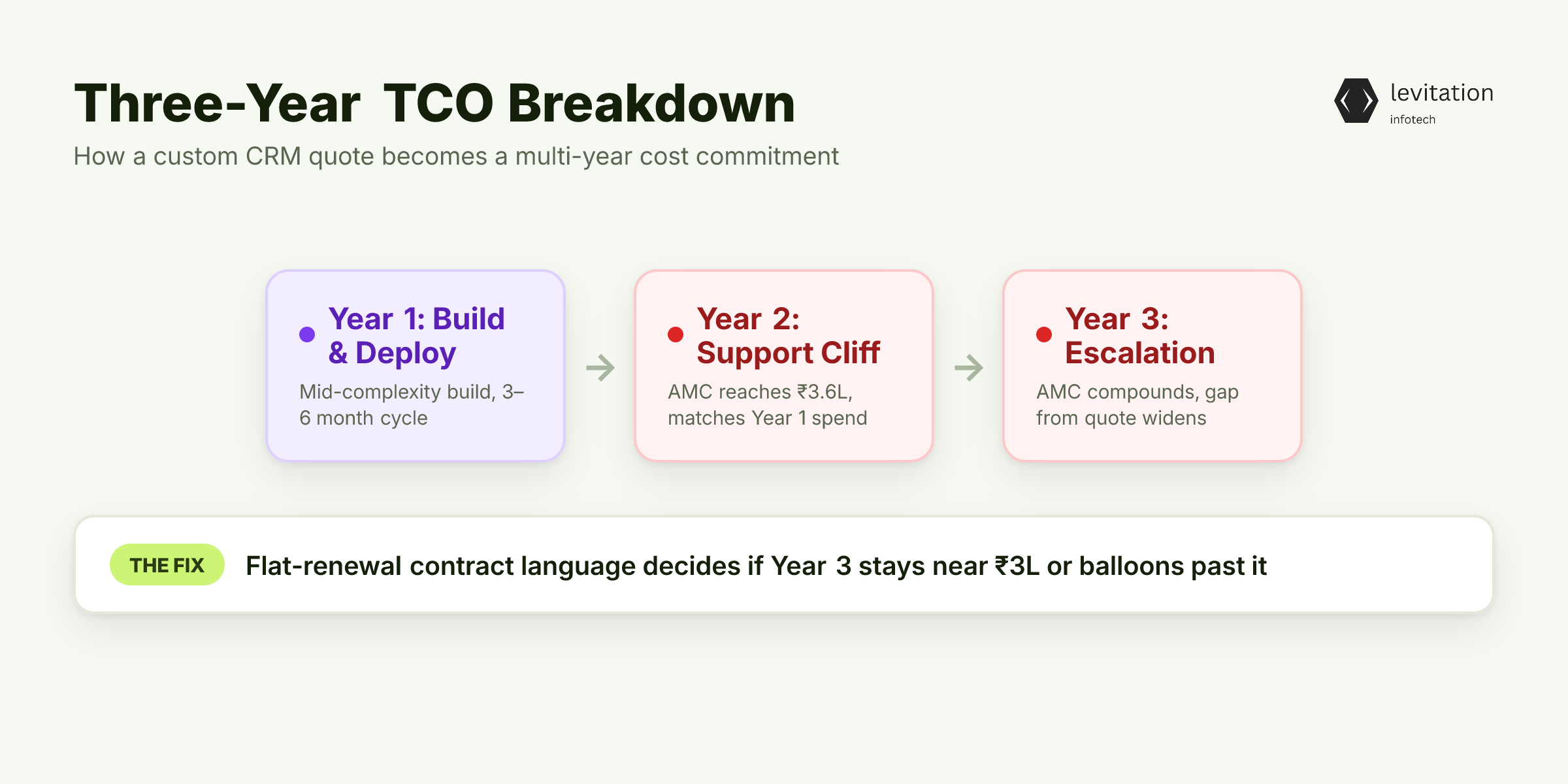
Year 1: Build and Deploy. A mid-complexity custom CRM in India from an offshore-style partner costs less than enterprise-grade deployments. The final price is driven by feature scope, integration count, and compliance requirements, not developer hours alone. Enterprise-grade builds with ERP integration, advanced workflows, and compliance features need more engineering investment. These often cost several times more than mid-complexity builds.
The deployment timeline is itself a cost variable. A typical 3-6 month build cycle, versus 18-24 months for an in-house team, cuts salary burn. It also cuts the period during which you pay for a CRM you don't yet have. Every month of delayed delivery is a month of CRM-less sales operations.
Year 2-3: The Support Cliff. Annual maintenance, priced as a recurring percentage of the original build cost, puts a mid-sized build into the ₹3.6 lakh range once the priority tier and integration maintenance are added. Add "priority" SLA upgrades and integration maintenance, and Year 2 alone can match Year 1 spend.
The escalation compounds. Annual escalation clauses mean a ₹3.6 lakh year-one support contract grows larger in each subsequent year. The gap between the original quote and the actual three-year spend widens.
The SaaS Counterfactual. A 20-person team on Salesforce or HubSpot at the lower end ($25/user/month) costs roughly ₹5 lakh per year with no ownership. The custom build breaks even with SaaS only in Year 3-4, and only if the AMC stays flat.
The moment AMC escalates, the math flips. This is why Indian CRM projects hit 2x budget more often than not. The second-year bill is where the budget disappears.
The variable that determines true CRM development cost isn't the build quote. It's whether the AMC escalates and whether integrations stay in scope.
Both are contract decisions. Not vendor decisions.
That cost isn't inevitable. Specific contract language determines whether your renewal stays flat or balloons past ₹3 lakh.
Contract Clauses That Lock In the ₹3.6 Lakh Renewal And How to Rewrite Them
Most founders treat the contract as legal housekeeping. It's actually the most expensive document in the engagement.
Five clauses do the heavy lifting: - Lock the AMC rate for three years, not one. Most vendors offer this if you ask. Default contracts auto-escalate AMC annually. That escalation turns the base AMC into the ₹3.6 lakh scenario once the priority tier and storage uplifts are added on top. - Define "support" explicitly in the contract. Bug fixes only, or bug fixes plus minor enhancements plus integration maintenance? The latter is where the ₹3.6 lakh tier lives. A narrow "bug fixes only" definition pushes every enhancement into a paid change request. That is the most common path to renewal inflation. - Require a cap on "scope change" hourly rates and pre-approve a fixed pool of integration/maintenance hours per quarter. Without this, every "small tweak" becomes a billable engagement at premium rates. - Negotiate a source-code escrow and full IP transfer clause. This alone gives you the option to switch vendors at renewal. It's the single strongest lever against AMC inflation. And it's the one clause most vendors resist hardest. If they won't sign it, ask why. - Build an exit clause with 60-day data export in standard formats. The cost of vendor lock-in is what turns a base AMC into a ₹3.6 lakh one. Without a clean exit, you pay whatever the renewal letter says.
These clauses don't require legal firepower. They require the willingness to walk away from a vendor who refuses them. The CRM software development market in India has enough suppliers that the leverage sits with the buyer, not the vendor.
What Transparent Indian CRM Pricing Actually Looks Like
Transparent vendors publish a three-year TCO on day one. The document covers build cost, fixed AMC, integration budget, and exit terms. Vendors don't wait for renewal to reveal each line. You should never sign a CRM contract without seeing all four numbers in writing.
Compliance pedigree matters. Vendors who have deployed compliant systems for regulated industries have already absorbed the audit, logging, and access-control work. That work drives up cost in a re-engineered build.
The same pedigree applies to DPDP-compliant CRM work for Indian enterprises. The cost has been paid once and doesn't recur in your contract.
When CRM development price discussions centre on retention rather than acquisition cost, founders stop getting ambushed at renewal. The cost was always knowable. It just wasn't written down.
Frequently Asked Questions: Custom CRM Cost in India
Q: How much does custom CRM development actually cost in India?
A: A mid-complexity custom CRM from an Indian development partner costs less than enterprise-grade builds. The final price is driven by feature scope, integration count, and compliance requirements. Enterprise-grade builds with ERP integration, advanced workflows, and compliance features need more engineering investment.
The build cost is only the first number. The three-year total including AMC usually exceeds it once priority support, integration maintenance, and storage uplifts are added. See our full CRM pricing in India breakdown for the components.
Q: What is a typical CRM maintenance contract in India?
A: Indian CRM vendors typically charge an Annual Maintenance Contract once the 90-day warranty expires. The AMC is priced as a recurring percentage of the original build cost. The exact percentage varies by vendor and support tier.
On a mid-sized build, the combination of base AMC, priority support, and integration maintenance routinely produces a renewal that reaches the ₹3.6 lakh range.
Q: How can I avoid hidden fees from Indian CRM vendors?
A: Demand a written three-year TCO that itemises build, AMC, integrations, storage, user expansion, and training separately. Lock the AMC rate for three years. Require a source-code escrow and full IP transfer clause. Pre-approve a fixed pool of integration hours per quarter.
The single strongest protection is the right to switch vendors at renewal. Without it, the AMC has no ceiling.
Q: Is it cheaper to build a custom CRM or buy Salesforce in India?
A: For teams under 15 users, Salesforce or HubSpot subscriptions ($25-$165 per user per month) are usually cheaper over a three-year horizon. For teams of 20+ users with Indian-specific workflows like GST invoicing or WhatsApp integration, a custom build typically breaks even with SaaS in 2-3 years. But this only holds if the AMC stays predictable, which is the contract problem covered above.
Q: What should a CRM support contract include beyond bug fixes?
A: A complete support contract covers bug fixes, minor enhancements, integration maintenance for connected systems, security patches, and defined SLAs for response time.
Anything narrower, like bug fixes only, pushes every enhancement into a paid change request. That is the most common path to the ₹3.6 lakh renewal. Get the scope of "support" defined in writing before signing.
A three-year TCO is the only document that prevents the renewal ambush, and Levitation hands it to clients in writing on day one.
About the author
Mayank Singh is a software developer at Levitation Infotech, where he builds web and AI-powered applications across the company’s fintech, healthcare, and enterprise projects.