


TL;DR: Agentic AI is scaling faster than enterprise authority. Another agent cannot be approved with a generic policy and a larger review queue.
Convert decision rights into runtime constraints, enforce them before actions, and productize the controls so autonomy grows without multiplying approvals.
Key Takeaways: - Give every agent one accountable owner, bounded actions, live monitoring, and decision-time evidence. - Pre-authorize low-risk, reversible work. Reserve human approval for high-impact or irreversible commitments. - Reuse identities, policies, approval routes, and evidence stores as shared enterprise infrastructure.
The 50-Point Gap Between Agents and Authority
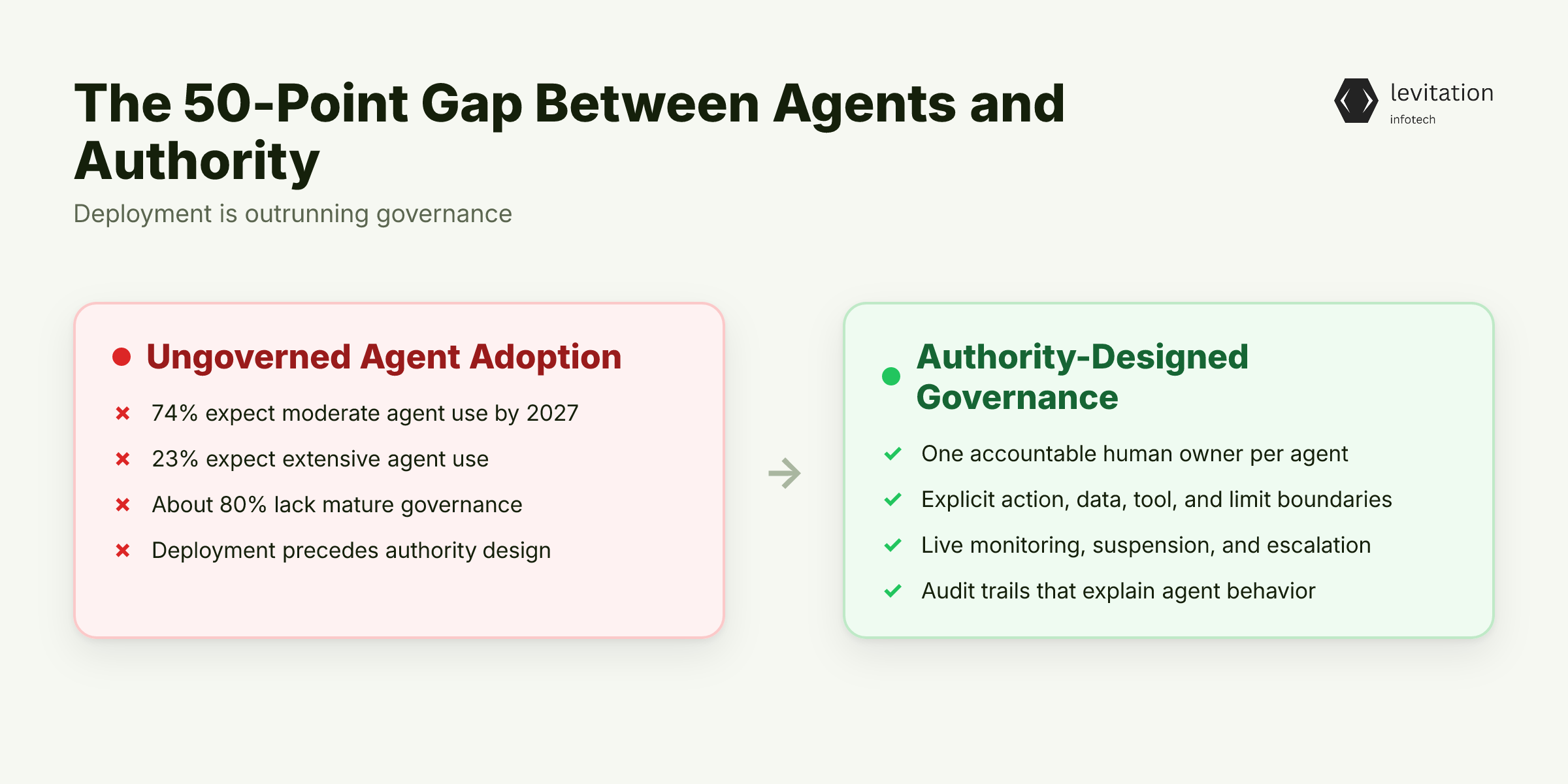
Your next AI agent can act before your company decides who may let it act. By 2027, 74% of respondents expect their companies to use AI agents at least moderately, according to Gartner.
Within that broader group, 23% expect extensive use. Another 5% expect agents to become core business operations. These are nested responses within the 74%, not separate populations.
Adoption is moving before governance
Gartner also identifies a 50-percentage-point gap between expected agentic AI deployment and existing governance capabilities. That gap is about authority design, not model quality. CTOs don't need another generic AI policy.
They need to know who may authorize each action, under which conditions, and within which limits. Consider a customer-support agent that reads an account, recommends a refund, calls a payment API, updates the CRM, and delegates a case.
Who authorized each consequential step? A generic model approval can't answer. How many organizations have built the controls to answer it?
Mature governance remains the exception
Deloitte surveyed 3,235 IT and business professionals. It found about 80% of organizations lack mature agentic AI governance. The missing capabilities are concrete: clear agent boundaries, real-time monitoring, and audit trails.
They aren't nice-to-have extras. They determine whether the enterprise can see, stop, and explain an agent's behavior. The gap points to a deeper issue: authority design.
The gap is an authority-design failure
Most enterprise AI solutions begin with access to models, data, and tools, often without an authority model. RBAC can limit what an identity reaches.
It can't decide whether a proposed refund is legitimate for this customer, agent, and moment. Decision rights close that gap by assigning purpose, authority, consequence, and evidence. What does a CTO-ready baseline require?
A CTO-ready baseline needs four things
Before another production deployment expands the governed surface, require: - One accountable human owner for every agent. - Explicit boundaries on permitted actions, data, tools, and limits. - Live monitoring, suspension, and escalation controls. - Decision-time evidence showing what happened and why it was allowed.
Without these controls, each new agent creates another blind spot with production access. Most enterprises have delegated actions without designing the authority behind them. Why do their programs still stall?
Why Approval Boards Become the Scaling Ceiling
Most approval boards can review an answer. They cannot supervise an action chain.
Traditional AI governance asks whether a response is accurate, safe, or compliant. Agentic AI agents can plan, call APIs, write code, change databases, and delegate work. Output checks cannot contain a chain of state changes.
A correct plan can still call the wrong tool with the wrong scope.
Output review cannot police an action chain
Consider an agent that drafts a discount, changes a customer tier, and sends the change to another agent. Each step can alter price, customer treatment, or downstream workload. Reviewing the final response misses those intermediate commitments.
Accountability also fragments across the stack. Model providers shape capabilities, while platform operators constrain environments. Integrators connect tools, and deploying organizations authorize use.
Delegating authority to an autonomous agent does not transfer the responsibility that comes with it. Shared responsibility without a named owner usually means no owner. What happens when execution moves faster than review?
Review cadence loses to execution cadence
Traditional audit-log review is insufficient when agents take more consequential actions than humans can inspect. Human review is valuable, but it cannot sit between every API call and state change without becoming the bottleneck. Two common responses make scaling worse: - Blanket human approval strips useful autonomy and creates a queue proportional to action volume. - Static policy documents cannot reliably stop a tool call, cap spending, revoke access, or block unauthorized delegation.
Written policies cannot reliably prevent unsafe actions once execution begins. Runtime controls are required. What should governance govern instead of every action?
Reframe the unit of governance
Stop asking who must review every action. Ask who may set an agent's boundaries, conditions, limits, and escalation triggers. Decision rights become the unit of governance because they translate into permissions and runtime checks.
The way out isn't faster committee meetings. Treat decision rights as constraints the runtime can enforce before an agent acts. How do those constraints become machine-enforceable authority?
Decision Rights Must Become Machine-Enforceable Authority
Machine-enforceable authority turns "be careful" into a decision the system must make before a tool call. This is governance by design: controls built into architecture, not bolted on after deployment. The key distinction is that traditional governance focuses on training, bias, and output quality.
Agentic governance must also cover autonomous decisions, tool use, delegation, memory, and downstream consequences. Neither framing supplies the missing operating contract. That contract must say who may act, within which envelope, and how authority terminates.
RBAC is necessary but insufficient
Role-based access control answers what an identity may access. AI decision rights add conditions, consequence, delegated limits, and proof of authorization. Consider a refund agent.
API access says where it can act. It doesn't say when the refund is allowed. That missing condition is authority.
How do you express that authority for each agent?
Give every agent an authority envelope
An envelope converts broad autonomy into bounded discretion. It should contain: - Purpose, permitted actions, data scopes, and available tools. - Spending and step limits, plus an expiration time. - Prohibited actions, approval triggers, and required evidence.
The envelope also defines the violation response: a denied action triggers a defined stop, escalation, suspension, or rollback. The envelope isn't paperwork.
It must drive credentials, policy checks, approval routes, and evidence capture. This is agentic AI governance expressed as an operating contract. Who must own and enforce that contract?
Separate authority from execution
Four roles must remain distinct: - An accountable human owner accepts the consequence. - An authorizing person or policy grants the envelope. - A control plane enforces it. - An escalation owner handles exceptions.
Shared ownership isn't accountability. A committee can advise, but one accountable owner must still answer for the agent. For enterprise AI solutions, that separation prevents a platform team from silently inheriting business risk.
How much autonomy should each role grant?
Tier autonomy by consequence, not model confidence
Use four consequence tiers: - Read-only observation. - Recommendation without state change. - Reversible execution. - High-impact or irreversible commitment.
Model confidence doesn't determine whether an action is safe to delegate. Consequence does. Pre-authorize routine decisions within the corresponding envelopes.
Reserve explicit approval for high-impact, irreversible, or policy-crossing actions. Humans should supervise exceptions and patterns, not repeat decisions already delegated. An authority model matters only if it becomes permissions, policy checks, approval routes, and evidence at the moment of action.
How do you build that map before adding another agent?
Build the Authority Map Before Adding Another Agent
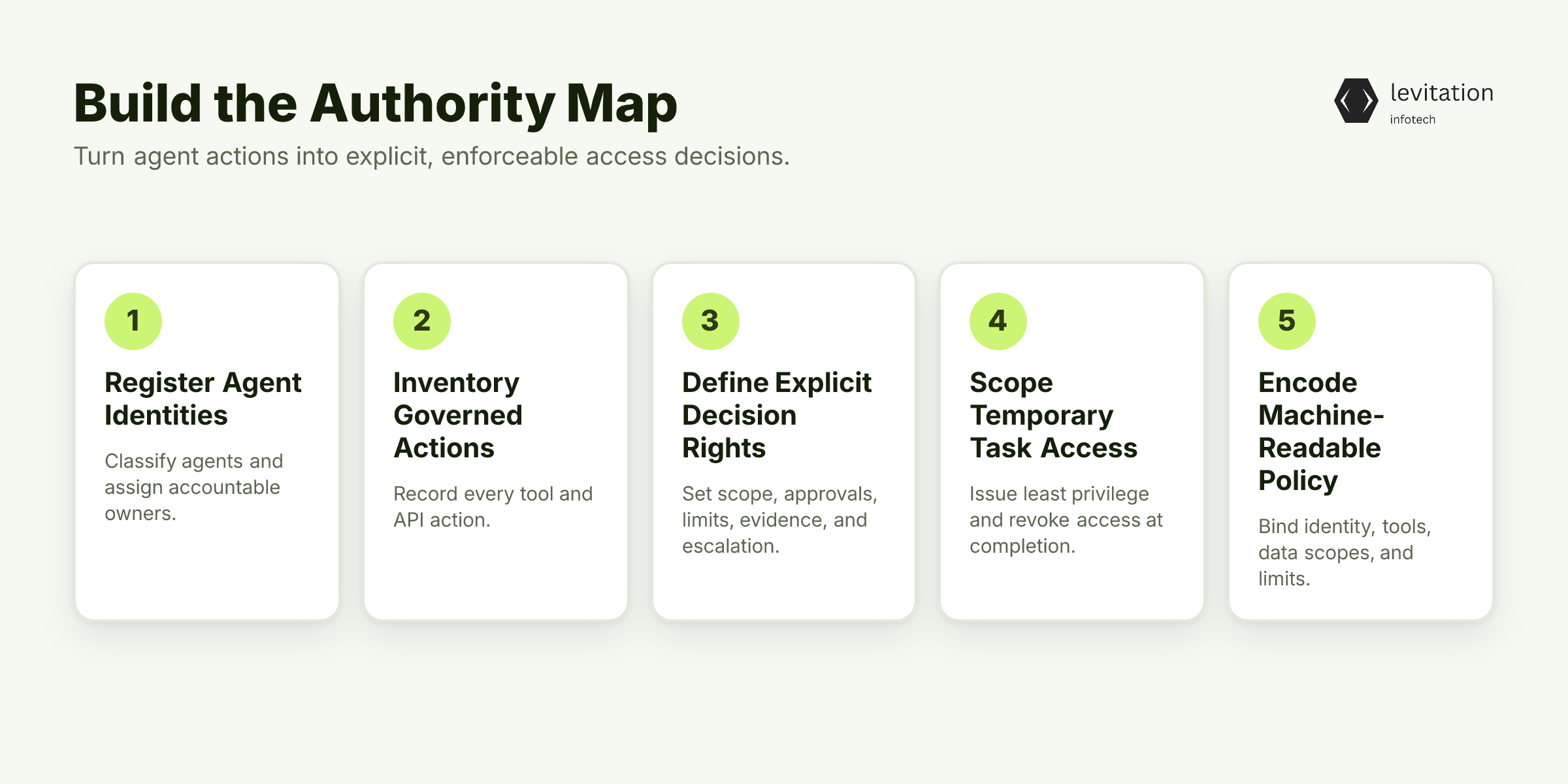
A decision matrix is useless if it lives in a slide deck. It must become the source of identity, authorization, and runtime control. This is the difference between a spreadsheet control plane and enforceable authority.
Centralize agents in a registry. Classify each as a nonhuman identity, then use temporary least-privilege access revoked when tasks end. Each registry entry should capture identity, purpose, owner, model, tools, data domains, environment, permissions, autonomy tier, and production status.
Inventory actions rather than use cases
A use case can hide many governed actions. Consider a customer-service workflow that reads records, drafts replies, changes priority, issues credit, closes tickets, and delegates cases. Inventory each action across every tool and API.
Record what can change, who benefits, and whether the effect reverses. This action inventory becomes the raw material for AI governance. How do you turn that inventory into explicit decisions?
Build a decision matrix
For each action, record: - Accountable business owner and authorized scope. - Risk level and required approval. - Financial or operational limit. - Evidence standard and escalation path.
This matrix is the organization's explicit AI decision rights. It closes gaps that generic risk tiers cannot.
For example, a support agent can draft a reply automatically. Issuing a refund above the agent's envelope requires a named approver. How should access follow the decision?
Scope access to the task
Issue temporary credentials for the active task. Revoke them when the task ends, rather than carrying dormant access forward. Delegation must narrow authority, never widen it.
A child agent can't receive broader tools, data, budgets, or permissions than its parent. Otherwise, a harmless planner can delegate itself into a privileged executor. Make that rule explicit in enterprise AI solutions, rather than leaving it to framework defaults.
How do you encode that rule for runtime use?
Encode the envelope in machine-readable policy
Each policy record should carry the agent ID, allowed tools, data scopes, and limits. It should also specify maximum steps, budget limits, approval requirements, expiry, and violation actions. Version every policy beside the registry.
Auditors must reconstruct the authority active at the moment of decision. Link each record to its accountable owner, source decision, and evidence destination. This turns governance from a spreadsheet into executable authority.
How do you prove the control path works?
Pilot one bounded workflow
Start with actions that are observable, reversible, and owned by a business team. Exercise logs, approvals, revocation, rollback, and incident handling under production conditions. Expand the envelope only when the control path proves it can contain failure.
That map still leaves the most important engineering question unanswered: where do permissions and approvals get enforced when the agent acts?
Enforce Decisions Inside the Action Path
Authority on paper has no stopping power when an AI agent calls a tool that changes state. Enforcement must sit inside the action path. A useful control sequence is: intent → policy checkpoint → tool gateway → state change → evidence store.
Before a database mutation, external message, financial commitment, or delegation, the checkpoint returns allow, deny, or require approval. Consider a refund agent. The model requests a credit.
The checkpoint checks its envelope, limits, and approval state before payment begins. This is runtime enforcement, not retrospective AI governance.
Layer runtime controls
Use several controls because none can replace an authorization boundary: - Scoped nonhuman identity and short-lived credentials. - Policy enforcement at tool gateways. - Sandboxing for code and generated artifacts. - Step limits, dynamic budgets, and rate limits. - Anomaly detection and automatic suspension.
At the same time, human oversight must operate at the speed and scale of autonomous action. Use autonomy tiers and risk-based escalation. Low-risk work can run autonomously, while high-impact and irreversible actions need explicit approval. Dynamic budgets and automated financial controls can stop execution after a limit is exceeded. What happens when one agent delegates to another?
Prevent authority amplification
Delegation should compute the intersection of the initiator's and child's authority, yielding the narrower envelope. The child can never escape the parent's envelope. This matters because an agent can turn one permitted action into many downstream actions.
Each inherited permission becomes a multiplication risk. Record the initiating agent, delegated agent, shared task, and effective envelope together. That record turns traceability into an enforcement control.
What must the system capture to prove each decision?
Capture evidence automatically
Log the agent identity, relevant context, requested action, tool arguments, policy version, approval decision, result, and resulting state change. Make records searchable, replayable, and linked to the accountable owner. The audit trail problem starts when these pieces stay disconnected.
Model logs won't prove action legitimacy. Only the decision path can. What should happen when the path denies or fails?
Engineer the exception path
Define triggers for human approval, agent suspension, access revocation, and workflow rollback. Include a kill switch and a compensating action for serious failures. The kill switch must live outside the agent, where a failed agent can't suppress it.
Test rollback before the incident. Otherwise, recovery becomes another improvised approval chain. How do you prove the whole chain fails safely?
Test the full action chain
Evaluate prompt injection, unauthorized delegation, supply-chain manipulation, tool misuse, policy drift, and ordinary failure modes. A passing model evaluation isn't enough if the surrounding agent can still take an unauthorized action. Test that the agent, its tools, its child agents, and its policy engine fail safely together.
With enforcement live, the payoff isn't merely safer agents. It is a reusable operating model for enterprise AI strategy. Can each business unit adopt that capability without rebuilding it?
Scale Autonomy on Governed Rails
Counting agents rewards activity, not control. A large agent estate can still contain weak authority. Measure governed throughput instead. - Deployment lead time and decision latency. - Consequential actions per human review. - Unauthorized-action blocks and policy-check coverage. - Exception rates, recovery time, and evidence completeness.
Autonomy and control should improve together. If action volume rises faster than coverage, the estate is becoming less governable.
Which shared capabilities can make that control repeatable?
Productize governance as an enterprise capability
Reuse agent identities, authority templates, policy engines, approval routes, tool controls, and evidence stores across business units. This turns governance from a project-by-project tax into shared enterprise AI strategy infrastructure.
For enterprise AI solutions, the reusable asset isn't another agent framework. It's the control plane around every agent.
That control plane does not remove the ownership problem described in AI Pilots Stall on Ownership, Not Models. How should executives see this shared control plane?
Make decision rights legible to executives
Give the board a portfolio view of delegated decisions, human-controlled decisions, recurring exceptions, and concentrated operational risk. The goal isn't zero human judgment. It's deliberate judgment at the right level.
Executives should see where autonomy expands safely, where exceptions cluster, and which controls fail under real demand. This turns a list of agents into a map of enterprise authority. What does that authority look like after launch?
Treat production longevity as governance evidence
A launch review proves little about control. Long-term production evidence shows whether authority, enforcement, evidence, and recovery hold up under real demand.
Which control will fail first under production load? Start with one bounded workflow, then expand only after its control path holds. The next deployment will reveal whether that control path can scale under real demand.
About the author
Mayank Singh is a software developer at Levitation Infotech, where he builds web and AI-powered applications across the company’s fintech, healthcare, and enterprise projects.