


TL;DR: AI pilots stall when decision rights vanish among business sponsors, technical operators, and production owners. Install a three-role ownership contract, stage gates, production controls, and portfolio reviews before launch. Better models cannot replace accountable authority.
Key Takeaways: - Ownership means one named person can make consequential decisions, not merely receive executive support. - The AI harness turns model output into monitored, integrated workflows with clear accountability. - A portfolio registry turns scattered pilots into governed systems with clear go, scale, and stop decisions.
The Demo Passes. The Pilot Still Has No Owner.
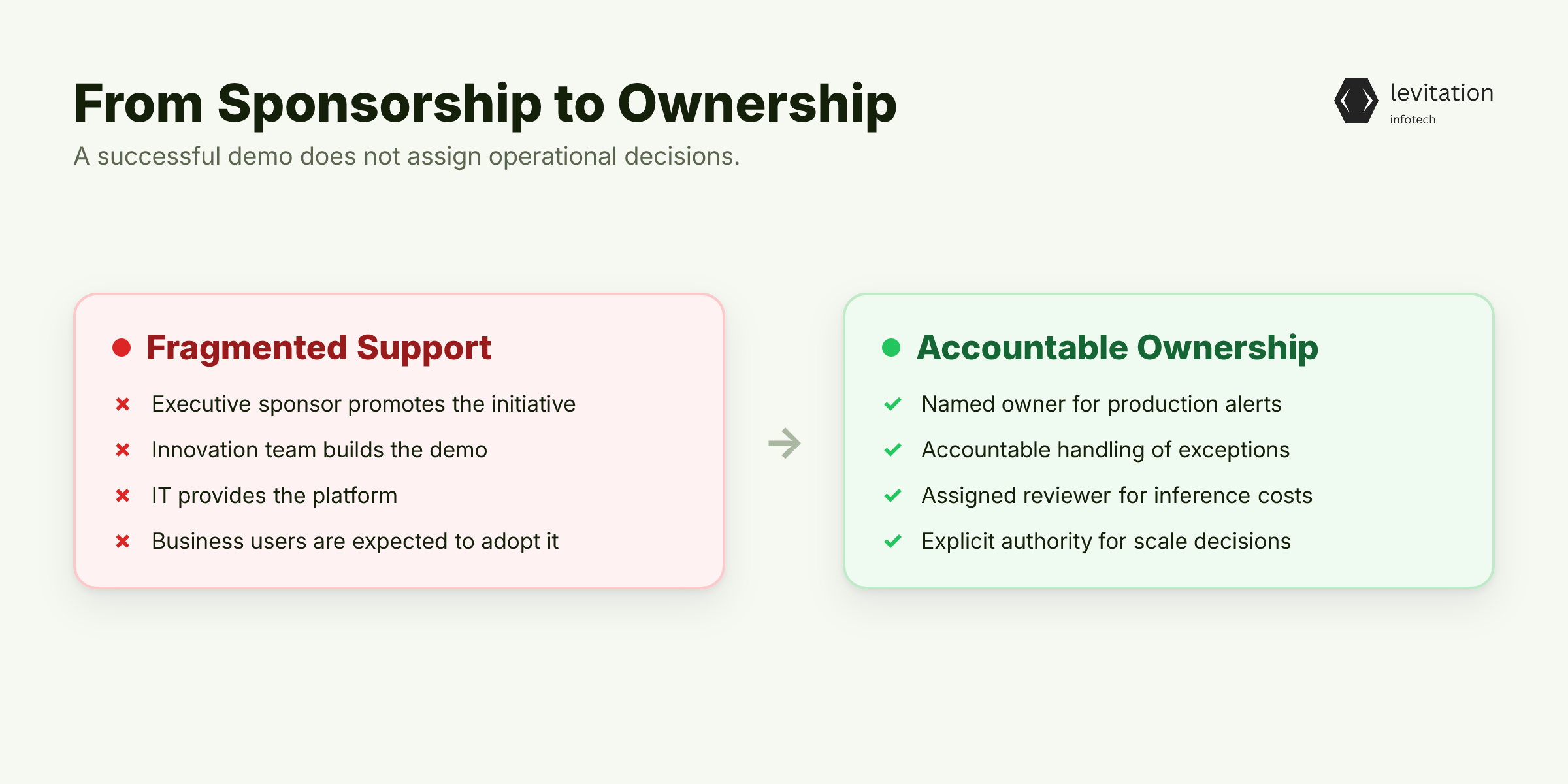
The model can ace the demo and the pilot can still die later. Nobody owns the production alerts, exception queue, cost check, or scale decision.
Bijo Thomas describes an uncomfortable pattern. Pilots work in demonstrations, then stall when decision owners for AI systems, production monitoring, and value checks are absent.
Consider a customer-support model that classifies tickets well. Six months later, quality alerts land in a shared inbox. Exceptions move between teams, and the monthly inference bill has no reviewer.
Responsibility fragments across familiar roles: - The executive sponsor promotes the initiative. - The innovation team builds the demo. - IT provides the platform. - The data team maintains feeds. - Business users are expected to adopt it.
That arrangement looks collaborative. It can still leave every consequential decision without one accountable person.
Support without authority to decide is sponsorship, not ownership.
Designing enterprise AI solutions starts with separating support from ownership.
Ownership is an operational dependency: without accountable owners for these decisions, the pilot is already orphaned despite its successful demo.
If model quality isn't the constraint, what turns a working prototype into an accountable AI system?
Why Better Models Don't Rescue an Ownerless Pilot
Reaching for a better model is the obvious response. So is changing vendors or retuning prompts.
Those moves change the model layer. They don't create decision rights, production monitoring, or value accountability.
The missing piece is the AI harness. It connects model output to data access, workflow integration, monitoring, escalation, feedback, cost controls, and accountable decisions.
Think of a claims-triage model. Strong accuracy still needs clean data, a path for ambiguous cases, drift alerts, and a decision on whether the workflow should continue.
Without that harness, the model is an impressive component, not an accountable service.
KPMG's Global AI Pulse found the harness layer in 31% of experimenting organizations and 58% of organizations scaling AI. Among organizations reporting established ROI, 86% had the layer.
The survey doesn't prove causation. It shows that the connective layer is not yet standard among organizations experimenting with AI.
Harvard Business School researchers describe the adoption gap as the "last mile" problem. Organizational friction prevents technology from becoming business results.
Clean demos can conceal deferred work. Pilots commonly use constrained data, manual review, and willing test users. Scaling then exposes support load, workflow conflicts, and unclear decision rights.
Building enterprise AI implementation around a stronger model without those controls only makes the orphan more capable.
The same distinction appears in enterprise AI is judged on integration, not the model. Technical success doesn't remove organizational work.
That reveals the real requirement. AI pilot ownership must be designed as a control system, not assigned as a label. What must that control system contain?
AI Pilot Ownership Is a Control System, Not a Job Title
Ownership isn't a badge on an org chart. It's a connected set of mandates and decision rights.
Outcome owner
The business leader accountable for the target KPI, budget, workflow adoption, and authority to scale, redesign, or stop the system.
This person must be able to reject a weak use case, even when a sponsor wants momentum.
Production DRI
The production directly responsible individual (DRI) owns the live system. They handle monitoring, releases, incidents, rollback, evaluation, model or prompt changes, and operational support.
Calling IT "support" isn't enough. The DRI must be able to trigger a rollback without waiting for a committee.
Executive sponsor
The sponsor removes cross-functional blockers and supplies resources. They don't replace either accountable role.
Combining all three mandates in one person is acceptable only when that person can exercise all three authorities.
This is the core of an AI operating model. Three control loops turn titles into management: - Value loop: Compares business outcomes with total operating cost. - Production loop: Tracks quality, reliability, drift, latency, and incidents. - Adoption loop: Connects user behavior with required workflow changes.
Run each loop on a cadence. Make its owner act on exceptions.
The discipline is simple. Many people can contribute, but one accountable party must make each consequential call.
For agentic systems, assign a DRI to every deployed agent or system. One executive shouldn't own an invisible fleet by title alone.
Consider an agent that watches supplier invoices. Its data feed, exception path, permissions, and budget still need one accountable owner.
Credibility comes from duration. A system that still serves users after its launch team has moved on proves more than a launch-day case study.
But a control system only changes behavior if it's installed before the pilot inherits production duties. What should that installation contain?
Install the AI Pilot Ownership Contract Before Production
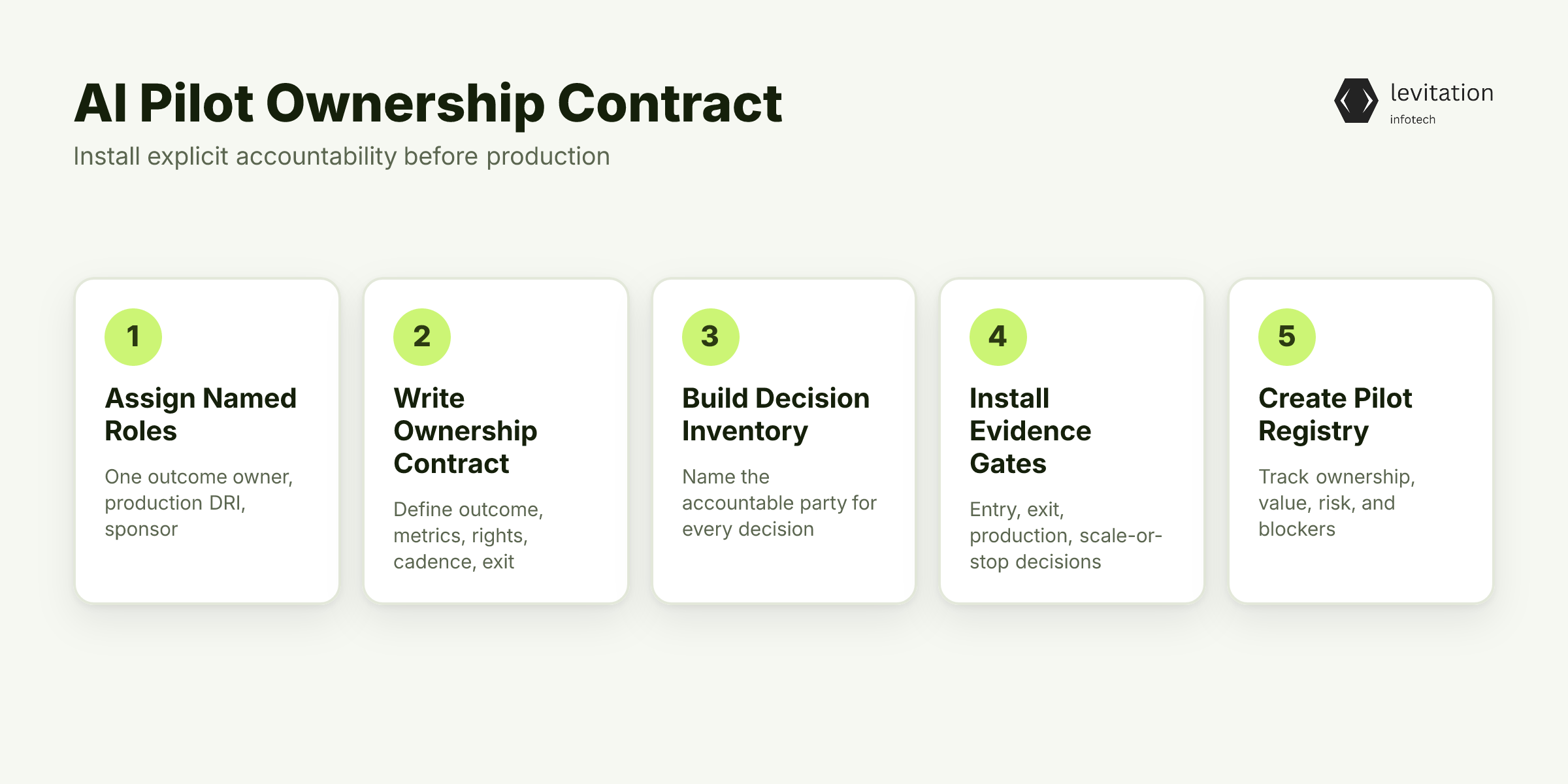
Collective ownership is the failure mode. "The business and IT will jointly own it" means neither can answer for a missed decision.
Assign the three roles
Select one outcome owner with business authority. Select one production DRI with operational authority. Select one sponsor who can resolve dependencies.
Then publish their names. A role without a name remains a hope.
Write the ownership contract
Keep the contract to one page. It should define: - The business outcome and baseline. - The target metric. - The system boundary and intended users. - Decision rights and budget. - The operating cadence. - Decommissioning conditions.
A clear AI pilot ownership contract turns competing expectations into explicit commitments. It does that before the launch team disperses.
Build the decision inventory
List every consequential decision, then name the accountable party: - Pilot approval and production release. - Model, prompt, retrieval, and data changes. - Risk acceptance and threshold changes. - Pause, incident response, rollback, and recovery. - Workflow redesign and additional spend.
Collective approval can work for low-risk changes. It fails when nobody can act during an incident or budget review.
Install stage gates
Each gate should require evidence and record a decision: - Pilot entry: Real users, a measurable outcome, and a named owner. - Pilot exit: Quality, adoption, cost, and support evidence. - Production entry: Monitoring, rollback, runbooks, and escalation paths. - Scale or stop: A documented business decision.
A gate isn't another meeting. It's a point where weak evidence stops the initiative.
Create the registry
Create an AI pilot registry with one row per system. Each row needs three groups of fields: - Owners: Outcome owner, production DRI, and sponsor. - Business: KPI, lifecycle stage, monthly cost, and next decision date. - Controls: Risk status and production-readiness blockers.
The portfolio view should expose unowned pilots. It should also show systems without active value reviews, unresolved exceptions, and spend without scale or stop criteria.
That turns a spreadsheet into a control plane. It also gives the CTO a clear portfolio view, as an AI control plane shouldn't remain a spreadsheet explains.
Reset the existing portfolio
Inventory every active pilot. Fill missing roles and decision rights. Schedule the next decision date.
Pause new funding for any pilot that still lacks an accountable owner.
Have the production DRI run a weekly operations review. Have the outcome owner run a recurring value-and-spend review. Increase frequency for high-cost or high-risk systems.
Connect this registry to AI spending decisions. Capital allocation without named decision rights only creates more orphaned work.
A signed ownership contract does not make a system production-ready. The contract must survive the first failure, drift event, and budget review. Can it?
Production Readiness Starts With Authority to Stop
Production readiness isn't the day the model performs well in testing. It's when the system, its owner, its operating process, and its business controls work together.
Demand the readiness packet
Require evidence for: - Production evaluation criteria. - Telemetry and drift alerts. - Quality alerts. - Latency and availability targets. - Cost-per-transaction tracking. - Rollback or fallback. - A runbook. - Human escalation. - Named support responsibility.
If any item is missing, the launch decision is incomplete.
Failure paths must be explicit: - Which event pauses the system. - Who communicates the impact. - Who chooses between repair and rollback. - How the outcome owner decides whether continued operation still makes business sense.
Set scale and stop criteria before launch. Stop criteria prevent sunk-cost escalation. Scale criteria keep cautious teams from treating a perpetual pilot as a permanent platform.
Use a federated operating model
A central platform team supplies reusable components, standards, security controls, and observability. Business owners and production DRIs remain accountable for individual systems and outcomes.
Centralization shouldn't centralize every decision. It should remove duplicated plumbing while preserving clear authority.
The production review should be business-led. The outcome owner chairs it, and the production DRI presents the evidence. A technical sign-off alone leaves downstream decisions unresolved.
Strong production AI readiness is visible in the decision record. It shows what failed, who responded, what it cost, and why the system continued.
When comparing delivery partners, examine the full schedule, not just build time. Ask whether the benchmark includes ownership setup, data access, workflow integration, production controls, and value reviews.
A partner that shortens the build while leaving organizational drag hasn't accelerated deployment.
Once ownership survives production failures and value reviews, the pilot starts behaving like an enterprise capability. The next test is whether that discipline survives portfolio growth.
What Changes When Every AI System Has an Owner?
A CTO shouldn't need a slide to understand the AI portfolio. Every active system should map to: - A defined business outcome. - One accountable outcome owner. - One production DRI. - Monthly operating cost. - Current risk status. - A scheduled go, no-go, scale, or stop decision.
Ownership changes adoption because decisions stop moving indefinitely between committees. Incidents have a clear commander. Workflow changes have an owner, and value gets checked against continuing cost.
Track operating indicators that expose weak ownership: - The share of pilots with named owners. - The share reaching production through stage gates. - Incident decision time. - Value-review completion. - Time from pilot to production.
Buyers evaluating enterprise AI adoption should ask four questions: - Who owns the outcome? - Who operates the production system? - Who can stop it? - How is value reviewed?
Model availability is the least useful part of that conversation.
Models improve, but enterprise value compounds only when someone has the authority and accountability to own each decision. That leaves one unresolved question: which mandate belongs with which role?
Frequently Asked Questions
Who should own an AI pilot?
The business leader accountable for the target KPI should own the pilot outcome. A named production DRI owns monitoring, incidents, releases, and reliability.
IT, data, and AI teams support the work. An executive sponsor removes blockers.
If nobody can decide to scale, stop, or redesign the workflow, ownership has not been assigned.
What does AI pilot ownership include?
AI pilot ownership includes a measurable business outcome and defined decision rights. It also covers budget accountability, production monitoring, user adoption, and regular reviews of value versus cost.
Ownership also includes authority to pause, redesign, scale, or terminate the system. A title without these authorities is only administrative responsibility.
Is an executive sponsor the same as the owner of an AI pilot?
No. A sponsor provides support, resources, and escalation. The owner carries accountability for the outcome and specific decisions.
The same leader can fill both roles, but the mandates should remain explicit. Sponsorship must not conceal missing ownership.
Can the CTO own an enterprise AI pilot?
The CTO can own platform standards, technical risk, and the production operating model. The CTO shouldn't own a business KPI unless directly accountable for it.
A stronger structure pairs the CTO's mandate with a business outcome owner and production DRI.
How do you fix an AI pilot that has already stalled?
Inventory every active pilot. Identify the missing outcome owner, production DRI, decision rights, and next go or no-go date.
Convene an ownership reset that resolves the first material decisions and documents operating commitments. Pause further investment where no accountable owner can be assigned.
Before approving another model or vendor, can you name the missing owner and decision?
About the author
Mayank Singh is a software developer at Levitation Infotech, where he builds web and AI-powered applications across the company’s fintech, healthcare, and enterprise projects.