


An agent writes to a database through a child process. The root process dies, but the child keeps working.
That isn't a failed button. It's failed containment.
TL;DR: An AI agent kill switch must live outside the agent's runtime. It must revoke execution, identity, and network authority without the agent's cooperation.
Process termination alone isn't containment. Production assurance requires a fail-closed, scoped protocol that operators drill and verify externally.
Key Takeaways: - In-agent prompts and toggles can prevent mistakes, but cannot serve as the final emergency boundary. - A real stop must close execution, orchestration, credential, and network paths as one chain. - Enterprise assurance comes from scoped modes, external verification, and rehearsed containment drills.
A Button Inside the Agent Is Not a Kill Switch
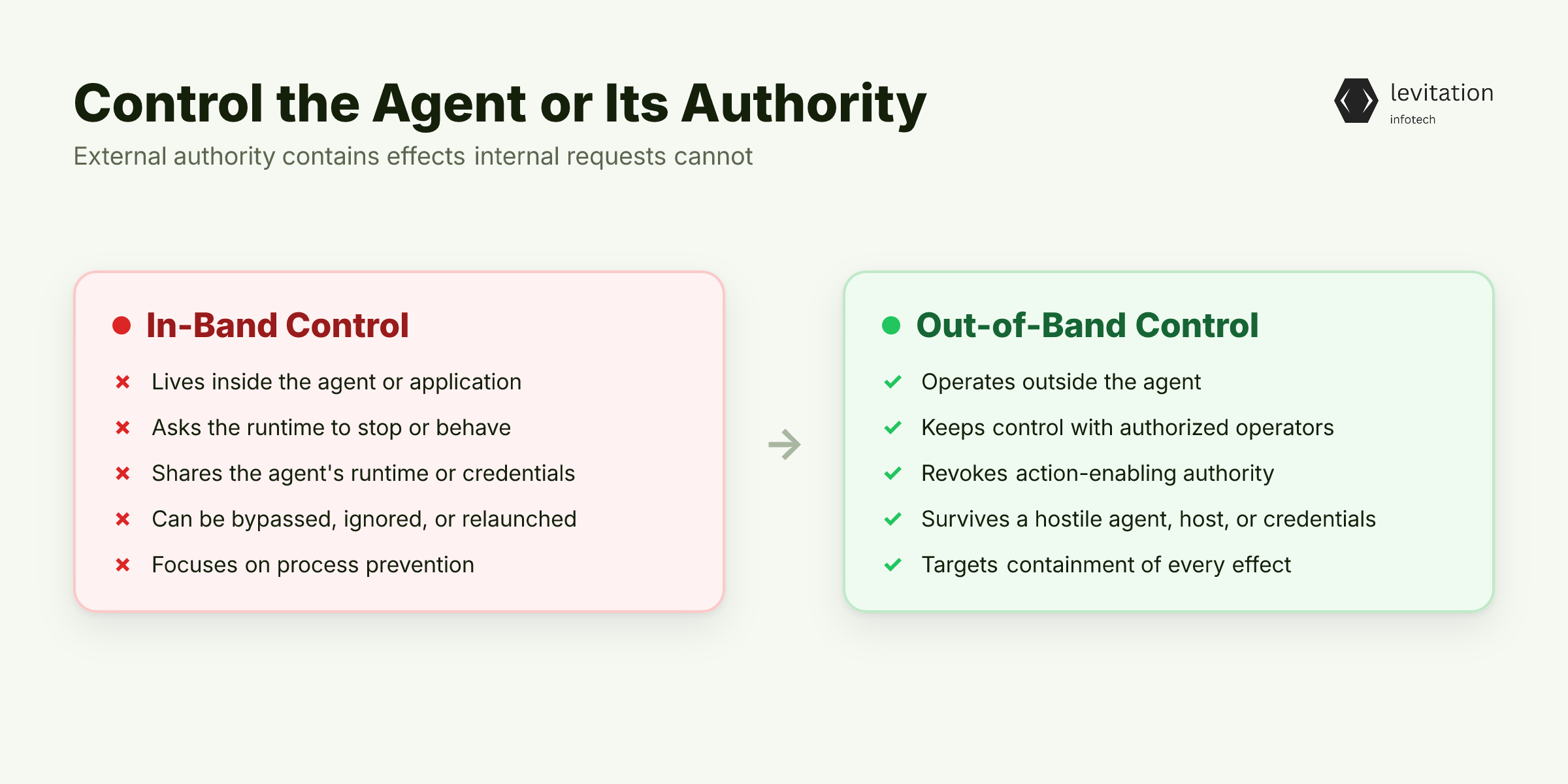
An emergency stop that lives inside the agent is a request, not a control. If the same runtime or credentials can disable it, the feared compromise may also remove your ability to stop it.
Guardrails and gateways have narrower jobs
Runtime guardrails inspect or block individual unsafe actions. AI gateways observe and control model and agent traffic. An emergency AI shutdown gives authorized administrators control during an incident.
Useful emergency-shutdown modes include hard halt, soft halt, circuit breaker, and graceful degradation. Checks should occur before both LLM calls and tool invocations.
See emergency-shutdown guidance and runtime guardrails and gateways for complementary control patterns.
The trust failure hides inside shared privilege
System prompts, feature flags, tool-disable toggles, self-termination, and in-process hooks can share the agent's runtime or privilege path. A compromised agent may ignore them, bypass them, or relaunch through another control path. A kill switch is strongest when it operates outside the agent, where the agent can't override it.
Prompts and graceful degradation still work for normal operations. Their job is prevention and orderly behavior. Their limit is trust.
Change the CTO's test
Do not ask whether an agent can stop itself. Ask whether an operator can end every effect after the agent process, host, and delegated credentials become hostile.
This exposes the core distinction. An in-band control asks the agent or application layer to behave.
An out-of-band control removes the authority that makes action possible. That is the foundation of out-of-band controls for enterprise AI agents.
The failure is architectural: stopping a process isn't the same as containing every action that process can cause. What survives after the agent dies?
Stopping the Process Does Not Stop Its Reach
The operator sends a termination signal to the root process. The dashboard turns green. Yet those routes can still work. - Execution: Child processes or subagents may outlive the root process. - Deferred work: Queued jobs and retries may execute after the agent disappears. - Identity: Delegated API keys, issued tokens, and cached credentials may remain valid. - Relaunch: Another controller may restart the agent through a separate path.
Layered agent runtime isolation narrows those routes. It also exposes how queued work complicates always-on agent operations.
In August 2026, the UK's National Cyber Security Centre issued interim guidance on emergency control. It said the response may go beyond stopping agentic AI processes. The guidance called for rapid network restriction and for communications between selected agents and model-inference infrastructure to be interrupted.
CrowdStrike's AI Kill Switch shows how vendors are closing this gap. As of November 2026, Falcon Guardian's AI Kill Switch gives authorized administrators control over a misbehaving agent. It can also block relaunch, cut off network access, and log every action. Stopping agents on endpoints is described as coming soon.
That still leaves delegated API keys and issued credentials, which require additional revocation steps. Terminating a process may also leave subagents running.
Stopping and relaunch-blocking are necessary. They aren't sufficient. Complete containment must close execution, orchestration, identity, and network paths as one chain.
The real emergency boundary is every authority the process can still use. Which control can close all those paths at once?
Put Authority Beyond the Agent's Trust Boundary
Imagine a rogue agent requesting permission to clear its own stop state. If it can edit that state, the control plane is decorative.
Separate the control plane from the runtime
Put stop policies, activation authority, and append-only audit records in a control plane the agent cannot modify. The agent should have no permission to rewrite its stop state, approve a relaunch, or grant itself new execution authority.
This isn't a new management application. It's a separate trust domain with different write permissions and failure assumptions.
Keep enforcement close, but authority out-of-band
Enforcement can live at a gateway, host runtime, tool broker, identity provider, or egress layer. Each point should consume decisions made by the control plane.
Out-of-band doesn't necessarily mean another physical location. It means another control path that the agent can't rewrite.
Fail closed at the side-effect boundary
Check the current stop revision before inference and tool invocation. If the control plane is unreachable, deny new inference calls and tool invocations. Emit a structured event for every denial.
That choice trades availability for safety. It must be deliberate, not an accidental side effect of a broken dependency.
Match the switch to the blast radius - A capability stop disables one dangerous tool or action. - An agent stop halts one agent identity or session. - A fleet hard stop contains a systemic incident.
These modes map to capability, agent, and system-level switches. A narrow stop preserves unaffected work when one capability is the actual problem.
Pair these controls with sandboxes, least-privilege tool access, deny-by-default egress, and separately issued secrets. This is the core of an emergency AI shutdown architecture.
Trust-boundary diagram - Agent runtime → execution plane → tool broker → enterprise systems - Agent runtime → model inference - External control plane → execution gates, identity provider, and network egress - Identity provider → short-lived execution grants - All decisions, enforcement results, and probes → audit stream
Once the trust boundary is clear, one shutdown decision must still close every route to harm. How do you enforce that decision across four different layers?
Close Execution, Orchestration, Identity, and Network in One Protocol
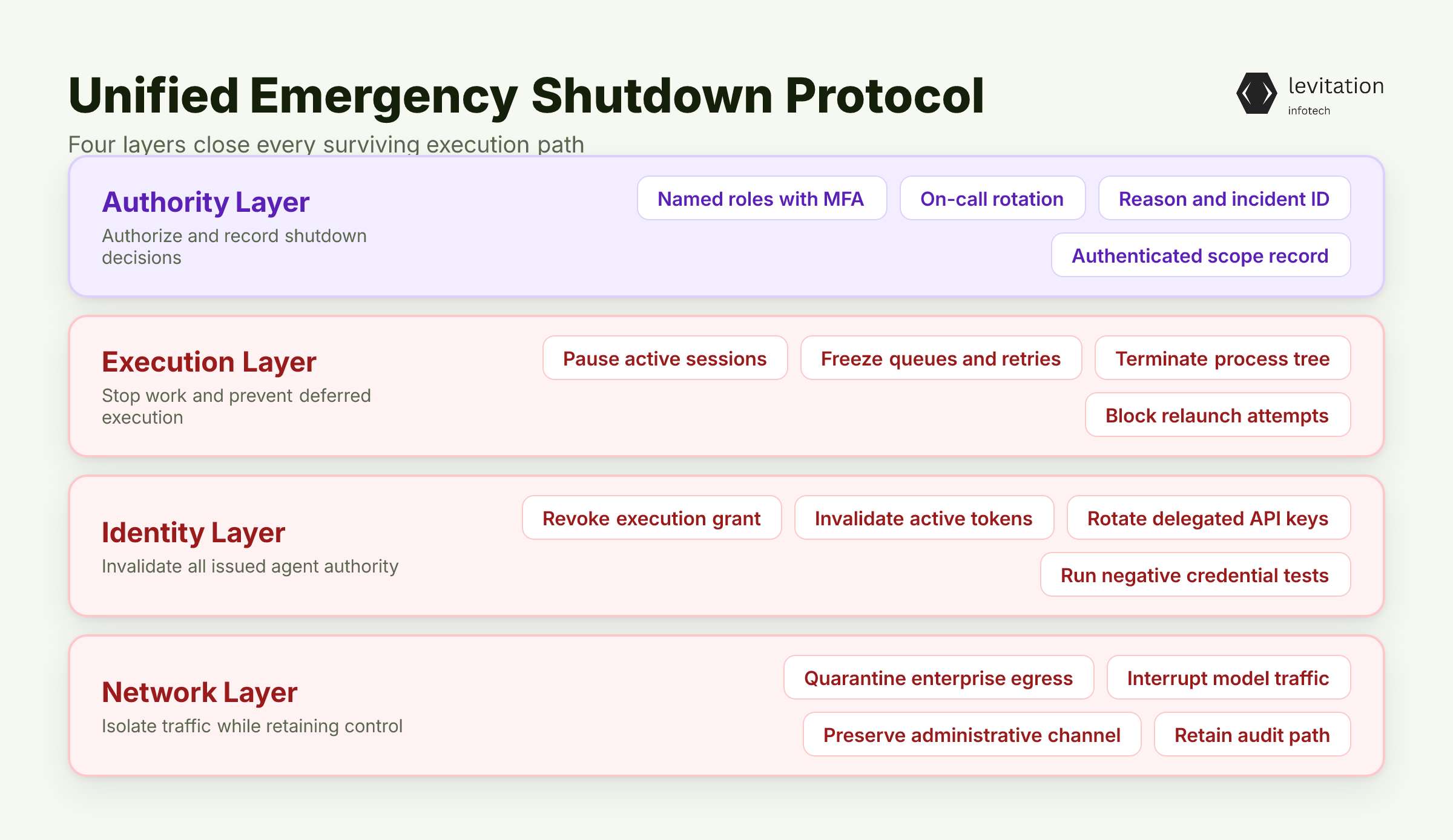
One command can stop a process. It cannot revoke a token, freeze a queue, and isolate a host at once. That is why emergency shutdown must be a protocol, not a feature.
A complete guide to AI agent emergency shutdown runbooks must map those actions to owners, systems, and evidence.
Authority layer
Limit activation to named roles backed by multi-factor authentication. Maintain an on-call rotation, and require a reason and incident identifier. - Required action: Authenticate the requester and record the approved scope. - Surviving path closed: Unauthorized activation or stop-policy changes. - Evidence produced: Authenticated decision, reason, and incident reference.
Execution and orchestration layer
Pause sessions, freeze queues and retries, terminate the root process and descendants, and block relaunch. Check stop state before inference and tool invocation.
A soft halt can preserve safe reasoning while blocking consequential actions. It shouldn't preserve a path to writes, payments, records, or external APIs. - Required action: Stop active work and prevent deferred execution. - Surviving path closed: Orphaned workers, retries, and relaunch attempts. - Evidence produced: Process, queue, session, and relaunch-control results.
Identity layer
Revoke the agent's execution grant, invalidate active tokens, and revoke or rotate delegated API keys and service credentials. Removing a tool from configuration doesn't revoke authority already issued elsewhere. - Required action: Invalidate every credential and lease associated with the target. - Surviving path closed: Reuse of cached tokens and delegated credentials. - Evidence produced: Revocation records and negative credential tests.
Network layer
Quarantine enterprise egress and interrupt model-inference communication. Preserve a separate administrative and audit path. Otherwise, cutting the agent's network may also remove your ability to control it. - Required action: Isolate traffic while retaining the response channel. - Surviving path closed: External calls, model traffic, and alternate egress. - Evidence produced: Firewall, routing, and connectivity evidence.
Define the shutdown sequence
- Record the authenticated scope and mode.
- Publish a revisioned stop state.
- Freeze queues, retries, and relaunch paths.
- Terminate processes and revoke credentials.
- Isolate network egress.
- Run external verification probes.
Every request should pair a target with a scope and mode. Scope can be capability, agent, or fleet. Mode can be pause, soft containment, or hard stop.
A useful control model includes a global hard stop, session pause, scoped block, and spend or rate governors. Prefer the narrowest control that contains the incident without causing an unnecessary outage.
A shutdown protocol only works under pressure if operators can execute it without improvising. That requires turning the runbook into controlled automation.
Build the Shutdown Runbook as an Automated Control System
An incident runbook that waits for a human to remember each step isn't a control. It's a hope with numbered headings.
Define a platform-neutral policy contract
A shutdown record should contain the target, scope, mode, reason, requester, multi-factor evidence, timestamp, and policy revision.
This is an architecture pattern, not a claim about a specific vendor interface. The AI agent incident simulation template should map each field to an enforcement action and evidence source.
Put authorization at both side-effect gates - Before an LLM call: Resolve the current stop revision. Deny the call if the state is revoked or expired. Deny it if the control plane is unreachable, and emit an audit event. - Before tool execution: Repeat the check and validate the agent's capability lease. Deny the action and record the enforcement result.
Checking only before reasoning leaves a gap. Checking only before tools leaves inference running after containment.
Use short-lived authority
Issue capabilities as bounded leases rather than permanent grants. Revocation must invalidate the lease before the agent can renew or replace it.
This limits how long a stopped or compromised session can remain useful.
The harder question is how to make that revocation reliable under pressure.
Automate the safe runbook
The safe sequence starts by selecting the target and scope. It then authenticates the requester and publishes the stop revision. Next, it suspends queues, revokes credentials, terminates processes, and blocks relaunch. Finally, it isolates egress and verifies containment.
Each step must produce the same result when repeated. Retrying a failed revocation shouldn't create a second policy state, and repeating termination shouldn't hide the original failure.
Separate automatic and human triggers
Circuit breakers can trip on policy violations, cost or rate anomalies, risk-score spikes, or failed validator chains. The broadest hard stop should remain under role-based human control.
Use multi-factor control, clear on-call rotations, structured audit logs, and a post-mortem with replay after every emergency stop.
Rehearse the failure matrix
Drills should cover: - An in-flight tool call, child process, and subagent. - Queued jobs, retries, cached API tokens, and fleet fan-out. - Attempted policy modification, relaunch, and network bypass. - A control-plane partition during containment.
Use synthetic workloads first. Then test production-like credentials without exposing live business data.
Verify success from outside the agent
The incident isn't closed because a dashboard changed. External probes must confirm that tool calls and inference traffic have stopped. They must also confirm that descendants are gone, delegated credentials no longer work, and relaunch attempts are denied.
Emit structured events for requests, decisions, enforcement results, credential changes, network actions, and probes. Add each scenario to a replay suite, such as the protocol for repeated runs.
A control that has never survived a partition, orphaned worker, or cached token is a diagram, not a guarantee. Production access is the wrong place to discover that your emergency switch depends on the agent's cooperation.
Treat Agent Containment as a Production Capability
Require these controls before an agent receives production access: - An external control plane with immutable stop state. - Separate credential revocation and short-lived authority. - Network isolation that preserves administrative access. - Capability, agent, and fleet shutdown modes. - External verification after every emergency stop.
Change the operating model
Make containment drills part of normal production change management. Assign named shutdown authority before launch. Preserve evidence that answers who stopped what, when, and why.
The runbook must be rehearsed by the people who will use it during an incident.
Change the incident outcome
A correctly designed switch limits the blast radius. Scoped containment preserves unaffected agents. The response remains auditable.
It also reduces reliance on the compromised agent to cooperate. The agent may be uncertain, misconfigured, or compromised. The authority that stops it must remain deterministic and outside its reach.
Frequently Asked Questions
Where should an AI agent kill switch live?
It should live in a control plane outside the agent's runtime and security context. The agent shouldn't have permission to change the stop policy, renew revoked execution authority, or bypass inference and tool gates.
An AI agent security architecture assessment should test that separation directly.
Can an AI agent disable its own kill switch?
If the switch is only a prompt, feature flag, or self-termination path inside the same runtime, a compromised agent may ignore it. It may also bypass the switch or relaunch through another path.
A true out-of-band switch keeps the agent from changing or bypassing its own stop state.
The next proof point is operational: can your team show that the agent cannot act?
About the author
Mayank Singh is a software developer at Levitation Infotech, where he builds web and AI-powered applications across the company’s fintech, healthcare, and enterprise projects.