


TL;DR: Standard cloud and Kubernetes audit logs capture that a service account called a model API. They do not capture the prompt, the tool results, or the decision that drove the call. To make agents accountable, treat them as non-human identities with full delegation lineage, and design an audit log that records who acted, why, on whose authority, and whether the action is reversible.
Key Takeaways: - Your existing audit infrastructure proves the agent was scheduled. It cannot prove what the agent did or why. - A proper AI agent audit entry has eight fields. They are anchored in a workload identity that preserves the delegation chain from a human to a tool call. - Logs must be append-only and cryptographically chained. They must be written by a trust boundary the agent cannot reach. Otherwise the agent can rewrite its own history.
The Service Account Told You Nothing
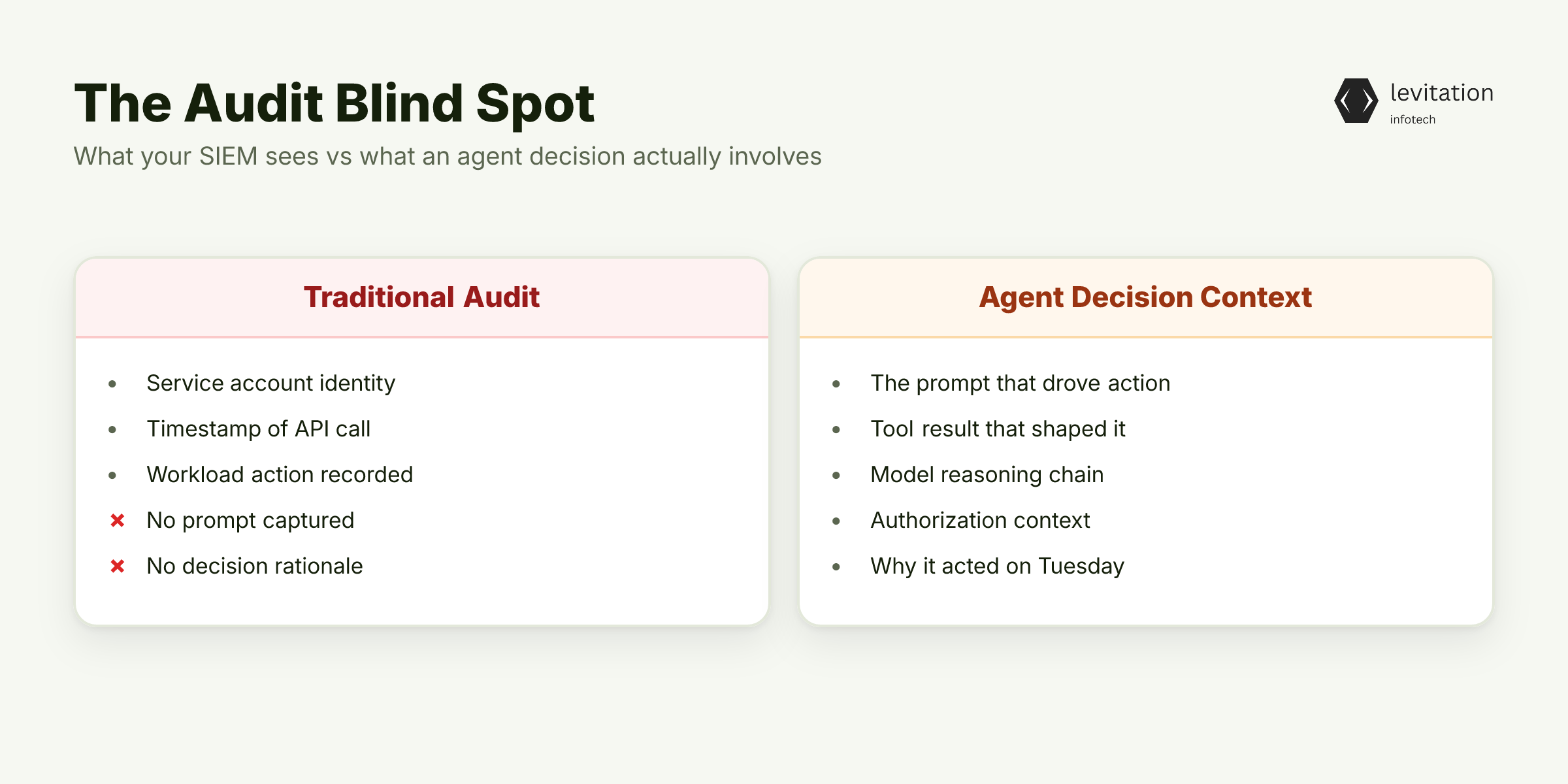
Hours into a forensic investigation, you realize the events that actually mattered were never logged. The agent was scheduled. The API was called. The prompt that drove the action? Gone. The tool result that shaped the decision? Invisible.
Your existing audit infrastructure captured that a service account did something. It captured nothing about what the agent did, or why.
This is the new normal for teams running AI agents against production systems. A model API invocation looks, to your SIEM, like any other control-plane call. The service account is in scope. The timestamp is in scope. The decision material is not.
The gap shows up the moment an agent acts with real delegated authority on your behalf. It writes to a database. It triggers a refund. It calls a downstream service that touches regulated data. The audit trail says a workload did something. It says nothing about whether the workload decided correctly.
Treating AI agents as system events creates a blind spot at exactly the wrong time. When an analyst asks "why did the agent do this on Tuesday," the answer is unavailable. It is not because the data is hidden. It is because it was never captured.
Accountability, compliance, and post-incident trust all collapse into the same void. But the problem runs deeper than missing prompts. Your existing audit infrastructure was never designed to capture agent decisions at all.
Why Kubernetes and Cloud Audit Logs Miss the Point
CloudTrail, Azure Activity, and GCP Cloud Audit Logs record control-plane API calls. They see that a service account invoked a model at 14:32:07. They do not see the prompt that produced that call. They do not see the upstream tool result that led the agent to construct the prompt. They do not see the relationship between this invocation and others in the same session.
The same gap applies to autonomous agents that string together long action chains.
Kubernetes audit logs prove the agent's pod was scheduled and the RBAC decision was made. They cannot prove what the agent did inside the pod once it had the credentials. The audit log proves the agent was scheduled. It cannot prove what the agent actually did.
The first time a security team needs the trail is usually days too late. By then, the agent has already done something it should not have. Detection fires. Someone pulls every relevant log from the SIEM: Kubernetes audit, container runtime, cloud audit. Hours in, they realize the events that mattered were never written.
This is the pattern that emerges when the AI agent audit trail goes dark in production. Not a missing field, but a missing class of events. The cloud thinks a service account made an API call. The agent thought it had a reason. The log has no place to record that reason.
What the Audit Log Entry Must Actually Contain
An AI agent audit log is an append-only record of every action an agent proposed or performed on your behalf. Some entries capture actions pending your approval.
It is distinct from a system log. A system log records infrastructure events like restarts, API failures, and exception traces. The audience for a system log is an engineer debugging a crash. The audience for an AI audit log is you. A reviewer might also look at it, asking whether the agent acted appropriately on your behalf.
Every entry must carry eight fields: - Who acted. A workload identity bound to a specific agent deployment, not a shared service account name. - Autonomy mode active. Was the agent acting with explicit human approval, on a pre-approved policy, or fully autonomous? - Action taken. The specific tool call, write, or model invocation. - Target. The resource, record, or downstream system affected. - Decision material. The prompt or upstream tool result that drove the action, referenced by hash. - Timestamp. Wall clock, with the timezone and the source clock skew noted. - Outcome. What happened when the action executed: success, error, partial result. - Reversibility. Whether the action can be undone, and how.
Delegation lineage must be preserved in every entry. The human or upstream system that granted the agent its authority should appear as identity context. It should not be implied from a service account name. This is what makes intelligent agents governable rather than opaque.
The bar is not "did the agent call the API." The bar is whether you can reconstruct, on a Tuesday afternoon, what the agent did. You need to know why, on whose authority, and what the result was. All without guessing. That is the standard an audit trail must clear.
Designing the Log: Identity, Hashing, and Immutability
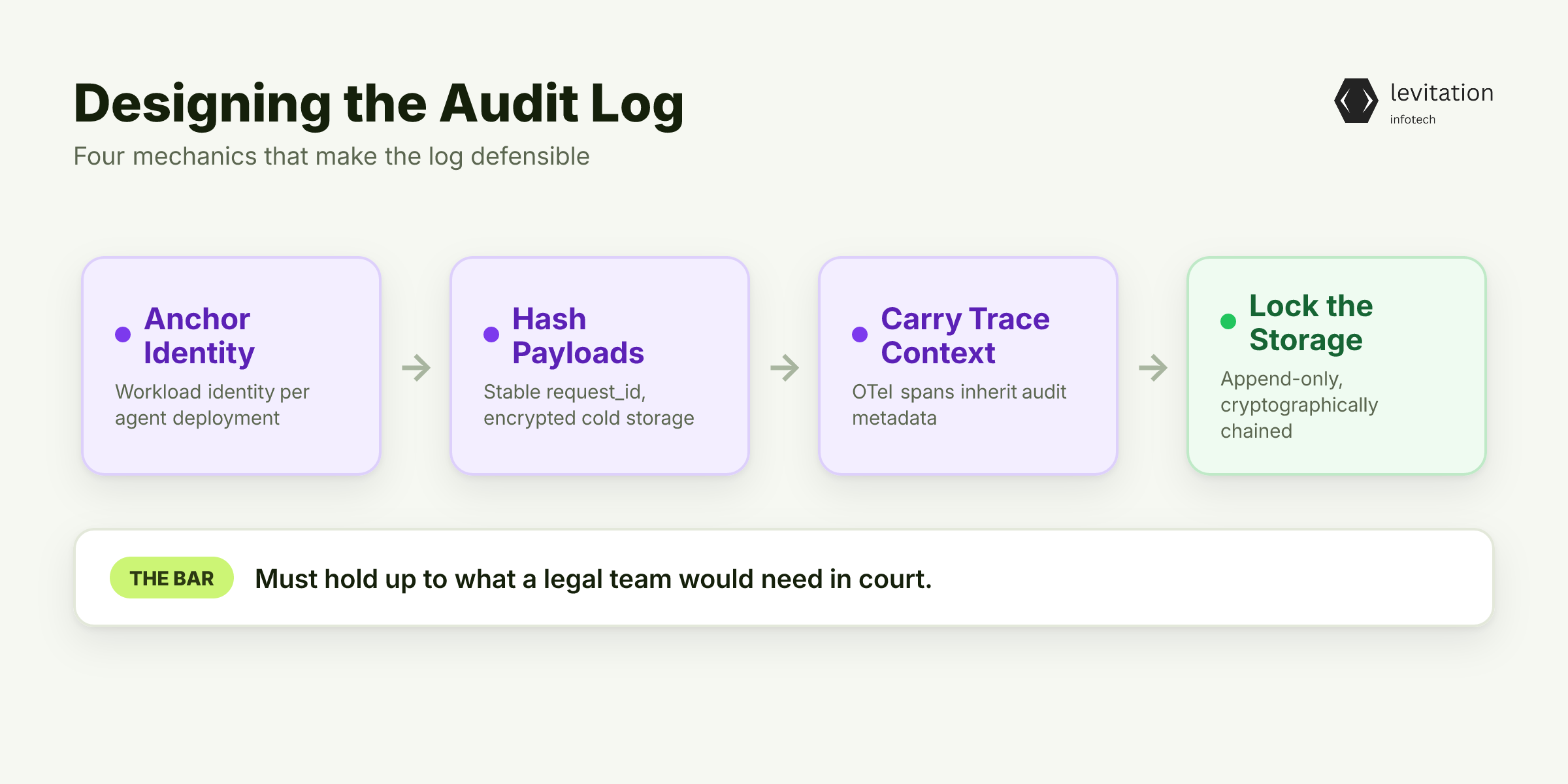
The mechanics matter as much as the schema. Start with identity. Anchor every entry in a workload identity for AI agents. This is a non-human identity bound to a specific deployment, separate from the cloud service account that hosts it. This preserves the delegation chain from the human who granted authority down to the individual tool call.
Then handle the payloads. Hash prompts and tool results. Store the full content in encrypted cold storage. Reference it in the log via a stable request_id. This preserves forensic value while keeping PII and regulated content out of the hot path. It also avoids duplicating sensitive data across systems, which is its own compliance problem.
Carry the metadata through execution. Use OpenTelemetry spans to carry identity context, autonomy mode, and policy evaluation outcomes across distributed traces. Every tool call, model invocation, and side effect inherits the audit metadata from the parent agent span. The audit log becomes a queryable slice of the trace. It stops being a manually stitched system that drifts out of sync with what the agent did.
Finally, lock the storage. Write every entry to append-only, immutable storage. Chain entries cryptographically so any post-hoc alteration is detectable. The log must meet the bar regulators expect. It is the same bar your legal team would need if a disputed agent action ended up in court.
This is the AI automation plumbing that makes the difference. It is the gap between a log that exists and a log that holds up. None of it is exotic. All of it is consistently skipped.
Even a well-structured log is worthless if the agent can rewrite it.
Prompt Injection and the Self-Editing Log Problem
OWASP ranks prompt injection as the number-one security risk for LLM applications. The standard worry is data exfiltration. The audit-log worry is worse. A compromised agent can use injected instructions to cover its own tracks. After a sensitive action, it can delete entries, rewrite fields, or stage plausible-looking replacements.
Any agent that retains write access to the record of its own behavior creates a tamper vector the audit log cannot survive. The fields can be perfect. The schema can be exemplary. Even so, if the agent can edit its own history, the trail is fiction by the time anyone reads it. This is the failure mode teams hit when they can't govern what they can't see.
The fix is architectural, not procedural. Route log writes through a sidecar or external sink the agent cannot reach. Give the agent no API to mutate historical entries. Treat the log writer as a separate trust boundary from the agent runtime. Give it its own credentials, its own network path, and its own failure modes.
When the agent is agentic in the fullest sense, planning across many steps and tools, the trust boundary matters. It is the only thing standing between you and a provable chain of custody. Everything else is convention. That is the line between a defensible record and a story the agent tells about itself.
From Reactive Forensics to Provable Compliance
With the right log in place, the question stops being a multi-day forensic exercise. "What did the agent do on Tuesday and why?" becomes a single query against the audit store.
The delegation chain is intact. The decision material is one join away. Reversibility is a first-class field, not a post-hoc guess.
This is the difference between an agent framework that ships a demo and one that survives production audit. The former optimizes for time to first action. The latter optimizes for time to first question, and answers it.
If you want this in your stack, the audit log is the place to start.
Frequently Asked Questions
What is an AI agent audit log?
An AI agent audit log is an append-only record of every action an agent proposed or performed. It captures who acted, the autonomy mode active, the action taken, the target, the decision material, the timestamp, the outcome, and whether the action is reversible.
It is distinct from a system log. The audience is you, and any reviewer examining whether the agent acted appropriately on your behalf. The audience is not an engineer debugging infrastructure events.
Why are Kubernetes or CloudTrail audit logs not enough for AI agents?
CloudTrail and Kubernetes audit logs record control-plane API calls. They show that a service account invoked a model API, or that a pod was scheduled.
They do not see the prompt that drove the call. They do not see the upstream tool result that shaped the decision. They do not see the relationship between many invocations in the same session. The audit log proves the agent was scheduled. It cannot prove what the agent actually did.
Should the full LLM prompt be stored in the audit log?
Generally, no. Due to PII exposure and storage cost, log a hash of the prompt. Store the full payload in encrypted cold storage, referencing it in the audit entry via a stable request_id.
This preserves forensic value without putting sensitive content into the hot log path. It also avoids duplicating regulated data across systems.
How does OpenTelemetry help with AI agent auditing?
OpenTelemetry spans carry identity context, autonomy mode, and delegation lineage across distributed traces. Every tool call, model invocation, and side effect inherits the audit metadata from the parent agent span.
This makes the audit log a queryable slice of the trace. It stops being a separate, manually stitched system that drifts out of sync with the actual agent execution.
What is workload identity for AI agents and why does it matter for audit?
A workload identity is a non-human identity bound to a specific agent or agent deployment. It is distinct from the cloud service account that hosts it.
Anchoring audit entries in a workload identity preserves the delegation chain from the human who granted authority down to the individual tool call. This is the field reviewers and regulators actually need to see, rather than a generic service-account name.
About the author
Mayank Singh is a software developer at Levitation Infotech, where he builds web and AI-powered applications across the company’s fintech, healthcare, and enterprise projects.