


TL;DR: Always-on agents fail through behavior, not uptime. Treat each agent as an observable trajectory. A versioned contract, continuous evaluation, least-privilege tools, and tested interventions must govern it. When behavior degrades, the system must know whether to continue, change, pause, or stop.
Key Takeaways: - Service availability proves only that the agent can respond, not that it completed the right work. - Batch MLOps breaks when agents retain state, call tools, and change external systems between releases. - Behavioral contracts, promotion gates, traces, and circuit breakers turn autonomy into governed operation.
The Silent Failure: Green Services, Degrading Decisions
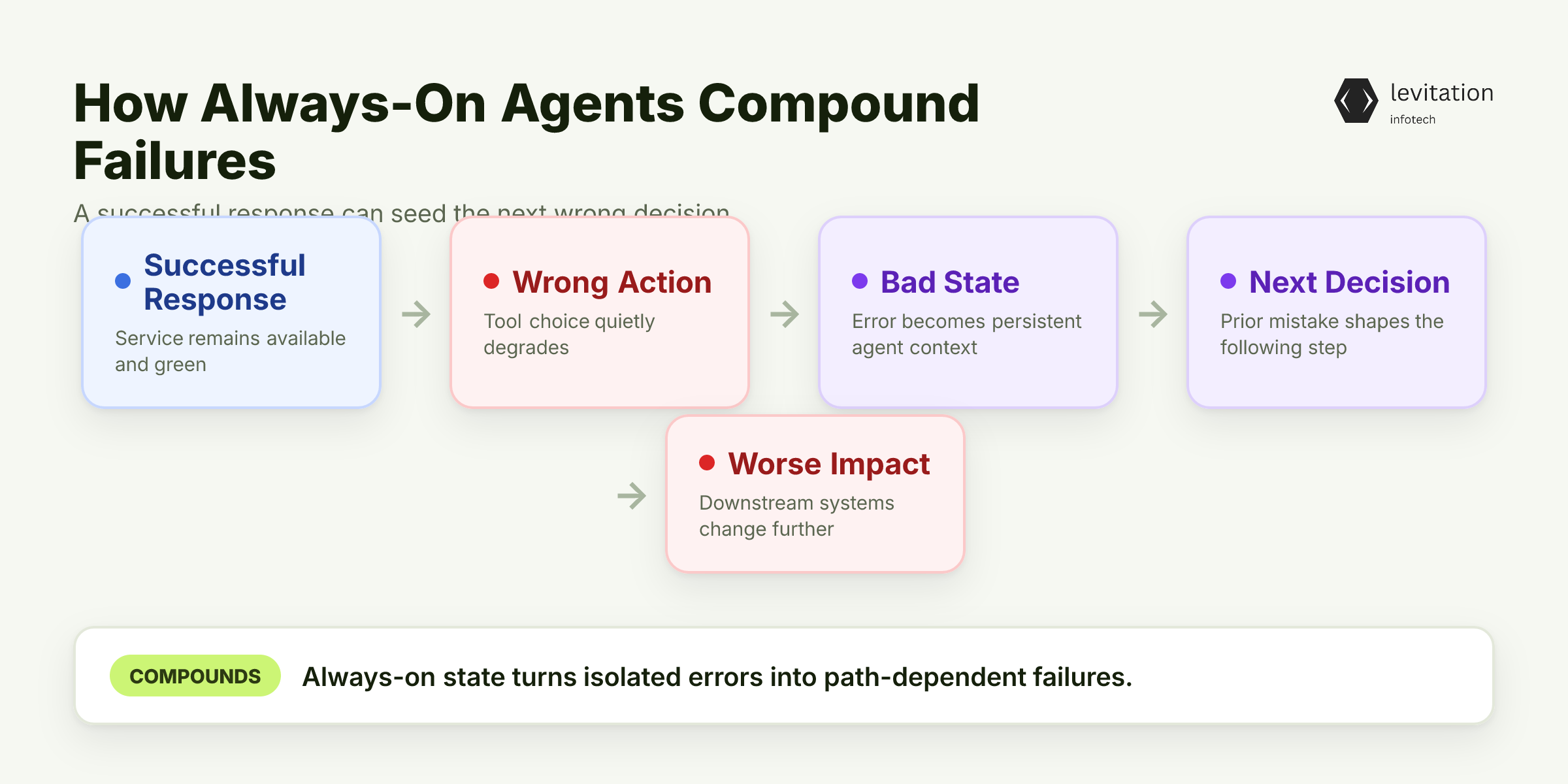
An agent can keep returning successful responses and pass every infrastructure check. It can still become operationally useless. The danger is not a crash. It is an available service whose decisions quietly degrade.
Green infrastructure, wrong work
Latency, error rate, and availability can look healthy while an agent completes the wrong action. A fast response can hide a wrong tool call, a skipped check, or an early stop.
That gap separates a healthy process from useful work. Availability shows that the process is alive. It reveals nothing about strategy choice, policy compliance, or downstream success.
This is also a cloud security posture for always-on AI agents problem: an exposed agent can remain reachable while doing unsafe work.
A minimum health contract must pair service signals with outcome signals:
1health_signals:2 availability: http_success3 task_completion: completed_workflow4 action_correctness: reviewed_tool_action5 policy_compliance: allowed_action6 downstream_result: verified_business_outcome
The outcome metrics need explicit definitions: - Did the agent reach the workflow's intended terminal state? - Was the selected tool and argument appropriate for the task? - Was every action allowed by policy and scoped to least privilege? - Did the action change the intended downstream system?
The same blind spot appears in why MLOps dashboards miss agent outages. Service health measures whether the agent responds, not whether its work matters. Why does staying online make that blind spot more dangerous?
Why always-on AI changes the risk
Always-on agents retain state, choose tools sequentially, and act on systems that continue changing after release.
An early mistake becomes input to the next decision. A bad record can trigger a worse tool call. That call changes another system and shapes what happens next.
This is path-dependent failure. Unlike a bounded prediction, an agent's result depends on the trajectory that produced it.
Two similar requests can require different actions because memory, state, tool access, and earlier decisions differ. The final response cannot reveal the entire path that produced it.
Start with outcome health measures covering task completion, action correctness, policy compliance, and downstream business results.
Green service status is not evidence of task success. If the dashboard stays green, which failure signals are your MLOps stack failing to measure?
Why Batch MLOps Breaks on Sequential, Stateful Work
Batch assumptions meet runtime behavior
Classical MLOps often follows a train, deploy, monitor, and retrain loop. That loop assumes a bounded artifact and a stable serving boundary.
An agent breaks both assumptions. Prompts, tools, permissions, retrieved context, memory, and external systems keep changing after release.
Every release should bind those moving parts into one reference:
1release:2 model: support-[email protected]3 prompt: support-playbook@74 tools: [crm-read, ticket-write]5 policies: [least-privilege-v3]6 retrieval: kb-index@2026-11-147 memory: customer-context@4
Without that binding, rollback restores only the model. Changed tools, permissions, and retrieval behavior remain behind. What if the inputs stay the same while the operating path changes?
Distribution drift is not enough
Distribution drift asks whether inputs changed. It cannot explain why two similar inputs require different actions.
State, accumulated context, tool availability, and prior decisions can change the correct path after a request arrives. The same drift detector misses this shift while behavior changes sharply.
Monitoring distribution alone is therefore too weak. Familiar inputs still produce different behavior when the operating context changes.
If inputs stay familiar, where should the rules for changing actions live?
A prompt is not a playbook
A prompt can guide one interaction. An always-on agent needs a scenario playbook.
Each scenario should define: - Permitted actions for the current context - Escalation paths and exception handling - Mandatory stop conditions and recovery behavior - Actions that require human approval
This is the difference between steering a response and governing a service. A prompt cannot anticipate every state, tool failure, permission change, or conflicting objective.
Who owns the rules when those cases cross team boundaries?
Separate stacks create ownership gaps
Running a classical ML pipeline beside an agent platform creates fragmented lineage, inconsistent release controls, duplicated telemetry, and unclear ownership.
Ownership often splits across teams. Model teams own the endpoint while platform teams own execution. Security defines policy while business owners define results.
The trajectory connecting them often has no clear owner.
Kubernetes-based agent orchestration can coordinate execution, but it cannot define behavioral ownership. The same gap appears in MLOps catches model drift while agents remain unguarded.
AI agent MLOps does not need to replace MLOps. It must extend lifecycle discipline to behavior, decisions, and actions.
The fix is not another dashboard. It is a different unit of management. What must that unit capture from prompt to action?
The Fix Is a Behavioral Contract, Not a Better Dashboard
Define the behavioral contract
A behavioral contract is a versioned operational artifact, not a policy PDF. It translates the agent's mission into enforceable boundaries and stop conditions.
The contract states the agent's mission, valid context, allowed tools, permission scope, success criteria, escalation rules, and mandatory stops. Resource limits belong here too, even when a runtime service enforces them.
Without mandatory stops, continued execution becomes the default.
An illustrative contract looks like this:
1contract: customer-support/32mission: Resolve support requests without unauthorized changes.3allowed_tools: - crm.read - ticket.write4permission_scope: Read customer records and create tickets only.5resource_limits: Enforced by runtime policy agent-access-v3.6success_criteria: - Request reaches an approved resolution state. - Required customer notification is recorded.7escalation: - Refund request - Identity dispute8stop_conditions: - Required context is unavailable. - A high-impact action lacks approval.
How will each release prove the contract still governs the full path?
Manage models and agents in one lifecycle
Manage model versions, prompts, tools, evaluation suites, policies, runs, and outcomes as one release graph.
The release artifact should describe an observable trajectory, not merely a model endpoint. Record context retrieval, decision events, tool calls, state changes, guardrail decisions, and final outcome in sequence.
The deployment unit becomes the path the agent takes, not only the answer it returns. That is why agent observability across models, tools, and outcomes must preserve the complete path.
The same principle appears in why GraphRAG can find the right answer for the wrong reason. Correct output does not prove a sound route to that output.
Evaluate components, trajectories, and business outcomes separately. A correct final answer cannot conceal an unsafe, wasteful, or unauthorized path. Which release control can prove that path before it reaches production?
Make guardrails a release prerequisite
Clear ownership keeps failures from falling between teams: - Platform teams own execution and telemetry. - ML teams own model and evaluation quality. - Security teams define action boundaries. - Business owners define meaningful outcomes.
Guardrails and permission layers are release prerequisites, not documentation. A document cannot constrain an API call.
A contract protects the business only when enforcement is continuous. A release-time check cannot cover every later action. How can that enforcement survive tool and policy changes after release?
Make Continuous Evaluation a Promotion Gate
Version the evaluation suite
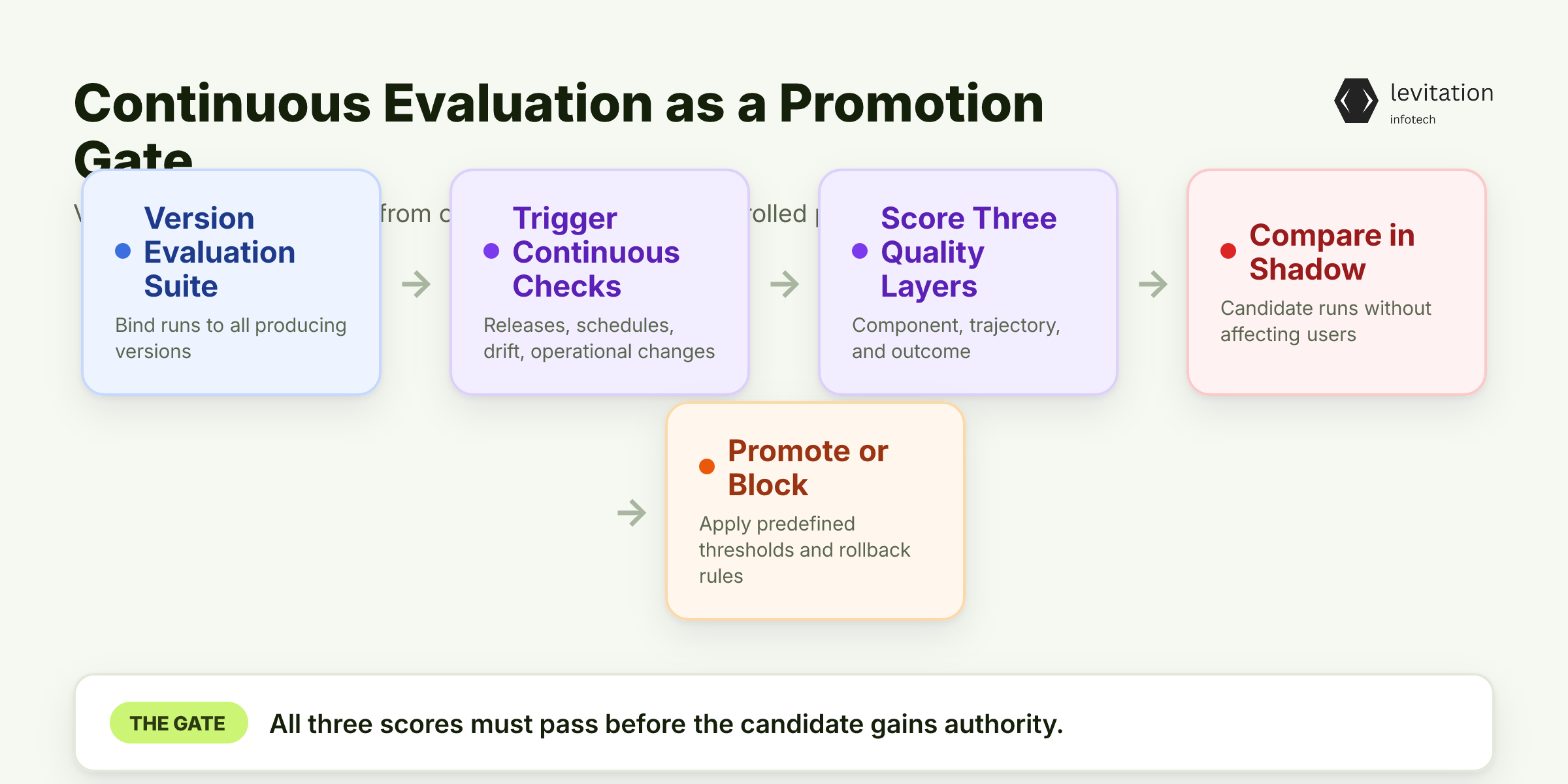
Keep representative scenarios, edge cases, and live-sampled cases under version control. Bind every run to the model, prompt, tool, policy, retrieval, and memory versions that produced it.
An evaluation suite without lineage cannot explain regressions.
Trigger checks on releases, scheduled intervals, drift signals, and operational changes. Tool-schema updates, retrieval changes, permission changes, and new external data all alter agent behavior.
A promotion policy can express those controls directly:
1evaluation:2 suite_ref: "support-evals@v7"3 triggers:4 release: true5 schedule_ref: "release-ops/evaluation-calendar"6 drift_signal: true7 operational_change: true8 comparison:9 baseline: production10 candidate: shadow11 thresholds_ref: "policy://support-agent/promotion-v3"12 require_declared_thresholds: true13 require_no_regression: true14 circuit_breaker:15 on: [component_regression, trajectory_regression, policy_violation]16 actions: [pause_candidate, notify_owner, rollback_candidate]
Which score should block promotion when the answer looks right but the path fails?
Evaluate continuously
Each run receives three scores: - Component quality: Was the individual model or tool output valid? - Trajectory quality: Did the action sequence remain correct and efficient? - Outcome quality: Did the task finish and change the intended downstream system?
A candidate must pass all three layers. Component accuracy cannot compensate for an unsafe trajectory. A successful trajectory cannot compensate for an ineffective outcome.
How do those scores reach production without exposing users to a weak candidate?
Promote with evidence
Shadow deployment compares a candidate with current production behavior before granting authority. The candidate still runs, but its actions do not affect users or business systems.
Promotion uses thresholds set before testing, not a subjective dashboard review. The policy should define the baseline, candidate, blocking conditions, and rollback action before traffic changes.
When a runtime trajectory fails, convert it into a permanent regression case with its trace and evaluation artifacts. This closes the loop between production failures and release controls.
Attribution requires evidence from each layer. Schema validation catches malformed inputs, lineage traces each change, and anomaly detection separates tool failures from model or retrieval degradation.
Attribution must distinguish the model, prompt, retrieval source, tool, policy, and environment. Secure cloud infrastructure for continuous MLOps evaluation must preserve that evidence.
Teams should also fix the evaluation design itself, as explained in why LLM evaluations approve failing models.
Evaluations explain whether quality changed. Observability must also reveal where the agent's path diverged and why.
Where should that path be recorded so every decision remains connected?
Trace Every Decision and Gate Every Action
Publish one correlated trace
Publish one trace keyed by run ID. It should connect every decision with the versions and resources that shaped it.
A minimal trace schema can enforce the required fields:
1{2 "$schema": "https://json-schema.org/draft/2020-12/schema",3 "title": "AgentRunTrace",4 "type": "object",5 "required": [6 "run_id",7 "agent_version",8 "prompt_version",9 "context_versions",10 "retrieval_ids",11 "events",12 "outcome"13 ],14 "properties": {15 "run_id": { "type": "string" },16 "agent_version": { "type": "string" },17 "prompt_version": { "type": "string" },18 "context_versions": { "type": "array", "items": { "type": "string" } },19 "retrieval_ids": { "type": "array", "items": { "type": "string" } },20 "events": { "type": "array", "items": { "type": "object" } },21 "outcome": { "type": "string" }22 }23}
Each event should record: - Tool name, arguments, result, and state delta - Guardrail decision and policy version - Cost, latency, and downstream outcome - Retry, handoff, escalation, and stop events
How can teams spot a bad path when its final response still looks healthy?
Monitor behavior alongside infrastructure
Combine behavioral monitoring with backend health, resource usage, data anomalies, and model drift. Do not alert only on HTTP or platform failures.
Watch for: - Repeated retries and action loops - Unnecessary tool calls - Policy denials and handoff failures - Completed responses without downstream results - Sharp movement in task-success or cost signals
These patterns reveal work that remains technically available while becoming operationally useless. Which boundary should stop a harmful action before execution?
Gate actions at the boundary
Validate intent and arguments before execution. Apply least-privilege credentials.
Isolate high-impact tools. Require human approval for designated actions.
1action_gate:2 validate_schema: required3 authorize: least_privilege4 high_impact_tools:5 issue_refund: human_approval6 modify_customer_record: human_approval
This boundary turns zero-trust permissions for agent actions into an execution control. A tool request that violates the contract fails before reaching the system.
What should happen when a harmful request passes every upstream check?
Build a tested intervention ladder
Use a tested sequence:
- Observe the behavior and record evidence.
- Alert the owning team.
- Pause the affected agent.
- Open the circuit breaker.
- Roll back the agent configuration.
- Escalate unresolved cases to a human owner.
Every transition needs a trigger, owner, and auditable record. Retain immutable audit trails that connect the trace, evaluation result, policy decision, intervention, and resolution.
A connected trace closes the gap described in why an AI agent's audit trail goes dark. The result is a concrete operating model, not another disconnected layer of AI tooling.
Which parts of this ladder can run automatically when evidence is incomplete?
Governed Autonomy Is the Real MLOps Upgrade
Adopt the operating model in order:
- Observe complete trajectories.
- Evaluate behavior continuously.
- Gate releases through shadow comparisons.
- Govern tools and permissions.
- Automate tested interventions.
Each step creates evidence for the next. The operational payoff is equally practical: - Fewer silent regressions - Faster root-cause analysis - Safer tool use - Clearer accountability - Greater autonomy only where evidence supports it
Before production access, confirm every agent has: - A versioned behavioral contract - A maintained evaluation suite - An end-to-end trace - Bounded permissions - A tested circuit breaker
For cloud migration planning for long-running enterprise AI systems, preserve the same contracts, gates, traces, permissions, and breakers. Migration must not erase operational evidence.
What does this operating model mean in practice?
Frequently Asked Questions
What is AI agent MLOps?
AI agent MLOps extends the model lifecycle to continuously running agents that retain state, call tools, and act on external systems. It governs the path from release to downstream action. The durable advantage is an operating system that knows when the agent should continue, change, pause, or stop.
Test whether your current stack can make that decision with evidence.
About the author
Mayank Singh is a software developer at Levitation Infotech, where he builds web and AI-powered applications across the company’s fintech, healthcare, and enterprise projects.