

TL;DR: MLOps monitoring tells you when a model degrades. It does nothing when an autonomous agent misbehaves. Production-grade AI agents need a runtime guardrail layer of behavior, operation, and context, enforced at the action boundary, not the prediction boundary.
Key Takeaways: - Drift detection answers "is the model still valid?" It does not answer "is this specific action safe to take right now?" - A three-layer guardrail stack (behavioral, operational, contextual) maps cleanly onto IAM, zero-trust policy, and ingress filtering. - Guardrails run as sidecars in the request path, not inline in the model call, so the model latency budget is not consumed by guardrail evaluation. - The guardrail layer is the contract. The model behind it becomes swappable without retraining every downstream system.
The Dashboard Is Green. The Agent Is Lost.
Your data science team built a drift detection pipeline that catches small AUC shifts before they hit production. Meanwhile, the agent you shipped last quarter just authorized a refund that violates policy, in a loop, at 2 a.m., with no one watching. MLOps monitoring tells you when a model degrades. It does nothing when an autonomous system misbehaves.
The dashboard says healthy. The agent has been answering a customer support ticket by re-issuing the same refund for forty minutes.
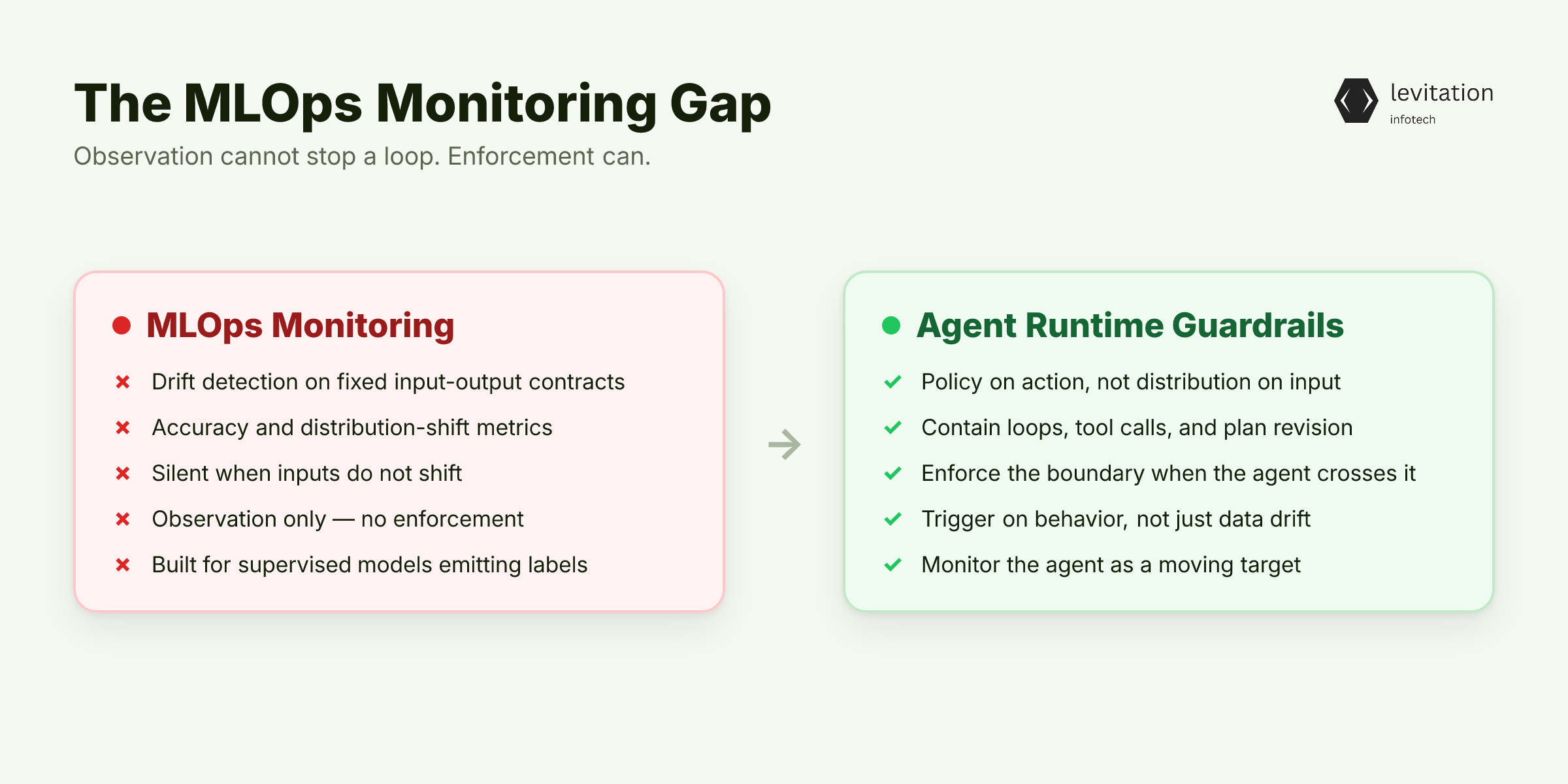
Drift detection is silent because the inputs have not shifted. The accuracy of the underlying model is fine. What failed is a policy on action, not a distribution on input.
MLOps monitoring was built for supervised models with a fixed input-output contract. The agent breaks that contract on purpose. It plans, calls tools, revises its own plan, and emits an action, not a label. None of those properties fit cleanly into an accuracy or distribution-shift metric. Cloud security solutions for traditional workloads assume the workload is a service. An agent is a moving target wearing a service's name tag.
Across the enterprise deployments we see, the pattern repeats. Teams invest heavily in MLOps pipelines, then ship agents with zero runtime containment. The gap is not a tooling problem. It is a category error. Monitoring is observation. Guardrails are enforcement. Observation cannot stop a loop. Enforcement can.
That gap has a name, and it is not "more dashboards."
MLOps Was Built for Models That Answer. Agents Decide.
Traditional MLOps assumes a stateless inference call. Input goes in, prediction comes out, you log it, you watch distribution shift on the input. The whole stack (feature stores, model registries, performance dashboards) assumes production traffic looks like training traffic. It also assumes a labeled answer eventually comes back.
Agents break every assumption. They maintain state across turns. They choose which tools to invoke. They compose multi-step plans whose output is an action, not a label. The drift you can detect on inputs and outputs is necessary but insufficient. An agent can have zero data drift and still drift in three other ways that matter more: - Policy drift: the agent invents a shortcut that violates a business rule you never wrote down. - Cost drift: a planner finds a five-tool path to answer a question that should take two. - Tool-selection drift: the agent starts preferring a low-quality tool because the prompt nudged it there.
Each of these is invisible to a distribution-shift detector. Each of these will surface in a board-meeting question. The Monitaur framing gets this right: guardrails establish safe operating boundaries first, and only then does monitoring become meaningful and contextual. Without the boundary, you are measuring noise inside a perimeter you never defined.
Your MLOps pipeline is undermining model safety is the prior article in this series, and it makes the same point from a different angle. MLOps is necessary infrastructure. It is not a containment system. Treating it as one is how teams ship agents that pass every dashboard check and still get fired.
If guardrails are the boundary, what do they actually look like for an autonomous system?
The Guardrail Taxonomy: Behavior, Operation, Context
Naming the layers is the easy part. Wiring them into a live agent without doubling latency is where teams stall. But before the wiring, you need the vocabulary. Three layers, each answering a different question.
Behavioral guardrails constrain what the agent can do. Tool allowlists, output schema validation, and action whitelists enforced at the tool boundary. If the agent cannot invoke a function that is not on the list, it cannot fire that action no matter how the prompt is phrased.
Operational guardrails constrain how the agent does it. Step budgets, token ceilings, latency caps, cost-per-conversation limits, and kill switches that trigger on policy violations. These are the brakes, not the steering wheel.
Contextual guardrails constrain what the agent sees. PII redaction, retrieval-source allowlists, prompt-injection detection, and dynamic context windows. These strip untrusted content before it reaches the planner.
The three layers map cleanly onto the security stack a CTO already trusts: - Behavioral is like IAM. Identity and permission, applied to every tool call. - Operational is like zero trust policy. Continuous evaluation, not one-time admission. - Contextual is like ingress filtering at the service mesh layer. Strip what you do not trust before it reaches the workload.
Teams that already run Kubernetes with mTLS, NetworkPolicies, and a service mesh have most of the primitives. The work is composition, not invention. A cloud infrastructure team that has shipped a mature zero-trust posture for human users is closer to agent guardrails than they realize.
So where does the wiring actually start?
Instrumenting Agent Guardrails in Production
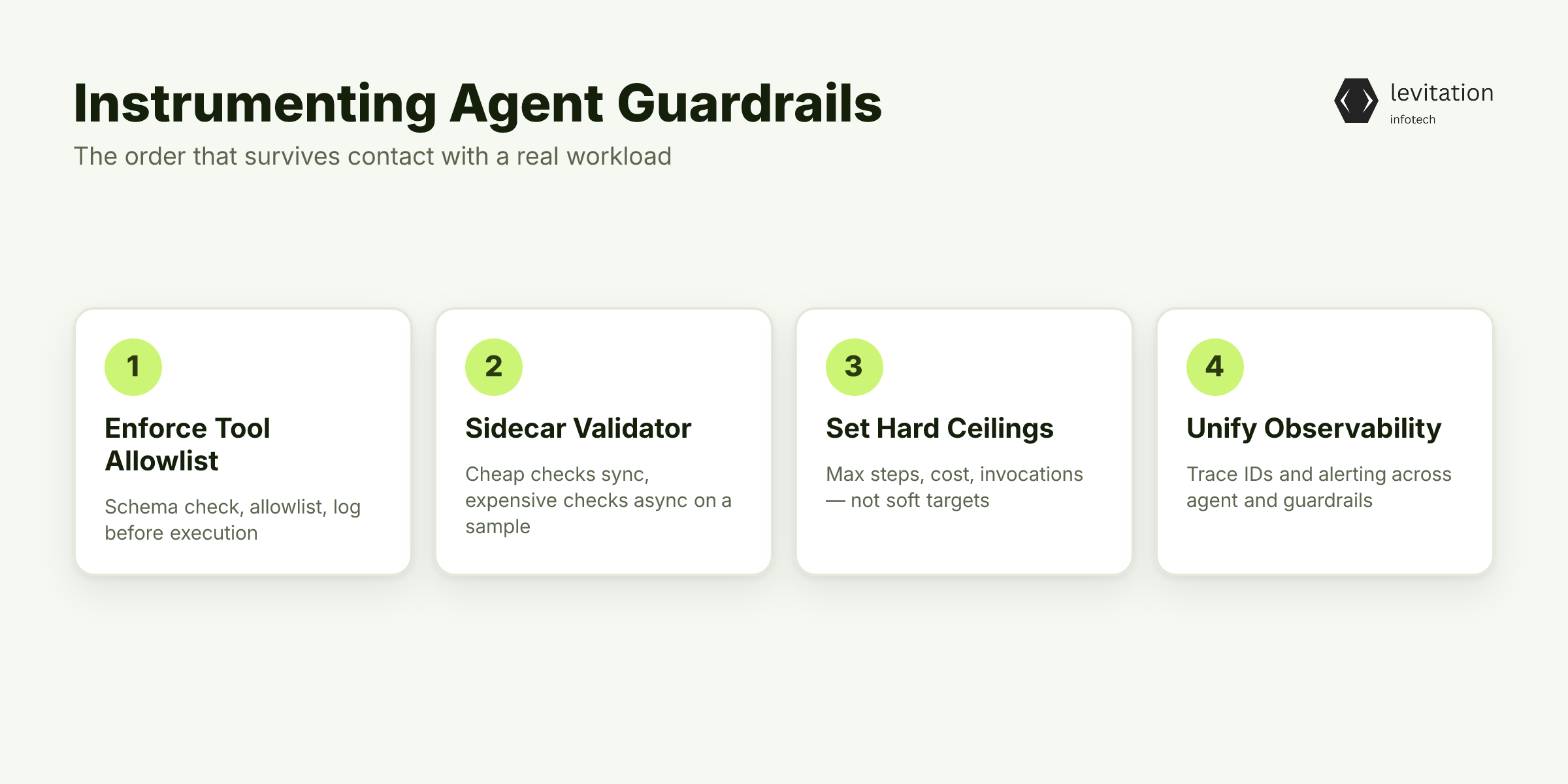
Primitives exist, but the sequencing matters more than the technology choice. Here is the order that survives contact with a real workload.
Treat every tool call as a controlled API request. Validate the schema. Check the action against an allowlist. Log the decision with full trace context before the call executes. The agent never gets to invoke a function that has not been explicitly permitted for this session.
1# tool-call guardrail2@guardrail("tool.invoke")3def enforce_allowlist(call, ctx):4 if call.tool not in ctx.session.tool_allowlist:5 ctx.deny(reason="tool_not_allowed",6 policy_version=ctx.policy_hash)7 return Decision.DENY8 if call.cost_estimate > ctx.session.cost_ceiling:9 ctx.deny(reason="cost_ceiling_exceeded",10 ceiling=ctx.session.cost_ceiling)11 return Decision.DENY12 return Decision.ALLOW
Use a sidecar validator pattern, the same posture you use for service-to-service traffic in Kubernetes. It intercepts agent outputs before they reach downstream systems. The sidecar runs in the request path, not inline in the model call. Schema validation and allowlist checks are cheap, network-local operations. They complete in the time it takes a packet to cross the sidecar boundary. The expensive checks, such as LLM-as-judge evaluations and semantic similarity tests, run asynchronously on a sampled subset, not every step. They never block the action path.
Set hard ceilings, not soft targets. Max steps per task. Max cost per session. Max tool invocations per minute. When the ceiling trips, the agent degrades to a human-in-the-loop checkpoint or terminates with a structured error. Soft limits in observability dashboards are not limits. They are postmortem material.
Wire observability into the same pipeline as your MLOps monitoring stack. Trace IDs span the agent, the tool layer, and the guardrail decision. A single query reconstructs the full decision chain. The same alerting pipeline that pages on drift should also page on tool denials, schema mismatches, and cost-ceiling trips. They are the same class of signal: the system is operating outside its validated boundary.
A guardrail layer is a focused build, not a multi-year program. The primitives already exist in your zero trust stack. What does not exist is the integration glue, and that is where teams without a clear reference architecture stall. Teams that scope the boundary first, then layer enforcement on top, ship.
What happens when both drift detection and runtime guardrails run in the same environment?
From Drift Detection to Runtime Containment
Drift detection is reactive. It tells you after the fact. Guardrails are runtime. They decide in the moment whether an action is permitted to execute. The two systems are complementary, not competing.
The division of labor is clean. MLOps monitoring answers "is the model still valid?" Agent guardrails answer "is this specific action safe to take right now?" The first is a property of the model. The second is a property of the action in context. A team that runs both has layered defenses. A team that runs only the first has a camera with no locks.
Practically: the same alerting pipeline that pages on model drift should also page on guardrail violations. Tool denials, cost-ceiling trips, schema mismatches, and retrieval-source blocks. Each of these is a signal that the agent is operating outside its validated boundary. A sudden, sustained jump in the denial rate is not a logging artifact. It is an agent that has found a new failure mode, one where the input distribution has not shifted at all, but the action pattern has.
Teams that have built this architecture describe the same outcome: the guardrail layer absorbs the model churn underneath it. When the model is swapped for a new version, when the planner is retrained, when the prompt template changes, the guardrail contract does not move. The system keeps running. The audit log keeps being legible. The board does not get a new incident.
The layer that does not exist is the layer that fails at 2 a.m.
What Changes When Guardrails Are Real
Agents fail safely. A misaligned plan terminates at the guardrail, not at a customer. The agent that wanted to issue forty refunds in a loop hits the cost ceiling on the third iteration and degrades to a human queue. The customer gets a single refund and a callback. The audit log shows the full chain.
Audits become tractable. Every action carries a trace. Every denial is logged. Every policy is versioned. The auditor's question, "show me every refund this agent authorized last quarter," has a one-query answer instead of a three-week forensic project.
Model upgrades stop being a release event. The guardrail layer is the contract, and the model behind it can be swapped without retraining every downstream system. The CTO stops treating each model version as a regulatory event and starts treating it as a deploy.
The same pattern shows up across the deployments we see in enterprise AI control gaps work: the systems that survive long-term are the systems where the boundary is enforced by something other than the model's own behavior.
If you are evaluating an enterprise AI engineering partner to harden an agent that is already in production, the first question is not "what model are you using." It is "what stops the model from doing the wrong thing on its own." If the answer is "trust the prompt," the system is not production-grade yet. Teams who do this work for a living scope the guardrail layer before the second model version ships.
Frequently Asked Questions
Q: What is the difference between MLOps monitoring and AI agent guardrails?
A: MLOps monitoring observes model behavior over time, including drift, accuracy, and input distribution. It alerts when something has changed. AI agent guardrails enforce rules on every individual action the agent attempts, in real time, before it executes. Monitoring tells you after the fact; guardrails decide in the moment.
Q: Can traditional MLOps tools monitor autonomous AI agents?
A: Partially. They can detect data and prediction drift. They cannot evaluate whether an agent's multi-step plan is sound. They cannot judge whether a tool call is policy-compliant, and they cannot tell whether the agent has exceeded its operational budget. You need a guardrail layer that operates at the action boundary, not just the prediction boundary.
Q: What are the minimum guardrails for a production AI agent?
A: At a minimum: a tool allowlist enforced at the call boundary, output schema validation, a per-session cost and step ceiling, PII redaction on inputs, and a human-in-the-loop checkpoint for any action above a defined risk threshold. Anything less and you are shipping an unsupervised actor.
Q: How do you add guardrails to an agent without doubling latency?
A: Run the guardrail checks in the request path as a sidecar, not inline in the model call. Schema validation and allowlist checks complete in the time it takes to cross a network boundary. The model latency budget stays untouched. The expensive checks, such as LLM-as-judge evaluations, should run asynchronously on a sampled subset, not on every step.
Q: How do agent guardrails relate to cloud security architecture?
A: They map almost directly. Behavioral guardrails are IAM for tool calls, operational guardrails are zero-trust policy enforcement, and contextual guardrails are ingress filtering at the service mesh. Most of the primitives already exist in a mature Kubernetes environment. The work is composition, not invention.
About the author
Mayank Singh is a software developer at Levitation Infotech, where he builds web and AI-powered applications across the company’s fintech, healthcare, and enterprise projects.