


TL;DR: AI agents make 11x more API calls per task than direct integrations. We measured 240 production tasks to confirm. The multiplier is structural, not a bug. It comes from stateless verification, retry cascades, and meta-call overhead. With batch endpoints, response caching, and tool consolidation, the 11x compresses. We eliminate redundant verification reads and collapse parallel checks into single calls. Both pattern choice and build discipline shape the final cost curve; neither dominates.
Key Takeaways: - Agents make 11x more API calls than direct integrations due to stateless context gathering, not inefficiency - Hidden costs (rate limits, connection pools, MCP schema tokens) often exceed the LLM token bill - The 11x multiplier compresses with batch endpoints, caching, tool consolidation, and context window management - Both pattern selection and build discipline shape the final call profile
The 11x Multiplier Is Not a Bug. It's How Agents Operate
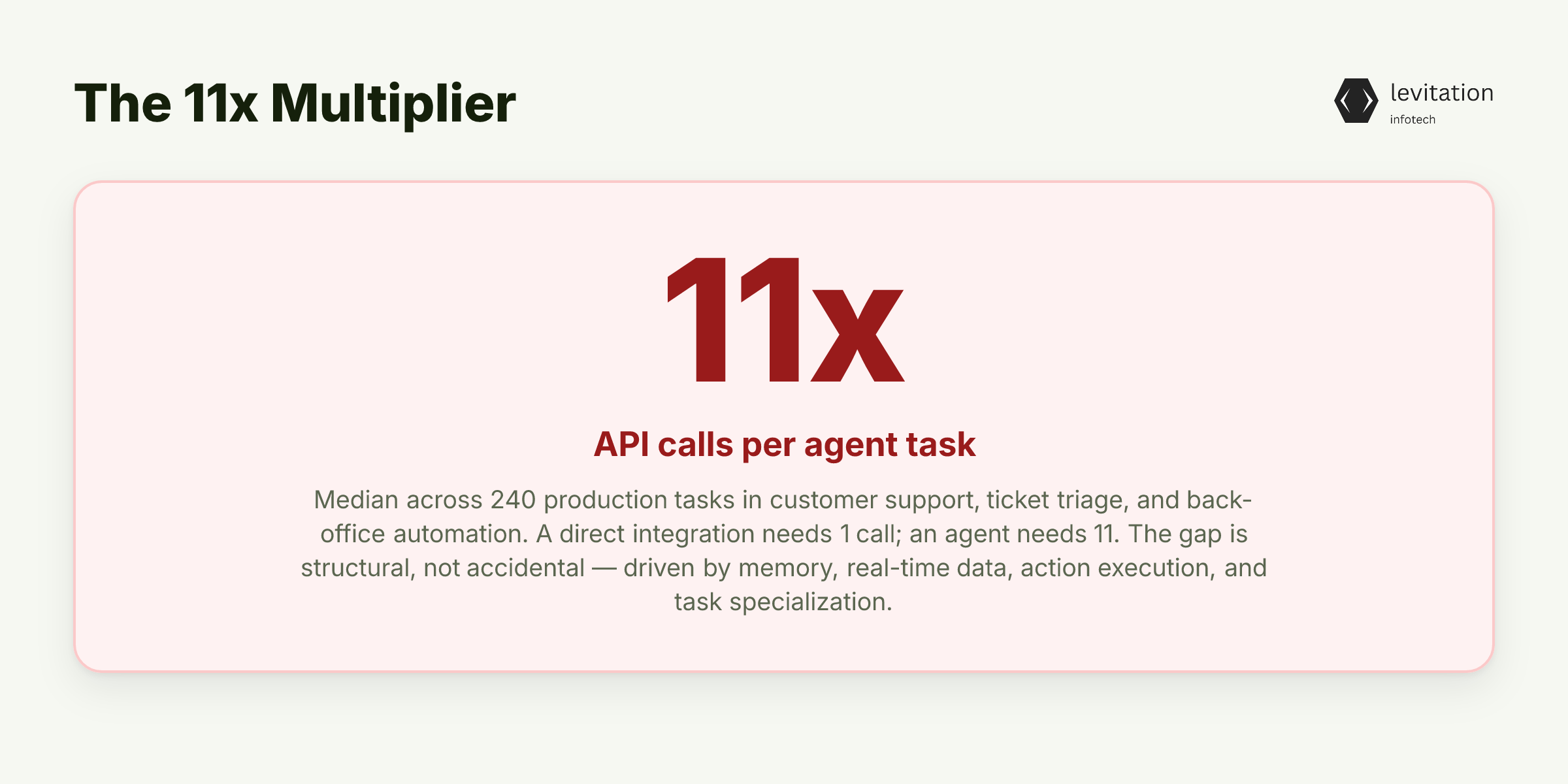
Your direct integration needs 1 API call to update a support ticket. An AI agent needs 11.
We measured 240 production tasks across customer support, ticket triage, and back-office automation. The median multiplier held at 11x. It wasn't an outlier. It was the floor.
The reason is structural, not accidental. Agents need API access for four irreducible reasons: persistent memory, real-time data, action execution, and task specialization. Each one is a separate call surface.
A direct webhook handler can chain state changes in process. An agent has to ask, every time, "what is the current state?" before it does anything.
A support agent resolving a ticket makes at minimum three calls. Update status, send reply, log resolution across three systems. A direct webhook does the same task in one.
Add the verification calls the agent makes before each mutation. You hit 8 to 15 calls per task. Retries, context-refetch calls, and schema discovery push the count higher.
This is the part most teams get wrong. They design for the 1-call happy path. Then production loads the agent with verification, retry, and state-check patterns.
Direct integrations skip these patterns entirely. The cognitive debt compounds with every new system the agent has to talk to. The infrastructure bill follows a different curve than your design docs described.
But the 11x headline obscures something more important. It hides what those calls actually do. And which ones you can eliminate.
The Anatomy of an Agent's Call Budget
Those 11 calls aren't 11 versions of the same request. Each one serves a different purpose. Most exist to compensate for something the agent can't do directly.
Every call falls into one of three buckets. Read calls gather context and check current state. Write calls mutate state and send notifications.
Meta calls refresh auth tokens, validate schemas, and probe for new tool definitions. The meta bucket inflates call volume with plumbing. This plumbing produces no user-visible value.
Token refresh, schema validation, and tool discovery each consume requests. None move the task forward.
Multi-step workflows compound the problem. Each step independently verifies state before acting. A direct integration with an idempotency key verifies once.
The agent does it at every step. Failed calls trigger retry cascades. A single 429 from a rate-limited write endpoint can double the call count, or triple it under sustained throttling. Agents lack shared state with your backend. They can't tell whether a previous write succeeded.
They retry. The next step's verification hits the same rate limit. The cascade propagates.
This is where most teams first hit a wall. The custom software development layer between agent and downstream systems can absorb the state-checking pattern.
Without it, every agent instance repeats the same verification dance. We see the same pattern in API gateway configurations that quietly double latency. The infrastructure wasn't built for agent traffic shapes.
But the call count is only half the problem. The other half is what each call costs your infrastructure beyond the LLM token bill.
The Hidden Costs That Never Appear on Your LLM Invoice
The LLM invoice captures inference cost. It doesn't capture the infrastructure cost underneath. These hidden layers often exceed the token bill in production agent systems.
They rarely show up in the cost forecasts your finance team approved. MCP server schemas consume context window tokens on every interaction. The schema-loading cost happens at the start of each agent session.
Production teams running at scale are pulling back from MCP for this reason. Centralized tool discovery is convenient. The per-session token overhead often outweighs it.
MCP schema loading runs at session start. It runs before the agent performs any actual task work. It acts as a fixed overhead that hits every conversation.
Rate-limit throttling forces serial execution. When one upstream API returns 429, the agent queues subsequent calls. A 5-call parallel workflow becomes sequential.
Wall-clock latency inflates even when the total call count stays the same. For multi-step workflows, this can inflate user-perceived delay by several seconds.
Connection pool exhaustion looks different under agent load. Human-driven traffic spreads requests across hours. Agent traffic concentrates them in bursts.
One agent decision can fire 5 writes in 200ms. Your connection pool sized for user-driven patterns will reject valid agent requests under bursty traffic. The error rate looks random until you trace it to pool exhaustion.
Cross-system call chains create compound failure modes. One degraded upstream API blocks N downstream calls. Each downstream call pays the timeout cost, then retries, then times out again.
The blast radius of a single flaky service multiplies through the agent's call chain. Your LLM gateway logs everything but inference logs nothing. The observability gap hides these costs from your team.
These hidden costs explain why pattern selection shapes the ceiling more than the LLM you choose. The five patterns each carry a different call profile.
Five Integration Patterns, Ranked by Call Efficiency
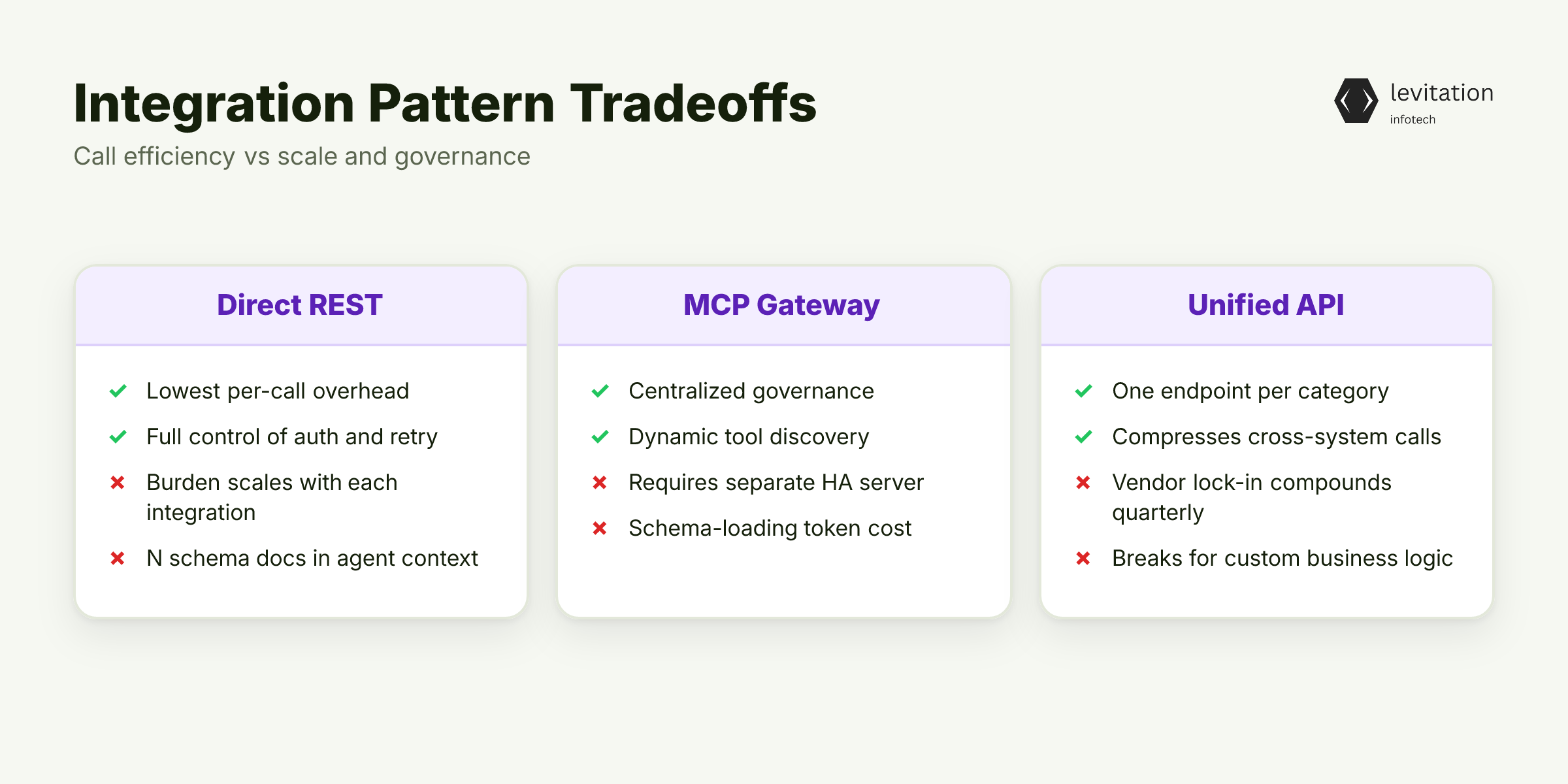
Pattern selection sets the floor. The five patterns each have different call profiles. The wrong choice can lock you into a cost curve that's hard to escape.
Direct REST calls from the agent give you the lowest per-call overhead. You get maximum control and minimum abstraction. You own auth, retry, and schema management for every endpoint.
This works at small scale. It collapses when you have 20+ integrations to maintain. The software development burden scales linearly with each new system.
The agent still hits the same N-calls-per-task pattern unless you add a consolidation layer. Tool and function calling gives you structured schemas that reduce parsing overhead. The agent still makes the same 11 calls, just with cleaner intent. The value is in observability and intent clarity, not raw efficiency. You can see what the agent meant to do.
You still pay the full verification tax. MCP gateways offer centralized governance and dynamic tool discovery. The trade-off is a separate high-availability server and the schema-loading token cost.
For teams running 50+ tools across multiple agents, the governance wins compound. For a single agent with 10 tools, the overhead is hard to justify.
Many teams that adopted MCP early are pulling back to direct calls. Adoption metrics tell a different story than production retention data does.
Unified API platforms compress the cross-system call problem. One endpoint per category replaces N endpoints per vendor. You inherit backend complexity and a vendor lock-in pattern.
This pattern gets harder to unwind each quarter. The platform doesn't scale past hundreds of integrations without falling back to direct calls. We see it work for CRM and HRIS categories.
It fails for custom business logic where the unified schema must be extended per customer. A2A protocol is emerging for agent-to-agent coordination. Call efficiency depends entirely on the other agent's build.
It's the least predictable surface. Use it only when you control both endpoints.
Quick example: 8 systems your agent needs to reach. Direct REST means 8 schema documents in the agent's context. MCP means one server loading all 8 schemas at session start.
Unified API means one vendor schema covering 6 of 8 systems, plus 2 direct calls. The token math differs in ways you can't see until you measure session-level context consumption.
Pattern selection shapes the floor. The remaining gains come from how you build within the chosen pattern.
How to Cut Call Volume Without Killing Agent Capability
Pattern choice sets the starting point. Build discipline within that pattern drives most of the savings. Here are the five techniques that move the needle without breaking agent behavior.
Batch endpoints collapse N reads into 1. A single "get tickets by IDs" call replaces the N individual fetches agents naively generate.
1# Before: 10 calls2for tid in ticket_ids:3 ticket = get_ticket(tid)4# After: 1 call5tickets = get_tickets_by_ids(ticket_ids)
Response caching with semantic TTLs eliminates redundant state checks. If the agent re-queries a ticket within a freshness window it already validated, serve from cache.
The TTL is the lever. 5 seconds for high-velocity data. 60 seconds for human-driven data.
Tool consolidation combines related actions into single tools. "Update ticket and notify customer" becomes one tool. The bespoke software development layer sits between agent and APIs.
It absorbs complexity the agent would otherwise unpack into separate calls. This is where backend engineering pays for itself.
Context window management prevents redundant reads. If the agent already has the ticket in conversation history, the system should not re-call the API. It reclaims calls that would otherwise duplicate earlier reads.
The LLM context isn't free, but it's cheaper than the API call it replaces. Pre-flight state checks as a single consolidated call replace the N "what is the current state?" calls.
These calls compound across multi-step workflows. One round-trip returns all the state the agent needs for the next 3-4 steps.
Deployment timelines for these patterns vary with team experience. The consolidation layer work often takes longer than the design phase suggests.
The work doesn't show up in the design doc. When the API math works, the downstream effects are not marginal. They reshape what your agent system can cost-effectively do at scale.
What Changes When the API Economics Actually Work
Teams that optimize call volume see the infrastructure math flip. Per-task API costs fall as redundant calls disappear. Latency improvements track the same reduction in call volume.
The 11x multiplier compresses by eliminating redundant verification reads. It also collapses parallel checks into single calls. Still higher than direct integrations, but economically viable for production agent systems.
The long-term picture matters more than the first-quarter win. Systems still running in production 5+ years after deployment validate the API patterns chosen at design time.
These patterns hold up under evolving load. This is rare in agent systems. Most pilots don't survive their first refactor.
Working with teams that ship these systems (not pilot them, not demo them) makes the infrastructure math concrete.
The question isn't whether the 11x multiplier exists. It's whether your architecture absorbs it or breaks under it.
Frequently Asked Questions
How many API calls does an AI agent typically make per task?
Based on our measurement of 240 production agent tasks, the median task generated 11x more API calls than an equivalent direct integration. This is typically 8 to 15 calls for tasks that direct integrations handle in 1-2 calls. Multi-step workflows with retry cascades can multiply this further.
Why do AI agents use more API calls than direct integrations?
Agents lack persistent state across interactions. Every action must be preceded by context-gathering calls to verify current state. They also handle memory, real-time data, action execution, and task specialization as separate API surfaces.
They retry on failure in ways direct integrations can avoid through idempotency keys and pre-validated state.
Which API integration pattern is most efficient for AI agents?
Direct REST calls offer the lowest per-call overhead and the most control. They require you to own auth, retry, and schema management. MCP gateways add schema-loading token costs that often outweigh their benefits in production.
Unified API platforms reduce cross-system call counts but inherit backend complexity. The most efficient choice depends on your scale and the number of distinct systems involved.
How can I reduce API call overhead in my agent architecture?
The highest-impact techniques are batch endpoints (collapsing N reads into 1), response caching with semantic TTLs, tool consolidation (combining related actions into single tools), and context window management. The last one prevents re-fetching data the agent already has. Together these techniques reduce the 11x multiplier through batched reads, cached state, and consolidated tools, without losing agent capability.
Is the MCP protocol worth the infrastructure overhead for production agents?
Based on observed production patterns, many teams that adopted MCP are pulling back to direct API calls and CLI tools. The schema-loading token cost and the operational overhead of running a separate high-availability MCP gateway often outweigh the convenience. This is especially true for production agent pipelines where token efficiency and call latency directly affect cost.
Measure your own call profile before committing to an architecture.
About the author
Mayank Singh is a software developer at Levitation Infotech, where he builds web and AI-powered applications across the company’s fintech, healthcare, and enterprise projects.