


TL;DR: One agent query can obey every rate limit and still trigger a $100 bill. A gateway must authorize and reserve cost before each model, tool, browser, and paid API call.
Key Takeaways: - A safe request rate can still produce an economically unsafe task. - Preflight authorization must reserve cost atomically before execution. - Layered budgets give workflows, agent runs, tools, and sub-agents distinct authority.
A Green Rate Limit Can Hide a $100 Single-Query Bill
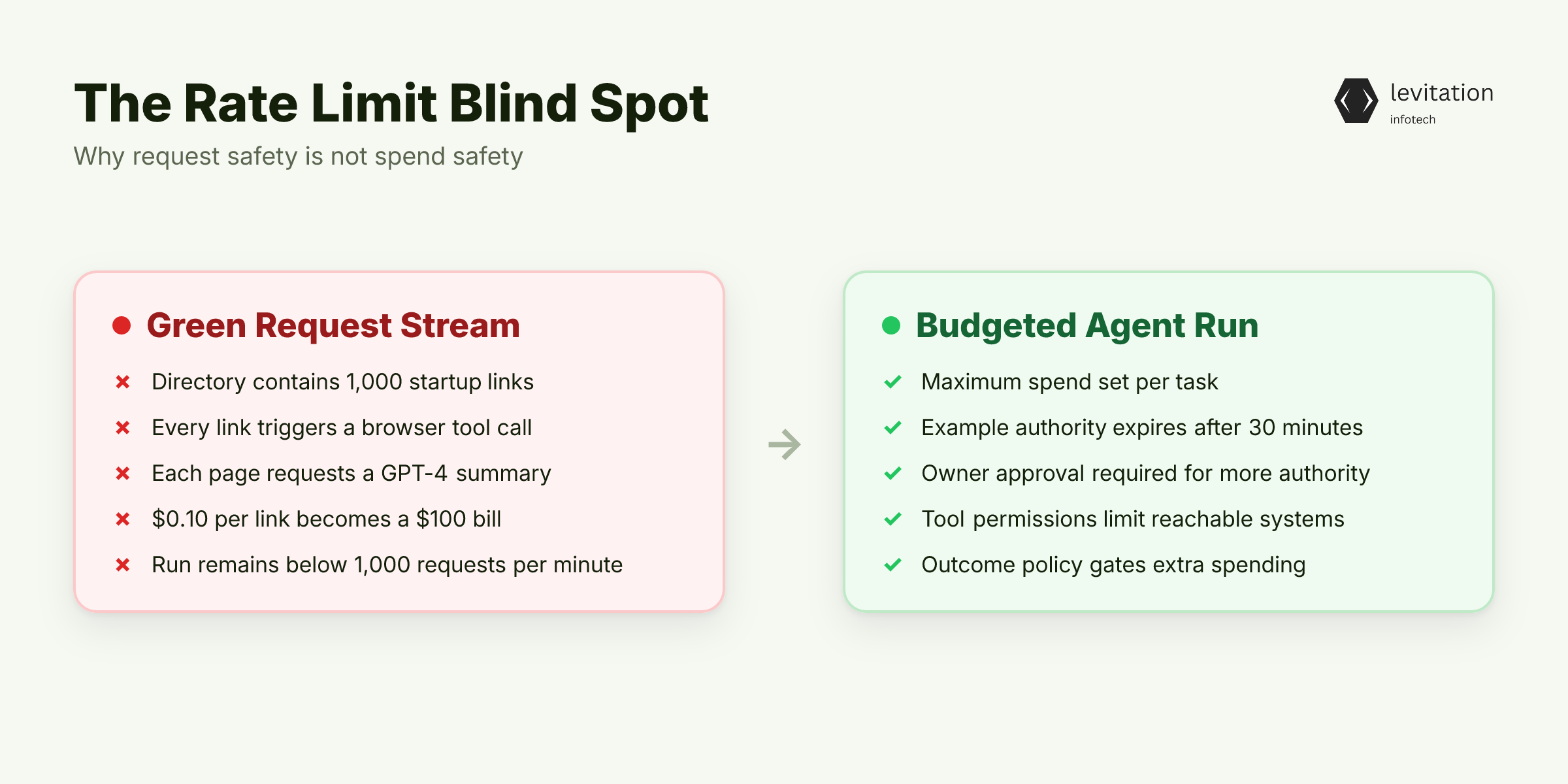
An agent can stay well under a 1,000-RPM limit and still turn one query into a $100 invoice. The traffic looks healthy. The economics do not.
In a published DEV Community example, an agent finds a directory of 1,000 startups. It visits every link, makes a browser tool call, and requests a GPT-4 summary for each page. At $0.10 per link, one user query produces a $100 invoice.
The run stays below 1,000 requests per minute.
Two different blast radii
Rate limits answer one question: “How fast can this caller act?” They protect provider capacity and latency.
API budgets answer a different question: “How much can this task spend?” They cap money lost to retries, loops, delegation, and excessive tool use. - Rate limit: Controls request frequency and infrastructure load. - API budget: Controls monetary authority, task scope, and expiry. - Tool permission: Controls which systems the agent can reach. - Outcome policy: Controls when extra spending is justified.
Keep rate limits. They remain necessary. But a healthy request stream says nothing about whether a run is economically acceptable.
Define the maximum acceptable loss per task in dollars and cents. Do not define safety only as a request frequency per minute. For AI agents, that changes the control boundary from traffic to money.
A concrete task policy might begin like this:
1task_budget:2 max_spend:3 amount: "1.00"4 currency: USD5 expires_in: PT30M
If a task needs more authority, an owner must approve it. Tool-enabled systems can otherwise turn a simple intent into an open-ended expense. That risk appears in open-source AI agents draining cloud budgets.
If the request stream looks normal, where does the runaway actually begin?
API Keys and Dashboards Miss the Agent's Real Cost Boundary
The runaway begins after one user request fans out into many paid actions.
An API key authenticates a caller. It does not express how much that caller can spend, which task it can fund, or when that authority expires.
1caller:2 identity: research-agent3 authenticated: true4 authorized_task: null5 authorized_spend: null6 expires_at: null
One request, many paid actions
A single agent turn triggers: - Model calls for planning, tool selection, and summarization. - Retrieval requests against paid vector or search services. - Browser operations and third-party API charges. - Retries after timeouts, rate limits, or partial failures. - Delegated sub-tasks with their own model and tool calls.
Provider dashboards combine invoice lines after execution. They cannot distinguish a valuable research path from an agent loop that stayed below the RPM ceiling.
A monthly organization-wide cap is also too blunt. Tasks differ in scope, price, duration, and business value. The same allowance can be wasteful for one workflow and restrictive for another.
Teams building custom software development systems must put economic policy inside the agent platform. It cannot live inside each integration built for AI agents, because delegated calls would bypass it.
The goal is to avoid another AI control plane spreadsheet. The gateway must enforce the policy instead of merely collecting evidence.
For autonomous agents, this makes the API gateway the economic control point. The answer is not another reporting dashboard, but an authorization decision made before the agent spends.
How do you turn that decision into an atomic ledger?
Require Preflight Authorization for Every API Spend
Start with a budget object, not a monthly quota.
An agent API budget is a scoped spending envelope. It needs an owner, maximum amount, expiry, remaining balance, permitted tools or providers, and exception policy.
1{2 "budgetId": "research-42",3 "owner": "market-research",4 "maxSpend": {"amount": "1.00", "currency": "USD"},5 "ttl": "PT30M",6 "permittedTools": ["browser", "approved-search", "llm-summary"],7 "finalizationReserve": {"amount": "0.05", "currency": "USD"},8 "escalation": "task-owner",9 "onExceeded": "block"10}
Authorize, reserve, settle
Every paid action follows the same sequence:
- Authorize: Resolve the effective budget and check expiry, permissions, price limits, and exceptions.
- Reserve: Atomically reserve the expected cost from the remaining balance.
- Execute: Forward the request to the model, MCP service, browser tool, or paid API.
- Settle: Record the actual charge and release any unused reservation.
This closes the gap between planned and actual cost. A dashboard reports what happened. Preflight authorization rejects an action before money is committed.
For variable or unknown prices, reserve a configured estimate backed by a per-call maximum. Do not let an unpriced external action bypass the budget path.
A parent workflow allocates bounded envelopes to children. Every child charge rolls into its parent total, while a child cannot access the parent’s full allowance.
Keep a small finalization reserve outside exploratory allocations. This lets the agent produce its final synthesis after normal task spending reaches its stated limit.
For AI agents, this envelope becomes the unit of delegation. Authentication says who the agent is. Spending authority says what that identity can buy.
But even a perfect per-call check cannot safely divide one balance among parallel child runs unless the hierarchy is explicit.
Layer Budgets by Task, Agent, Tool, and Sub-Agent
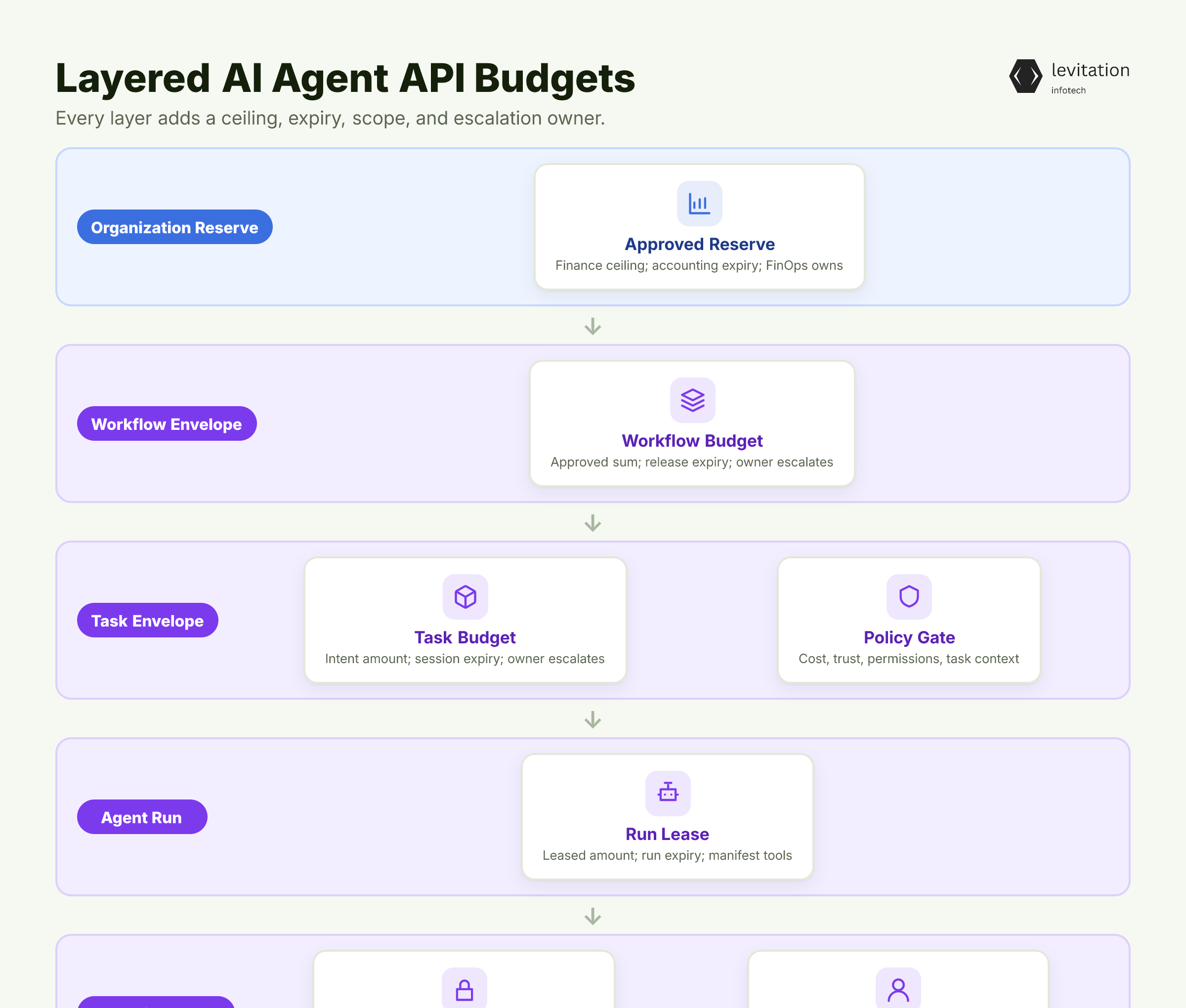
Parallel work turns a budget into a tree.
Each layer keeps its own maximum and expiry, even when it inherits a parent ceiling. The hierarchy makes ownership and delegation explicit.
1organization_reserve:2 workflow_budget:3 name: market_research4 task_budget:5 name: research_426 agent_run:7 name: run_78 sub_agent:9 name: finder_210 tool_budget: browser
A practical decision matrix looks like this: - Organization: The maximum is the finance-approved reserve, and expiry follows the accounting period. It allocates envelopes. FinOps handles escalation, and every allocation requires an audit record. - Workflow: The maximum is the sum of approved task envelopes, and expiry follows the workflow release window. It creates task budgets. The workflow owner handles escalation. - Task or payment session: The maximum is the approved amount for that intent, and expiry matches the session deadline. Its scope includes only permitted providers and tools. The task owner handles escalation. - Agent run: The maximum is the amount leased from the task, and expiry matches the run deadline. Its scope includes only tools in the run manifest. The agent owner handles escalation. - Tool: The maximum is the per-call ceiling, and expiry inherits the effective task deadline. Only the named provider or tool is permitted. Policy handles escalation. - Sub-agent: The maximum is the amount leased from the parent, and expiry matches the child deadline. Its actions stay inside the child manifest. The parent owner handles escalation.
A global daily budget helps, but document summarization and broad market research should not receive equal authority.
Context must also affect the decision. A request passes only when its cost, provider trust, tool permissions, and task context satisfy policy.
The cheapest request is not automatically safe. An unfamiliar provider can create a security risk.
The most expensive request is not automatically malicious either. It can be the right action inside a high-value research task.
For teams building custom software development systems, this hierarchy belongs in the runtime. Control cannot depend on separate AI agents integrations to handle the same limits independently.
Once scopes are clear, one gap remains: parallel calls can all pass a check before any cost is recorded.
Enforce Budgets Inside the API Gateway
A layered policy becomes real only when it sits on the request path.
The path is straightforward: AI agent to budget-aware gateway to model provider, MCP service, browser tool, or paid external API. Enforcement happens before traffic leaves the environment.
Every request needs a minimum metadata envelope:
1{2 "agentId": "research-agent",3 "taskId": "task-42",4 "budgetId": "task-research-42",5 "parentBudgetId": "workflow-market-research",6 "provider": "approved-search",7 "tool": "search-api",8 "estimatedCost": {"amount": "0.08", "currency": "USD"},9 "idempotencyKey": "task-42-search-17",10 "reason": "Collect source material for competitor brief"11}
The gateway sequence is:
- Authenticate the caller.
- Resolve the effective budget.
- Check expiry and contextual policy.
- Reserve estimated cost atomically.
- Forward the request.
- Settle the actual charge.
- Release the unused reservation.
- Emit an audit receipt.
Here is a runnable in-memory version of the core reservation pattern:
1from decimal import Decimal2from threading import Lock34class Gateway:5 def __init__(self, limit):6 self.limit = Decimal(limit)7 self.spent = Decimal("0")8 self.reserved = Decimal("0")9 self.lock = Lock()1011 def authorize(self, request, providers):12 estimate = Decimal(request["estimated_cost"])13 with self.lock:14 available = self.limit - self.spent - self.reserved15 return request["provider"] in providers and estimate <= available1617 def reserve(self, request):18 estimate = Decimal(request["estimated_cost"])19 with self.lock:20 available = self.limit - self.spent - self.reserved21 if estimate > available:22 raise PermissionError("Budget exceeded")23 self.reserved += estimate24 return estimate2526 def settle(self, reservation, actual):27 actual = Decimal(actual)28 with self.lock:29 if actual > reservation:30 raise ValueError("Settlement exceeds reservation")31 self.reserved -= reservation32 self.spent += actual3334def paid_call(gateway, request, providers, execute):35 if not gateway.authorize(request, providers):36 raise PermissionError("Request denied")37 reservation = gateway.reserve(request)38 try:39 result = execute(request)40 except Exception as error:41 gateway.settle(reservation, getattr(error, "charged_cost", "0"))42 raise43 gateway.settle(reservation, result["actual_cost"])44 return result4546gateway = Gateway("1.00")47request = {"provider": "search", "estimated_cost": "0.08"}48result = paid_call(49 gateway, request, {"search"}, lambda _: {"actual_cost": "0.07"}50)51print(result)
Production gateways need a durable transaction ledger. The compare-and-reserve operation must remain atomic across concurrent workers.
Failure-mode tests should cover: - Parallel calls: Several requests compete for one balance without exceeding it. - Expired budget: The gateway denies the request and returns a signed receipt. - Child exhaustion: The child stops while the parent’s remaining balance stays protected. - Unknown pricing: The configured per-call maximum applies, or the action is denied. - Retries: The idempotency key and original reservation prevent duplicate charges. - Partial provider failure: Known charges settle, unused funds release, and the provider reference remains attached.
Add circuit breakers for repeated retries, abnormal fan-out, or a workflow approaching its limit. A blocked action returns a signed decision receipt, not a silent failure.
In practice, this strengthens the API gateway layer that often sabotages AI productivity. For custom software development, economic enforcement should be part of the platform, not an optional middleware wrapper.
Production use, repeated enterprise deployments, and client retention signal operating experience. They do not prove that your budget gateway will save money.
Enforcement shows the engineering team where the money went. It leaves one question for finance: did the spend produce a worthwhile outcome?
Turn Budget Telemetry Into an AI FinOps Loop
Call-level enforcement can stop spend. Telemetry must then show whether that spend created value.
Attribute every charge to the fields that affect price and value: user, provider, model, token type, tool, task, and budget ID.
1{2 "userId": "user-17",3 "provider": "approved-search",4 "model": "summary-model",5 "tokenType": "output",6 "tool": "browser",7 "taskId": "task-42",8 "budgetId": "task-research-42",9 "estimatedCost": {"amount": "0.08", "currency": "USD"},10 "actualCost": {"amount": "0.07", "currency": "USD"},11 "decision": "allow",12 "outcome": "success"13}
Cost per outcome
Cost per million tokens shows token efficiency. Cost per successful task shows economic utility. The second metric exposes whether the agent produced a useful result or merely burned its allowance.
A global AI FinOps view should join warnings, blocks, approved increases, and policy changes to the audit trail. The same trail should cover cloud, DevOps, and security governance.
The weekly review should stay small and repeatable:
- Inspect budget spend by workflow.
- Identify expensive model, provider, and tool choices.
- Adjust routing, permissions, or limits.
- Test whether the change improves cost per successful outcome.
- Record the decision and its evidence.
Preflight enforcement and reporting after each run remain complementary. The gateway prevents unacceptable requests in the moment. Telemetry reveals where the system design wastes money, as shown in why FinOps AI can bleed money.
That separation matters for enterprise platform teams. Delivery experience earns trust, but cost-per-outcome data earns budget increases.
With enforcement and cost tracking working together, autonomy can expand without turning every exception into a finance incident. The remaining question is how to delegate authority without giving an agent a blank check.
What Explicit Spending Authority Changes
The practical change is that spending becomes delegated authority.
The new platform primitive
Treat spending authority as a first-class capability of AI agents, beside authentication, tool permissions, and rate limits.
1delegation:2 agent: research-agent3 maxSpend:4 amount: "1.00"5 currency: USD6 expiresIn: PT30M7 permittedTools: [browser, approved-search, llm-summary]8 escalation: task-owner
The payoff for teams designing custom software development systems is operational: - Every task has a bounded blast radius. - Every authority grant has an expiry. - Every exception has an escalation path. - Runaway loops stop before the balance is exhausted. - Infrastructure bills become more predictable. - Agents can be delegated more broadly without granting unrestricted access.
Broader delegation now depends on one question: what authority should your agent receive when its work justifies more?
About the author
Mayank Singh is a software developer at Levitation Infotech, where he builds web and AI-powered applications across the company’s fintech, healthcare, and enterprise projects.