


TL;DR: Passing a technical AI audit does not earn board trust. Boards worry about model drift. They also worry about vendor concentration. And they worry about autonomous decision liability. These are risks that point-in-time audits don't cover. CTOs who close the gap shift from annual compliance reporting to continuous AI assurance. As a result, they have a clear executive owner. They have a board-readable risk view. And they have a mapped framework strategy.
Key Takeaways: - 78% of executives lack confidence in their AI passing an independent governance audit. This is true even when technical checks have passed. - Audit compliance validates controls at a moment in time. Board governance evaluates trust, trajectory, and exposure over time. - The three risks boards care about most are model drift, foundation model dependency, and autonomous decision liability. These sit outside the audit checklist. However, they sit inside the fiduciary concern set. - A board-ready framework maps NIST, EU AI Act, ISO 42001, and Colorado SB 205 to specific director questions. It does not map director questions to frameworks. - Quarterly AI risk reporting with a named CTO owner turns governance from a blocker. It becomes a deployment accelerator.
Why Passing an AI Audit Doesn't Satisfy Your Board
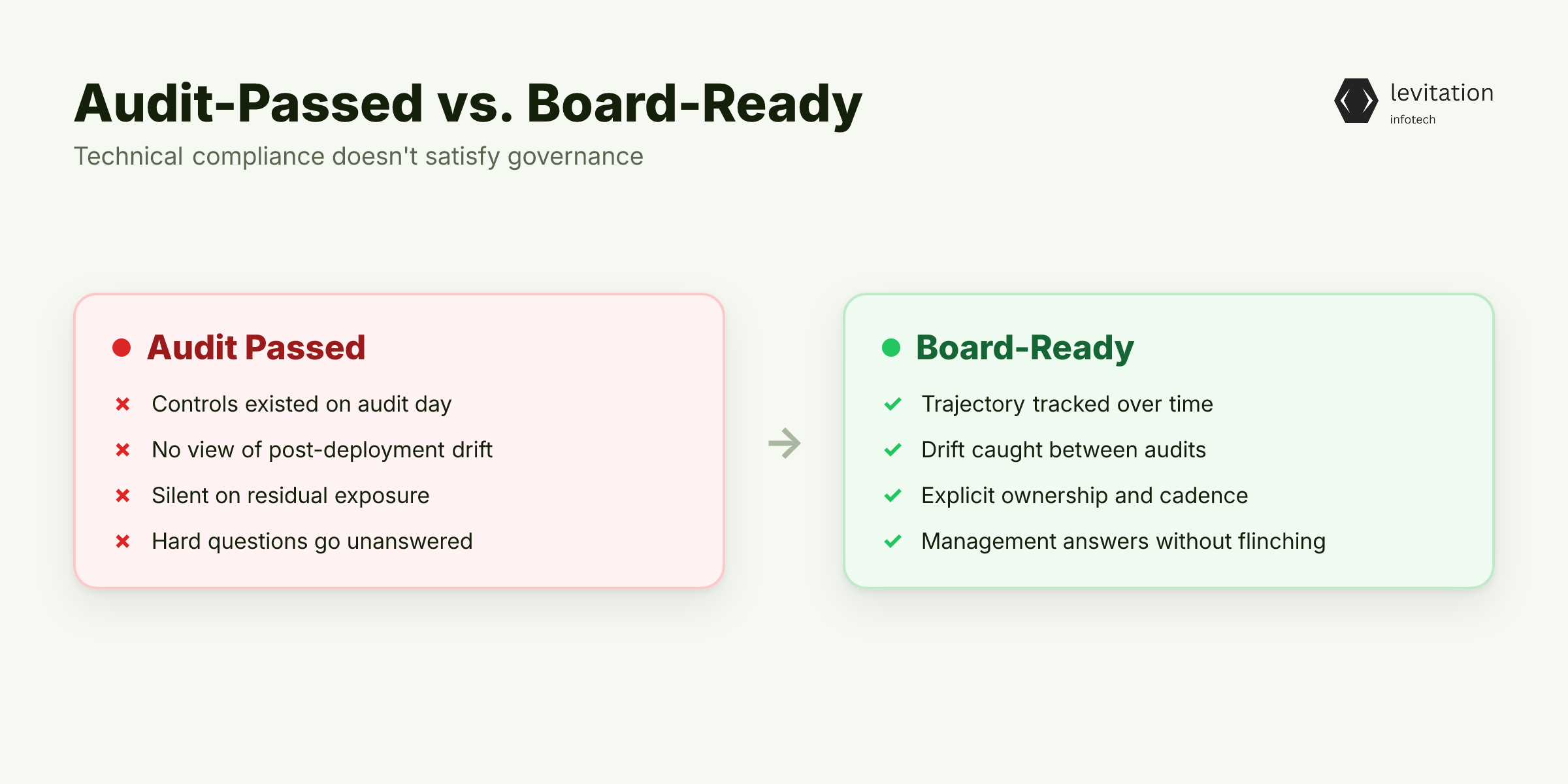
Seventy-eight percent of executives don't trust their own AI systems to pass an independent governance audit. That's the finding from recent enterprise research. Yet most of those same systems have already cleared technical compliance checks.
The two facts live side by side, and that is the problem. Passing an audit tells the board one thing. Your controls existed on the day the auditor showed up. Boards think in longer arcs.
They evaluate trajectory, residual exposure, and whether management can answer hard questions without flinching. When those two lenses diverge, the silence becomes its own risk signal.
Consider the second number. Nearly half of boards set zero AI governance expectations. That silence isn't neutrality.
It's a red flag to regulators. It's a red flag to auditors next year. And it's a red flag to directors who later ask why nobody raised the topic. Boards that skip AI expectations get blindsided when an AI system makes a consequential decision in production.
The foundations of effective AI governance require explicit ownership and cadence. They don't require the absence of either. The pattern repeats across industries.
A credit model passes its model risk audit, then drifts months later. It starts producing materially different outcomes for the population it was validated on.
The audit report looks fine. The board remains worried. Both are correct.
A hiring tool clears bias testing. Then a foundation model update shifts its scoring behavior. This shift happens in ways the original tests never covered. The problem isn't your AI system.
It's what your board can't see. It's also what they're afraid to ask.
The Audit Compliance Trap: What Auditors Check vs. What Boards Fear
Audits confirm documented controls. They trace data lineage, verify access policies, and confirm approval workflows. They rarely test how a model behaves when conditions shift.
Production data drifts from training data. Adversarial users push prompts to their limits. Audit work is not designed to cover these cases.
The deeper problem shows up at the board level. McKinsey's analysis on board governance of AI is blunt. Few directors believe their boards have the expertise needed to govern AI well. They also lack the structures. And the information is missing too.
Oversight falls between committees. Responsibility stays unclear. Risk discussions lag the pace of adoption.
Deloitte's research was published through the Wall Street Journal Risk and Compliance Journal. The research finds directors worry about moving too slowly on AI. They worry even more about moving blindly.
AI risk conversations tend to stay at the level of high-level principles. The operational reality rarely surfaces.
Think about what this means in practice. A board member reads an audit report that confirms your data governance controls. The report also confirms your model documentation. The report says nothing about what happens when a generative AI provider changes pricing mid-quarter.
It says nothing about model deprecation or regional outages. It says nothing about how your system behaves when production traffic patterns shift. These shifts happen in ways the test set never captured. It says nothing about the operational reality of running AI systems at enterprise scale.
An audit report tells a board what was checked. It does not tell them what your AI is actually doing in production. Those are two different deliverables. Confusing them is how AI programs get quietly defunded.
This isn't a board problem you solve by sending directors to an AI literacy seminar.
Three Risks Boards Care About That Audits Don't Cover
Model drift and behavioral change. An AI system that passed audit months ago behaves differently today. Training data ages. Customer behavior shifts.
Feature distributions change. Audit reports capture a snapshot. Boards need continuous assurance that the model still does what your documentation says it does.
This is the failure mode that drift detection in production AI systems is built to catch. It is also the one that most audit cycles miss entirely.
When drift goes unflagged, the model isn't just wrong. It's wrong in a way nobody is required to report.
Foundation model and vendor concentration risk. Boards want to know what happens when a generative AI provider changes terms. They also want to know what happens when a provider deprecates a model version. And they want to know about public incidents. Few audits address upstream dependencies at all.
If your entire customer service workflow runs on a single model API, one provider decision can take you offline. Your audit report doesn't capture that fact. The practical reality of agent stack compliance shows that vendor risk compounds quietly. It stays quiet until it doesn't.
Reputational and autonomous decision liability. Boards fear scenarios where an AI system makes a consequential decision. A credit denial. A medical triage call. A hiring rejection.
Each can trigger regulatory inquiry or media exposure. Audit reports rarely quantify this exposure. The audit confirms your process was followed. It doesn't estimate the cost of the decision going wrong in public.
Each of these risks exists outside the audit checklist. However, each exists inside the board's fiduciary concern set. That's the practical difference between audit compliance and real responsibility.
So what does board-ready AI governance look like in practice?
The Board-Ready AI Assurance Framework
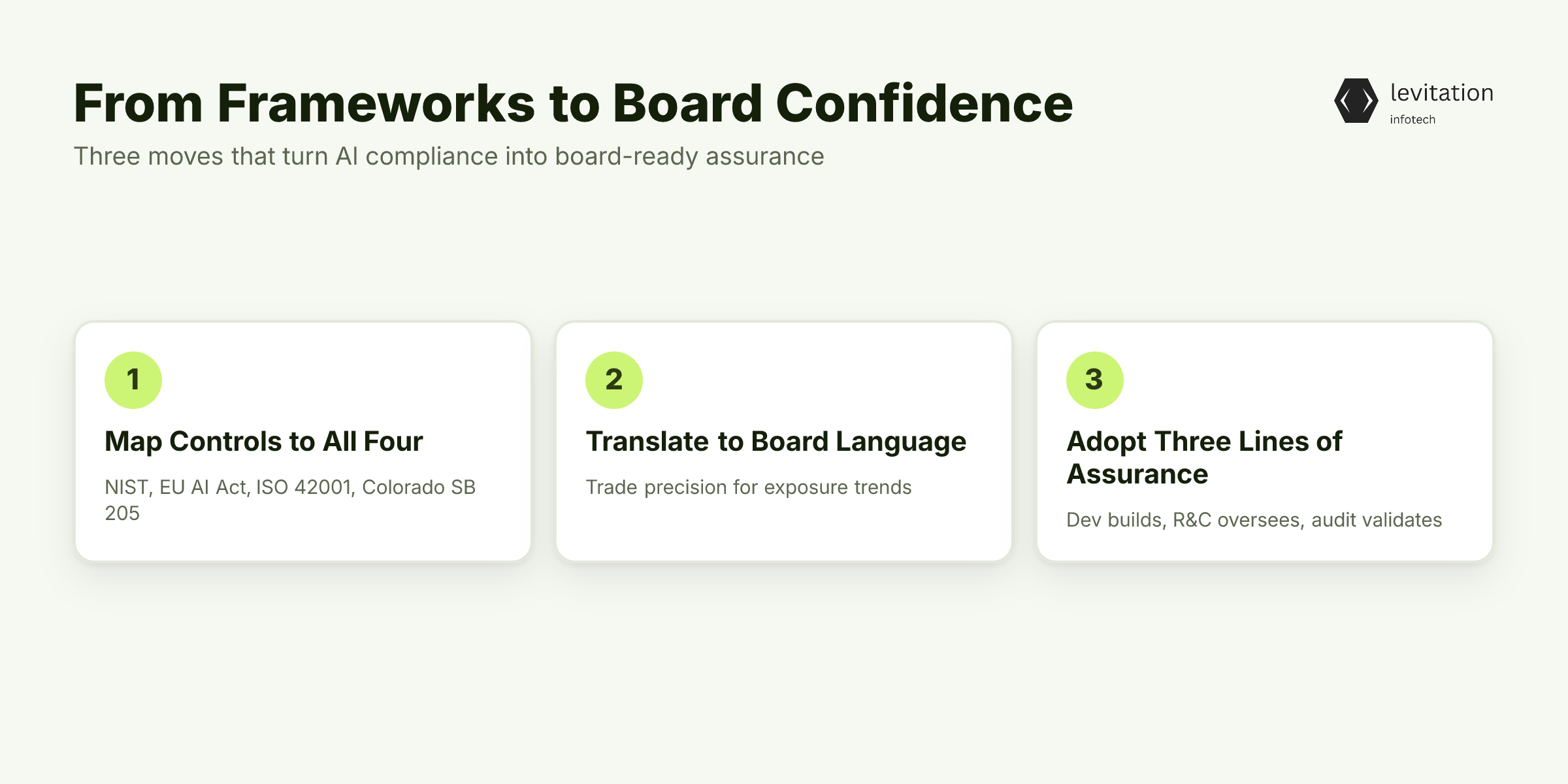
Four frameworks dominate the conversation right now. They are the NIST AI Risk Management Framework, the EU AI Act, ISO 42001, and Colorado SB 205. Most CTOs treat them as competing standards. That's the wrong frame.
The smart move is to map your existing controls against all four. Then show the board which director questions each one answers.
NIST gives you a vocabulary for risk that directors can read without an engineering degree. The EU AI Act gives you regulatory teeth. This is especially true if you serve European customers. ISO 42001 gives you a certifiable management system that audit committees already understand.
Colorado SB 205 gives you a concrete operational standard for high-risk use cases. Pick the combination that maps to your exposure, not the one with the best marketing.
The next move is translation. Technical metrics like precision, recall, drift scores, and hallucination rates don't belong in board materials. Board-level indicators do.
Replace "our precision metric dropped below threshold" with "exposure trend on the credit decisioning system is amber, driven by input drift in the last quarter." Replace "we logged several hallucination events this period" with "the customer-facing assistant has a residual risk rating of medium, with one open incident under review."
The third move is structure. Use the three lines of assurance model, adapted for AI. The development team owns controls.
Risk and compliance owns oversight. Internal audit owns independent validation. This pattern is familiar to audit committees because it mirrors how they govern financial reporting.
It maps directly to what audit committees already understand.
So what do you actually put in front of the board each quarter?
The CTO's Board Reporting Playbook
Cadence. Annual AI updates are no longer defensible. Move to quarterly AI risk reports with a standing agenda item on the audit or risk committee docket. High-velocity deployments should include a monthly operational summary to the responsible executive. This is especially true for anything using generative AI.
Model behavior changes faster than annual cycles can catch.
Content. Replace the technical dashboard with a one-page AI risk heatmap. It needs five elements. They are model inventory, drift indicators, open incidents, regulatory exposure, and upcoming model changes. If a director can't parse the page quickly, the page isn't done. They also need to know whether to ask a follow-up question.
The discipline of continuous AI risk management shows up in the design of this artifact. It shows up more than anywhere else.
Ownership. Clarify in writing which committee owns AI oversight. In most organizations, it lands in the audit committee. Sometimes it is shared with the risk committee. Then make the CTO the single accountable executive for AI assurance reporting.
One name, one page, one quarterly conversation. The clarity itself reduces board anxiety.
Organizations that treat board reporting as a relationship tend to keep their AI systems running in production long after deployment. They treat it as a relationship rather than a compliance exercise. The systems stay alive because the operators made governance reporting a continuous discipline.
Trust compounds when reporting is consistent and honest. When this works, the payoff extends well beyond calmer board meetings. That compound effect is what separates programs that scale from those that quietly stall.
From Board Anxiety to a Faster AI Pipeline
AI governance trust is a deployment speed multiplier. When the board trusts your assurance process, new use cases get approved in weeks instead of quarters. When the board doesn't trust it, every AI initiative carries an invisible tax. The tax shows up as a delay. It shows up as a re-review. And it shows up as a quiet "let's table this for now."
When governance is built in from the start, AI projects reach production faster. When teams bolt governance on after deployment, the same projects stall. The difference isn't engineering talent. It's whether governance is an enabler or an afterthought.
For the CTO, this is competitive advantage. Faster AI implementation cycles. Fewer stalled initiatives.
A board that becomes a sponsor rather than a blocker. Governance maturity is the single biggest predictor of whether an AI portfolio scales across regulated deployments. It is also the biggest predictor of whether it stalls.
The CTO who walks in with a one-page heatmap owns the conversation. They also bring a named framework mapping and a quarterly cadence. The CTO who walks in with a 40-page audit report and a defensive tone is already on the back foot. Same AI system. Different trust.
Frequently Asked Questions
What is the difference between AI audit compliance and AI governance?
AI audit compliance verifies that documented controls meet a defined standard. It also checks data practices and model procedures. This check happens at a point in time. AI governance is the ongoing operating model. It includes roles, reporting cadence, risk appetite, and decision rights. It keeps the AI system trustworthy between audits. Passing an audit does not mean you have governance. It means you had controls on the day the auditor checked.
How do boards typically evaluate AI risk?
Boards evaluate AI risk through the same lens as any other enterprise risk. The lens covers likelihood, impact, velocity, ownership, and visibility. Most boards do not review model metrics directly. They review whether the CTO can answer questions about exposure with confidence. They also check whether the risk function can answer about incidents and regulatory readiness with consistency.
Which AI frameworks should enterprises adopt for board-level assurance?
The four most commonly adopted are the NIST AI Risk Management Framework, the EU AI Act, ISO 42001, and Colorado SB 205. For a CTO reporting to a board, the practical move is to map your existing controls against all four. It is better to map against all four rather than pick one. Boards care about whether you can show alignment with whichever regulation applies to your jurisdiction and customers.
How often should AI risk be reported to the board?
At minimum quarterly, with a standing item on the audit or risk committee agenda. High-velocity AI deployments should include a monthly operational summary. This is especially true for those using generative AI or foundation models. The summary goes to the responsible executive. A quarterly summary goes to the full board. Annual reporting is no longer defensible given the pace of model and regulatory change.
What are the most common AI governance gaps boards flag?
The most common gaps boards surface are several. There is no clear executive owner of AI risk. There is no model inventory. There is no defined policy on generative AI and foundation model use. There is no incident response plan for AI-specific failures. Finally, there is no mechanism to escalate model behavior changes between audit cycles. Each of these is easy to identify. Each is also difficult to defend if missing when the board asks.
Sources
Research and references cited in this article:
- Enterprise AI Governance Framework
- 5 Leading AI Governance Frameworks Every Organization ...
- AI Compliance Framework: Ensuring Responsible & Compliant AI - WitnessAI
- AI Compliance Framework
- What Is an Enterprise AI Trust Framework? Full Guide
- Majority of US business leaders not confident they could pass AI audit – study - The Global Legal Post
- AI Risk for Boards: What Directors Must Know in 2026
- Most corporate boards lack rules for AI use: Deloitte survey
- Why AI Governance Keeps Failing UK Boards
- The Board Is Becoming the Weakest Link in AI Governance
- AI and Enterprise Risk Management: What to Know in 2026 | Workday US
- AI Governance in Enterprises: Manage Risk and Scale ...
About the author
Mayank Singh is a software developer at Levitation Infotech, where he builds web and AI-powered applications across the company’s fintech, healthcare, and enterprise projects.