


TL;DR: AI coding can lower the token-related part of a Noida app build. It does not automatically lower annual support, so separate build, run, and change before you negotiate.
Key Takeaways: - Treat AI savings as token-sensitive, not as a discount on the whole project. - A compatible gateway can lower token spend without changing the coding workflow. - A cheaper deal needs a smaller build ledger, an explicit run ledger, and bounded change terms.
AI Cuts the Build Bill, Not the Run Bill
A ₹1-2 lakh annual support bill can remain untouched after a cheaper app build. Founders notice the difference because the new project quote looks leaner. Yet the post-launch promise has not changed.
AI coding can halve the token bill behind a Noida app quote. This happens when token pricing and reuse are controlled. However, the cheaper part is building code, not operating the product.
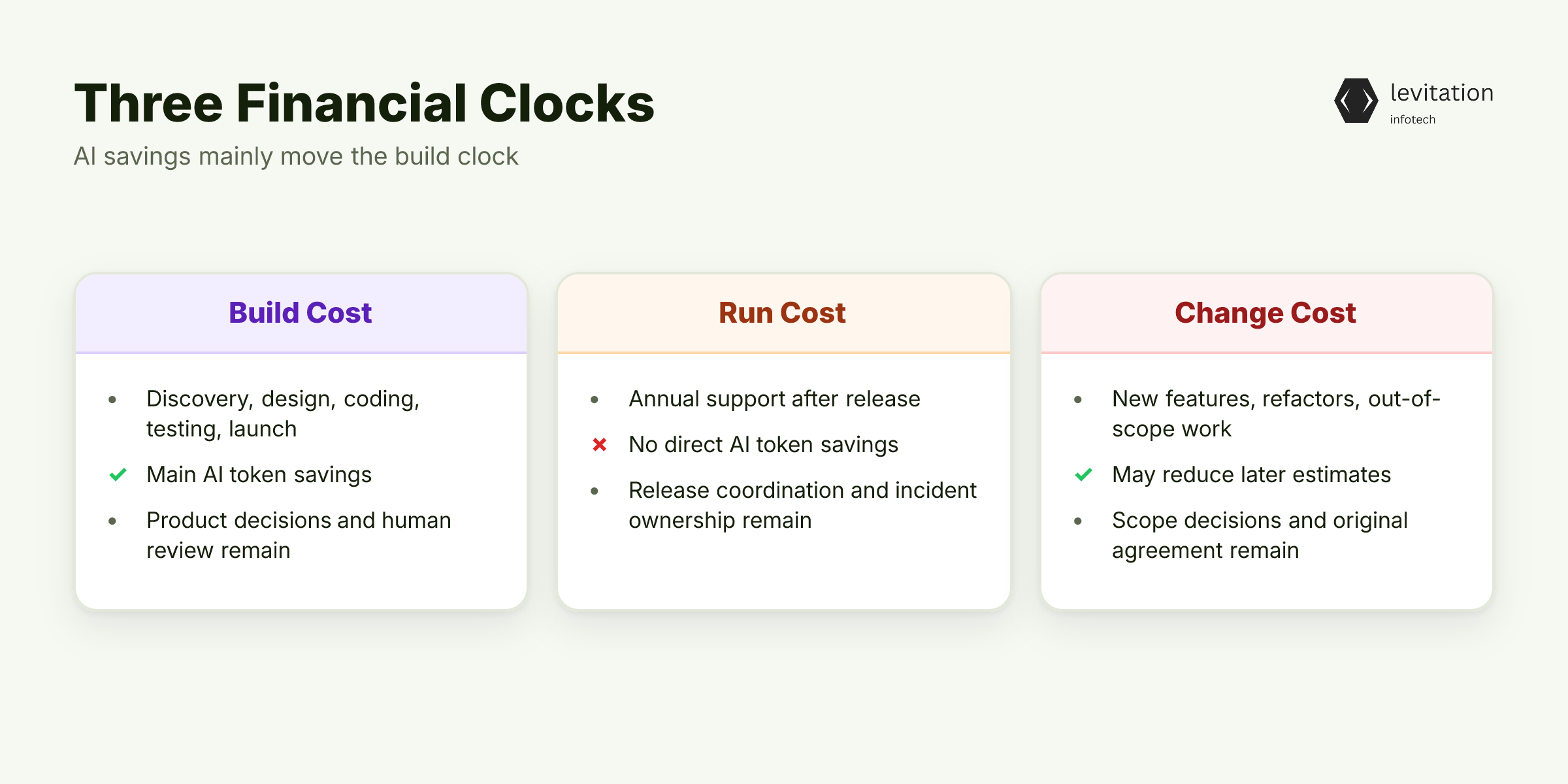
Most founders see one price and think of one decision. The quote actually mixes three financial clocks.
A project quote pays for a product becoming real. The support commitment pays for keeping that product dependable after launch.
In practice, every quote should show at least three clocks. The build cost covers discovery, design, coding, testing, and launch. The run cost covers annual support after release.
The change cost covers new features and refactors. It also covers work outside the original agreement.
A token discount mainly moves the build clock. It can also reduce later change estimates. It does not erase product decisions. It also leaves human review, release coordination, and incident ownership in place.
The mobile app development cost in India guide can provide a build benchmark. Still, it cannot set a standard for a support contract by itself. This is why a Noida app quote can hide the real cost unless the buyer separates the clocks.
The goal is not to force the ₹1-2 lakh support figure down. Instead, it is to learn what that scope buys and whether the vendor will stand behind it.
To see where the quote savings stop, follow the token. Which clock does the advertised discount actually move?
Why Cheaper Tokens Do Not Buy Cheaper Support
Cheaper tokens are a pricing result, not a staffing result. Here, coding agents often resend project context on each turn.
Each turn can include repository rules, architecture notes, prior messages, and task history. If stable material is treated as fresh input, the team can pay again. The tool has already received that information. Think of it as photocopying the same brief before every decision.
Token pricing and context reuse are the main savings levers. Neither the vendor's nor the client's name creates a saving on its own.
For compatible clients, a discounted OpenAI-compatible endpoint can lower token pricing without changing the workflow. Then, the token bill can drop while the team works the same way.
In practice, four controls shape token cost. Prompt caching reuses known prompt prefixes at the cached rate. Task routing then sends routine transformations to cheaper models and reserves stronger models for complex reasoning.
Lean context removes repeated project material before the agent resends it. One gateway also puts compatible access in one place, so pricing, usage, and routing stay visible.
When all four controls work as intended, the AI coding token bill can fall by half or more. Test that claim in your own workflow, because it is not a universal promise.
These levers change token economics. Still, they do not reduce human support labor, release ownership, or incident response.
A lower token bill can shrink a build estimate or change request. Yet it cannot shrink an unchanged annual support scope.
When you compare app development cost in India, treat token-sensitive coding and contract-sensitive support as different markets. Then, once token economics are separated from service duties, the quote becomes negotiable.
But which duties are fixed, and which are open for trade?
Separate Build, Run, and Change in Every Quote
A single total hides the trade that matters most. For this reason, three ledgers force the buyer to see it.
Build ledger
Then, list the build in separate, tagged lines. Discovery is contract-sensitive because product choices need human judgment with clear ownership. UX is contract-sensitive because product flows still need human validation.
Here, coding is token-sensitive because agents can speed up repetitive work. Quality assurance is contract-sensitive because AI assists testing while people still own release quality. Launch is contract-sensitive because store submissions and release coordination depend on external parties.
Also, AI can speed up coding, test setup, repetitive transformations, and some code-review tasks. It cannot remove acceptance decisions, test sign-off, or release ownership.
Run ledger
Then, define the annual support line before signing. State what is included, along with response expectations, maintenance cadence, release handling, and platform or third-party work.
These lines are contract-sensitive. They describe who responds, how quickly, and what gets maintained. If the scope stays the same, it can still carry a ₹1-2 lakh commitment.
AI can help prepare a patch. It does not own the pager or inherit the contractual promise.
Change ledger
First, separate work that arrives after the agreed baseline. New features require token-sensitive coding and contract-sensitive acceptance. Refactors create token-sensitive code work and contract-sensitive release risk.
Scope changes remain contract-sensitive and require separate approval.
Then, price each item against the original product definition. AI-generated code can otherwise hide change inside a recurring retainer. This makes the work invisible and hard to forecast.
If deployment shortens the build timeline, the support clock can start earlier. So, annual support starts sooner, even when its scope and price remain unchanged.
A cost to build an app guide can provide a delivery benchmark. However, it will not settle support terms.
Compare vendors only after putting all three ledgers on the same basis. Use the same platforms, schedule, release scope, and support period.
The three-ledger model works only if token economics are set up before code creation starts. Otherwise, faster output can blur the line between original scope and new work.
Which line will your current quote hide?
Configure One Gateway, Reuse Context, Route by Task
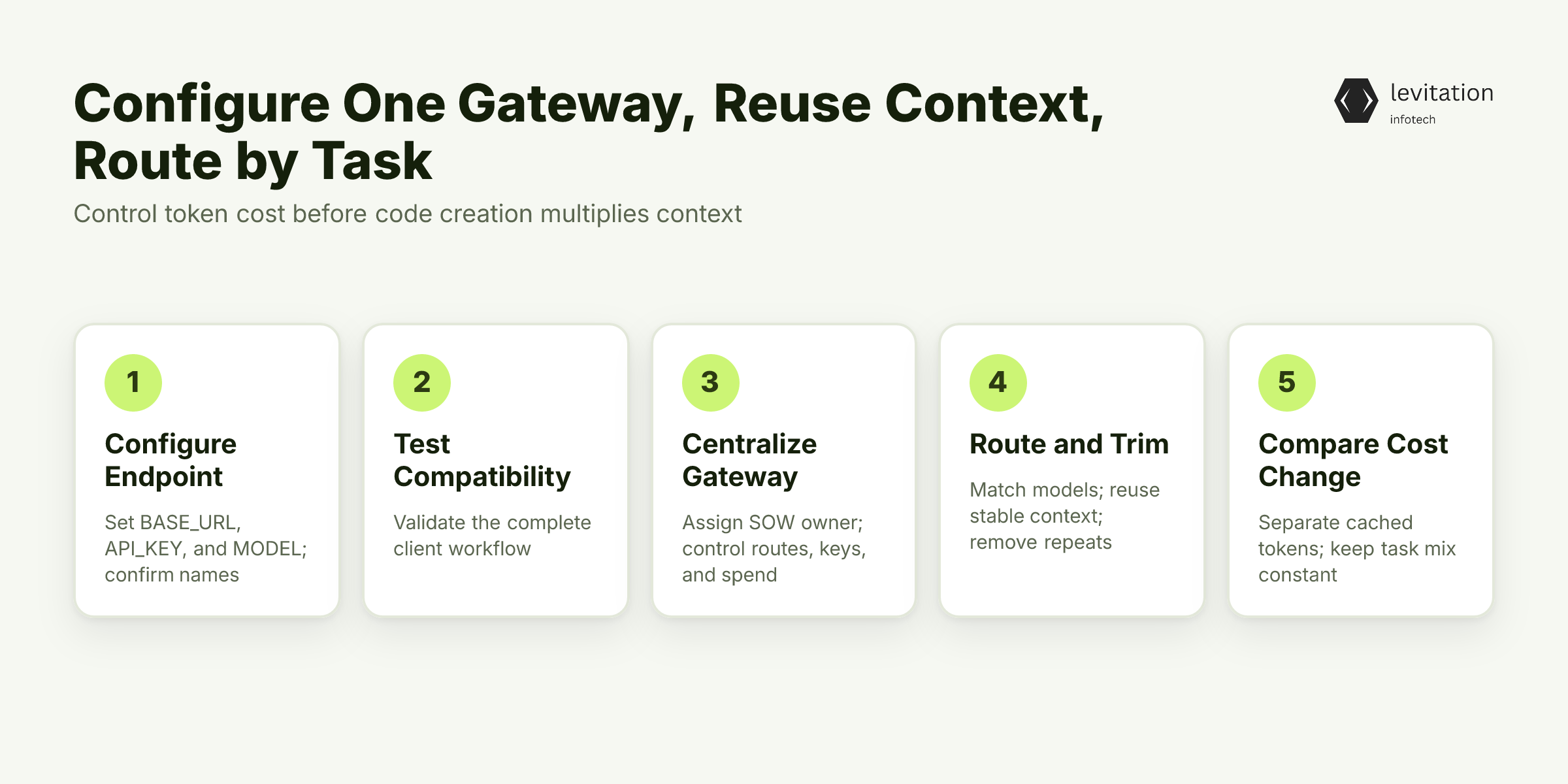
Here, token control must happen before code creation multiplies context.
Keep the workflow
For compatible clients, point Claude Code, Codex, or OpenClaw at a discounted OpenAI-compatible endpoint. This is configuration, not migration, and the workflow can stay the same.
Then, use three placeholders: BASE_URL, API_KEY, and MODEL. They represent the gateway address, credential, and model, not a universal setup. Confirm each tool's supported environment-variable names before making changes.
Also, test compatibility. A compatible endpoint can still lack some client features, so validate the full workflow before switching.
Centralize the spend
Then, route all coding tools through one gateway. Token usage, cached context, model selection, and spend then appear in one view.
Centralization also creates a control point for credentials, routes, and usage visibility. Name its owner in the mobile app development statement of work. Define who can change model policy, rotate keys, and inspect usage.
An API gateway can create value and friction, as why an API gateway can sabotage AI productivity explains. Gateway ownership belongs in the commercial agreement, not an informal chat.
Match the model to the task
Here, use cheaper models for routine transformations. Reserve stronger models for complex reasoning and high-impact decisions.
Validate that split against your own tasks. Model routing is a cost and quality policy. It should be tested, not assumed.
Cache and trim context
Then, keep stable prompts unchanged so the provider can recognize reusable material. Remove repeated project context before the agent sends it again.
Caching and trimming solve different problems. One reuses priced context. The other avoids sending unnecessary context.
Measure the change
Next, compare total token use and spend before and after configuration. Separate cached input tokens from uncached input, and keep the task mix constant. Otherwise, a savings percentage can hide changes in the work itself.
The goal is not a lower app development price at any cost. It is a traceable lower token cost with steady delivery quality.
With AI usage controlled, negotiate commercial terms instead of comparing headline quotes. What is each bidder actually selling?
Turn AI Savings Into Comparable Vendor Quotes
Headline quotes are easy to compare because they hide everything that matters. Require every bidder to complete the same three ledgers.
First, ask each bidder to state the same assumptions. They must define the build scope, supported platforms, and release scope. They must specify the support period, delivery schedule, and renewal terms.
Each bidder must also state the planned model mix and context-reuse approach.
Then, compare mobile app development with web app development on lifecycle duties, not launch price alone. A browser-based delivery model does not remove ongoing quality checks, release work, or platform work.
The same lifecycle distinction appears in how build savings and ongoing run costs differ. The launch price describes one part of the product's economics.
When a founder plans to hire React developers, ask who manages the gateway and prompt caching. Also, ask who owns production incidents. Then, ask whether token consumption sits inside the build price or gets charged separately.
Reject any quote that treats AI assistance as a discount label without a baseline. Require the vendor to show which duplicated effort, task, or token cost the discount removes.
Next, ask for a milestone plan. It should state when the support period begins and how staffing changes as the project reaches launch.
Negotiate a clear renewal review. Renewal discounts can move separately, as AI vendor prices and renewal quotes can move separately demonstrates.
If the annual retainer must remain ₹1-2 lakh, make that an explicit scope decision. Otherwise, the same amount can quietly cover an undefined stream of requests. Which savings will you keep, and which support terms will you refuse to let drift?
Keep Build Savings, Bound Support Exposure
AI coding can make the initial mobile app development quote and future change work cheaper. The annual support budget can remain stable. That trade-off is a commercial choice, not a failure.
Here, put clear guardrails in the agreement. These include support inclusions and exclusions, response ownership, token-budget visibility, change-order thresholds, and renewal checkpoints.
If the ₹1-2 lakh commitment must stay, require it to buy a defined scope rather than vague availability. Reduce support channels, service cadence, or included feature work only when those boundaries are negotiable and contractually clear.
Then, apply a three-question decision rule. First, did the build ledger fall?
Second, is the run ledger unchanged or explicitly reduced? Third, are change requests bounded?
A quote is not truly cheaper unless all three answers are clear.
About the author
Mayank Singh is a software developer at Levitation Infotech, where he builds web and AI-powered applications across the company’s fintech, healthcare, and enterprise projects.