


TL;DR: Every lowball Noida app quote is a slice, not the pie. App development in Noida swings from ₹10,000 to ₹15 lakh for the same brief, and year two runs 15-25% of build cost whether you budgeted for it or not. The quote isn't dishonest; it's structured to win the first conversation, not to survive the second year.
Key Takeaways: - ₹3 lakh quotes cover one screen flow with no backend, admin panel, auth, or support. They are partial, not misleading. - Year-one add-ons (APIs, hosting, store accounts, admin panels, testing) compound quickly past the headline number because each carries its own vendor cost, setup time, and integration work. - Year-two maintenance runs 15-25% of build cost every year, and agencies that omit it from the quote usually own you by month 12. - Forcing a line-item breakdown with hourly rates and exclusions is the only way to compare quotes honestly.
Why Every ₹3 Lakh Quote in Noida Is a Partial Number
A Noida agency quoted your MVP at ₹3 lakh. Three Noida agencies quoted you the same. Here's what none of them mentioned: the real bill for a startup-grade app in India climbs toward the upper end of the published range in year one, and year two costs 15-25% of build cost whether you planned for it or not. The quote isn't a lie. It's just incomplete.
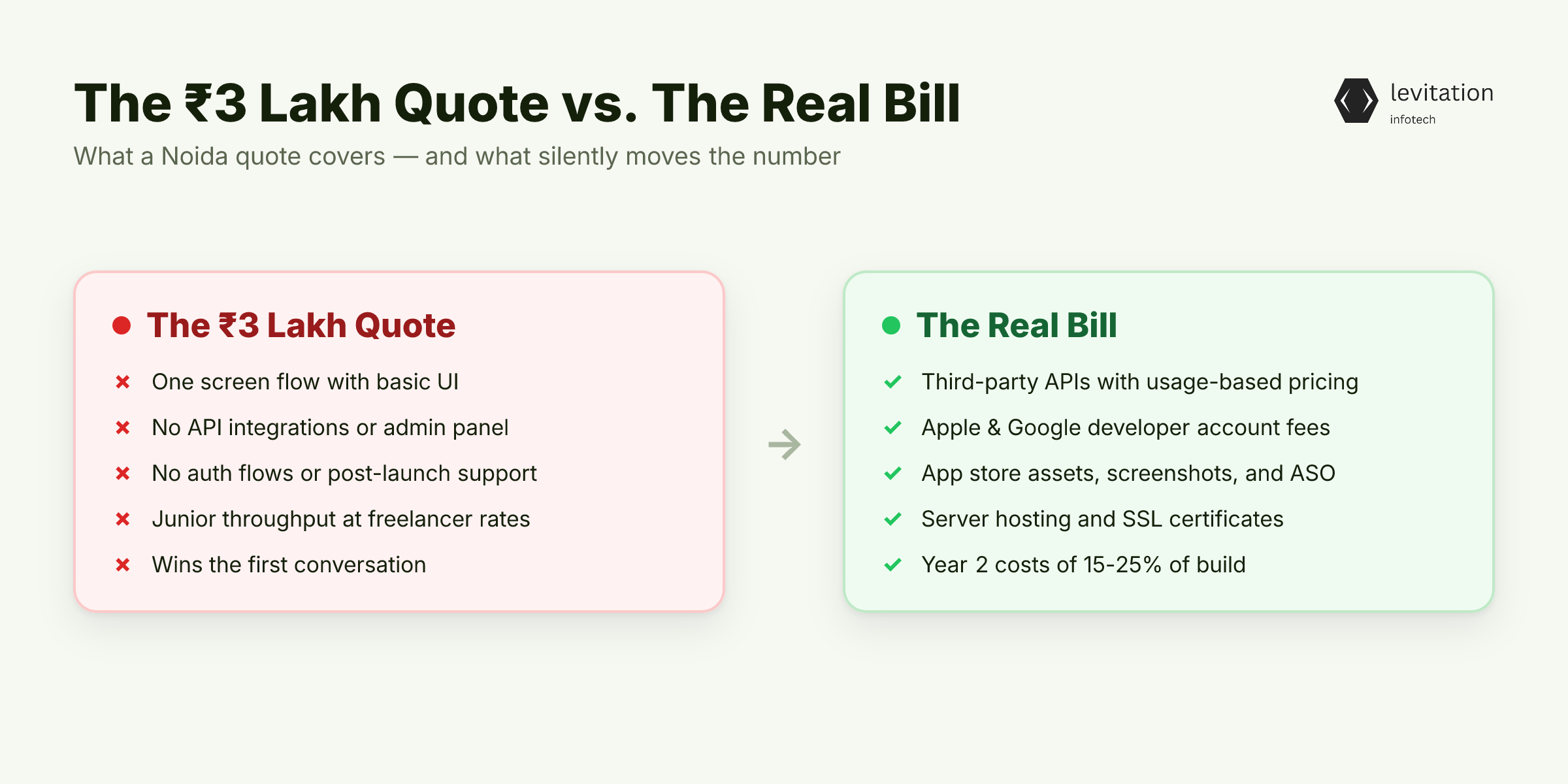
App development cost in Noida swings from ₹10,000 to ₹15 lakh for what looks like the same brief. That gap isn't because agencies are guessing. It's because they're quoting on different slices of the work. The ₹3 lakh figure almost always covers one screen flow, basic UI, no API integrations, no admin panel, no auth flows, and no post-launch support. It's a prototype disguised as a product.
What gets stripped out is where the money actually lives. Third-party APIs carry per-call or tier-based pricing that scales with usage and integration count. Apple and Google developer accounts add their own fees on top of build cost, with Apple charging annually and Google charging a one-time registration. App store assets, screenshots, and ASO sit on a separate line. Then there's server hosting, SSL certificates, and the small print that inflates your ₹3 lakh quote well past the original number by month 9.
Rate cards tell the same story. Indian freelance rates start low and climb through mid-sized agencies to top Noida firms. The premium buys in-house design and senior engineers who don't need hand-holding. The ₹3 lakh number usually assumes junior throughput at freelancer rates, then bills the missing hours as "change requests" once you're locked in.
The problem isn't that Noida agencies are dishonest. It's that their quoting model is built to win the first conversation, not to survive the second year.
The Line Items Your Quote Strips Out (and Why They Exist)
UI/UX design eats a meaningful share of any real project, and most low quotes skip it or fold it into "frontend." A real design pass includes wireframes, user flows, component libraries, and a clickable prototype you can test before a line of code is written. If your quote has one line that says "design," the agency is planning to ship screens and argue later about what they should look like.
Backend and database work is where MERN stack saves money. MERN can cut backend cost meaningfully versus Java or .NET, but only if your team has shipped production MERN before. Bad MERN code costs more to fix than well-written native code. The saving evaporates the moment you hire a "MERN fixer" at premium rates because the original code has no tests, no docs, and no schema discipline. The choice isn't "MERN vs. native" in the abstract. It's "MERN from a team that's done it" vs. "MERN from a team that watched a tutorial."
Admin panels and dashboards are the most common omission. Most startup quotes don't include an internal tool to manage users, content, or transactions, then bill it as a "Phase 2" add-on with its own price tag the moment you need to actually run the business. If your quote has no admin panel line item, the agency has decided you don't need one yet. You will.
Testing and QA is a non-trivial portion of any real project. The cheapest agencies skip it and call it "agile delivery." That word means nothing. What it means in practice is: bugs ship to production, users find them, and you pay hourly rates to fix them after launch. The same work would have cost less done before release.
App store submission, ASO assets, and screenshots carry their own design, copy, and A/B testing costs that most quotes don't mention. Screenshots alone, the ones that convert browsers into installers, need design, copy, and A/B variants. Most quotes don't mention them. By the time you need them, the launch is already two weeks late.
How much does an app cost when these gaps are visible? Anywhere up to the top of the published range, around ₹15 lakh, for a real startup MVP. These gaps explain why the year-one bill climbs well past the quoted figure. But the real trap isn't year one. It's the 12 months that follow.
Year Two: The 15-25% Rule Nobody Mentions Until You're Locked In
Mobile app maintenance cost in India runs 15-25% of original build cost every year. A ₹10 lakh app needs ₹1.5 to ₹2.5 lakh annually just to stay alive. This isn't optional. It covers OS updates, security patches, dependency upgrades, server costs that scale with users, and crash fixes from a real production workload.
The hosting math is brutal once you have actual users. AWS or GCP bills scale with traffic, storage, and data transfer, climbing as your user base grows. Firebase plus Cloud Functions carries its own tiered pricing that rises with active users and invocations. None of this is in your year-one quote because the agency doesn't know your traffic curve, and they'd rather win the bid than model your infrastructure bill.
If your app touches payments, user KYC, or regulated data, expect a significant audit and certification workload in year one or two. This isn't a feature. It's a cost of operating in a regulated industry, and it usually surfaces after the build is done, not before. Compliance requirements change faster than your roadmap.
The refactor debt is where the real bill lives. Cheap codebases often need rewriting within 18 months. That's another major lump sum tied to the original build cost, which you didn't plan for. The trigger is usually a new feature the existing architecture can't support, or a security finding that can't be patched without a rewrite. Either way, you're paying for the same work twice.
This is where process discipline separates vendors. Teams with high client retention don't have that number because they're the cheapest. They have it because the support holds up after launch, the code survives contact with production, and the year-two conversation doesn't start with a hostage negotiation over credentials. Your Noida CRM Vendor Has 3 Developers. One Will Leave In 6 Months shows why team stability matters as much as hourly rate.
The real cost stack becomes clearer once you see what each tier delivers, from freelancer to top-tier Noida firm.
The Real Cost Stack: What Each Tier Actually Delivers
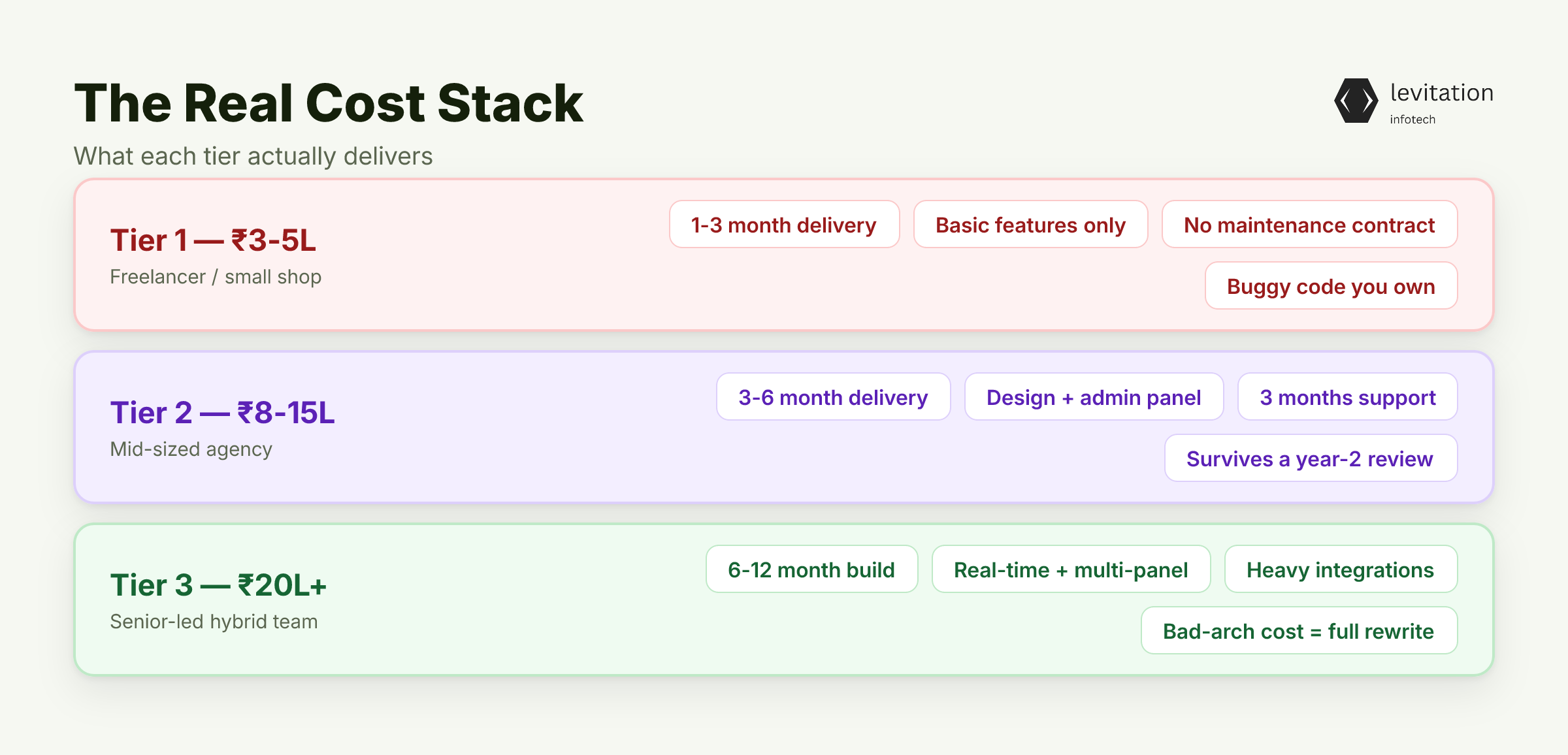
Tier 1 (₹3-₹5 lakh) buys a freelancer or a small Noida shop. Delivery runs 1-3 months for basic features. There's no maintenance contract, no admin panel, and you own buggy code. The hourly rate behind this number is low, and the savings come from missing requirements, not from efficiency.
Tier 2 (₹8-₹15 lakh) is where most "real" startups land. Mid-sized agencies deliver in 3-6 months at mid-tier hourly rates. This tier includes design, backend, admin panel, and typically 3 months of support. It's the first tier where the quote can actually survive contact with a year-two reality check.
Tier 3 (₹20 lakh and above) covers complex apps: Zomato, Blinkit, or Urban Company clones with real-time sync, multiple user panels, and heavy third-party integration. Build runs 6-12 months. This is where senior-led hybrid teams earn their premium, because the cost of a bad architectural decision at this scale is a full rewrite.
Use the formula: Cost = (Features × Complexity Weight) × Hourly Rate × Hours. If the agency won't show you the inputs to this, they're padding somewhere. The quote is a sales tool, not an estimate. Senior teams with deep enterprise track records run their own numbers before they run yours, and they share the math. Why Three Noida Dev Quotes Differ by ₹22 Lakh walks through what actually drives that spread. For MERN-specific budgeting, see MERN stack development cost and the broader app development cost benchmarks.
Knowing the tiers is half the battle. The other half is knowing which tier your brief actually fits, and forcing the agency to prove it.
5 Questions That Force Any Noida Quote to Show Its Math
First, ask: "What is your hourly rate and the estimated hours per role?" If they won't break this down, the quote is fiction. A senior engineer at 80 hours and a junior at 200 hours is a different number than the reverse, and the difference shows up in your code six months later.
Second, ask: "What is excluded from this quote?" The list of exclusions is more honest than the list of inclusions. Every agency will say they include "design and development." Few will volunteer that they exclude testing, deployment, or post-launch support unless you ask. The exclusions document is your real contract.
Third, ask: "What does the 90-day post-launch support cover, and what does it cost after?" Maintenance contracts are where margins hide. A "free" 90-day window followed by a steep annual renewal is the standard pattern. Get the post-90-day rate in writing before you sign. Your Indian CRM Vendor's 90 'Free' Support Days End at a ₹3.6 Lakh Renewal breaks down this exact pattern.
Fourth, ask: "Who owns the code, repo, and deployment credentials on day one?" Agencies that hold these hostage lock you into year-two overcharges. If you don't have production access on launch day, you don't own your product. You rent it.
Fifth, ask: "Show me a similar app you built and its year-two maintenance bill." Real answers separate sales teams from engineering teams. A vendor who can show you a live app, a real maintenance invoice, and a client you can call has nothing to hide. A vendor who deflects is telling you everything. A Noida app development company that can't answer this question is a sales pipeline, not a delivery partner.
Apply those questions and the picture sharpens. Negotiating from this position changes the math before you sign, and the math is where the real leverage lives.
What Smart Founders Do Differently (and What It Buys Them)
They budget 2.5x the quoted figure for year one and 20% of build cost annually for year two. Not because every agency is a scam. Because every quote has gaps, and the gaps compound.
They pay 10-15% more upfront for a senior-led hybrid team because the refactor cost in month 14 is what kills cash runway. Cheap senior rates are an oxymoron. Senior engineers cost more per hour and less per outcome. The 60% Day-One Trap: 6 of 10 Lose It by Year Two shows how the first-year saving gets eaten by the second-year rebuild.
They lock maintenance scope, hourly rate, and response SLAs into the original contract. Not as a "we'll discuss later" line item. The maintenance terms are part of the build deal, signed on day one, or they're a future negotiation you'll lose.
They choose MERN stack only when the team has shipped production MERN before. The MERN saving disappears the moment you hire a MERN fixer. The technology choice is downstream of the team choice, and most founders get the order wrong.
At Levitation, we've watched enough Noida builds blow past their year-two budget to know the pattern. The agencies that survive contact with production share three traits: they show hourly math upfront, they hand over credentials on day one, and they price maintenance as a deliverable, not an upsell. 39+ banks trust us for security-critical systems because the same process discipline that protects payment flows also protects your build budget. The cost to build an app that actually survives two years is the cost you should be quoting yourself, not the one in the agency's pitch deck.
Frequently Asked Questions
How much does app development actually cost in India for a startup MVP?
A real startup-grade MVP in India costs up to ₹15 lakh from a mid-sized agency, the top of the published range for the same brief, or ₹4-₹5 lakh from a freelancer with tradeoffs in quality. The ₹3 lakh quote you see advertised covers a fraction of the work, usually one screen flow with no backend depth.
What is mobile app maintenance cost in India per year?
Expect 15-25% of the original build cost annually. A ₹10 lakh app needs ₹1.5-₹2.5 lakh per year for OS updates, security patches, server scaling, and dependency upgrades. Skipping this is how apps die within 18 months.
Is MERN stack cheaper than native app development?
MERN can cut backend costs meaningfully versus Java or .NET, but only if your team has shipped production MERN before. Bad MERN code is more expensive to refactor than well-written native code, so the saving depends entirely on the developer's track record.
Why do Noida app development companies quote such low prices?
Low quotes are partial quotes. They cover design and frontend for a few screens, but exclude backend, admin panels, APIs, testing, deployment, and post-launch support. The agency wins the first conversation on price and recovers margins on every add-on.
How do I verify if an app development quote in India is realistic?
Ask for hourly rate, estimated hours per role, a list of exclusions, and the year-two maintenance cost. Cross-check against the formula: Cost = (Features × Complexity) × Hourly Rate × Hours. If they won't show this math, the quote is built to win you, not to serve you.
About the author
Mayank Singh is a software developer at Levitation Infotech, where he builds web and AI-powered applications across the company’s fintech, healthcare, and enterprise projects.