


TL;DR: A Noida AI engineer earning ₹2.5 lakh a month reportedly spends 70% on life infrastructure, including rent, commute, food, and EMIs. The same ratio shows up inside AI teams. Roughly 70-80% of engineering hours go to infrastructure plumbing, not modeling. Founders who don't separate the two end up paying senior salaries for pipeline maintenance.
Key Takeaways: - The viral "70% on plumbing" story is the same story for every AI hire. Invisible infrastructure work consumes the majority of paid time. - A senior AI engineer's modeling output is 20-30% of their week. The rest is data pipelines, dashboards, and incident response. - Splitting plumbing from intelligence changes your unit economics more than any hiring decision you will make this year.
The Noida Salary Story Isn't About Lifestyle Inflation
A 22-year-old AI engineer in Noida reportedly takes home ₹2.5 lakh a month. Then 70% of it vanishes on rent, EMIs, food delivery, and the cost of moving through a metro that punishes you for living in it. The Times of India called it "lifestyle inflation disguised as convenience." The internet had opinions.
Most readers missed the point. The story isn't about one engineer's spending habits. It's about the ratio. The 70% is the invisible cost of running a life in a working city. The same way 70% of an AI engineer's week is the invisible cost of running a production system.
The IIM alumnus who bragged that his plumber makes ₹2-3 lakh and is "AI-proof" was accidentally making the same argument. The person doing unglamorous setup work often earns more than the person doing the headline task. Plumbing pays.
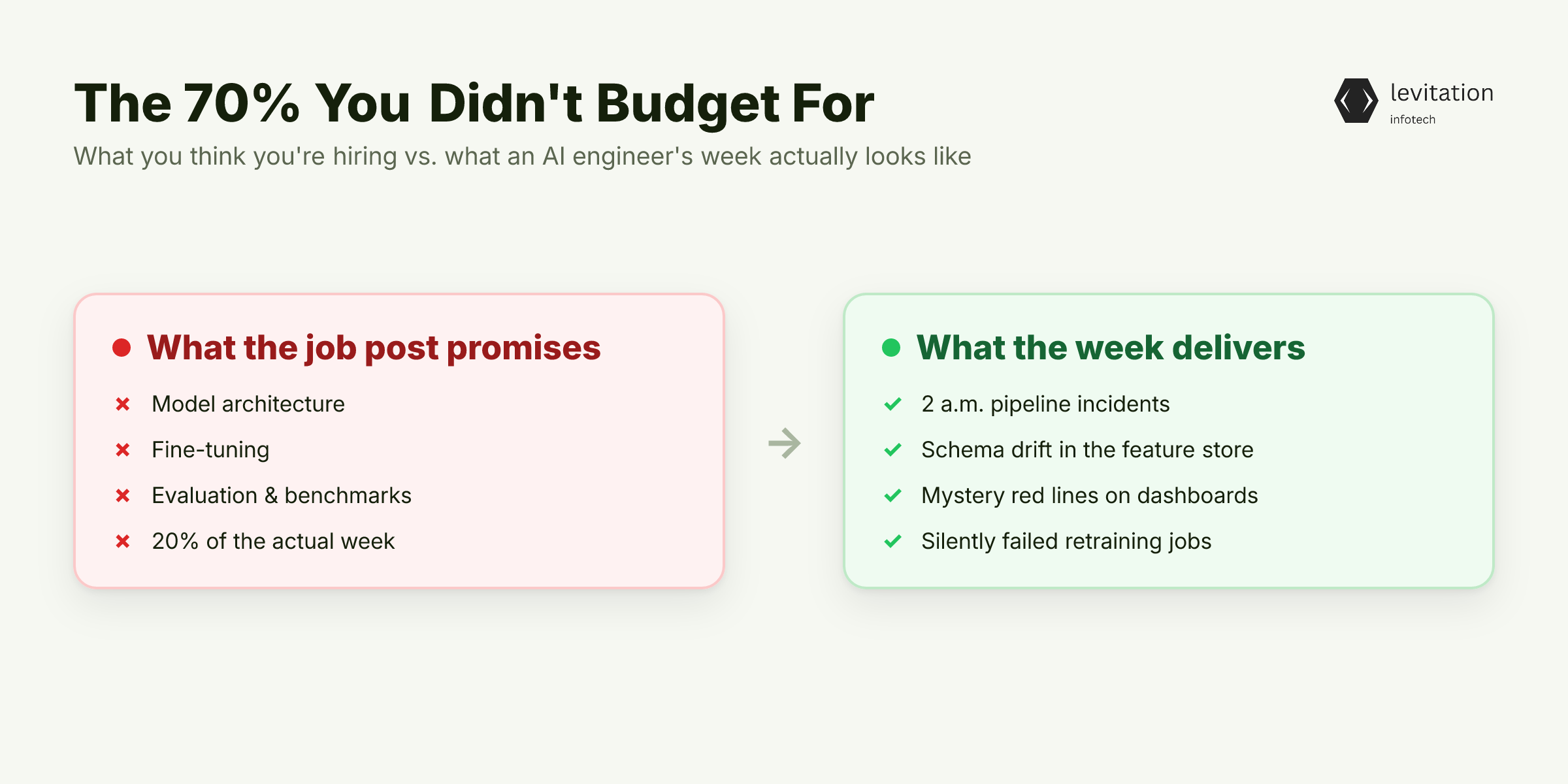
This is exactly what happens when you hire AI developers. You write a job description full of "model architecture," "fine-tuning," and "evaluation." You budget for the headline task. Then the actual week shows up.
The pipeline broke at 2 a.m. Schema drift hit the feature store. A monitoring dashboard shows a red line nobody can explain. The retraining job failed silently. Your senior engineer's calendar is a wall of operational sludge. The 20% of their week that touches actual modeling is what you thought you were paying for.
But the Noida analogy only works if you understand what "plumbing" means inside an AI team, and most founders don't.
What 'Plumbing' Actually Means in an AI Project
Plumbing is every task that keeps a model alive after it ships. Data ingestion from upstream sources. Schema drift handling when a vendor changes a field. Feature stores that recompute correctly when traffic spikes. Model versioning so you can roll back without panic. CI/CD for models, which is nothing like CI/CD for normal software. Monitoring, drift detection, retraining schedules. Cost dashboards, IAM, secret rotation, audit logs, incident response.
None of that is "AI." All of that is what stops your AI from breaking in month three.
The modeling work, including choosing architectures, training, evaluating, tuning prompts, and fine-tuning, is maybe 20-30% of a shipped AI system. The other 70-80% is the plumbing that keeps it alive in production. This is not a controversial claim. It's the reason every serious AI development company staffs MLOps engineers separately from research engineers, and the reason most "AI demos" never survive contact with real users.
When you budget for "an AI developer," you are budgeting for the plumbing, not the intelligence. Most founders don't realize this until the bill arrives. We see the same pattern in our MLOps work. The intelligence is the easy part. Keeping it running is where the cost lives.
If that's true, then hiring a full-time AI engineer is one of the worst unit economics in a startup budget. The math is brutal.
The Unit Economics of an AI Engineer Hire
The salary is the visible line item. The real cost hides underneath. Add overhead for benefits, equipment, and management. Add recruiting costs, which absorb a real share of annual salary for senior AI hires in a tight market. Add 3-6 months of ramp time. The engineer is learning your data, your stack, and your business, producing close to nothing.
Then strip out the plumbing hours. If 70-80% of their week is infrastructure work, you are paying full salary while receiving only a fraction of modeling output. The effective cost per hour of intelligence work climbs far above the headline rate. Most paid hours go to keeping the system alive. That is before you account for context-switching across multiple ongoing pipelines, which fragments whatever focus remains.
Contrast that with a specialized AI software development team where the plumbing is already built and amortized across many clients. Every hour on your engagement goes toward your specific problem, because the platform underneath was solved years ago.
The Rapido-riding Noida engineer who lost his job and could not pay his EMIs is the downside scenario. A single in-house hire is a binary bet. You pay 100% of the cost and get 0% of the output if they leave, get sick, burn out, or take a better offer. You are paying for one body, and one body is fragile.
The teams that survive year three and beyond tend to have one thing in common: systems still running in production five or more years after deployment. The plumbing underneath was engineered to outlast any individual contributor. You don't get that from a single hire at any salary.
So if plumbing is the bulk of the work, the obvious question is: can you buy the plumbing once instead of hiring a full-time plumber?
Unbundling Plumbing From Intelligence
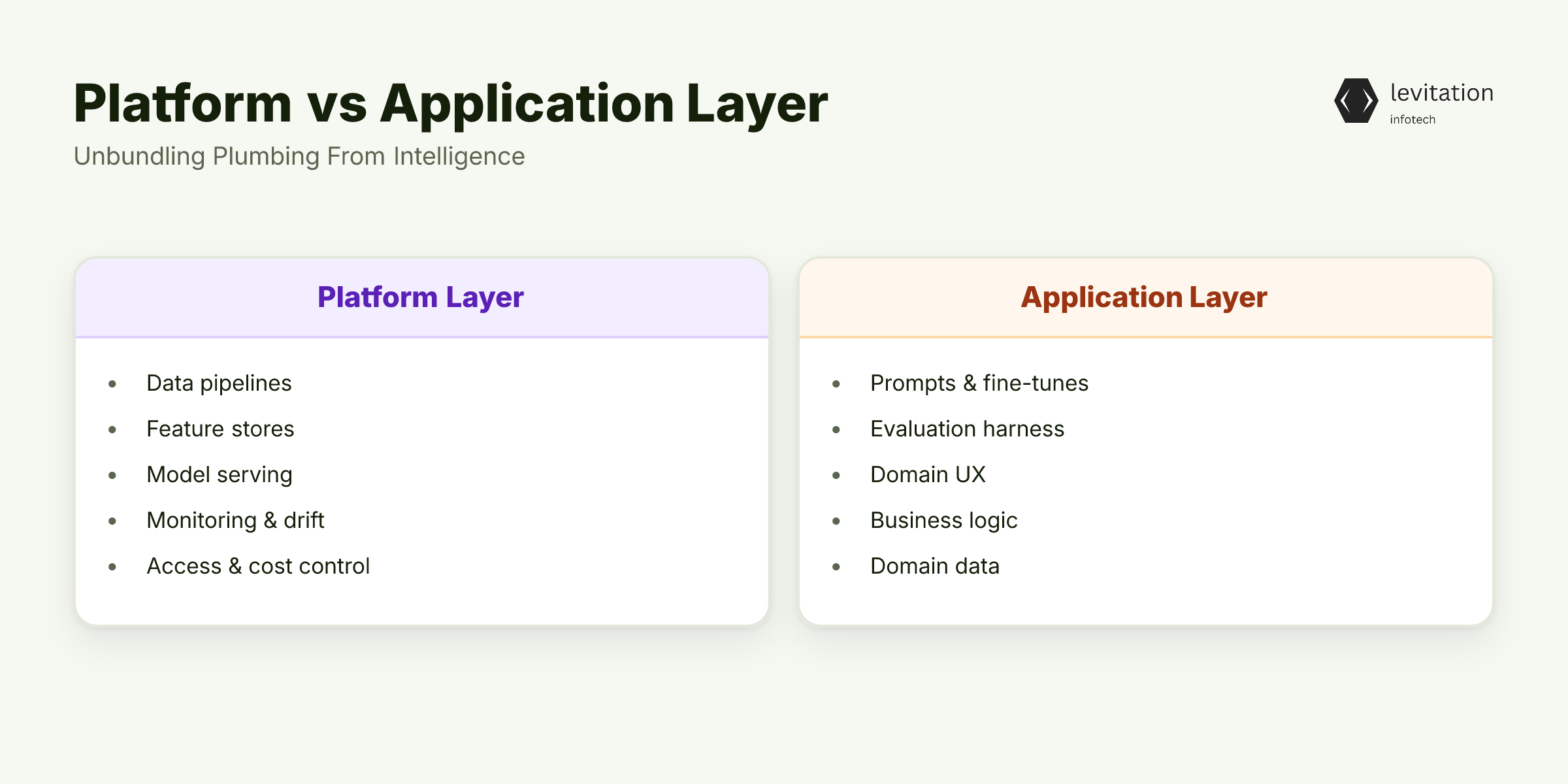
The core insight is simple, and most teams miss it. Separate the platform layer from the application layer.
The platform layer is data pipelines, feature stores, model serving, monitoring, drift detection, retraining, access control, and cost governance. It is the same set of problems every AI team solves, in the same order, with the same tools. It is a solved problem with reusable templates. You should pay for it once, not rebuild it every time you hire a new engineer.
The application layer is your specific use case. Your prompts, your fine-tunes, your evaluation harness, your UX, your domain data, your business logic. This is what differentiates your product. This is what your senior AI engineer's hours should be touching.
This is why enterprise custom AI development shops with mature platforms deploy in 3-6 months. In-house teams take 18-24 months. They have already paid the plumbing tax on previous engagements. Every new client reuses the platform. The speed advantage compounds.
The same logic applies to cost. Our analysis of AI cost overruns shows the teams bleeding money are the ones rebuilding pipelines for every new model. The teams holding their budget treat the platform as shared infrastructure.
That sounds clean in theory. What does it actually look like to restructure your AI team around this split?
How to Restructure Your AI Spend in 3 Steps
Step 1: Audit your last 3 months of AI work. Tag every task as "intelligence" or "plumbing." Intelligence covers modeling, evaluation, prompt design, and fine-tuning. Plumbing covers pipelines, infra, monitoring, dashboards, and on-call.
Most teams discover the majority is plumbing. That number is uncomfortable. Write it down anyway.
Step 2: Outsource or template the plumbing layer. Hand it to an enterprise AI development partner who has already built it. Teams trusted with production AI systems for Fortune 500 brands in India have solved this layer a hundred times. Your in-house team, or your founder hours, should only be touching intelligence. The plumbing should be invisible, maintained, and boring, which is the highest compliment you can give infrastructure.
Step 3: Hire your senior AI engineer against intelligence-only scope. Write deliverables as model performance metrics, shipped features, evaluation reports, and prompt quality scores. Not "maintain the pipeline."
If a candidate's resume is 80% MLOps, you are hiring a plumber and paying a modeler. Both are valid roles. They are not the same salary.
When you do this, what actually changes?
What Changes When You Stop Paying for Plumbing Twice
Your senior AI engineer now spends 80% or more of their week on the work you actually hired them for. Every modeling decision compounds because the plumbing underneath is solid, monitored, and maintained by people whose entire job is plumbing. Their evaluation cycles get faster. Their model quality improves. Their judgment sharpens. You start getting the senior engineer you thought you were paying for all along.
Time-to-production drops from 18-24 months to 3-6 months. You are not rebuilding the same pipelines every new hire sets up from scratch. The platform is a one-time cost, not a per-hire tax.
Your AI system stays alive past year three, year five, and beyond. The plumbing was built to be maintained, not duct-taped together by a 22-year-old who will be on a Rapido in 18 months. Longevity is engineered, not hired.
The Noida engineer's plumbing bill never went down. Yours can. The choice is whether you treat plumbing as a per-person tax or a shared asset.
Teams that get this right often work with a partner who has already absorbed the platform cost. Levitation is one such partner, where every engagement hour goes toward your specific intelligence problem.
Frequently Asked Questions
How much does it cost to hire an AI developer in India?
A mid-level AI engineer's salary in India varies widely by experience, location, and specialization. There is also real overhead for benefits, equipment, and management. Senior AI engineers with production experience are scarce, and the market reflects that scarcity in compensation. The real cost is the ramp time before they ship useful work. It is also the 70%+ of hours that go to infrastructure plumbing rather than AI modeling work.
What is the difference between AI development and MLOps?
AI development covers the intelligence layer, including model selection, training, evaluation, prompt engineering, and fine-tuning. MLOps is the plumbing: data pipelines, model serving, versioning, monitoring, drift detection, and retraining. Most AI project time is spent on MLOps, which is why separating the two changes your unit economics.
Is it cheaper to outsource AI development than hire in-house?
For most startups building their first or second AI system, yes. A specialized AI development partner amortizes plumbing costs across many clients. They can deploy in 3-6 months versus 18-24 months for an in-house team. In-house hiring makes sense once you have a stable production system and ongoing intelligence work that justifies a full-time senior engineer.
How long does it take to deploy an AI system to production?
An experienced AI development team with a pre-built platform layer can deploy a production AI system in 3-6 months. An in-house team building everything from scratch typically takes 18-24 months. They pay the full plumbing tax, including data pipelines, monitoring, CI/CD, and security, before the first model ships.
What does a senior AI engineer actually do day to day?
Roughly 20-30% of a senior AI engineer's week goes to actual modeling, including architecture decisions, training, evaluation, and prompt tuning. The other 70-80% is plumbing. That includes maintaining data pipelines, debugging model serving issues, updating monitoring dashboards, handling schema drift, and responding to production incidents. This ratio is why the "AI engineer" title is often a misnomer for what is really an ML platform engineer.
About the author
Mayank Singh is a software developer at Levitation Infotech, where he builds web and AI-powered applications across the company’s fintech, healthcare, and enterprise projects.