


TL;DR: Seven of ten Indian AI projects silently double in cost by day 90 because quotes cover the build, not the operating layer. Inference at scale, quarterly retraining, and change management each look small alone but compound into a second invoice no one saw coming. The fix is a day-180 budget baked into the day-one SOW, with retraining, inference caps, and exit terms named as line items.
Key Takeaways: - The quote covers the demo. The doubling covers the production system. - Three leaks converge around day 90: inference, retraining, and change management. - Lock retraining and inference as fixed line items, not time and materials. - A cost dashboard beats a model dashboard when the runway is on the line.
The Day-90 Invoice No Quote Mentions
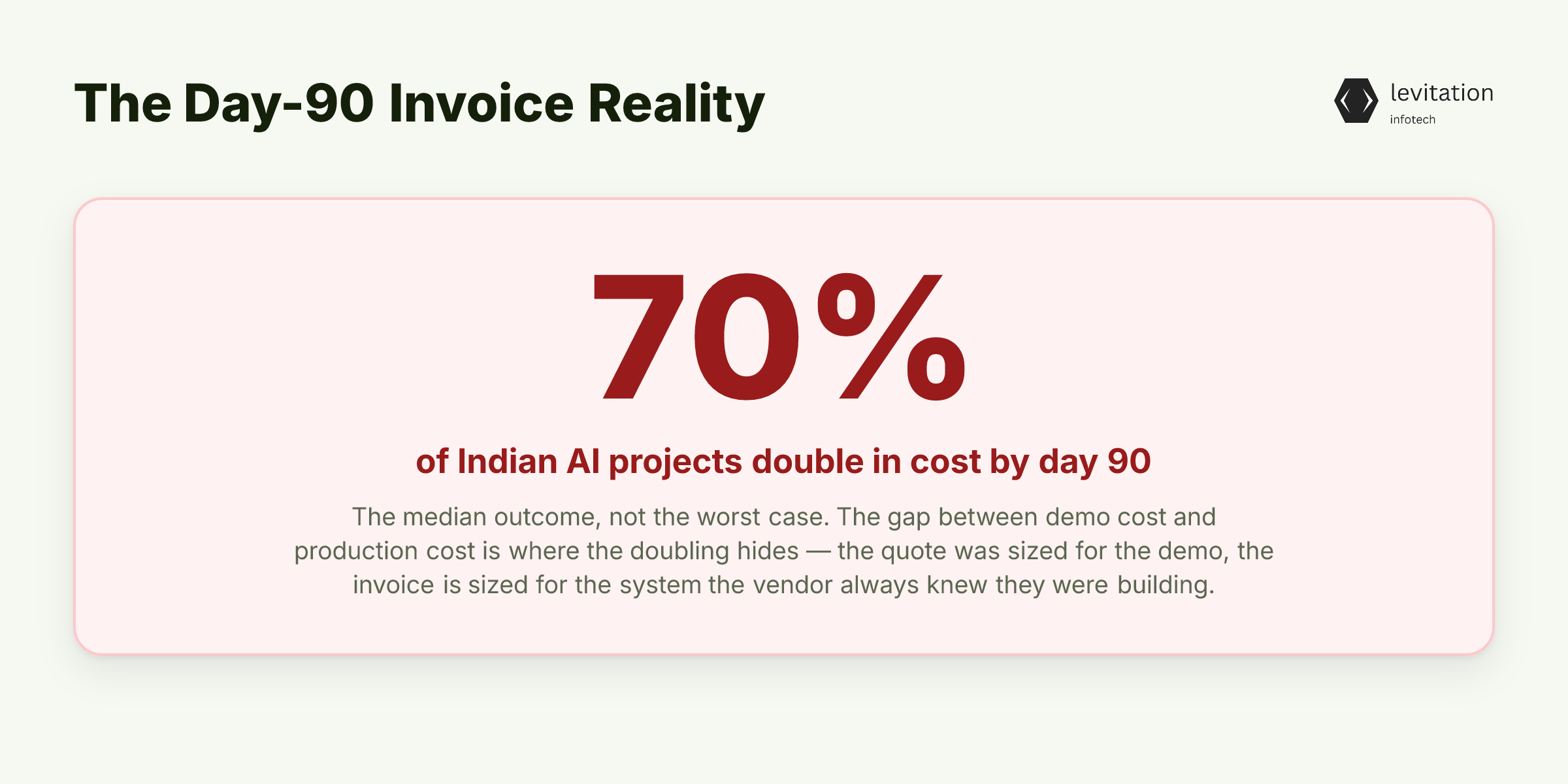
You budgeted 30 lakhs for your AI build. By day 90, the invoice hits 60 lakhs, and the model still isn't in production. You're not unlucky. You're in the 70%.
Seven of ten Indian AI projects double in cost by day 90. That's not a worst-case scenario. It's the median outcome in a market that quotes aggressively, ships fast, and treats production economics as someone else's problem.
The pattern shows up across sectors. A founder signs a 30-lakh SOW. The demo lands in six weeks. The invoice lands three months later, sized for the system the vendor always knew they were building. Switching costs are already too high. The runway just got shorter. We saw the same shape in our earlier work on why AI cost forecasts always break by month 4.
AI development services teams that quote low win deals. Teams that quote realistic lose them to FOMO. The Indian AI market rewards speed and price. Founders reward vendors who tell them what they want to hear.
The gap between demo cost and production cost is where the doubling hides. The demo runs on sample data, a few hundred users, and a single environment. The production system runs on your real data, your real traffic, and a stack the vendor didn't fully scope. Neither side planned for the gap. The same dynamic shows up in why most Indian AI builds triple in cost.
Most founders discover the overrun after the money is committed. The change order arrives with the second invoice. By then the model is half-trained, the team has context, and the next funding round depends on a working AI product. Walking away costs more than paying.
But here's the worse part - the doubling isn't a single missed estimate. It's a pattern hiding in plain sight, and the vendors who quote it know exactly where it lives.
Why Cheap Quotes Become Expensive Projects
AI development cost quotes are built on unknowns. The vendor sees your data only after the SOW is signed. They size integration depth after discovery. They model inference volume based on hopes, not traffic. Every unknown becomes a variable the quote absorbs with a smile, and recoups with a change order.
The infrastructure floor behind serious AI work is real. Research-grade efforts in India start at 10 to 20 lakhs before any product is built. GPU access, vector databases, evaluation harnesses, and the MLOps plumbing to make a model production-grade all cost money the demo never touches. When a quote is half that floor, the gap has to come from somewhere. It comes from your second invoice.
Top generative AI companies in India compete on price. Aggressive pricing hides scope gaps rather than absorbing them. The market punishes vendors who quote the real number. Founders want speed, savings, and a number that fits the deck. The second 50% is structural, not negotiable.
Build quotes cover engineering only. Cloud infrastructure, data preparation, model monitoring, and compliance are line items that arrive later. Build costs scale with system complexity, with standalone features at the low end, custom ML systems in the middle, and production generative AI applications at the high end. None of these quotes include the day-180 operating layer. The same pattern shows up in why generative AI quotes 2.5x in India.
The "we'll figure it out in sprint 2" pattern is the silent killer. Sprint 2 is where inference enters the conversation. Sprint 3 is where retraining gets a line. Sprint 4 is where the cost dashboard becomes a board topic. The 30-lakh quote becomes a 60-lakh invoice because each sprint added scope the original number couldn't hold.
Vendor selection at the quoting stage matters more than the rate card. A vendor who has shipped production systems in regulated environments prices the day-180 bill into the day-1 quote. A vendor who hasn't learned it yet.
So if the quote is already optimistic, where exactly does the second 50% go? It goes into three specific buckets that almost every Indian AI build underestimates.
The Three Cost Leaks That Trigger the Day-90 Spike
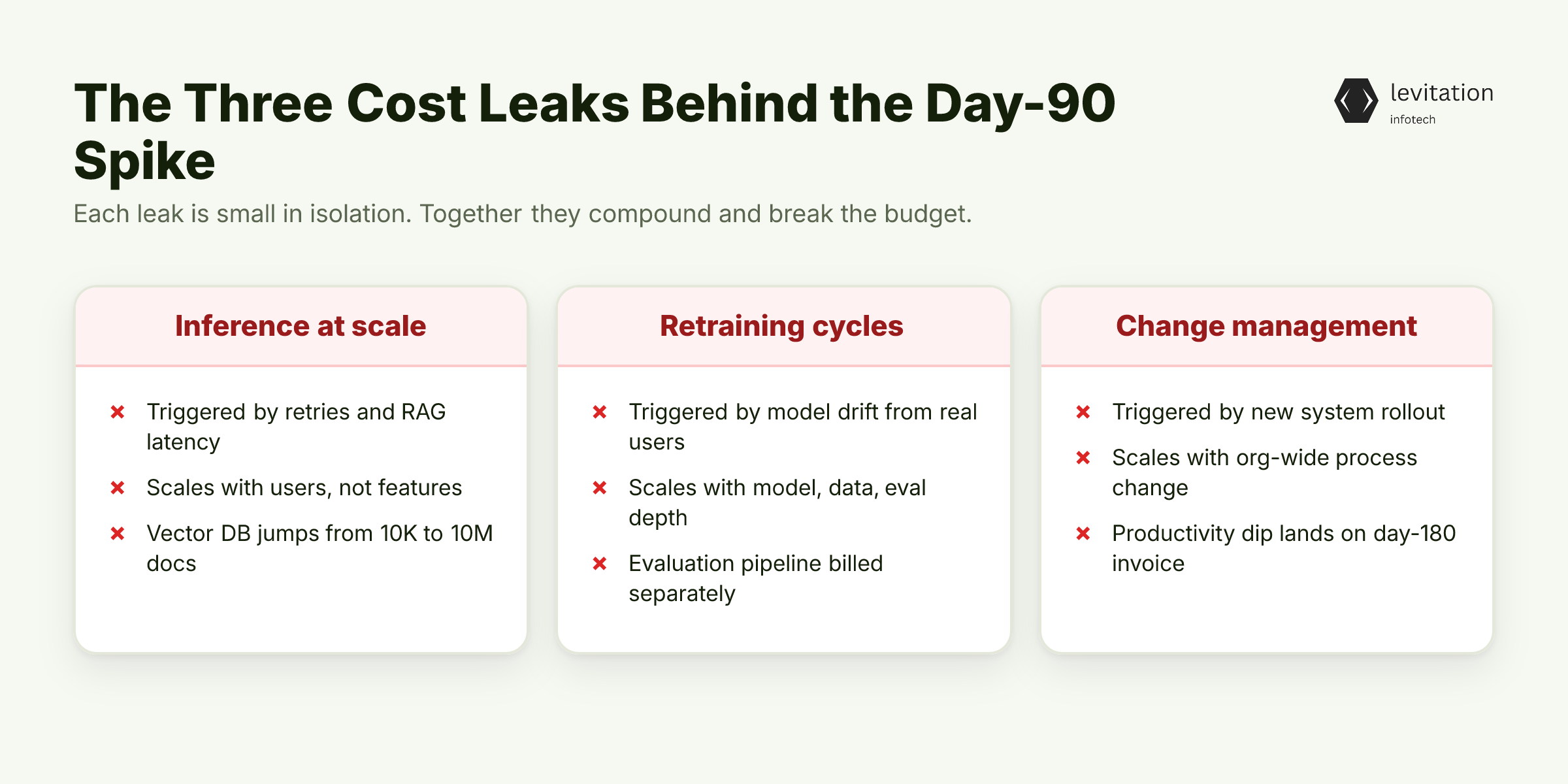
The leaks are structural. Every one of them shows up the moment your AI stops being a demo and starts being a system. Each leak is small in isolation. Together, they break the budget.
Leak 1: Inference at scale. Per-token pricing looks harmless on a vendor's pricing page. It isn't. RAG retrieval adds latency, latency drives retries, and retries multiply tokens. A vector database that handles 10,000 documents behaves very differently from one that handles 10 million. Your bill scales with users, not features. The same pattern burns budgets in GPU autoscaling blind spots and in vector DB overspend. Enterprise AI solutions that ship without per-request cost caps ship a future invoice shock.
Leak 2: Retraining cycles. A production model drifts the day real users touch it. The minimum cadence for a serious model is quarterly, and each cycle is its own line item that scales with model complexity, data volume, and evaluation depth. The evaluation pipeline that decides whether a new model is actually better, and worth the deployment risk, is another line item nobody quotes separately. Stopping the bleed on LLM inference gets you part of the way. Retraining is its own budget line.
Leak 3: Change management. The least visible cost. The engineering team doesn't own it, so they don't include it. Training users, redesigning processes, walking operations through the new system, and absorbing the productivity dip during rollout are costs that rarely make the original SOW but always land on the day-180 invoice. The 15-lakh quote that becomes 40-75 lakhs, which we covered in the year-two bill analysis, is largely change management nobody budgeted for.
All three leaks converge around day 90. That window is the gap between MVP demo and first real user load. The leaks don't add. They compound. A 30% inference overrun plus a 25% retraining overrun isn't a 55% total. It's a budget that breaks the next funding round, because by the time the second invoice lands, you've also absorbed the change management hit you never planned for.
Knowing the leaks is step one. Plugging them before you sign the first SOW is where the savings actually live, and the six moves below turn that gap into a line item you can defend in a board meeting.
How to Build a Day-180 Budget on Day One
The day-90 doubling is not inevitable. It's a planning failure, and planning failures are fixable before the contract is signed. The framework is six moves, in this order.
Lock the contract. Name retraining, monitoring, and inference caps as line items. Not time and materials. Not "to be discussed in sprint 2." Fixed price per retraining cycle. Capped per-request inference cost. Monitoring with a defined SLA. If your AI development services vendor won't write these as line items, the vendor knows the second invoice is coming and doesn't want it in writing.
Set token budgets and cost alerts before the first user call. Per-request token budgets, per-day spend caps, and alert thresholds that page a human when burn rate exceeds plan. Not after the first invoice shock. Before. The same discipline that prevents runaway inference costs prevents the doubling here.
Default to managed inference for the first six months. Self-hosting is a runway killer at low scale. You don't have the GPU ops maturity, and your AI vendor's SRE team isn't covering your bills. Managed inference trades margin for predictability, and predictability is what day-180 budgeting requires.
Insist on a cost dashboard, not just a model performance dashboard. Latency, recall, and accuracy tell you the model is healthy. They don't tell you whether you can afford next month. A production-grade team that ships into regulated environments treats the operating layer as a first-class artifact, not an afterthought.
Build a retirement clause for any model whose per-user inference cost exceeds its budgeted ceiling. Not "we'll optimize later." A defined trigger, a defined date, a defined replacement path. If a model is bleeding margin, kill it on schedule.
Five questions to ask any vendor before signing: - What is the per-cycle retraining cost in writing? - Is inference priced per request, per token, or per month, and at what volume breaks? - Who owns data refresh - us or you? - What are the exit terms, and do we get the model and the infrastructure? - Show me two production deployments in regulated environments and their day-180 cost.
If any answer is vague, the doubling is coming. Vendors who price the day-180 bill into the day-1 quote give crisp answers because they have the data. Teams that have shipped in regulated environments have that data. The rest have a deck, and the difference shows up in the year-two renewal rate.
Run this framework, and the day-90 doubling stops being inevitable. It becomes a planning failure you chose to avoid, and a competitive edge most of your competitors won't have.
What Founders Who Stay on Budget Do Differently
The founders who stay on budget treat AI as a system with operating costs. Not a deliverable with a launch date. The mental model shift changes every downstream decision, from which vendor to hire to which metrics the board sees.
They run quarterly cost reviews tied to model performance, not just product features. Inference cost per user. Retraining cost per accuracy point. Cost per resolved support ticket. These are the metrics that catch drift before it catches the runway. The same principle shows up at the infrastructure layer in our analysis of GPU idle costs.
They buy inference, build differentiation. The inversion most teams miss is treating LLM access as the product. It isn't. The product is what you wrap around the model: the data, the workflow, the guardrails, the integration. When vendors retain clients deep into year two and beyond, that's not a sales metric. It's a planning signal. Vendors who plan for day 180 keep clients past day 365, because the same discipline that prevents the doubling also prevents the churn. Enterprise AI solutions that survive year two are the ones whose day-180 budget matched the day-1 quote.
The compounding advantage is brutal. Under-budget AI projects get re-funded. Over-budget ones get cut, and the founder's next idea dies in the planning stage. Your second AI build is funded by the credibility of your first. The doubling you avoid today funds the experiment you run tomorrow.
Frequently Asked Questions
What is the average AI development cost for a startup in India?
Most Indian AI builds for startups run from narrow feature budgets to full production system budgets, but the day-180 number, including retraining, inference, and monitoring, often lands near double the initial quote. Budget for the second number, not the first.
Why do AI projects cost more than quoted in India?
Three leaks drive the overrun: inference costs at scale, quarterly model retraining as its own per-cycle line item, and change management costs that the engineering quote never included. Quotes usually cover engineering only, not the operating layer that kicks in around day 90.
How can I reduce AI development cost without losing quality?
Use managed inference for the first six months, lock retraining into a fixed line item instead of time and materials, and require a cost dashboard alongside the model dashboard. These three moves together close the gap between the day-1 quote and the day-180 invoice without changing the model.
Is generative AI development more expensive than traditional ML?
Yes, materially. Generative AI adds per-request inference cost (token-based pricing), RAG infrastructure, and guardrail evaluation. A comparable traditional ML system typically costs less to run in production because inference isn't token-priced, but generative AI often wins on user experience and speed to market, which is the trade-off you should price explicitly in the SOW.
What should be in an AI development services contract to prevent cost overruns?
Five named line items: a per-request or per-token inference cost cap, a fixed-price retraining cadence (not T&M), a defined monitoring SLA, a data refresh plan with ownership spelled out, and an exit clause that hands over the model and infrastructure without lock-in. If any of these are missing, the day-90 doubling is likely, and there is no contractual recourse for it.
About the author
Mayank Singh is a software developer at Levitation Infotech, where he builds web and AI-powered applications across the company’s fintech, healthcare, and enterprise projects.