


TL;DR: Fast models can still miss an SLA when queueing, network hops, cold starts, and poor capacity use up the response deadline. Treat inference placement as a deadline-budget contract. Route with measured end-to-end evidence, then activate a quality-gated fallback before useful output is lost.
Key Takeaways: - Model benchmarks do not prove service latency. Trace the complete request and measure tail percentiles. - Geography is a weak routing signal. The remaining deadline is the hard constraint. - Placement becomes an operating policy through endpoint telemetry, routing, fallback, and continuous evaluation.
Your Fast Model Still Misses the SLA
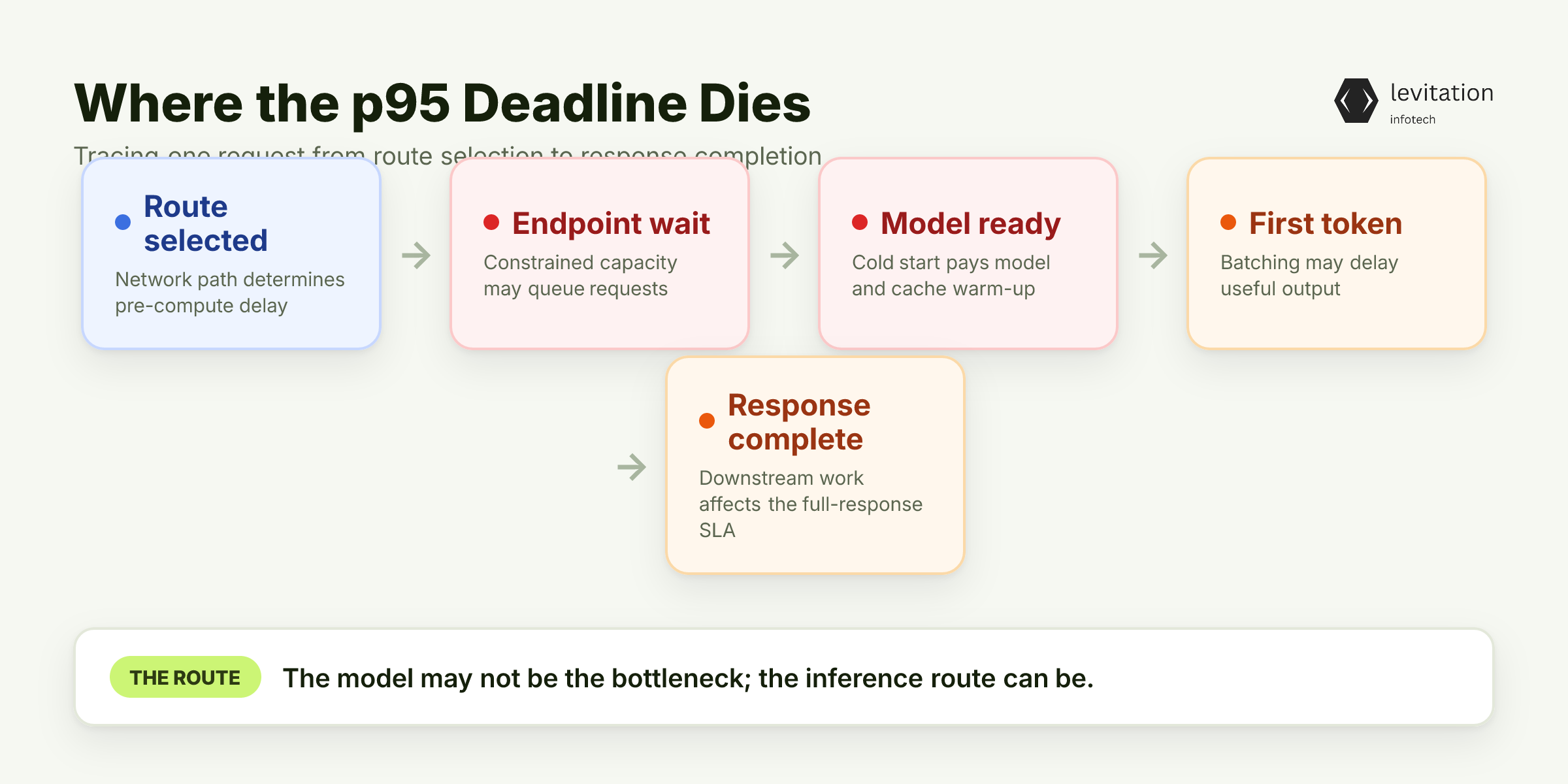
Your model can post excellent generation benchmarks and still miss a customer's p95 time-to-first-token target. The request may take a slow network path, hit a cold endpoint, or land in a capacity pool with no room.
The model may not be the bottleneck. The inference route can be.
A generation benchmark measures token generation at a warm endpoint under controlled batching. A service SLA measures the whole request: queueing, network travel, readiness, first token, completion, and downstream work.
Consider a standard workload with an illustrative p95 time-to-first-token target of 1.5 seconds or less. Its p95 full-response target is six seconds or less.
These figures describe the example, not universal defaults.
Placement failures consume the deadline in a predictable chain: - An extra network hop burns time before compute starts. - A cold endpoint pays model and cache warm-up costs. - A constrained capacity pool queues work behind other traffic. - Unfavorable batching delays the first useful token.
Record the same events for every request:
1{2 "request_id": "req-42",3 "event_order": [4 "route_selected",5 "endpoint_wait_start",6 "model_ready",7 "first_token",8 "complete"9 ]10}
Throughput and average token speed can stay healthy while p95 and p99 latency miss their targets. Failures show up in the tail, where customer-facing deadlines live.
Trace one request across route selection, network transit, endpoint wait, model readiness, first token, and completion. This shows where the deadline died. It also separates model-side inference speed from service speed.
Training throughput measures a different system. AI/ML training may produce a capable model without proving that its deployed route can meet a serving deadline.
The model did not slow down. The route did. So why does sending every request to the nearest region still fail under real load?
Why the Nearest Endpoint Is Not the Fastest
Geography is a weak default. Network topology, congestion, endpoint load, model residency, cache state, and cold starts can reverse geographic order. A nearby edge with poor hardware or low utilization can lose to a healthier regional endpoint.
The same placement problem appears in multi-region AI inference and data residency. Data rules narrow the candidate set. They do not determine which candidate will respond fastest.
One architecture, several placement tiers
Three layers solve different constraints: - Hyperscale cloud: Hosts AI/ML training, model preparation, and batch work that can wait. - Regional data center: Runs large-scale inference with high compute density and controlled network paths. - Edge or on-device: Handles decisions that must happen close to the event or user.
Training wants density. Regional inference wants throughput. Edge inference wants proximity.
Asking which layer wins is the wrong choice. The useful choice is to determine which pipeline stage belongs where and which evidence should govern that decision.
Place each pipeline stage deliberately
Inference is not one indivisible block. Preprocessing, embedding, model execution, KV-cache access, and downstream processing each have different timing and locality needs.
Moving only the model can move the bottleneck somewhere else. A regional embedding lookup may erase the benefit of an edge model. A remote cache can waste more time than model execution.
Can edge placement still win when the endpoint is slow or cold?
Challenge the generic edge recommendation
Edge is not a free latency win. Constrained hardware, low utilization, cold starts, or cache misses can erase network gains. Keep edge only when its complete path passes the acceptance test.
The matrix below uses the illustrative standard-request target, not a universal default.
1placement_matrix:2 interactive_decision:3 usable_output_deadline: before_next_user_action4 data_location: source_local_or_approved_edge5 transfer_size: bounded_by_deadline6 model_size: fits_endpoint_memory7 quality_requirement: fixed_task_floor8 cache_affinity: session_local9 expected_endpoint_state: warm10 connectivity_loss_behavior: local_completion11 cost_priority: after_deadline_and_quality1213 standard_customer_request:14 usable_output_deadline: "p95_ttft<=1500ms; full_response<=6000ms"15 data_location: approved_region16 transfer_size: bounded_by_regional_path17 model_size: fits_regional_capacity18 quality_requirement: approved_primary_tier19 cache_affinity: session_or_tenant_affine20 expected_endpoint_state: warm21 connectivity_loss_behavior: nearby_approved_region_if_permitted22 cost_priority: secondary_to_slo2324 deferred_batch:25 usable_output_deadline: agreed_delivery_window26 data_location: approved_region27 transfer_size: larger_transfers_allowed28 model_size: batch_capacity29 quality_requirement: workload_specific_floor30 cache_affinity: low31 expected_endpoint_state: scheduled_capacity32 connectivity_loss_behavior: retry_or_resume33 cost_priority: primary_after_feasibility
Assign a location to each workload and acceptance condition. Do not assign one location to an entire application by default. If distance is not a dependable proxy, what can tell the router whether a request can still finish in time?
Make Placement a Deadline-Budget Contract
A placement contract starts with the usable-output deadline, not a region name. At minimum, total latency breaks down as follows:
1total_latency = network_hop_time + cache_warmup_time + compute_time
Use this as the minimum decomposition. Production tracing must also expose queue wait, preprocessing, embedding, downstream work, and model-server overhead.
Track time-to-first-token and full-response time separately. One route can start quickly and still miss completion. Another can generate quickly but deliver its first token too late.
Classify work by deadline
Create explicit workload classes: - Real-time interactive: Output affects the next user or machine action. - Standard customer-facing: Output supports a customer workflow under an agreed SLA. - Deferred or batch: Output must arrive within a delivery window, not an interaction deadline.
Each request then carries a machine-readable placement contract:
1{2 "request_id": "req-42",3 "workload_class": "standard_customer",4 "model_version": "customer-assistant-v3",5 "deadline_ms": 6000,6 "first_token_deadline_ms": 1500,7 "quality_floor": "customer-task-eval-v3",8 "approved_quality_tiers": ["primary"],9 "allowed_locations": ["approved-region-a", "approved-edge"],10 "data_policy": "approved-data-zones",11 "fallback_class": "approved_local_small",12 "cost_policy": "optimize_after_slo"13}
How should the router enforce these classes and constraints?
Apply constraints in a deliberate order
- Reject routes that fail data policy, quality, model compatibility, or deadline feasibility.
- Among feasible routes, prefer measured tail latency and availability.
- Use accelerator utilization, token cost, and egress cost only as secondary tie-breakers.
An SLO is the internal engineering target. The contractual SLA keeps margin for traffic the internal target does not model. Do not treat the contractual number as a retry threshold.
Use p95 and p99 as routing evidence. Keep averages for utilization and capacity planning. SLA-aware inference succeeds when the route preserves the required probability of meeting the deadline.
Placement becomes controllable when each candidate route can complete the task before its deadline. A budget identifies the deadline, but traffic needs an executable policy.
That policy must survive slow starts, congestion, and endpoint failure. How do you turn it into one?
Route by Deadline, Not Geography
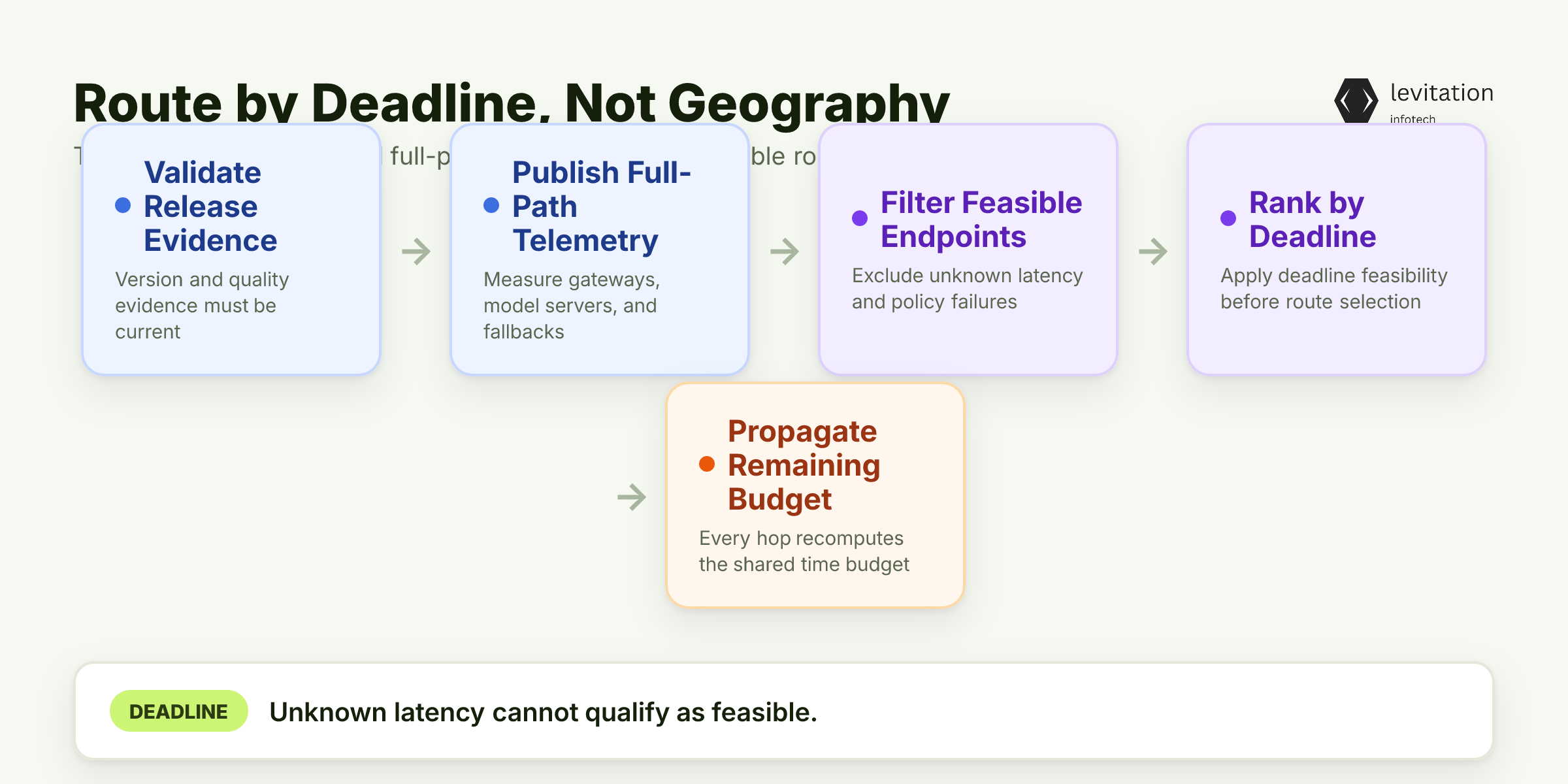
A registry turns placement into executable policy. A model released through AI/ML training must update its version and quality evidence before the router sees it.
1endpoints: - endpoint_id: regional-primary2 model_version: customer-assistant-v33 location: approved-region-a4 supported_workload_classes: [standard_customer]5 quality_tier: primary6 endpoint_state: warm7 available_capacity: true8 data_policy_ok: true9 cache_affinity: session-affine10 ttft_p95_ms: null11 ttft_p99_ms: null12 full_response_p95_ms: null13 full_response_p99_ms: null14 cost_per_1k_tokens: null
Publish these values only from full-path telemetry under current load. Null means unknown, and unknown cannot qualify as feasible.
Telemetry must include gateways, model servers, and fallback paths. The inference orchestrator P99 blind spot appears when control-plane metrics exclude the real serving path.
Schedulers, gateways, model servers, and fallback handlers must receive the same remaining-time budget. Each hop should recompute that budget. Otherwise, one layer can preserve its timeout while destroying the request deadline.
Filter candidates before ranking them
This Python function applies the required decision order:
1def select_route(request, endpoints):2 eligible = []34 for endpoint in endpoints:5 if endpoint["model_version"] != request["model_version"]:6 continue7 if endpoint["location"] not in request["allowed_locations"]:8 continue9 if endpoint["quality_tier"] not in request["approved_quality_tiers"]:10 continue11 if request["workload_class"] not in endpoint["supported_workload_classes"]:12 continue13 if not endpoint["available_capacity"] or not endpoint["data_policy_ok"]:14 continue15 if endpoint["ttft_p95_ms"] is None:16 continue17 if endpoint["full_response_p95_ms"] is None:18 continue19 if endpoint["ttft_p99_ms"] is None:20 continue21 if endpoint["full_response_p99_ms"] is None:22 continue23 if endpoint["cost_per_1k_tokens"] is None:24 continue25 if endpoint["ttft_p95_ms"] > request["first_token_deadline_ms"]:26 continue27 if endpoint["full_response_p95_ms"] > request["deadline_ms"]:28 continue29 eligible.append(endpoint)3031 if not eligible:32 raise RuntimeError("No deadline-feasible inference endpoint")3334 return min(35 eligible,36 key=lambda endpoint: (37 endpoint["ttft_p99_ms"],38 endpoint["full_response_p99_ms"],39 endpoint["cost_per_1k_tokens"],40 ),41 )
Cheap placement cannot win before quality and feasibility pass. The selected route then streams under its own first-token deadline.
What if the chosen route stalls before it sends a token?
Fall back before useful output is lost
1dynamic_fallback:2 trigger: no_first_token3 threshold_ms: 8004 primary_action: cancel5 fallback_endpoint_class: approved_local_small6 quality_gate: approved_task_eval
In this example, the primary model has not emitted its first token within 800 ms. Cancel it and fail over to a smaller, faster local model. The 800 ms trigger is configurable and must come from the workload SLA.
Guard fallback quality with task-specific evals. The fallback model must pass the minimum quality floor before it can serve traffic. A fast incorrect answer does not satisfy the business SLA.
This is why LLM evals that approve failing models remain dangerous.
Use retry budgets and circuit breakers so retries cannot consume the remaining deadline. Make fallback decisions before partial output creates an inconsistent response.
Log every decision: - Decision record: Request ID, selected endpoint, candidate set, and rejection reasons. - Timing record: Queue wait, network time, warm-up time, first-token time, and completion time. - Model record: Model version, fallback trigger, and incurred cost.
After deadline feasibility and quality are secured, optimize utilization, token-generation cost, and egress cost. The router can make a policy-compliant choice and still select the wrong endpoint. That happens when telemetry does not reflect the real path. How do you prove the placement works before production?
Test the Full Inference Path
Placement must be tested at the workload level. Require evidence for output quality, usable response time, data handling, operating cost, and behavior during unavailability.
An access-network label such as 5G does not prove that an edge endpoint is close enough. Measure the complete proposed path under intended operating conditions.
1evaluation_matrix:2 dimensions:3 workload_class: [interactive, standard_customer, deferred]4 endpoint_location: [approved_hyperscale, approved_regional, approved_edge, on_device]5 endpoint_state: [warm, cold]6 utilization: [representative_load_bands]7 model_version: [approved_candidates]8 network_path: [intended_paths]9 fallback_mode: [primary, local_small, regional_fallback]10 acceptance:11 latency: [ttft_p95, ttft_p99, full_response_p95, full_response_p99]12 quality: task_specific_floor13 data_handling: policy_pass14 outage_behavior: within_deadline
Accept a route only when its p95 and p99 first-token and full-response results pass. Pair timing with output evals so a faster, lower-quality route cannot win by default.
Exercise each failure independently: - A slow first token triggers the approved fallback. - Endpoint saturation moves work before the deadline expires. - Cache warm-up remains inside the route's latency budget. - Network degradation produces a defined response. - Primary-model unavailability invokes an eligible fallback.
Validate the fallback model independently on the same task and prompt set. Then validate the failed-over response end to end. Routing can change context handling as well as latency.
Roll out evidence in stages:
- Establish the current placement baseline.
- Test candidate placements under representative load.
- Canary the routing policy with bounded traffic.
- Compare production behavior with the placement contract.
Model promotion through AI/ML training does not approve a serving route. Promotion and placement acceptance remain separate decisions.
Once placement is measured per workload, it stops being a one-time infrastructure choice. Who owns that capability when the model, endpoint, and network all change?
The Payoff: SLA-Aware Inference at Runtime
Placement becomes a measured, continuously governed routing policy. The platform team owns the evidence that each route can meet its contract.
1placement_governance:2 owner: inference-platform3 review_triggers: - model_promotion - endpoint_change - routing_change - network_change4 required_evidence: - quality_floor - deadline_feasibility - tail_latency - fallback_behavior - cost_evidence
Training, model promotion, endpoint readiness, routing policy, and fallback evaluation must stay connected. Otherwise, each team can optimize its own layer.
That shared system must survive the next model, endpoint, or network change. Start with one workload, then make its deadline the test for every route change.
About the author
Mayank Singh is a software developer at Levitation Infotech, where he builds web and AI-powered applications across the company’s fintech, healthcare, and enterprise projects.