


TL;DR: AI replaced per-seat software with per-call inference pricing, and most finance teams are still budgeting the old way. The teams that get ahead model cost per outcome, tag every endpoint, and run a six-week production audit before signing multi-year contracts.
Key Takeaways: - Inference now absorbs roughly 85% of enterprise AI spend, up from 20% in 2023, because the variable cost of every model call scales with product success. - Agents multiply model calls by 10x to 20x per task, so a product that piloted cheaply in dev can scale to tens of thousands of dollars per month in production. - Cost per outcome, not cost per seat, is the unit finance needs to see before the next production invoice arrives.
The $400 Seat Disappeared. Nobody Told Finance.
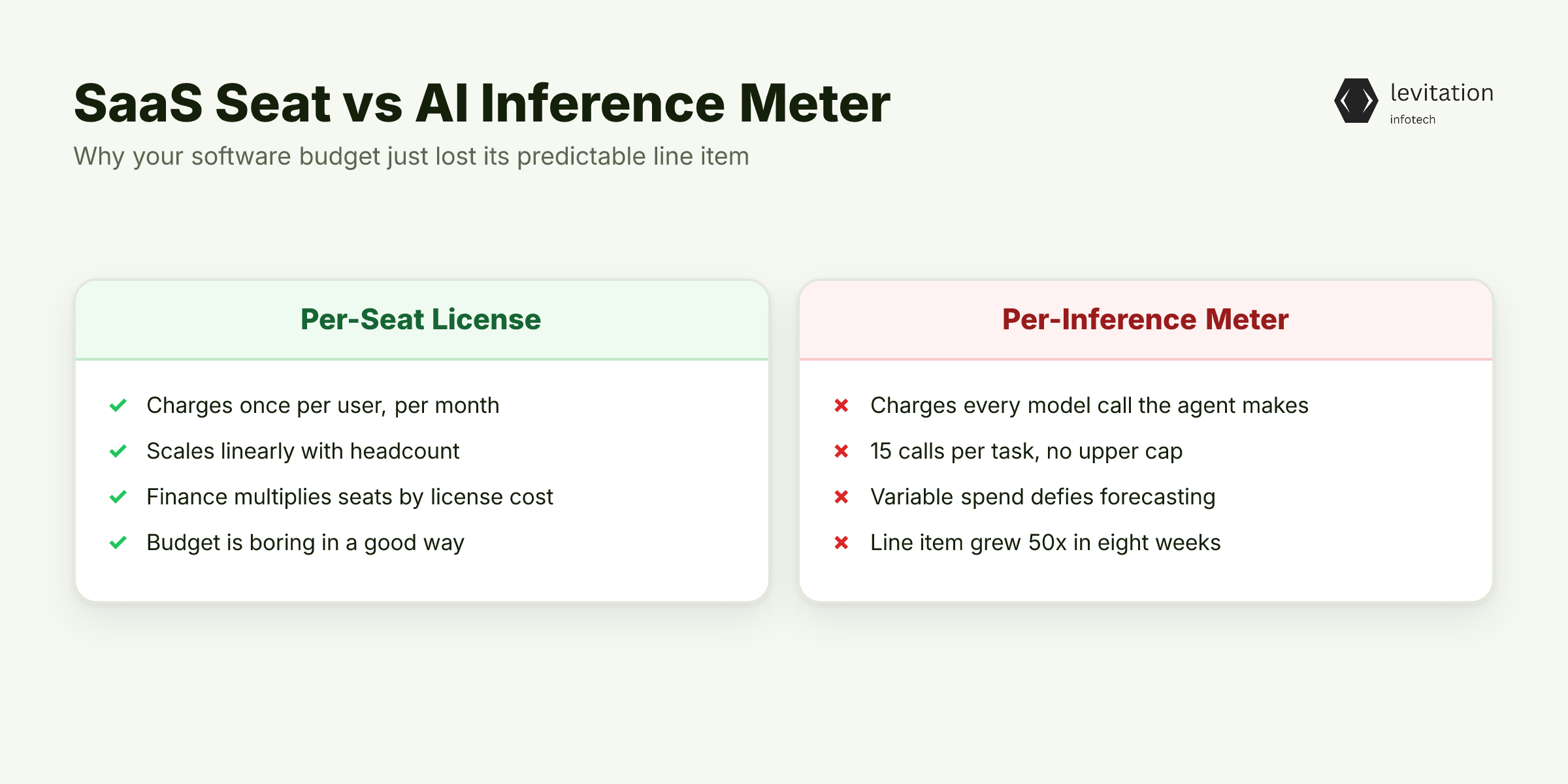
You fired three SaaS vendors this quarter. You celebrated the savings. What you didn't notice: the agent replacing those seats makes 15 model calls per task. Your CFO just flagged a line item that grew 50x in eight weeks.
Per-seat pricing made software budgets boring in a good way. A finance lead could multiply seats by license cost and call it a quarter. That math is dead.
AI agents now absorb the work human seats used to do. A third of enterprises are quietly building internal tools instead of renewing SaaS contracts. The vendors that survive this shift are pivoting fast.
They charge per resolved ticket, per processed transaction, per generated report. The license didn't shrink. It morphed into a meter that runs every time a model thinks. AI just repriced your SaaS contract, and most renewal clauses were never written to handle it.
This is the part finance teams miss. The variable cost of inference replaces the predictable cost of a license. There is no upper bound.
A seat charges once. A model call charges as many times as the agent decides it needs to reason, verify, or self-correct. Enterprise AI solutions that model this as a per-seat replacement will under-budget by an order of magnitude within two quarters of launch.
The CFO saw the seat count drop and assumed the software line got cheaper. That's when the production invoice arrived.
Your $200 Pilot Became a $10,000 Production Bill
One team documented it cleanly. The bill was $200 a month during development. It hit $10,000 a month the moment real users reached the endpoint. That is a 50x jump with no model change, no vendor change, and no headcount change. The same pattern shows up in why production costs 47x more than the pilot across industries.
The cause is consistent enough to name. Prompts are uncontrollable. Phrases written by end customers and internal employees swing token count wildly.
A question phrased politely with full context costs more than a terse command. You can't enforce a style guide on a customer typing into a chat box. You can't predict which inputs your employees will send on a Tuesday afternoon. Your AI/ML training set shaped the model. Production traffic shapes the bill.
The budget shape is shifting too. In 2023, AI budgets were roughly 20% inference. As of 2026, inference is about 85% of the AI line item. Global spend on inference crossed $50 billion, exceeding training for the first time.
Training is a down payment. Inference is the mortgage, and it compounds with every product win.
That 50x jump wasn't a model problem. It was a usage-shape problem, and the shape changes again the moment you ship an agent.
The Agent Call Multiplication Problem Nobody Warned You About
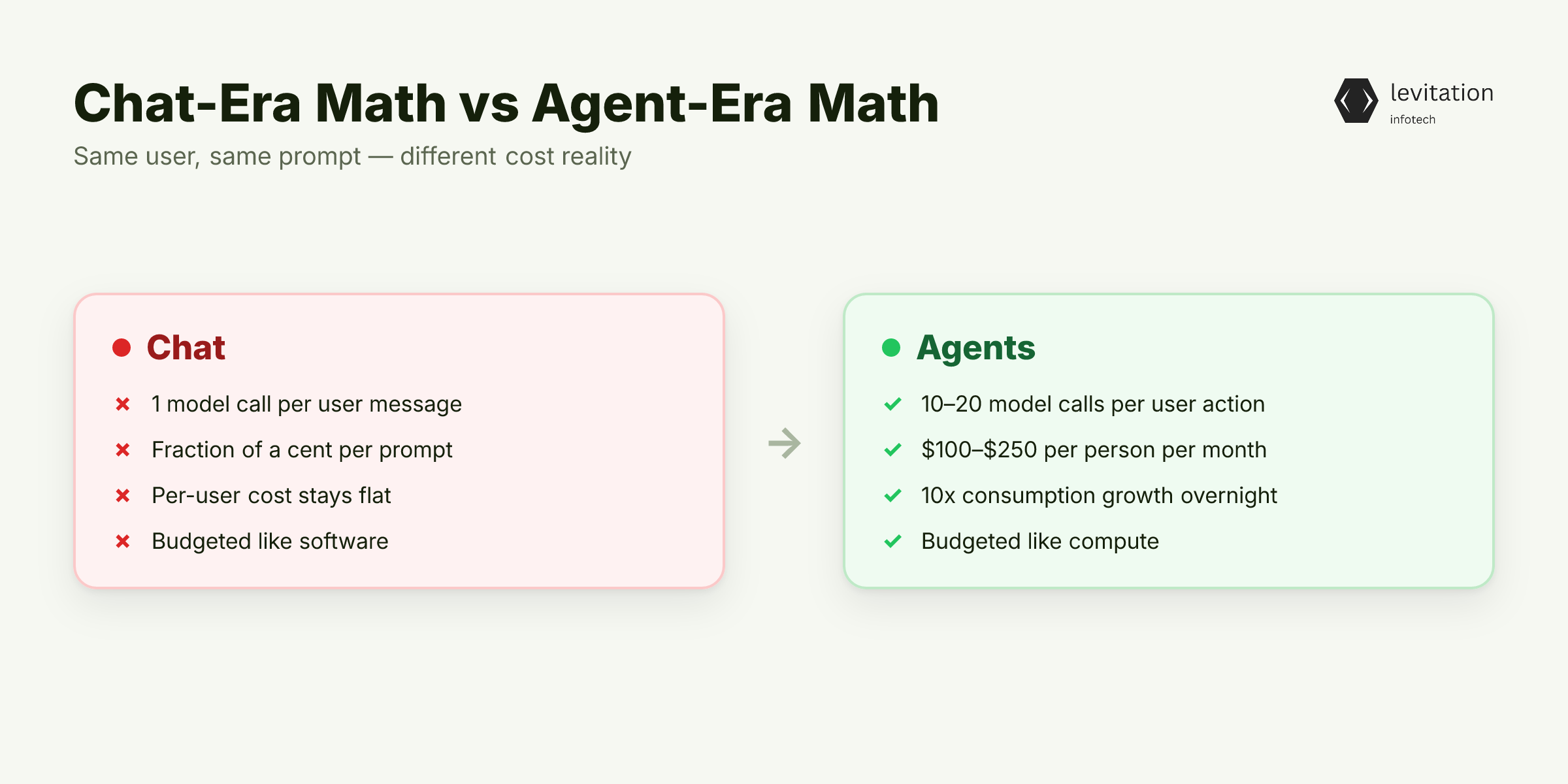
A chatbot burns one model call per user message. An agent completing the same task reasons through the problem. It calls external tools, verifies the result, and self-corrects if something looks wrong.
That loop is 10 to 20 model calls for one user action. The same prompt that cost a fraction of a cent in chat now costs real money. Multi-agent LLM architectures cost 4x more than modeled for exactly this reason.
The enterprise AI platform you built for chat is not the platform you run when agents ship. The numbers land hard. Heavy agentic users sit at $100 to $250 per person per month.
Headcount didn't change. Vendor pricing didn't change. Teams that piloted with chat and shipped with agents watched consumption grow 10x overnight. The board sees a feature launch. Finance sees a new cost line.
Unlike the seat model, there is no per-user ceiling on cost. There is only a per-task ceiling, and most teams have no idea what their per-task cost actually is.
The compounding effect is what kills budgets. A user who triggered one call per session now triggers fifteen. Multiply that across your active base. Then add the verification calls the agent makes on its own. The monthly bill stops looking like software spend.
It looks like compute spend. It behaves like compute spend. It should be budgeted like compute spend, but almost no one is doing that yet, and the gap between seat-era thinking and call-era reality widens with every shipped feature.
Multiplication explains the bill. But the bill is driven by a handful of technical knobs most CFOs have never seen. Those knobs are the only levers you actually control.
What Actually Drives an Inference Bill
Every prompt and every generated token incurs compute cost. Cost scales with volume and throughput, which is the part most budgets capture. The part they miss is why throughput itself collapses under load.
Tracking LLM costs from 100K to 100M tokens shows the curve is not linear. The reason sits inside the model. Context length is the silent killer.
Transformer attention is quadratic. Doubling the context window quadruples the compute, it doesn't double it. Longer contexts force the model to hold more in KV cache, which inflates GPU memory and slows throughput per request.
A product that ships with a 4K context window costs a fraction of one that ships with 32K. That ratio grows as concurrent users climb. The details of transformer architecture and inference optimization show up directly on the invoice.
Three knobs move the per-token price by 3x to 10x: - Model size: a frontier model costs several times a fine-tuned small model per token. - Runtime efficiency: batching strategy, speculative decoding, and KV cache management change throughput without changing the model. - Hardware choice: purpose-built inference silicon often beats general GPUs at lower cost per request, but only at scale.
Unit cost of inference is falling. That is real. But total consumption is rising faster, so the bill climbs even as the rate drops. The teams winning this aren't paying less per token.
They're shipping features whose value per token justifies the spend, and they measure it that way. Knowing the knobs is not the same as controlling them. The next question is what to put in front of the board before you sign a production contract.
Modeling True AI TCO Before You Sign the Check
The first move is to stop reviewing cost per seat and start reviewing cost per outcome. Resolved ticket, processed claim, generated report, underwritten loan. Whatever the agent ships as its final output is the unit finance should see monthly.
A line item that grows 40% stops looking like a problem when each resolved ticket costs $0.11. The product retains users at that price. The number goes from a complaint to a shipping decision. Enterprise AI solutions that surface per-outcome cost in the same dashboard as the feature roadmap change the conversation entirely.
About the author
Mayank Singh is a software developer at Levitation Infotech, where he builds web and AI-powered applications across the company’s fintech, healthcare, and enterprise projects.