


TL;DR: Multi-agent LLM architectures run about 4x the cost projected in spreadsheet models. The gap is structural, not a token pricing surprise. The real culprit is a hidden infrastructure stack: observability, evaluation, security, and alignment. It also includes compounding agent loops that finance never sees. These hidden costs sit underneath the visible token spend. As a result, the question shifts. It shifts from "can we afford it" to "which use cases earn the 4x premium."
Key Takeaways: - The 4x cost gap comes from agent loop compounding and a hidden cost stack, not from frontier model token pricing alone - Cutting agent count to save money collapses quality, because the real cost driver is iteration depth per task - Adaptive routing matches model tier to query difficulty and cuts cost with minimal quality loss - The 4x premium earns its ROI on multi-domain tasks (helpdesk, support, legal review, manufacturing QC) and fails on single-domain work
The 4x Multiplier Nobody Warned You About
Your cost model projected a comfortable monthly figure for that multi-agent rollout. Eight weeks into production, the bill is several times higher. Finance wants answers you don't have. Sound familiar?
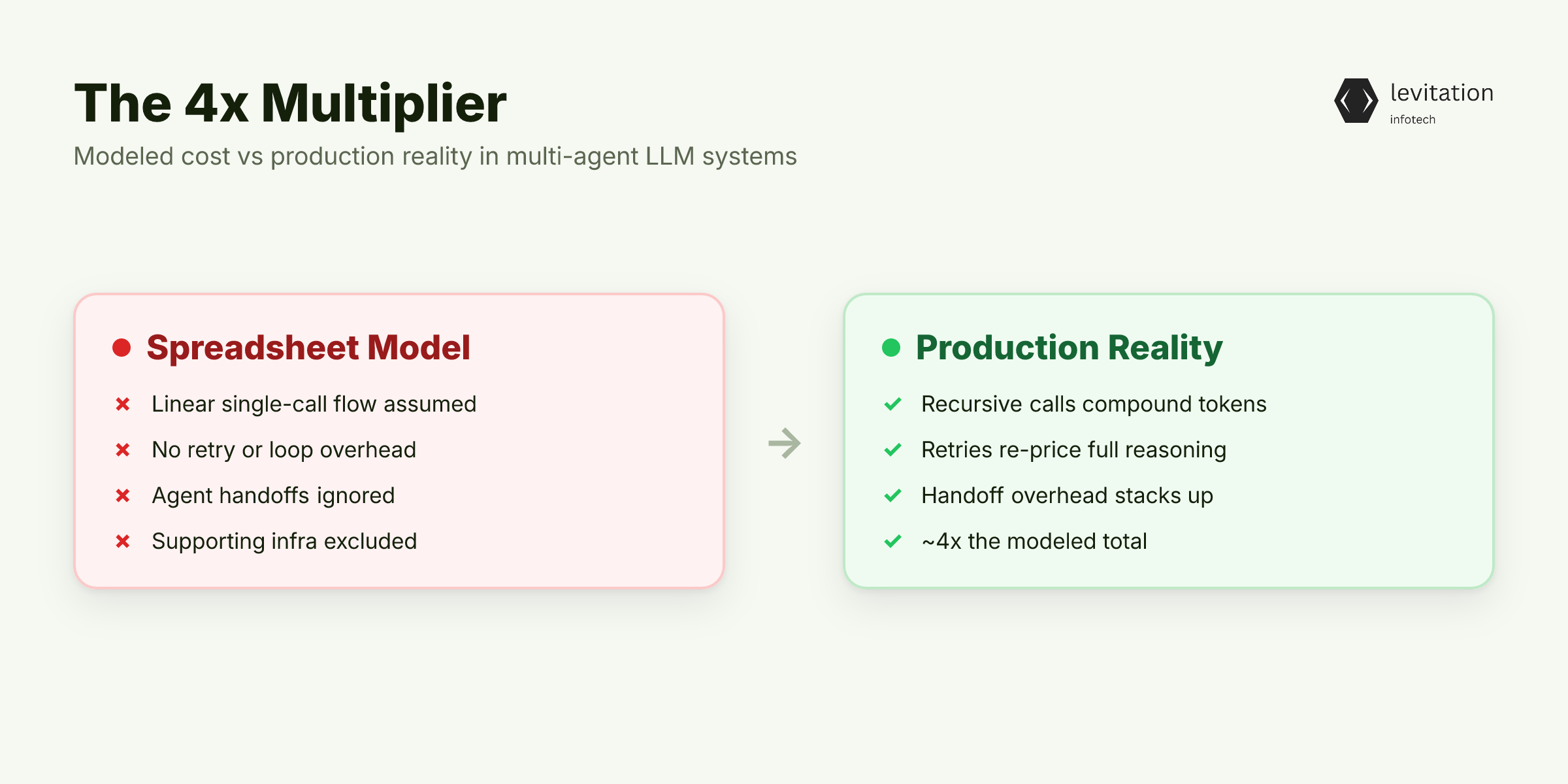
Multi-agent LLM architectures often run about 4x the modeled cost in production. The gap is not a token pricing surprise. Spreadsheets miss the agent loops and the handoff overhead. They also miss the supporting infrastructure that every production system carries.
Frontier models are the largest single cost driver. An agent loop may call GPT-5, Claude Opus 4.7, or Gemini 3.x on every iteration. The per-token cost compounds through recursive calls. Each retry re-prices the full reasoning pass. So a system that looks linear in a spreadsheet behaves very fast at runtime. We have seen this before. It happened in fintech AI deployments where cost forecasts broke well ahead of plan. The root cause was the same under-modeling of iteration depth.
The token math isn't where the surprise hides. Instead, the surprise starts with a false view of what multi-agent architecture does at runtime.
Why "Just Use Fewer Agents" Makes the Problem Worse
The first instinct when costs blow up is to cut headcount. In a multi-agent system, that means combining agents. However, the instinct is wrong.
Multi-agent architectures exist because single agents fail at tasks that need special reasoning, retrieval, and validation. A generalist agent asked to draft a legal review, retrieve case law, and check compliance against policy will underperform. It will underperform on all three tasks.
Role separation is the same base design that makes distributed systems work in non-LLM software. When you collapse agents, you collapse quality. The system then makes up for it with retries, longer context windows, and more iterations. As a result, costs go up, not down.
The real cost driver is iteration depth per task. It is also the quality threshold that triggers re-runs. A validation agent that fails its first pass triggers a regeneration loop. It burns tokens at twice the planned rate. This compounds across the system. When teams combine special agents, the remaining agents take on work they were never tuned for. Quality drops then trigger more re-runs. So bills climb higher, not lower.
The 4x gap is mostly iteration depth, not seat count. The token economics inside each loop also compound faster than linear math suggests.
The Token Economics Compounding Problem
Linear cost math is the enemy. Multiple agents in a pipeline do not cost a simple multiple of a single agent. They cost far more at high iteration depth, and here is why.
Each agent-to-agent handoff re-sends the full context window. The reasoning agent's output becomes input to the validation agent. The validation agent's output feeds back to the orchestrator. Tokens flow forward and backward at every step. The context keeps growing as a result.
A pipeline that looks like a small number of LLM calls in a diagram triggers more at runtime. Many more, in practice.
Agent loops are recursive. Consider a reasoning agent that calls a retrieval agent twice and a validation agent once. That setup means multiple inference rounds for one user request, not one. Add a quality check that triggers a re-run, and the count doubles. By the time a single user query resolves, you often spend the token budget of several simple requests.
We tracked LLM costs from 100K to 100M tokens and the curve is steep. The link between volume and cost is closer to geometric than arithmetic.
Frontier model pricing magnifies the effect. When a validation agent falls back to a frontier model "just to be safe," every fallback counts. It is a budget event. The per-token delta between frontier and mini models is large. This is the most common cost leak in multi-agent systems, and it is invisible until the bill arrives.
Adaptive routing changes the math. Picking model tier and sample count based on query difficulty produces cost cuts with minimal quality loss. The pattern is simple: send simple queries to mini models, and reserve frontier models for reasoning-heavy paths. The savings are structural, not small.
Token costs are only the visible layer. The invisible stack (observability, evaluation, security, alignment) is where budgets actually break.
The Hidden Cost Stack You Never Modeled
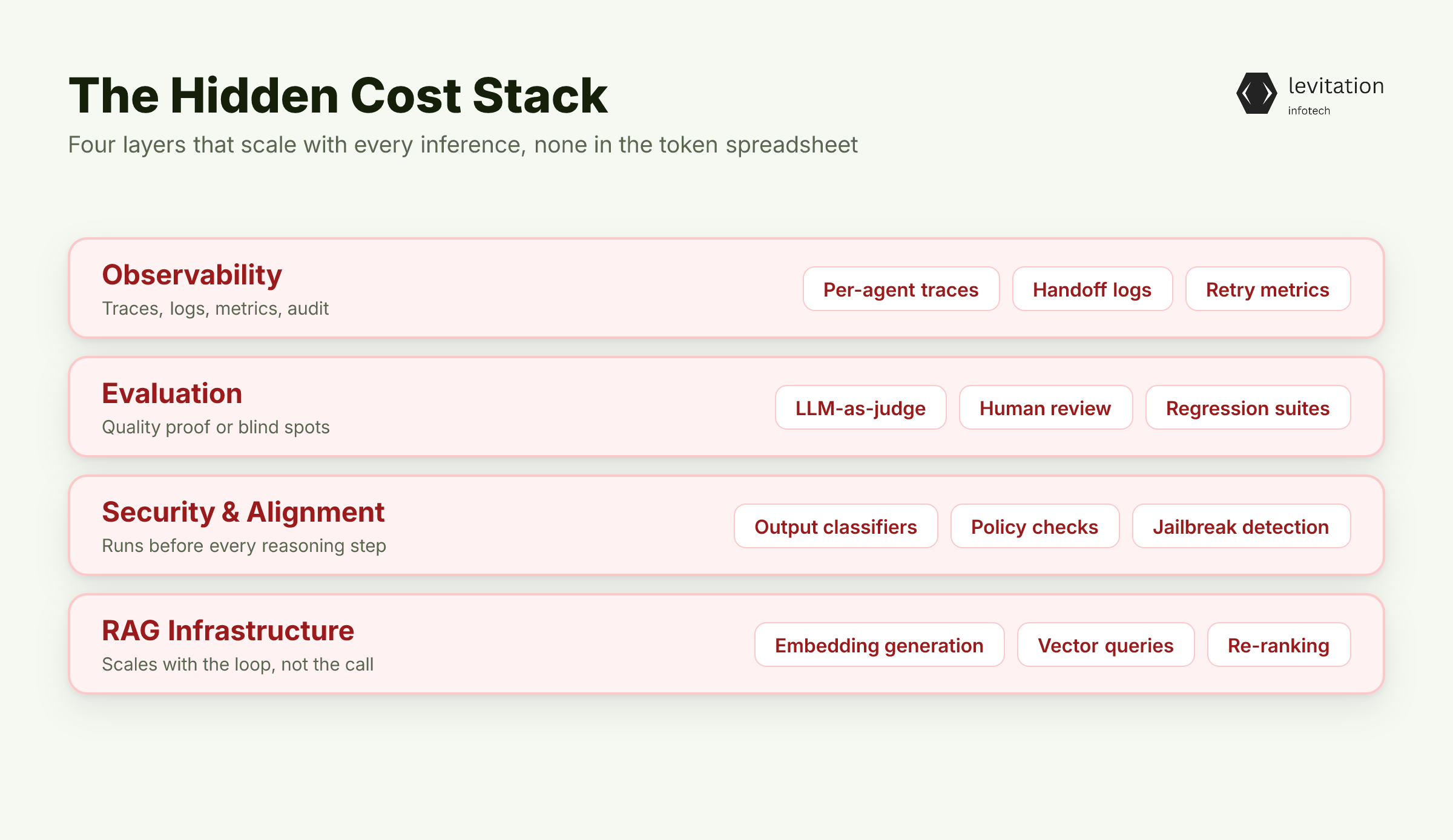
Beyond the LLM call, every production multi-agent system carries four required cost categories. None of them appear in the token spreadsheet. - Observability: traces, logs, metrics, and audit trails for every agent, every handoff, every retry. This is mandatory for any system that must be debugged. - Evaluation: LLM-as-judge scoring, human review sampling, and regression suites. Skipping it means you cannot prove quality. - Security and alignment: output classifiers, policy checks, jailbreak detection. These run on every LLM iteration before any reasoning happens. They are not optional in any regulated context. - RAG infrastructure: embedding generation, vector queries, and re-ranking on every iteration. Each agent's RAG layer adds retrieval cost that scales with the loop, not the call.
The trap is treating these as a flat line item. They scale with inference volume, so they grow exactly when costs are already strained. A system that runs many times the planned inference also runs the same multiplier. This multiplier applies to observability, evaluation, and security checks. The hidden stack does not spread out.
This matches what we logged across hundreds of AI agent production failures. The top root causes were observability gaps, evaluation blind spots, and infrastructure scaling failures. The same categories that drive hidden cost also drive hidden risk.
This is why a 4x cost shock feels larger. The visible layer overshoots by 4x, and the invisible layer scales on top of that.
Once you see the full cost picture, the question shifts. It shifts from "can we afford it" to a harder question. That question is "how do you model it honestly enough to defend to the board?"
Modeling Multi-Agent Costs You Can Defend
The fix is not a cheaper model. It is a better model of the system. Here is the pattern that holds up in board-level review.
Start with a production-traffic pilot, not a synthetic benchmark. Lab tests always undercount iteration depth. Real user traffic triggers retries, ambiguity, and quality loops that benchmarks never reproduce. If you cannot show production data, you cannot defend the cost.
Model per-task iteration count, not per-call cost. A single user request triggers many LLM calls across agents. Your cost model needs to show that spread, not the average.
Build adaptive routing. Send simple queries to mini models, and reserve frontier models for reasoning-heavy paths. The savings are structural and they compound across the system.
Budget the hidden stack as a share of inference, not a flat line. These categories scale with volume, and they need to be in the model from day one.
Treat each layer (observability, evaluation, security, RAG) as a multiplier on inference spend rather than a fixed line item. Before committing to fine-tuning a smaller model, measure whether routing already captures the savings.
Fine-tuning has its own deployment and maintenance cost, and it can land before routing is used up. Teams that skip this step end up with both a fine-tuned model they do not need. They also get a routing policy they never built. They pay maintenance on two systems when one would have done the job.
Now the harder question: when does paying 4x actually pay off?
When the 4x Premium Earns Its Keep
Multi-agent is not always the right answer. The 4x premium earns its keep only on use cases that match the architecture's strengths.
Internal IT helpdesk, customer support, sales research, and legal and compliance review all have one thing in common. They need special reasoning, retrieval, and validation across domains. No single agent covers the full scope well. Manufacturing quality control is a fit. Multi-agent handles the visual inspection, rule validation, and escalation loop naturally.
The use cases that fail share a pattern. The task is single-domain reasoning that a single well-prompted agent can handle. The 4x premium has no ROI ceiling there, because there is no headroom to recover.
Here is the math that holds up. If your single-agent baseline needs a human in the loop, multi-agent pays for itself by removing that human. If it does not, you pay 4x to remove a human who was already cheap. The architecture earns its keep when the alternative cost is real, not theoretical.
Production experience is the only thing that closes this loop. GPU selection, routing policy, and hidden-stack sizing are not problems you solve in a design doc. They are problems you solve by running production traffic. The use cases that pass that test look very different in pilot than they do in slideware.
Frequently Asked Questions
Q: How much do multi-agent LLM systems actually cost in production?
A: Multi-agent LLM architectures run 4x the cost projected in initial models. The gap comes from compounded agent loops and context-window handoffs. It also comes from the hidden infrastructure stack (observability, evaluation, security) that never appears in spreadsheet estimates.
Q: What drives the cost in a multi-agent LLM architecture?
A: Five layers drive the cost: the LLM core, observability, evaluation infrastructure, security and alignment checks, and the iterative agent loops. The LLM core includes frontier models like GPT-5 and Claude Opus 4.7. The iterative agent loops re-send full context on every handoff.
Q: How can I reduce multi-agent LLM costs without losing quality?
A: Build adaptive routing that matches model tier to query difficulty. Model per-task iteration count instead of per-call cost, and run production-traffic pilots before committing budget. Adaptive routing produces cost cuts with minimal quality loss on real-world datasets.
Q: When does a multi-agent LLM architecture actually pay off?
A: Multi-agent architectures earn their 4x premium on tasks that need special reasoning, retrieval, and validation across domains. These tasks include internal IT helpdesk, customer support, sales research, legal and compliance review, and manufacturing quality control.
Q: Is it cheaper to build multi-agent in-house or use a framework?
A: In-house multi-agent deployments typically take longer to reach production than vendor-led rollouts. The cost difference is usually in opportunity cost. The 4x premium is easier to defend when the system runs and generates ROI. It is harder to defend when production traffic is still far off.
If you are sizing a build, the first conversation worth having starts with iteration depth, not model choice.
Sources
Research and references cited in this article:
- LLM Agent Architectures 2026: Components and Patterns
- Multi-Agent LLMs: How Specialized AI Agents Collaborate | Deepchecks
- Multi-agent LLMs in 2026 +frameworks
- Benchmarking Multi-Agent LLM Architectures for Financial Document Processing: A Comparative Study of Orchestration Patterns, Cost-Accuracy Tradeoffs and Production Scaling Strategies _(academic)_
- LLM Agent Architecture: A Complete Guide 2026 | Coworker AI
- Token Economics for LLM Agents: A Dual-View Study from ... _(academic)_
- The Hidden Economics of AI Agents: Managing Token Costs ... _(academic)_
- LLM-Based Multi-Agent Orchestration: A Survey of ...
- LLM-Based Multi-Agent Orchestration: A Survey of Frameworks, Communication Protocols, and Emerging Patterns
- LLM Agent Orchestration Patterns: Architectural ...
- AI Agents 2026 — Guide from LLM to Multi-Agent Systems - EITT
- Enterprise AI Agents 2026: Top Use Cases, ROI & Business Impact
About the author
Mayank Singh is a software developer at Levitation Infotech, where he builds web and AI-powered applications across the company’s fintech, healthcare, and enterprise projects.