


TL;DR: AI underwriting delivered the 40% speed gain your vendor promised. The same systems added 60% more time to audit trail reconstruction. This is not a vendor failure. It is an architectural tension between inference speed and end-to-end observability. The fix is treating the audit trail as a real-time, first-class data product designed for an examiner you have never met.
Key Takeaways: - AI underwriting speed gains create an auditability debt that traditional logging cannot repay. - The audit trail has a reader you did not design for: the examiner. They want independent traceability, not narrated explanations. - Treating the audit store as a production data product with its own SLOs compresses exam cycles. The evidence becomes queryable rather than reconstructable.
The 40-60 Paradox Nobody Warned You About
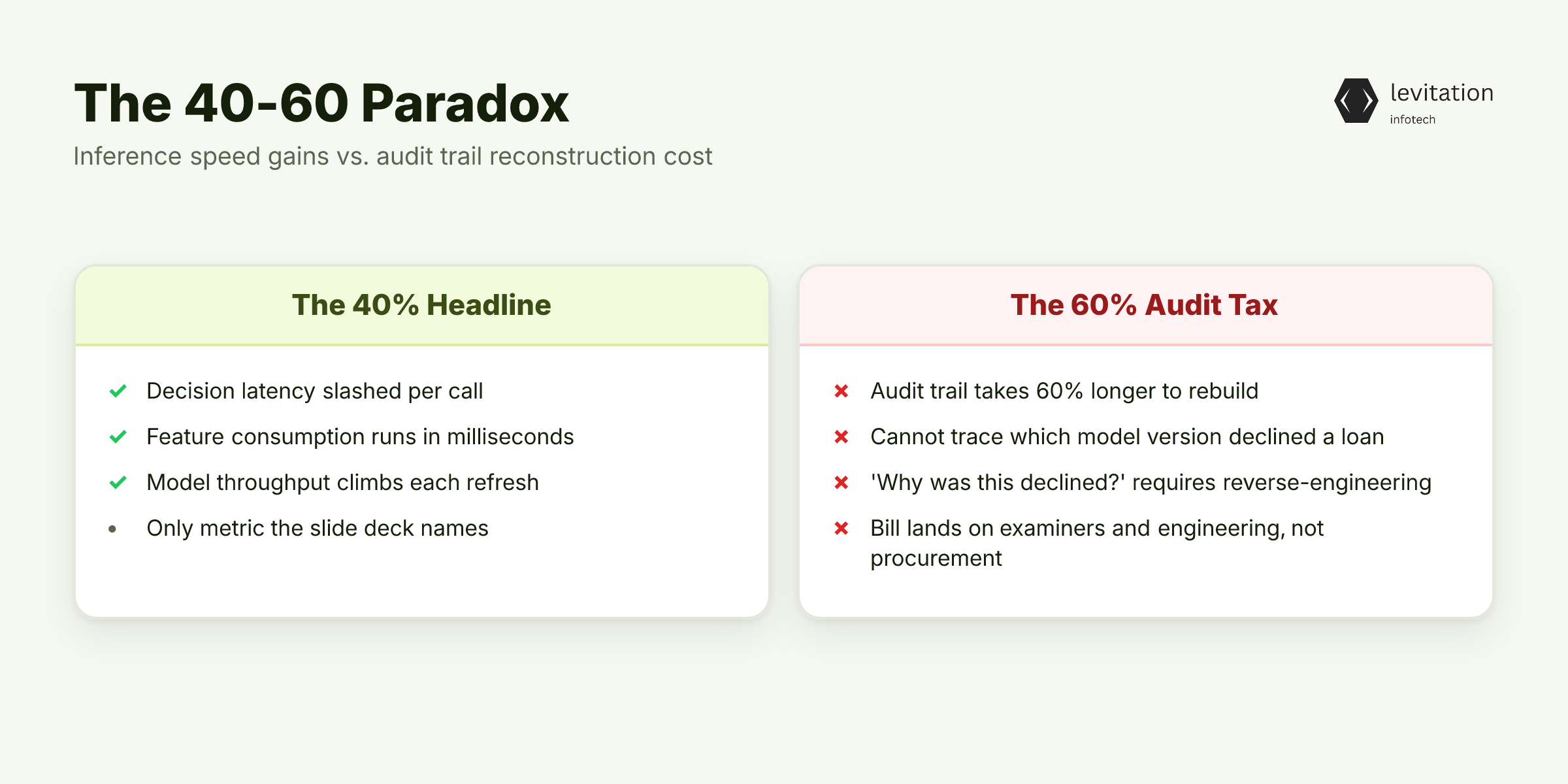
Your AI underwriter just cut decision time by 40%. That is the line the vendor put in the slide deck. Congratulations.
Now explain to your examiner why the audit trail takes 60% longer to reconstruct. Explain why you cannot trace which model version rejected that commercial loan last Tuesday. Both numbers come from the same deployment.
The 40 is the marketing headline. The 60 is the line item nobody priced.
This is not a vendor failure. It is an architectural tension between inference latency and end-to-end observability. AI underwriting systems are optimized for one thing: returning a decision in milliseconds.
The decision path inside the model, which features were consumed, which rules fired, which model version was live, gets treated as a runtime cost. Not a product artifact. So when the examiner asks "why was this declined" six months later, the answer has to be reverse-engineered from logs that were never designed to answer that question.
CTOs measure model accuracy and throughput. Almost none measure how long it takes to answer "why was this loan declined" six months after the fact.
That gap is the auditability debt. It grows with every model refresh. The 40-60 paradox is a tax on every inference call. The only people who see the bill are the examiners and the engineers tasked with producing evidence for them.
The AI governance conversation that started in procurement never quite got around to this trade-off.
The 40-60 trade is not unique to lending. We measured similar drift in clinical AI inference logs that look complete but hide HIPAA gaps. The shape of the problem is identical. Speed gains on the front end. Traceability losses on the back end.
But here is the part that should keep you up at night: the obvious fix makes it worse.
Why Traditional Logging Makes the Problem Worse
The obvious fix is more logs. Capture every input, every output, every event. Then aggregate, index, and search. This is the playbook most teams reach for, and it is wrong for AI decisioning.
Post-hoc log aggregation captures inputs and outputs. It loses the decision context between them. Reconstruction becomes forensic archaeology.
You have the applicant's name, the model version ID, the timestamp, and the score. You do not have the feature snapshot the model actually consumed at inference. You do not have the policy rules that fired in sequence. You do not have the upstream data quality signal that changed a feature value mid-second.
Batch snapshots of model state miss the same thing. When a feature pipeline updates at 3:47 PM and a loan is scored at 3:48 PM, the snapshot from 3:00 PM is a lie.
The examiner will find this. The bank's engineering team usually does not, until the consent order arrives.
Append-only event logs without semantic structure are even worse. They require weeks of manual stitching per audit. The work does not scale.
One examiner request for "all decisions on applicant X in 2024 where the model rejected based on debt-to-income" turns into a multi-week cross-system correlation project. Multiply that across an active applicant portfolio, and the audit team becomes a permanent line item.
Retrofitting observability onto a system never designed for it costs more than rebuilding the decisioning path with audit as a constraint from day one. This is the lesson hidden in our finding that most organizations fail AI governance audits because they cannot see what their models are doing.
Logging is not the same as traceability. The responsible AI posture demands more than a log shipper.
If throwing more logs at the problem does not work, the question becomes: who exactly is this audit trail for?
Your Audit Trail Has a Reader You Have Never Met
The underwriter is not the final consumer of the audit trail. The examiner is, and they arrive with a different question.
Examiners are not buying your controls. They are buying their own ability to see and bound those controls independently.
When the examiner asks for a decision replay, they want to pull the exact model version. They want the exact feature values. They want the exact rule set that fired, on their own time, on their own tooling.
If your team has to translate, narrate, or hand-walk them through the data, the audit is already failing.
Evidence beats explanation every time. A replayable decision store passes model risk assessments. A narrated slide deck invites consent orders.
One system can be inspected. The other has to be trusted on faith.
This is why the architectural shift moves you from one question to another. The old question is "can we explain this decision." The new question is "can the examiner trace it without our team in the room."
That second question is the only one that matters in a real examination. Your engineers should not be the bridge between the examiner and the decision. The decision store should be.
The AI ethics principle is straightforward: independent traceability is the test. If your team is the only path to the evidence, the system is not auditable. It is merely documented.
That shift re-frames the entire architecture problem. The next layer is where most teams go wrong.
Audit-First Architecture: Treating the Trail as a Data Product
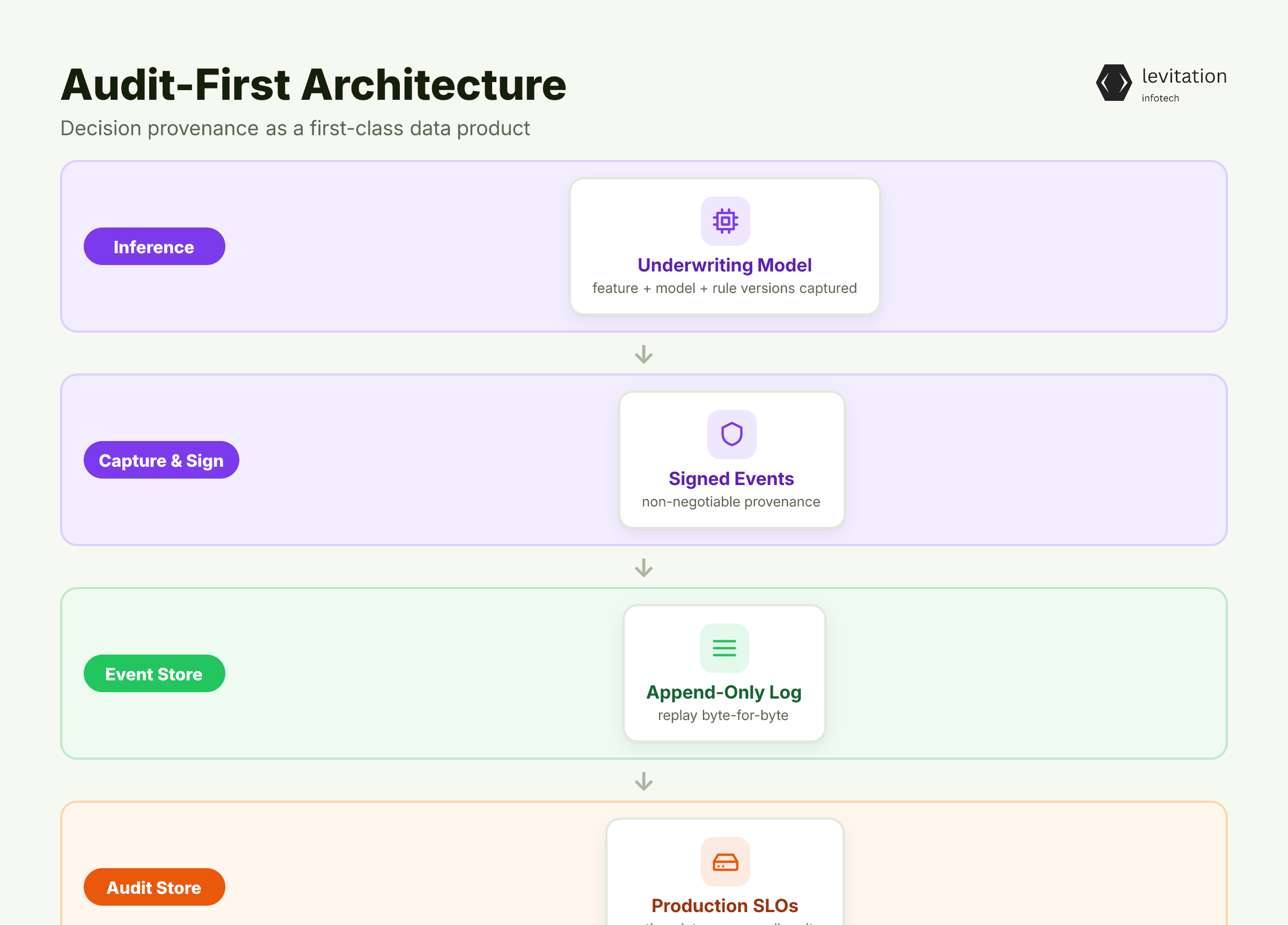
The fix starts with the data model, not the model.
Design the audit data model before designing the underwriting model. Decision provenance becomes a first-class schema, not a logging afterthought. This single change is the difference between a system that can be examined and a system that has to be defended.
At the moment of inference, capture the feature version, the model version, and the rule version. Then sign the event so it cannot be quietly rewritten. This is non-negotiable.
The same lesson applies to model rollbacks: if the audit trail was not built to be replayable, the rollback becomes evidence deletion. The signing is what makes the trail durable across legal holds and multi-year retention requirements.
Use immutable, append-only event sourcing so any historical decision can be replayed byte-for-byte against the same inputs. This is the same architectural pattern that powers financial ledgers and trading systems.
It works because the only write operation is append. The only read operation is replay. There is no path for silent mutation.
Treat the audit store as a production system with the same SLOs as the decisioning path: same uptime, same latency budget, same on-call rotation.
An audit store that goes down when the decisioning system goes down is a single point of failure. An audit store with separate SLOs is a competitive moat.
The AI risk management framework should treat this as infrastructure, not paperwork.
The theory is clean. The implementation is where most teams stall.
What Real-Time AI Audit Looks Like in Production
Production looks like this. Every inference call is wrapped in a decision event. The event captures inputs, model version, feature snapshot, and every policy rule evaluated in that path.
The event is signed at write time. The event is indexed for retrieval. The event is durable for the full retention window the regulator requires.
Before any examiner-facing query goes live, run shadow-mode validation for a full quarter. Log decisions against a parallel audit pipeline. Compare the captured trail against the source of truth in the decisioning system.
If they diverge, the audit pipeline is not yet safe to expose. This is unglamorous work.
Most teams skip it. Most teams regret skipping it.
Index the audit store by applicant ID, decision timestamp, and model lineage, not just by transaction ID. The examiner's natural questions are applicant-centric, not transaction-centric.
A query like "show me every decision for John Smith in 2024, with the model and rule versions used" should return in milliseconds. If it returns in days, the index is wrong.
Expose a query interface that a non-engineer can use. Applicant name plus date range should pull the full decision replay without a developer in the room.
This is the moment where the AI governance frameworks shift from slideware to system. If the examiner needs a translator, the framework is decorative.
Plan for a deployment window that is a fraction of the time an in-house build typically consumes. When built correctly, post-issue audit completion time drops because the evidence is already assembled.
The pattern is mature. Adoption is still uneven. The first institution to close that gap in your market sets the standard the rest will be measured against.
When you get this right, several things change. None of them are the ones you predicted.
What Changes When Your Audit Trail Is Fast
Exam cycles compress because the evidence is already assembled and queryable. The tension between fast loan approval and tight audit windows stops being a paradox. The audit window becomes a query, not an investigation.
The same loan, scored in milliseconds, can be replayed in milliseconds. The shape of the exam changes.
Model risk assessments drop because the examiner can validate lineage independently, without your team acting as a translator. The examiner is not asking "can you prove this?" anymore. They are asking "how do I pull this myself?"
The first question is a cost center. The second is a system property.
The audit store becomes a platform for responsible AI practices. It spans the entire lending book, not just the model the examiner happened to be reviewing that quarter.
Your AI underwriter stops being a regulatory liability and starts being the system examiners actually want to see. That is the inversion.
The 40% speed gain becomes a 40% speed gain with audit compression on top. Both numbers live in the same system. Neither requires trade-off.
Frequently Asked Questions
What is an AI audit trail in lending?
An AI audit trail in lending is an immutable, time-stamped record of every input, model version, feature snapshot, and policy rule evaluated at the moment an underwriting decision was made. It must be replayable end-to-end so an examiner can reconstruct intent without engineering support.
Why do AI underwriters make audits harder?
AI underwriters add decisioning components (model versions, feature pipelines, scoring rules) that change continuously. Traditional loan files captured a human's reasoning on paper. AI decisions spread across systems that must be linked to reconstruct intent, so audit retrieval time grows with model complexity.
What is real-time AI audit?
Real-time AI audit is the practice of capturing decision provenance at the moment of inference and indexing it for immediate retrieval, rather than reconstructing context after the fact from logs. It treats the audit trail as a production data product with its own uptime and latency SLOs.
How do banks pass AI audit examinations?
Banks pass AI audits by giving examiners independent traceability. The examiner queries a decision store and sees the model and feature versions used. Policy adherence is validated without the bank's engineering team in the room. The trail is built for the examiner, not the developer.
What is the difference between model governance and audit infrastructure?
Model governance covers the lifecycle: training, validation, approval, and ongoing monitoring of models. Audit infrastructure covers the runtime trail. It records what the model did, on what data, under which rules, at the moment a specific applicant was scored. Both are required, and neither substitutes for the other.
For a starting checklist on moving from log aggregation to an examiner-grade audit store, start here.
About the author
Mayank Singh is a software developer at Levitation Infotech, where he builds web and AI-powered applications across the company’s fintech, healthcare, and enterprise projects.