


TL;DR: AI vendor lock-in is usually an end-to-end portability failure, not a renewal dispute. In our 24-contract audit, 19 agreements contained material dependencies that would make switching expensive or disruptive. Pair enforceable exit clauses with an engineering exit drill before signature.
Key Takeaways: - Separate visible commercial lock-in from hidden data, model, workflow, and operations dependencies. - Treat portability as an operating capability, not a vendor promise. - Attach measurable export and substitution tests to the contract.
The Lock-In Can Look Negotiable
Nineteen of the 24 AI vendor contracts we audited made switching harder than their renewal terms suggested. The issue was not just a renewal clause. A data, workflow, or liability dependency turns an ordinary provider switch into an enterprise rebuild.
“Hidden” is an operational description, not an accusation of deception. Every flagged agreement contained dependencies that would be expensive or disruptive to unwind. The sample is a warning signal, not a market-wide prevalence estimate.
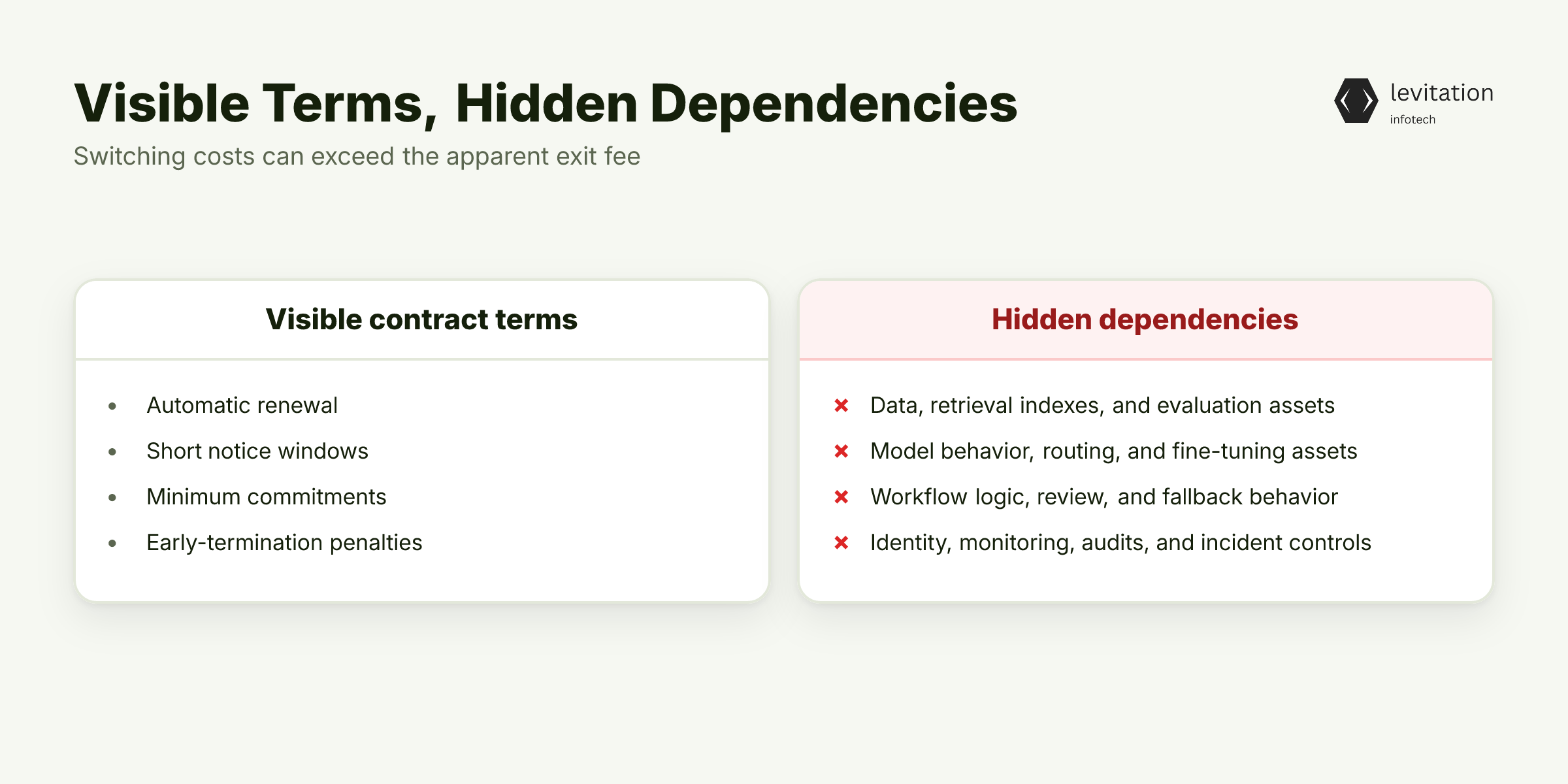
Visible terms versus hidden dependencies
Ordinary commercial lock-in looks familiar: - Automatic renewal. - Short notice windows. - Minimum commitments. - Early-termination penalties.
The deeper problem sits elsewhere: - Data, retrieval indexes, and evaluation assets. - Model behavior, routing, and fine-tuning assets. - Workflow logic, human review, and fallback behavior. - Identity, monitoring, audit trails, and incident controls.
A company can cancel an AI platform on time. It can still lose the context needed to reproduce its service. It can own source records while depending on vendor-specific embeddings and orchestration.
The exit fee may be small. The rebuild can be enormous. Which question exposes that cost before signature?
The CTO-level question
Replace “Can we terminate?” with a harder question:
Can we operate the same AI service elsewhere without losing data, retesting workflows, or accepting an open-ended rebuild?
That question turns procurement into exit design. Our AI procurement risk guide explains why technical owners must join legal review early.
If obvious exit clauses are not the main risk, the review method must change. Which production tests should fill that gap?
Why the SaaS Checklist Misses AI Dependencies
A traditional review checks the legal boundary. AI procurement must test the production boundary.
Legal teams usually verify price, renewal, data use, liability caps, and termination rights. Those checks remain necessary.
They do not show whether the live system can move without rebuilding its data pipeline, model stack, orchestration, and controls.
Imagine a contract that permits data export. The export includes customer records. It leaves out embeddings, prompt templates, evaluation sets, logs, and the workflow that connects the model to human approval.
Paper exit rights exist. Operational exit does not.
Contract terms can compound this gap. A vendor can control model behavior and customer data reuse while limiting liability. The customer keeps the final business decision and its financial consequences, without equivalent control over the system producing that decision.
Use the vendor lock-in checklist for visible traps. Use the AI vendor contract review guide for production dependencies. The shift also affects pricing, as AI Just Repriced Your SaaS Contract explains.
Clause review reveals what the vendor admits. What can an exit drill reveal that the architecture still permits?
Model Portability Has Four Hidden Dependencies
A company can export every customer record and still be unable to reproduce its AI service. That contradiction is where portability fails. Which four layers must a buyer test?
Data layer
Source data is only one part of the running system. Ask for visibility into: - Source and derived data. - Retrieval corpora, indexes, and embeddings. - Prompt and configuration artifacts. - Evaluation sets, logs, and audit records.
An export without these artifacts preserves the information but loses the method that turned it into a service.
If the data layer is portable but the model assets are not, can the buyer still reproduce the service?
Model layer
A substitute model must reproduce agreed quality, safety, latency, and cost thresholds. Document fine-tuning assets, model versions, adapters, routing rules, and the validation process for a replacement. Behavioral equivalence is not a safe assumption.
If behavior cannot be assumed, what evidence must a replacement provide?
Workflow layer
Map proprietary APIs, tool connectors, orchestration graphs, prompt templates, guardrails, human-review steps, and fallback logic. The model can be portable while the workflow around it remains bound to one platform.
Which operational pieces keep that workflow running?
Operations layer
Identity, secrets, monitoring, audit trails, deployment configuration, incident history, rollback procedures, and service levels determine whether service continues when the provider changes. Without them, continuity is a promise, not a capability.
How can a buyer record all four layers before contract language starts compounding them?
Build the dependency register
For every artifact, record its owner, format, replacement path, estimated migration effort, cost, and required contractual right. Use the model portability framework to define portability across all four layers while preserving agreed service thresholds.
An export of final outputs is not model portability. It is just an archive.
With dependencies mapped, which contract patterns should the team watch for?
Four Contract Patterns Turn Dependencies Into Lock-In
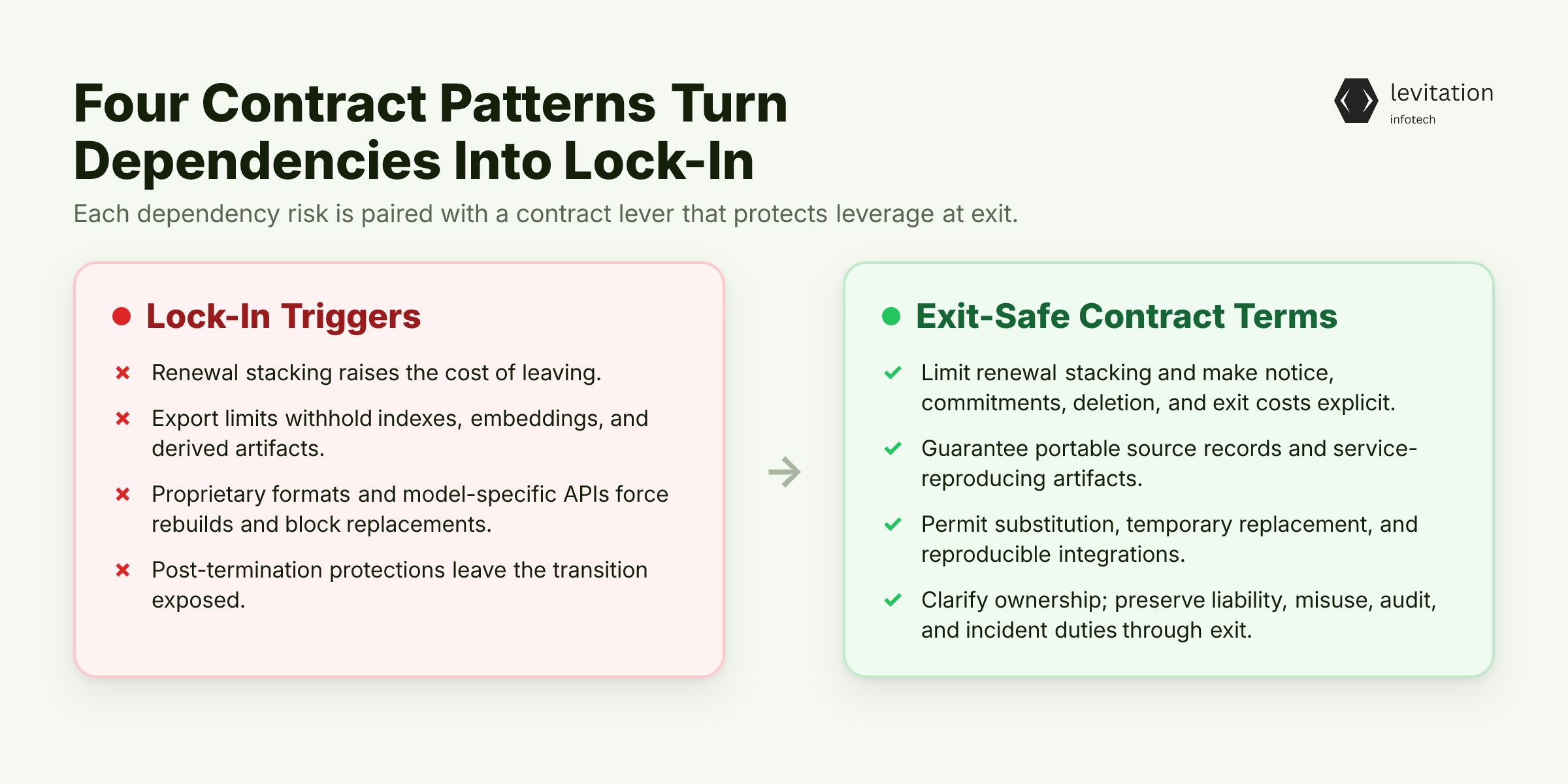
Dependencies become lock-in when contract terms magnify them. The same technical asset can give one buyer bargaining power and leave another stuck.
Take a retrieval assistant. The vendor can keep source records and indexes while restricting API use. The vendor can offer only final answers as an export.
At exit, the customer owns the data but lacks a reproducible service.
Renewal and termination stacking
Automatic renewal can combine with short notice, minimum commitments, deletion deadlines, and punitive exit fees. The visible price of leaving is only the first layer of exit cost.
Stacked terms turn timing into bargaining power. A missed notice window activates another commitment.
How does that timing pressure compound the cost of moving?
The data-hostage pattern
Broad data-use rights can sit beside restricted export or missing derived artifacts. They can also block reuse by a replacement provider, shorten retention after termination, or remove deletion evidence.
The customer can download source records and still lack the embeddings or indexes that shaped each answer.
Which missing artifact creates that gap, and which clause should close it?
Workflow and model captivity
Proprietary formats, platform-only APIs, model-specific embeddings, undocumented settings, and substitution restrictions can force a new integration. You would rebuild and revalidate during an incident or market change.
Substitution restrictions can also block a temporary replacement during an outage.
What contract terms turn that dependency into lasting risk?
Risk allocation that survives exit
Review liability caps, indemnities, output ownership, data-misuse limits, audit rights, and incident duties. If protections end at termination, or if vendor exposure stays capped while customer accountability remains, commercial dependency becomes operational risk.
Protections that vanish after termination leave the transition period exposed.
Which clauses can close these gaps before signature?
Organize the 19 flagged agreements by the material exposure each creates: data, model, workflow, or operations. The sample supports the overall 19-of-24 finding, not a frequency for any pattern.
Use the AI procurement contract checklist to mark the trigger. Then ask which operational asset would block the exit.
Which clauses can stop those patterns from becoming unavoidable at exit?
Contract Clauses That Survive an Exit Drill
The fix is not one broad portability promise. It is a set of clauses that define artifacts, tests, support, and remedies.
Data portability clause
Require exports of source data, derived data, embeddings, prompts, configurations, evaluation sets, and logs. Specify documented, machine-readable formats and a defined post-termination export window.
Add a deletion certificate. State that required export rights survive termination.
Which model substitution rights must follow?
Model substitution clause
Require reasonable cooperation with a replacement-provider test and documented transition assistance. Set measurable quality, safety, latency, and cost thresholds. Block unilateral model or service changes that invalidate an agreed portability test.
What operational support is needed during the move?
Operational exit clause
Define notice periods, termination rights, transition support, continued service levels, knowledge transfer, and a practical retrieval timeline. Avoid terms that force a fresh negotiation over every service and artifact.
Which liability and governance terms must remain active?
Liability and governance
Negotiate a meaningful super-cap and specified uncapped carve-outs for confidentiality, data misuse, IP infringement, and security failures. Preserve output ownership, audit rights, subprocessor transparency, incident duties, and evidence access during transition.
How do these clauses become measurable tests?
Put acceptance tests in the contract
Attach a portability schedule. It should define export fields, sample formats, documentation, replacement thresholds, transition deliverables, and remedies for missed requirements.
For example, “customer data” is too broad. Name embeddings, indexes, prompts, evaluation sets, and logs. State which fields each export must contain.
The model clause should name quality, safety, latency, and cost thresholds. The exit clause should define continued access and support.
The most urgent dependency should anchor the first redline. Give legal an objective test and a fallback position for every requested right.
Use a clause-by-clause matrix: - Dependency and risk owner. - Current wording and requested right. - Objective acceptance test and fallback position.
Engineering should validate operational terms. Legal should translate them into enforceable language. The AI vendor contract clause library and model portability worksheet can support that handoff.
The clause is only as useful as the buyer's ability to pass its test. Can the buyer actually pass it?
Run a Portability Drill Before Signature
Clause review can pass while the architecture still fails. The exit drill tests both together.
Inventory the production dependency graph
Assign owners to data, model, workflow, and operations. Record where each artifact lives, which clause governs it, and what cannot be exported today.
Derived representations need separate tests, as The Embedding Migration That Quietly Breaks Your Vector Index shows.
Which export should prove the dependency map?
Test one representative export
Request a sample export. Verify completeness, readability, field definitions, volume handling, and derived or operational artifacts. Do not accept a vendor-generated archive on trust.
What happens when a second provider enters the test?
Shadow a replacement path
Run a representative workflow against another model or provider. Compare quality, safety, latency, cost, and human-review burden against agreed thresholds. Document every change needed to preserve behavior.
How should each gap become a contract demand with an owner?
Convert gaps into redlines and ownership
Assign each gap to procurement, legal, security, data, or engineering. Attach an acceptance test. Set a no-go escalation when material exit rights remain unresolved.
Treat these as no-go triggers: - Proprietary-only data or missing derived artifacts. - Unowned workflows or unavailable audit logs. - Untestable model substitution. - Liability protections that disappear during exit.
Keep export samples, test logs, threshold comparisons, and named owners in one repository. Every unresolved item needs an owner, deadline, contractual ask, and engineering acceptance test.
Use the implementation benchmark to pressure-test estimates. A provider switch that recreates the entire environment is not a model swap.
Migration duration depends on how much of the data, model, workflow, and operations stack must be rebuilt and revalidated.
The portability test worksheet should record evidence, owners, and unresolved gaps.
Once the evidence is complete, what choice does it create at renewal?
Portability Turns Renewal Into a Business Decision
Portable contracts create bargaining power before renewal. They also preserve continuity when models, priorities, or operating conditions change.
The payoff is not constant low-cost switching. It is credible optionality. A CTO can stay because the vendor performs, without surrendering data, control, or evidence.
The practical gains are specific: - Renewal bargaining power before notice windows close. - Lower cost and shorter duration when a provider changes. - Continuity for data, controls, and audit evidence during transition.
That changes a renewal discussion, as Your AI Vendor Is Cutting Prices. Your Renewal Quote Isn't explains.
Durable vendor relationships work better when exit rights are enforceable. Both sides can plan transitions without turning every change into a confrontation.
Operational durability matters when choosing a partner. Portable systems make AI architecture a strategic choice. Non-portable systems make the first vendor contract an accidental long-term constraint.
Most AI procurement debates collapse once teams separate visible fees from structural dependencies. Which layer controls continuity?
Frequently Asked Questions
What is vendor lock-in in AI vendor contracts?
Vendor lock-in combines contractual and technical dependencies that make switching an AI provider much more expensive or disruptive. It often includes automatic renewal and termination penalties. The deeper risk is control over data, model behavior, workflows, and operational evidence.
How can a CTO identify hidden lock-in before signing?
Run two passes. Review the contract against the data, model, workflow, and operations layers. Then run an exit drill against a sample export and replacement-provider test.
A clause that promises portability is meaningful only if the current architecture can demonstrate it.
What should AI vendor contracts include for model portability?
The agreement should define machine-readable export rights, ownership and use of derived artifacts, and replacement-model testing. It should also cover transition assistance, continued operational access, and enforceable remedies for missed requirements.
Attach measurable acceptance criteria so portability remains testable throughout the relationship.
Does exporting our data eliminate AI vendor lock-in?
No. Source-data export alone does not provide the embeddings, indexes, prompts, evaluation sets, logs, or workflow logic needed to reproduce the service. Start with the dependency most likely to stop continuity during a switch. Which one would stop yours first?
About the author
Mayank Singh is a software developer at Levitation Infotech, where he builds web and AI-powered applications across the company’s fintech, healthcare, and enterprise projects.