


TL;DR: Changing an embedding model is sold as a config swap, but stored vectors live in a different latent space. Migration needs re-embedding and reindexing. Blue-green architecture with dual writes, background re-embedding, and shadow A/B testing is the only production-grade path. The total lifecycle cost has four layers, and the architecture choice matters more than the model choice.
Key Takeaways: - Embedding model swaps invalidate stored vectors. Each model defines its own latent space, so old and new vectors are not comparable. - Blue-green migration with dual writes and a background re-embedding job is the only zero-downtime path for production vector indexes. - The real cost of embedding migration is operational, not compute. It does not scale in a straight line as your vector count grows.
The 30-Second Config Swap That Breaks Production
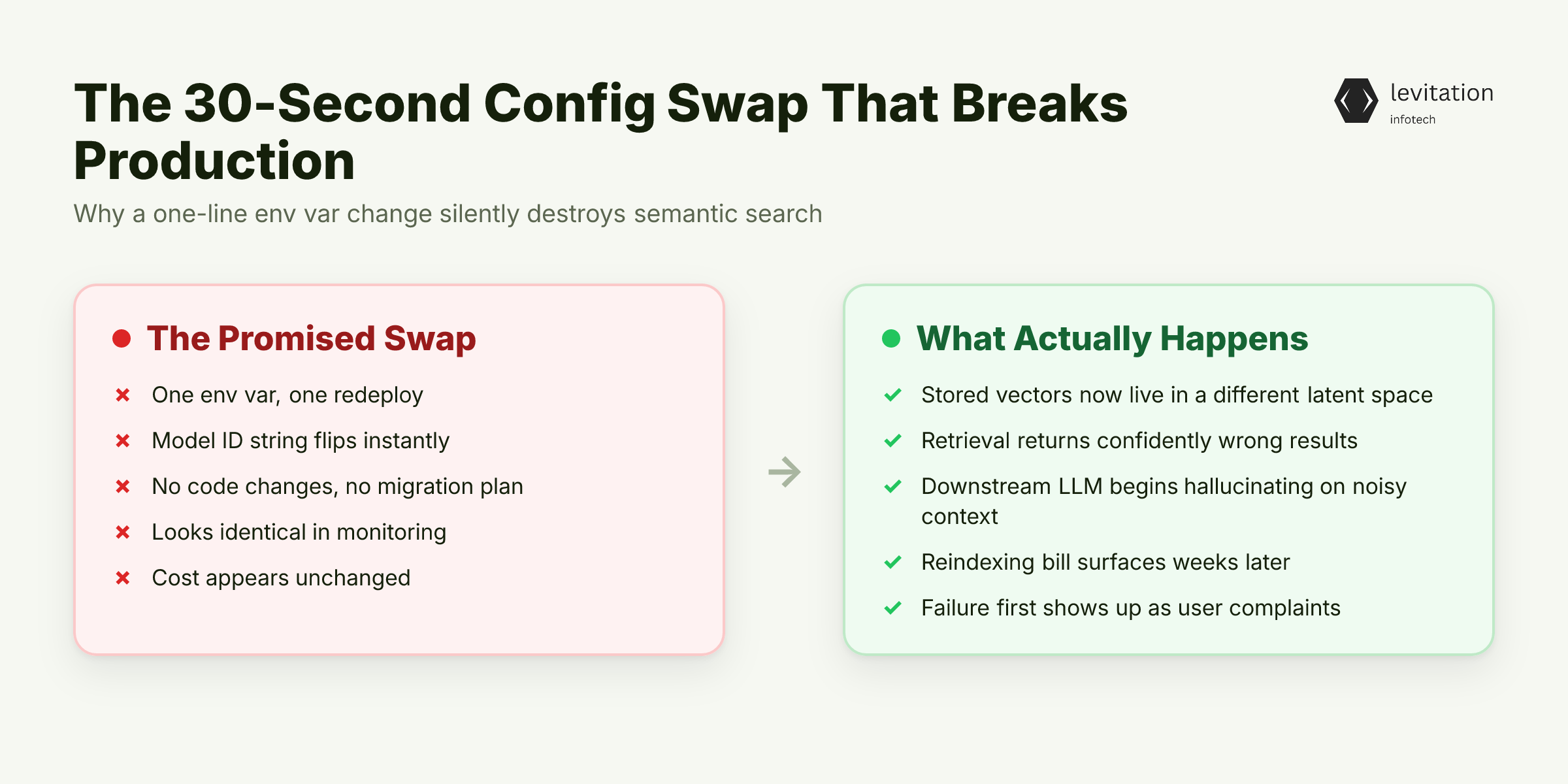
Changing an embedding model is advertised as a 30-second config swap. In production, it can silently corrupt 18 months of semantic search results. It inflates your RAG infrastructure cost. It forces a reindexing bill most teams never budget for.
The model ID string changes instantly. One env var, one redeploy, one restart. The stored vectors in your database were generated by a model that no longer matches the one your service is calling. The new model produces vectors in a different latent space.
Two vectors that meant "similar" under the old model now mean nothing comparable under the new one. This is the foundational-layer problem that makes embedding models dangerous. They sit beneath RAG pipelines, semantic search, and agent stacks, so corruption propagates silently downstream.
Your retrieval layer returns confidently wrong results. Your LLM hallucinates because the context it gets is noise. Your users see degraded answers with no error logs to explain why.
The breakage rarely announces itself: - Semantic recall drops, but your monitoring dashboards show green. - Hallucination spikes appear in downstream LLM calls, weeks after the swap. - A/B tests on the LLM layer show no regression, because the model didn't change.
Most engineers discover the failure through user complaints. Sometimes it shows up as a sudden silence in retrieval that no one can explain. The instinct is to re-embed everything. That instinct is where the real damage starts.
Why "Just Re-Embed Everything" Is the Wrong First Move
Re-embedding sounds simple. You point your service at a new model and iterate over your corpus. You write fresh vectors. Then the schema fights back.
Say your new model has different output dimensions, like moving from a smaller embedding to a much larger one. You cannot do an in-place overwrite. The vector field in your collection expects a fixed size. Changing it means dropping and recreating the collection, which means downtime and a maintenance window nobody scheduled.
Even if the dimensions match, dual storage during migration doubles your vector database footprint. For a 10M-vector index, that is not a trivial line item. You pay for two copies of your entire semantic space while the migration runs.
Migrations hit your GPU infrastructure for re-embedding, and that costs money per hour. The worst option is re-embedding on the fly during queries. Some teams try to save storage by embedding incoming queries with the new model. They keep serving against a mix of old and new vectors in the same index.
This creates inconsistent results. Old and new vectors coexist in the same collection during the cutover window. Your top-k retrieval becomes a coin flip between two latent spaces.
Three failure modes are baked into naive re-embedding: - Dimension mismatch forces a destructive schema change. - Dual storage inflates costs during the migration run. - Mixed-space serving corrupts retrieval quality in production.
Even if you accept the reindexing cost, most architects are modeling the wrong number entirely.
The Total Lifecycle Cost Most Architects Underestimate
The real cost of an embedding migration is not the reindexing run. It is the four layers underneath: initial build, migration run, ongoing operational overhead, and business risk from degraded retrieval.
Vector database management for a 10M-vector system handling 5,000 daily queries runs $600 to $1,500 per month. That number is before any migration. Add the compute for two full reindexes, which can cost as little as $94, and the headline cost looks low. The difference between two candidate models can be as low as $11 per run.
This means the model selection tradeoffs matter less than the architecture choice. That result runs counter to intuition for teams that obsess over benchmark deltas. The danger is that costs do not scale in a straight line. Storage, query latency, and reindexing time all grow with vector count.
As your vector count multiplies, reindexing time can extend from a manageable window to one that overlaps with neural network training pipelines. Inference workloads compete for the same GPU pool. The on-paper benchmark rarely matches the production bill, as covered in our analysis of why your vector DB is bleeding compliance money.
The strategic tension shows up here: - A model with marginally better retrieval accuracy can double your index size. - A larger index means slower queries, which forces you to over-provision hardware. - Over-provisioning during the migration window creates a bill spike your finance team will question.
Most teams undercount the business risk layer. A one-week window of degraded retrieval quality can erode user trust faster than any reindexing bill. If your RAG system is customer-facing, that week is measurable in churn.
If it is internal, it shows up as a spike in support tickets and a postmortem that blames "the embedding change."
Knowing the real cost is necessary, but the real leverage is in the migration architecture itself.
Blue-Green Architecture for Embedding Migrations
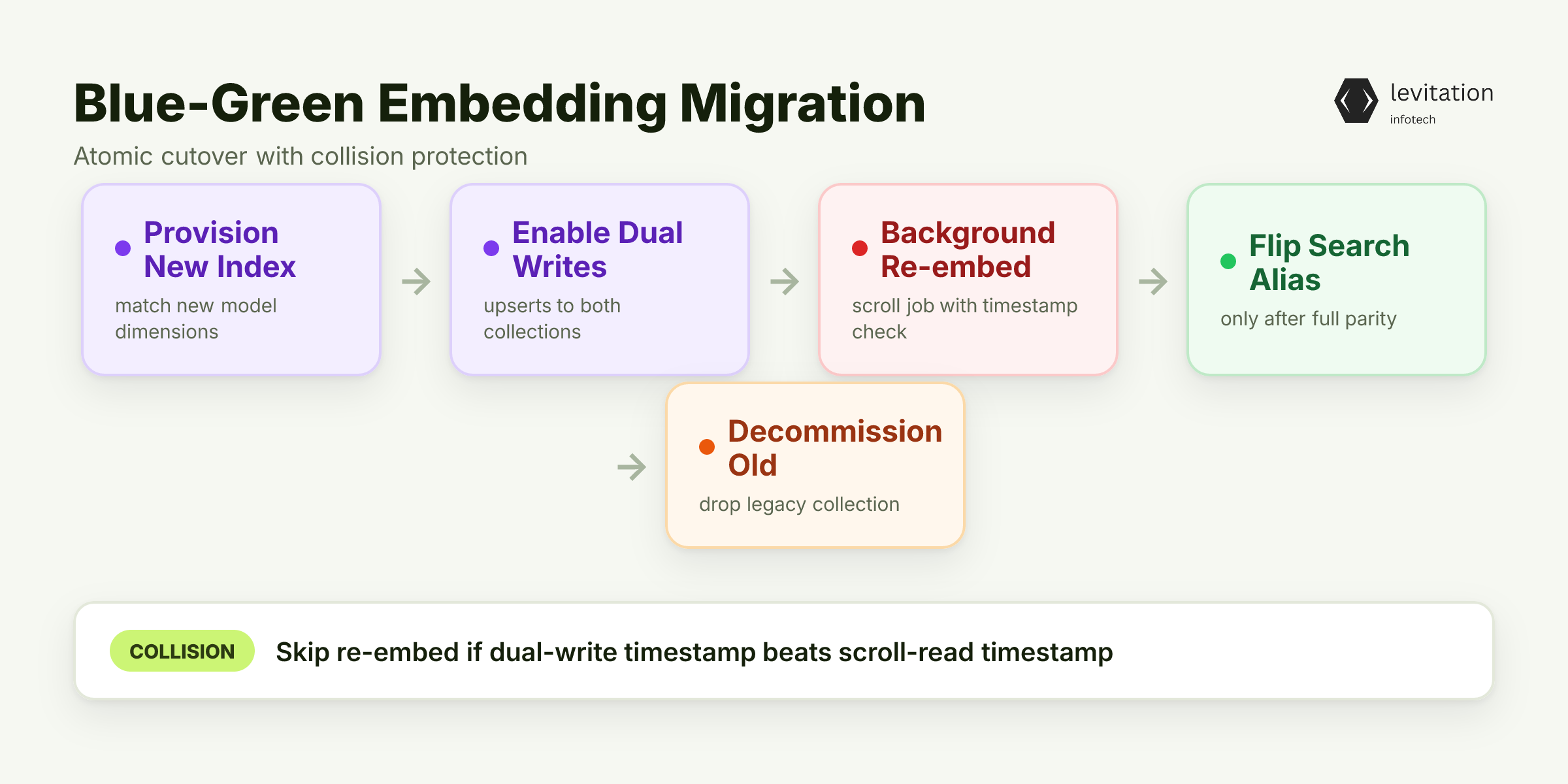
The blue-green pattern solves the cutover problem without downtime. It treats the vector index as a swappable backend, not a sacred cow. The approach mirrors blue-green deploys for stateless services, with one critical addition: collision protection during the re-embedding pass.
Here is the flow:
- Create a new collection configured for the new model's vector dimensions before touching the old one.
- Enable dual writes so every upsert flows to both collections at the same time.
- Run a background scroll job that re-embeds each existing point with the new model and writes it to the new collection.
- Flip the search alias to point at the new collection only after the re-embedding job reports full parity.
- Disable dual writes and drop the old collection to free storage.
The dual-write step is where most teams get clever and break things. The background re-embedding job must not overwrite points that have been updated since the migration started.
Imagine a user edits a document at 10:00 AM. Your scroll job reads it at 10:01 AM with stale metadata. You will lose the edit. The fix is a timestamp check. Skip re-embedding if the dual-write timestamp is newer than the scroll-read timestamp.
A quick check before the flip:
1async def re_embed_with_collision_check(point_id, new_vector):2 existing = await new_collection.retrieve(3 point_id, with_payload=True4 )5 if existing and existing.payload.get("dual_write_ts", 0) > scroll_read_ts:6 # Dual write already updated this point. Skip.7 return8 await new_collection.upsert(9 point_id, vector=new_vector, payload=payload10 )
A blue-green RAG infrastructure pattern is not exotic. It is the same approach your application tier uses for stateless deploys. The twist is that vector indexes are not stateless. They are derived data with a costly regeneration cost.
The swap must be atomic from the search client's perspective and idempotent from the writer's perspective. This is where vector database operations earn their complexity budget. The alias flip is one line.
The scroll job with collision protection is the part that takes real engineering time to get right. The same dynamic shows up in scaling RAG on Kubernetes: the architecture is well-understood, but the operational details around dual writes and state reconciliation are where projects stall.
Blue-green gets you a clean cutover. It does not tell you whether the new model is actually better on your data.
A/B Testing: The Step Most Blue-Green Tutorials Skip
You have flipped the alias. Your new collection is live. Your dashboards are green.
And your retrieval quality is worse than before. How?
Offline benchmarks can show improvement while live relevance actually drops, because your query distribution and document corpus differ from public evaluation sets. The model that won MTEB on general English might lose on your specific domain.
Your domain has its own jargon, chunking strategy, and user intent mix. The mechanism is straightforward: attention mechanism behavior is shaped by training data, and your retrieval corpus is rarely representative of the training distribution.
The fix is shadow testing: - Route a percentage of live queries to both the old and new collections. - Compare top-k results and measure downstream task success. - Track retrieval precision, not just cosine similarity. Two models can score identically on benchmarks and still produce different document rankings on your data.
Retrieval precision is the metric that matters. Cosine similarity is a proxy. Two models can agree on similarity scores in aggregate.
They can still disagree on which document is the single best match for a specific query. Your users care about the single best match.
A useful heuristic: if the new model's top-1 retrieval differs from the old model's on most of your shadow traffic, do not flip the alias. Investigate the disagreement.
The disagreement is where your domain-specific knowledge lives. It is exactly what fine-tuning evaluation methods are designed to surface, even when you are evaluating a third-party model.
This is also why benchmark-driven model selection is unreliable. A model that wins on a public benchmark by a narrow margin can still underperform on your specific query distribution.
The benchmark does not see your chunking boundaries, your metadata filters, or your user intent mix. The gap is the same one we measured in why benchmarks miss real-world vector DB costs: the test environment and the production environment are not the same system.
The migration is the hard part to do. The harder part is designing so the next one is cheap.
Design as If the Model Will Change Again
The real fix is architectural. Stop treating the vector index as a load-bearing database. Treat it as a derived view.
This is the single most important decision you will make about your embedding layer, and almost no one makes it deliberately.
Three principles: - Treat the vector index as derived data, not the source of truth. Re-embedding is always a regeneration job, never a recovery operation.
Sources
Research and references cited in this article:
- Vector Databases Are Dying. Here's the Production ...
- When Good Models Go Bad
- Hidden patterns in embedding optimization — Part I
- Versioning and managing changes in embedding models ...
- Migrate to a New Embedding Model
- RAG in Production: What It Actually Costs (Infrastructure, Embedding, Retrieval — Real Numbers)
- RAG Vector Database Optimization: Cut Costs 50% | LeanOps
- Medium
- Vector Databases & RAG: Infrastructure-First Architecture for Production Retrieval
- The Problem of Updating Embeddings in Vector Databases
- Best Embedding Model for RAG 2026: 10 Models Compared
- Medium
About the author
Mayank Singh is a software developer at Levitation Infotech, where he builds web and AI-powered applications across the company’s fintech, healthcare, and enterprise projects.