


TL;DR: Healthcare AI pilots often double in cost between year one and year two. The cause is not rising inference prices. Instead, production-only categories enter the budget for the first time. These include HIS integration maintenance, model retraining, clinical validation, compliance overhead, and audit risk from upcoding. Procurement teams that model only inference costs miss the system costs that drive TCO. As a result, budget gaps surface within 18 months. The fix is a 36-month TCO model. It separates inference from system costs. It also prices the upcoding multiplier before signing.
Key Takeaways: - The pilot-to-year-two cost doubling comes from operational and compliance categories that pilots do not contain. - Ambient documentation ($600M market) and coding automation ($450M) scale faster than procurement can model them. - AI-assisted upcoding added $663M in inpatient and $1.67B in outpatient spending across tracked sites, the largest hidden TCO driver. - A 36-month TCO model that separates inference from system costs is the only honest budgeting frame.
The 2x Cost Shock: What 28 Hospital Sites Actually Showed
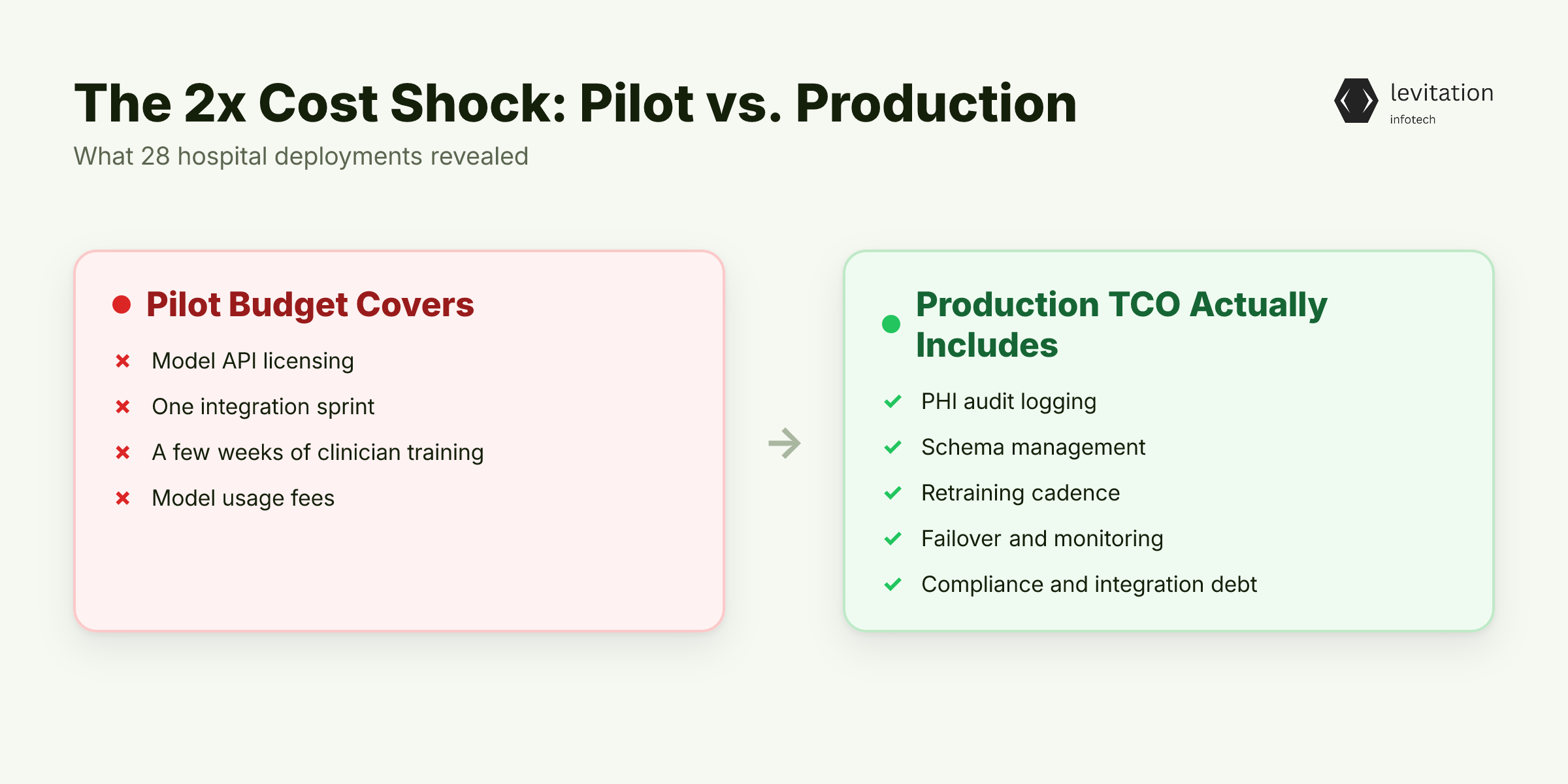
Your AI pilot budget is fiction. After tracking 28 hospital deployments, costs doubled before the system was fully integrated. The line items driving the surge are not the ones anyone budgeted for.
The pattern is brutally consistent. Pilot budgets cover model licensing, one integration sprint, and a few weeks of clinician training. Production TCO includes monitoring, retraining, compliance, and integration debt that no pilot scope captures.
CTOs who treat AI as a software license see this doubling within 12-18 months. The market context explains why the gap widens. Ambient clinical documentation is now a $600 million category. Coding and billing automation sits at $450 million.
Prior authorization AI is growing 10x year over year. These categories scale faster than any procurement model can track. Each one pulls in its own tail of HIS integration work, clinical validation cycles, and audit exposure.
This matters because the doubling categories are not exotic. They are the boring operational layers: PHI audit logging, schema management, retraining cadence, and failover. The obvious budget line items are model API costs and integration hours. In practice, these are the least of what you will actually pay.
For a deeper look at how AI for healthcare procurement fails, the pattern repeats across buyer maturity levels.
What specific cost categories do pilot budgets hide, and why do they stay hidden until production?
Why Pilot Budgets Lie: The Categories That Don't Exist Until Production
Pilots run in controlled environments. They skip the costs that production mandates. These include PHI audit logging, HIPAA-grade access controls, and 24/7 monitoring infrastructure. They also require the multi-tenant isolation that survives a Joint Commission survey.
Integration with HIS, EHR, and LIS systems is mocked in pilots. A sandbox FHIR endpoint, a test tenant, and a few sample patients. In production, the same integration becomes a multi-quarter engineering effort. HIS vendors release schema updates. EHR workflows change. Lab interfaces drift.
What looked like a six-week integration in the pilot becomes a permanent line item. This happens once real clinical traffic hits. Clinical workflow redesign is rarely scoped as a budget line at all. Yet it takes the largest share of year-two AI spend.
Physicians change how they document. Nurses change how they triage. Billing teams change how they code. Each workflow shift creates training overhead and exception handling. It also creates downstream system updates that nobody priced into the pilot.
Change management and clinician retraining are treated as one-time costs in pilots. In practice, they recur every year. Staff rotates. New use cases deploy. Model behavior shifts. The retraining bill never ends.
If pilot budgets hide these categories, the real question becomes: what does an honest healthcare AI TCO model actually contain?
Anatomy of Healthcare AI TCO: 7 Line Items Most CTOs Miss
Most TCO models focus on inference and stop. The real spend lives in seven categories that pilots do not contain. - Line item 1: Model inference costs scale non-linearly with patient volume. Ambient scribe deployments at the 28 tracked sites showed per-encounter costs rising as encounter complexity increased. Long-form transcripts, multi-speaker encounters, and specialty-specific vocabulary each add token consumption that flat pricing cannot absorb. - Line item 2: Data pipeline maintenance. HIS and EHR integration needs ongoing schema management. Every vendor release is a potential breaking change. The same healthcare AI deployment ran cleanly in month three. By month seven, it starts throwing mapping errors. A single hospital LIS upgrade can trigger the cascade. - Line item 3: Model retraining and drift monitoring. Clinical AI needs quarterly retraining cycles to keep accuracy on local patient populations. This work is rarely included in vendor quotes. It shows up as a separate line on year-two invoices. Or it shows up as degraded model performance that nobody budgeted to fix. - Line item 4: Compliance overhead. HIPAA, ABDM alignment, and state-level regulations need dedicated audit infrastructure. PHI access logs, model decision trails, and breach notification pipelines are not optional, and they are not free. They typically appear as their first real cost once the system enters full clinical use. - Line item 5: Clinical validation. Re-validating model performance against local patient populations is an annual fixed cost. Demographics shift. Disease prevalence shifts. The model that worked in the pilot drifts silently until someone re-runs the validation. - Line item 6: Redundancy and failover. Clinical AI systems cannot go down. Active-active deployments that survive a regional cloud outage need redundant infrastructure that adds to the bill. This is the line item that the Hidden TCO of Real-Time Pipelines problem makes unavoidable. - Line item 7: Vendor management overhead. Leading organizations deploy across multiple AI categories: ambient documentation, coding automation, and prior authorization. Each vendor adds a coordination tax. Contracts, security reviews, integration testing, and uptime monitoring all need dedicated staff or a partner. Vendors whose systems are still running in production 5+ years after deployment signal lower TCO risk. They have already absorbed the integration, compliance, and retraining costs that inflate year-two budgets.
One category shows up in neither pilot budgets nor standard TCO frameworks. It has triggered the largest cost explosions measured.
The Upcoding Multiplier: When AI Becomes a Revenue (and Cost) Amplifier
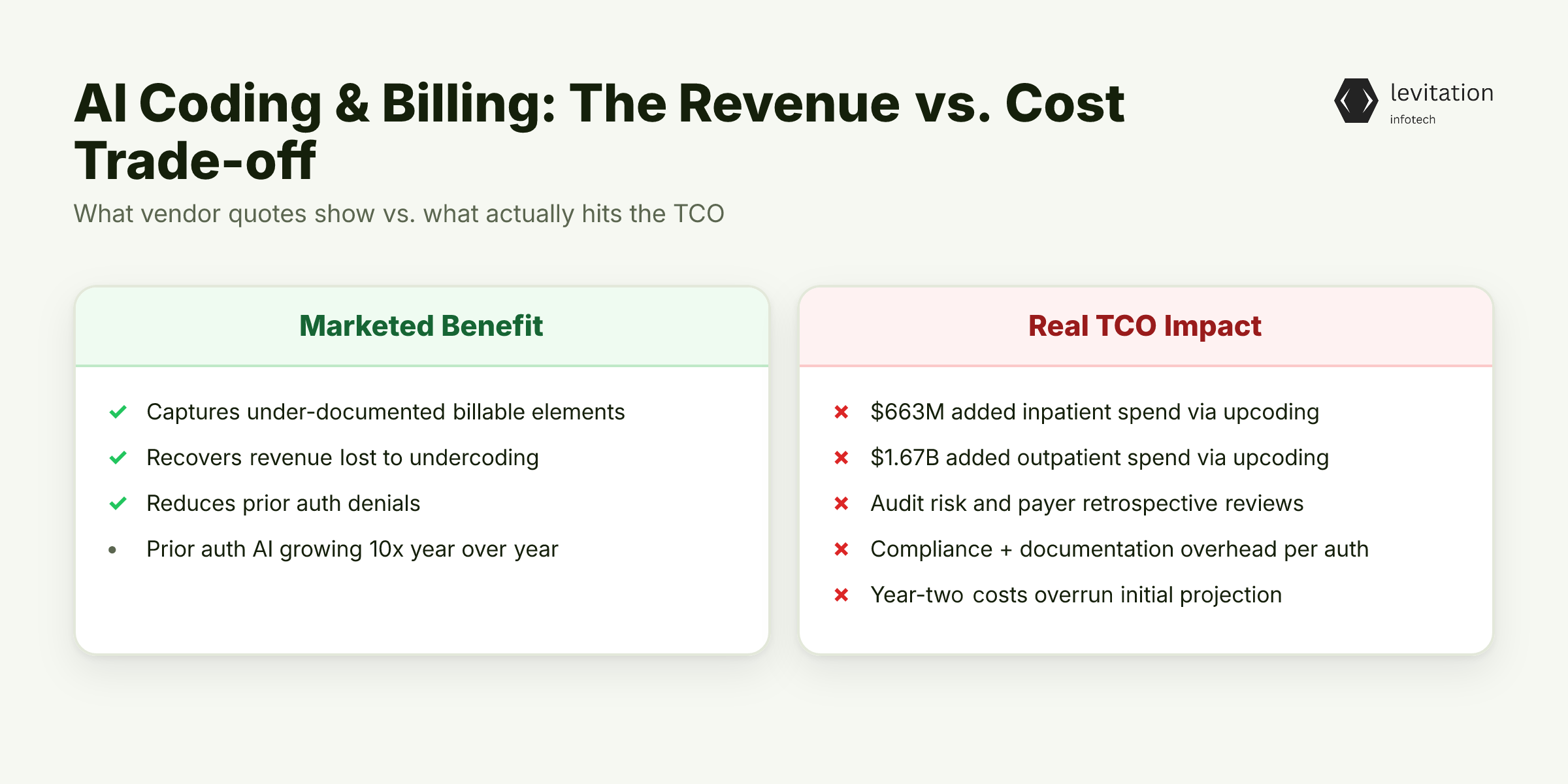
AI-assisted upcoding added $663 million in inpatient spending across the 28 tracked sites. It also added $1.67 billion in outpatient spending. That is the single largest TCO driver observed, and it is not on any vendor's quote.
Coding and billing automation, a $450 million market category, creates a paradox. It recovers revenue lost to undercoding and denials. It also triggers audit risk, payer scrutiny, and compliance costs that budgets rarely account for.
When AI aggressively captures every billable element, it surfaces diagnoses and procedures that were previously under-documented. That sounds like a win, until payers flag the shift and launch retrospective reviews. The same dynamic shows up in hospital management decision-making, where revenue-cycle AI is pitched as pure upside.
Prior authorization AI, growing 10x year over year, reduces denials but increases documentation overhead. Every prior auth the AI approves or denies feeds back into clinical workflow costs.
Physicians spend more time generating the structured evidence the AI needs. Compliance teams spend more time auditing its decisions.
CTOs who model only the "recovery" side of these categories systematically under-budget. The rule of thumb is simple. For every dollar of revenue AI recovers, budget for the audit, compliance, and documentation overhead it creates. Skip this line and year-two costs overrun the initial projection.
Understanding the cost categories is needed but not enough. The real question is how to model TCO before procurement locks in a multi-year commitment.
Building a Realistic Healthcare AI TCO Model: A 5-Step Framework
A realistic TCO model is not a spreadsheet extension of the pilot budget. It is a separate exercise with five distinct steps. - Step 1: Separate inference costs from system costs. Inference, the per-call or per-token API spend, is a minority share of total TCO. System costs (integration, monitoring, compliance, retraining, failover) dominate. If your model lumps these together, the inference number looks reasonable and the system number never gets questioned. Break them apart. - Step 2: Model the 24-month cost trajectory from day one. Include year-two categories like retraining, audit, and clinical validation in the initial budget. Do not wait for year two to discover them. The difference between a model that captures the full trajectory and one that does not is large. It is the gap between an approved budget and an emergency funding request. - Step 3: Price in HIS integration debt. Budget for schema changes, API versioning, and vendor coordination as recurring annual costs. They are not one-time integration expenses. They are a maintenance line that appears every year for the life of the system. The same pattern drives the RAG Is Dead for Healthcare AI problem: integration debt compounds quietly. - Step 4: Add the hidden multiplier. Factor in upcoding-driven audit risk, compliance review cycles, and documentation overhead for revenue-cycle AI. This is the category that turns a break-even deployment into a cost center. - Step 5: Compare deployment timelines. Faster deployment timelines reach production TCO sooner. They also avoid the extended parallel-running costs of slower in-house builds. The breakeven point on AI investment shifts with deployment speed. Vendor consolidation reduces management overhead. Deploying across many AI vendors (ambient, coding, prior auth) adds coordination costs that compound with each extra relationship. Operational maturity across regulated industries is the kind of track record that closes this gap.
When you apply this framework honestly, the deployment timeline and vendor structure matter more. They matter more than the model price itself. The procurement conversation that follows looks nothing like the one built on pilot numbers.
What Changes When You Model Healthcare AI TCO Honestly
Procurement conversations shift from "what is the per-call price" to "what is the 24-month total commitment." That single shift changes which vendors win.
Per-call pricing is a procurement trap because it hides the system costs that drive TCO. The honest question covers integration, compliance, and retraining in the same line.
Vendor selection criteria change. Longevity matters more than feature breadth. Systems running 5+ years in production signal lower TCO risk than newer entrants. The integration, compliance, and retraining costs have already been absorbed across many deployments. So they do not hit a single buyer in year two.
A health information system that has survived five years of clinical use is a different risk profile. It differs from one launched last quarter. Longevity in production is the proxy metric for whether a vendor's deployments actually work at year three.
Budget approvals become realistic. A 2x year-two cost is normal for poorly scoped deployments and avoidable for properly modeled ones. CTOs who model TCO correctly report lower actual spend than those who budget on pilot numbers. They have already priced the categories that cause the surprise.
The Why 73% of Hospital AI Pilots Die in Year One pattern is not about technology failure. It is about budget failure. The pilots that survive are the ones whose TCO was modeled honestly before the contract was signed.
Frequently Asked Questions
Q: Why does healthcare AI cost double between pilot and year two?
A: Pilot budgets cover model licensing and initial integration. However, production TCO includes HIS/EHR integration maintenance, HIPAA compliance infrastructure, model retraining cycles, clinical validation, and redundancy costs. These categories drive total spend. Most do not appear until year two when the system enters full clinical use.
Q: What is the biggest hidden cost in hospital AI deployments?
A: AI-assisted upcoding risk and the resulting audit/compliance overhead is the single largest hidden cost driver. Coding and billing automation recovers revenue. It also creates documentation and audit exposure that budgets rarely account for. This adds audit-driven overhead to year-two TCO in tracked deployments.
Q: How long should a healthcare AI TCO model cover?
A: A minimum of 36 months is needed to capture retraining cycles, annual compliance reviews, and HIS vendor updates. Pilot-to-year-two is the critical window where costs double. Modeling beyond 36 months adds uncertainty. However, the 24-month mark is where most budget gaps appear.
Q: Do AI deployment timelines affect total cost of ownership?
A: Yes. Faster deployments reach production TCO sooner and avoid the extended parallel-running costs of slower in-house builds. The breakeven point on AI investment shifts with deployment speed.
Q: How many AI vendors should a hospital system use?
A: Most high-performing organizations deploy across 2-3 specialized AI categories. These include ambient documentation, coding automation, and prior authorization. However, vendor management overhead rises sharply beyond 3 vendors. Consolidation onto platforms with longer production track records reduces the coordination overhead that multi-vendor strategies impose.
About the author
Mayank Singh is a software developer at Levitation Infotech, where he builds web and AI-powered applications across the company’s fintech, healthcare, and enterprise projects.