


TL;DR: Your enterprise AI stack is governed by dozens of vendor-defined policies you never approved. Traditional AI governance frameworks were designed to review model outputs, not to control agent actions. CTOs need a runtime authority layer. It intercepts agent actions before execution. It scopes credentials per agent. It also produces an audit trail that holds up under scrutiny.
Key Takeaways: - Every AI vendor in your stack ships with embedded safety policies and content filters. They also ship with tool-use constraints. Together, these act as de facto compliance rules. - Traditional AI governance audits outputs after the fact. Agentic AI governance must control actions before they happen. - Runtime authority boundaries, scoped identity, and continuous audit trails are the controls that close the gap.
Your AI Stack Has a Compliance Policy Layer You Never Wrote
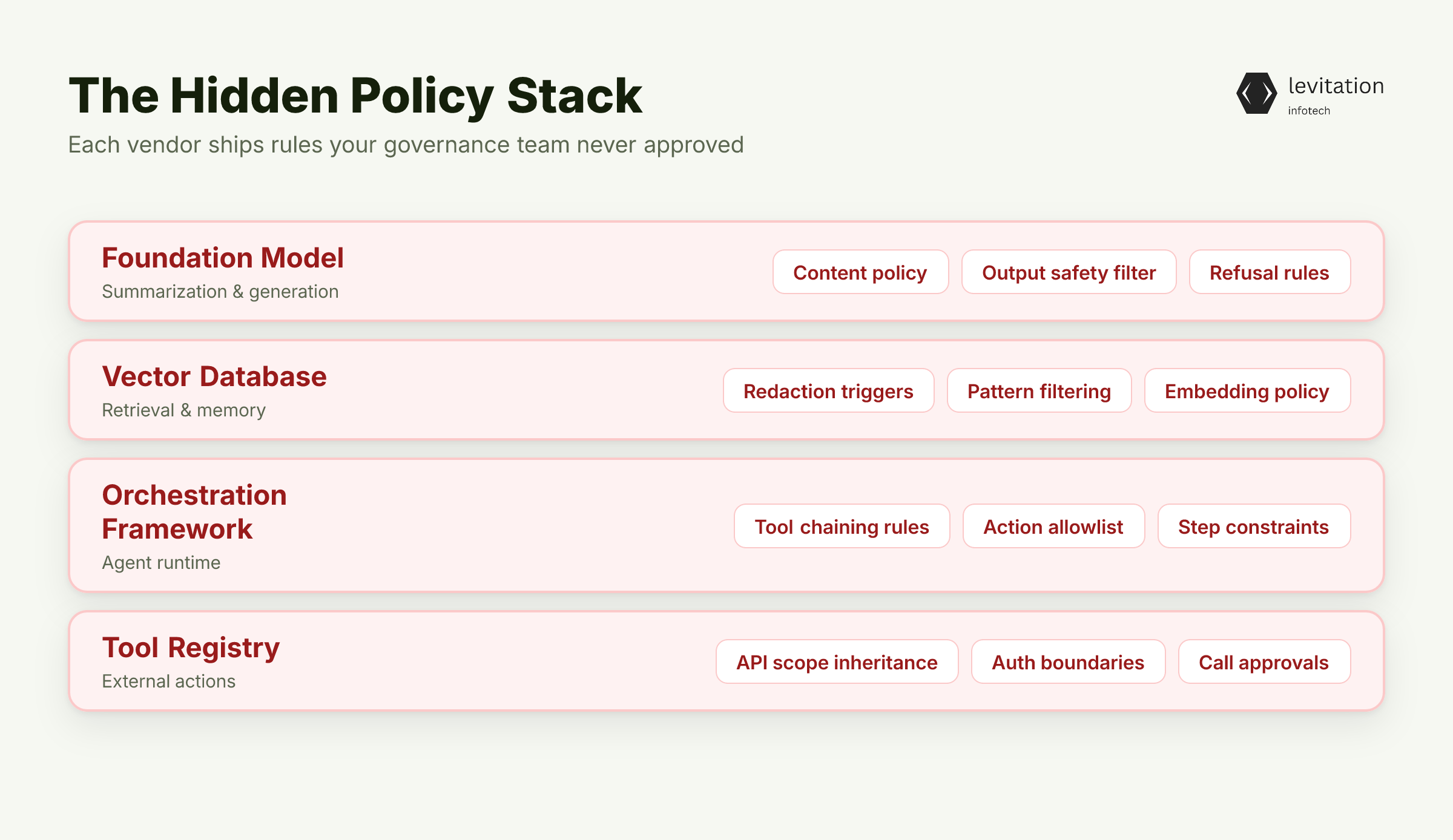
Your enterprise didn't approve a single one of them. Yet your stack of foundation model, vector database, orchestration, and tool vendors is already setting the rules. They set the policies, boundaries, and approval rules your AI agents will follow. Most CTOs discover this only when an auditor asks for the policy stack.
Consider a typical mid-market deployment. A team adopts a foundation model for summarization. They add a vector store for retrieval. They pick an agent framework for orchestration. They wire in a tool registry for actions. Each component ships with its own content policy, safety filter, and tool-use constraint.
None of those policies went through your AI compliance review. They arrived inside the SDK.
The adoption pattern made it invisible. Employees added AI tools faster than procurement could review them. At the same time, vendors added AI features silently to existing contracts. The "planned AI governance problem" was always a handful of sanctioned tools. The actual reality is a sprawling mesh of vendor-defined rules your AI governance team has never seen. - Foundation model providers define what your agent can and cannot say. - Vector databases define which data patterns trigger redaction or filtering. - Orchestration frameworks define which tools an agent can chain together. - Tool vendors define which API scopes an agent can inherit.
The core question for any CTO is straightforward. When an auditor asks who defined the policies your agents operate under, can you point to your own documentation? Or must you point to a vendor's terms of service? For most enterprises running agentic systems across regulated industries, the honest answer is the latter. This policy gap is one of the most important audit findings. It shows up when governance has not kept pace with tool adoption.
The problem runs deeper than scattered policies. Traditional AI governance frameworks were designed for a different risk class. Most enterprises built these frameworks over the last two years. They were not built for agentic systems.
Why Traditional AI Governance Misses the Agentic Risk Entirely
Traditional AI governance asks a quality question: is the model output accurate, fair, and unbiased? It's a quality assurance discipline, applied after generation, through periodic reviews and bias audits. Most enterprise AI solutions built during the early wave of generative AI adoption were set up for exactly this.
Agentic AI governance asks a different question. Is this AI agent authorized to take this action right now? Do its boundaries hold while it runs? That's an authority control discipline, applied before execution, while the system is live.
The distinction matters because the timing breaks everything downstream. A quarterly output review cannot catch an agent that has already done harm. The agent may have exfiltrated data, executed a financial transaction, or revoked access for a production system. By the time a human reviews the output, the side effect is irreversible. The audit window for catching agentic damage is measured in seconds or minutes, not quarters.
The framing of the primary control question has to change. "Is the model accurate?" assumes a human is in the loop, reading and approving outputs. When agents act without human confirmation, the right question becomes "is the agent authorized to act?" The two questions require different measurement, different controls, and different audit trails.
Existing governance programs were built to score outputs, not to stop actions. They collect samples. They run fairness checks. They produce quarterly reports. None of that machinery fires in the milliseconds between decision and execution. An agent decides to call a tool, and the tool runs almost at once.
If traditional governance can't see the risk, where is this authority being transferred? And how did it happen without a signed contract?
The Quiet Authority Transfer Happening in Every Vendor Contract
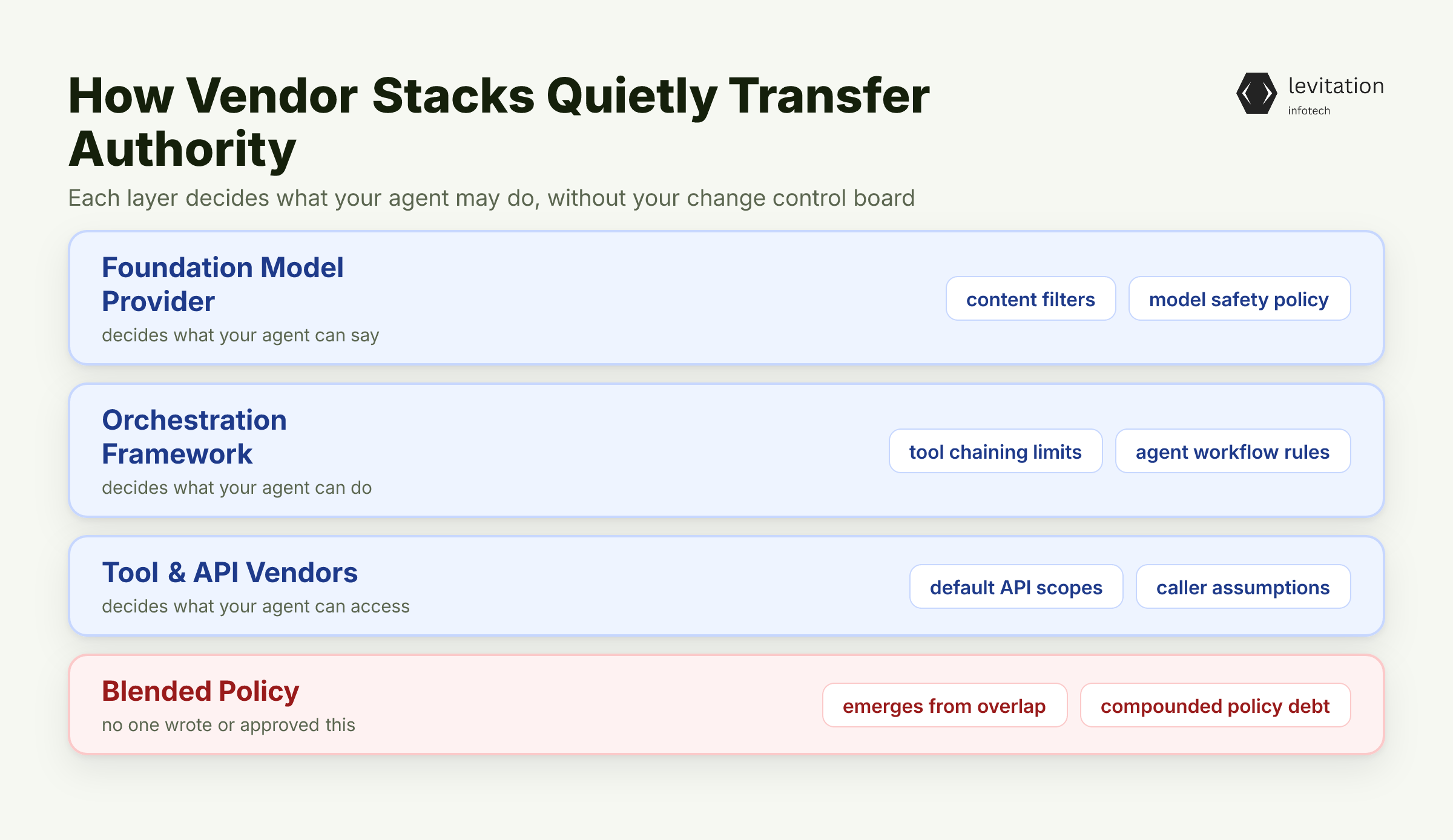
Each vendor's safety layer is a compliance decision made on your behalf. When a foundation model provider builds a content filter, they are deciding what your agent can say. When an orchestration framework restricts tool chaining, they are deciding what your agent can do. When a tool vendor scopes API permissions by default, they are deciding what your agent can access.
None of these decisions went through your change control board.
The mechanism compounds when agents are stacked. An AI agent built on Vendor A's foundation model inherits Vendor A's policy. When it uses Vendor B's orchestration framework, it adds Vendor B's policy. Vendor C's tool registry adds a third layer. The result is a blended policy from all three. Your team reviewed none of them.
The blended policy is emerging. It's not a document anyone wrote, and it's not a setup anyone approved. It exists as the overlap of three separate vendor defaults. This is how an agent stack quietly accumulates policy debt without any single person noticing.
The tool-permission problem is the sharpest edge. When an agent is granted access to an API, it inherits that API's scope. It also inherits the vendor's assumptions about who should hold that scope. A vendor that assumes "the caller is a human developer" will scope one way. A vendor that assumes "the caller is a self-running agent operating around the clock" will scope differently. If your team never negotiated that assumption, the agent is operating under someone else's threat model.
Authority is the new core of compliance. Governance is no longer about reviewing outputs. It's about controlling which autonomous agents can call which tools with which credentials at which moments. Every other layer of your AI governance program, from model validation to bias testing to output review, still matters. But it sits downstream of the authority decision. If the agent was never authorized to act, the output review is an after-the-fact review. It reviews a system that should never have run.
The deeper problem is that existing AI governance frameworks were never designed for this. They were never built to enforce these boundaries in the first place.
Building Runtime Controls Your Existing Framework Can't Provide
Five steps separate enterprises that govern agents from those that just document them. - Inventory the actual policy surface. Pull every vendor's content policy, safety filter, and tool-use constraint into a single registry. Do this even if you didn't write them. You can't govern what you can't see. The registry becomes the source of truth for what's actually enforced. - Define an authority boundary layer. Sit runtime guardrails between your AI agents and the tool layer. These stop actions before execution, not after. The key shift is timing-based: the decision happens before the side effect, not during a quarterly review. - Scope identity per agent. Each autonomous agent gets its own credential set with minimum necessary scope. Tokens are short-lived enough to limit blast radius. A single shared service account for all agents is risky. It is the same as giving every contractor in your building the same master key. - Build a continuous audit trail. Log every tool call, every policy decision, every override. Structure the logs for both your board and external regulators. The trail must answer "what did this agent do, and was it authorized" in seconds, not days. This kind of evidence changes the outcome of a compliance review. It shifts the result from "needs more documentation" to "control verified." - Treat retirement as a governance phase. Tool integrations disabled, credentials revoked, historical records preserved. Authority should end as carefully as it began. A decommissioned agent with live credentials is an open door.
The gap between teams is wide. Teams that build a runtime layer in parallel with their agents do better. Teams that retrofit governance onto an already-running stack do worse. It shows up in months of rework. It also appears as audit findings that a control-first design would have prevented.
What Mature Agentic AI Governance Actually Delivers
The shift from regular after-the-fact audits to real-time, built-in guardrails is the operational difference. Reviewing what happened last quarter is a historical exercise. Halting unauthorized actions before they occur is a control system. The first produces a report. The second prevents an incident.
The primary control question changes across your entire AI governance program. "Is the model accurate?" remains relevant. But it sits beneath a new question: "Is the agent authorized to act right now?" When that question is answered at runtime, every downstream control gets cleaner. Output review, bias testing, and model validation all benefit. This is because the population of actions under review is already filtered for legitimacy. This is the difference between two kinds of governance. One survives external scrutiny. The other produces a binder no one opens.
The board gets a single source of truth. A registry of every agent, its authority scope, its active tool permissions, and its live policy decisions. No more "we think our agents are operating within policy." The system can answer the question directly.
Faster genai adoption follows. When the risk boundary can be shown, procurement stops blocking new vendors. The runtime layer already enforces the limits regardless of what the vendor ships. That changes the conversation. Instead of "is this AI tool safe to approve," teams ask "does this AI tool give us capabilities we need." It's a more productive framing for the business. The end state is what mature agentic programs look like. They appear across regulated industries once the runtime boundary is in place.
Governance becomes a lifecycle commitment, not a documentation phase. The most resilient agentic programs share one trait: their governance runs continuously, not at audit time.
Your AI compliance posture is no longer defined by the policies you wrote. It's defined by the policies actually enforced at the moment an agent acts. If that moment isn't measured, your governance program is documentation, not control.
Frequently Asked Questions
What is agentic AI governance?
Agentic AI governance is the disciplined management of delegated authority in self-running AI systems. It defines what an agent can access. It also defines which tools it can call. Finally, it defines which actions it can take without human confirmation. It then continuously checks those boundaries hold during live operation. Unlike traditional AI governance, which reviews output quality, it controls action authorization in real time.
How is agentic AI governance different from traditional AI governance?
Traditional AI governance is a quality assurance discipline. It asks whether a model output is accurate, fair, and compliant through regular after-the-fact audits. Agentic AI governance is an authority control discipline. It asks whether an agent is authorized to take an action right now and enforces that boundary before execution. The two require different frameworks, controls, and oversight structures.
What are the main risks of AI agents in enterprise environments?
The primary risks are action-level. An agent calling tools outside its authorized scope. An agent accessing data it shouldn't reach. An agent executing transactions without approval, or chaining tool calls in ways no human reviewed. Output-level risks like hallucination and bias still exist. However, the new risk class is actions taken with real side effects. These side effects hit production systems, data, and external APIs.
Who is responsible when AI agents act autonomously?
Accountability remains with the organization that deployed the agent. The practical responsibility chain runs through several people. The chain runs through whoever defined the agent's authority scope and granted its tool permissions. It also runs through whoever set up its runtime guardrails. Vendor safety policies limit behavior but do not transfer accountability. The deploying organization owns the outcomes regardless of which foundation model or tool vendor supplied the underlying capability.
How do you implement agentic AI governance in an existing enterprise?
Start by inventorying every vendor's embedded policies into a single registry. Also include safety filters and tool-use constraints. Then layer a runtime authority boundary between your agents and the tool layer. Scope each agent's credentials to minimum necessary access with short-lived tokens. Build a continuous audit trail of every tool call and policy decision. Mature deployments follow this pattern, with the runtime layer paralleling agent build-out rather than retrofitting after rollout.
Map the policy surface you didn't write. The control layer follows from there.
About the author
Mayank Singh is a software developer at Levitation Infotech, where he builds web and AI-powered applications across the company’s fintech, healthcare, and enterprise projects.