


TL;DR: The "50% of code is AI-generated" stat that boards love to quote measures characters Copilot suggested. It does not measure lines shipped to production. As a result, legal teams have no way to audit what they can't tell apart from human-written code. A defensible AI code compliance program needs provenance tracking, review gates, and automated audit trails. These controls must map to existing regulatory frameworks.
Key Takeaways: - GitHub's 50% claim conflates three different metrics: suggested, accepted, and shipped to production - Most AI coding assistants don't write provenance metadata into commits. So legal teams audit a codebase they can't tell apart from human-written code - A working governance framework tags AI code at the point of suggestion. It also automates review gates and maps every control to a regulatory requirement
The 50% Stat Doesn't Measure What You Think It Does
GitHub says Copilot suggests about 50% of new code. Your CTO probably repeated that number in the last board meeting, right between the cloud cost slide and the hiring plan. It sounds impressive. It also sounds like progress your legal team can measure.
It isn't.
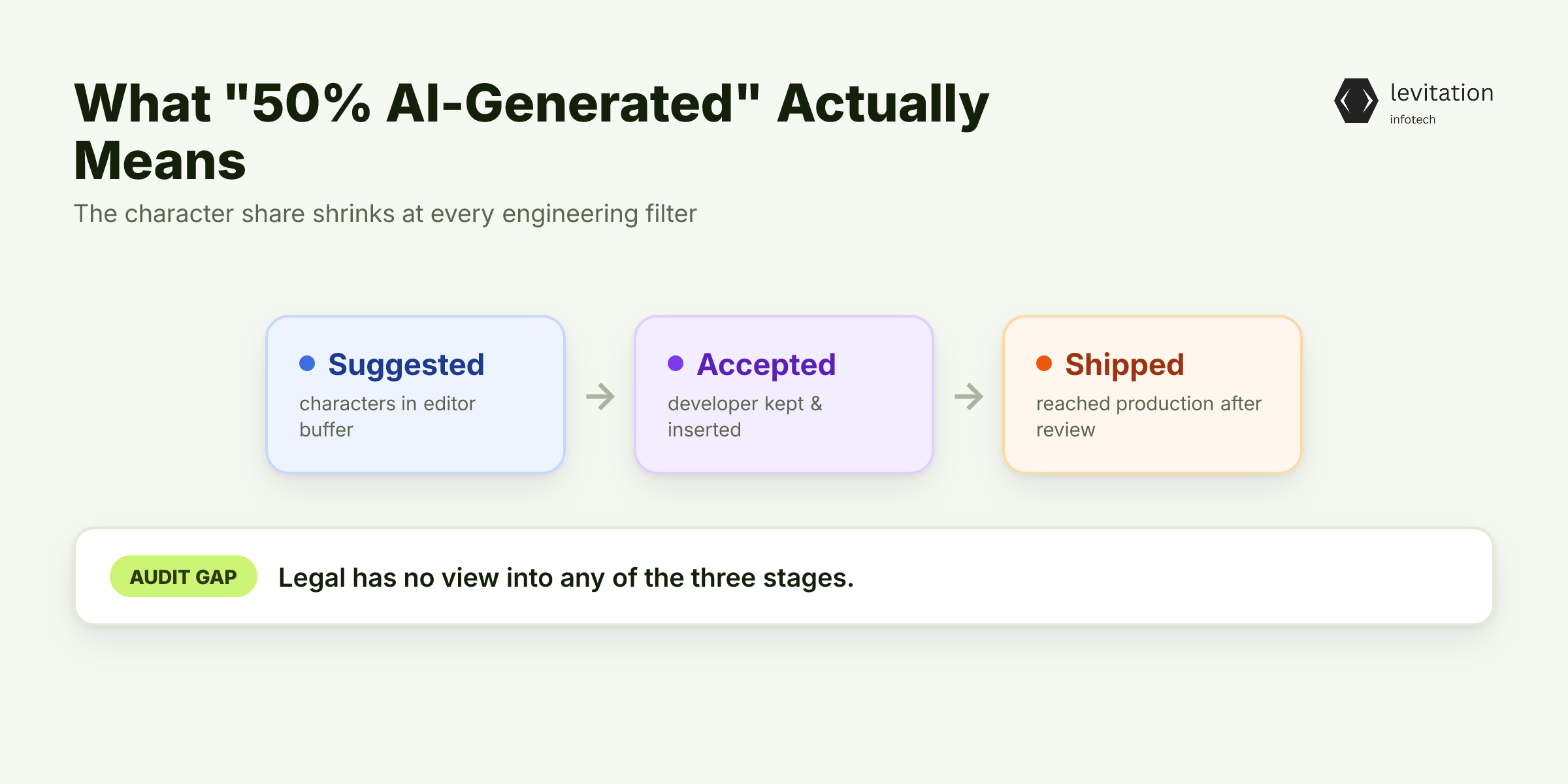
That 50% measures the share of characters Copilot suggested in the files developers opened during the study. Not lines. Not files. Not shipped artifacts. The study measured characters in a working buffer. Many of those characters were rejected, rewritten, or deleted before the next commit.
Three metrics get conflated every time this stat gets quoted: - Suggested: characters or lines Copilot proposed in the editor - Accepted: the slice the developer kept and inserted - Shipped: the portion that actually reached production after review, testing, and merge
A 50% suggestion rate can turn into something very different in the deployed codebase. The gap between those numbers grows with every filter a mature engineering org applies. Legal has no view into any of them.
This is exactly the problem AI compliance frameworks are now trying to solve.
If a board member asks your CTO next quarter what share of the production system was AI-assisted, the honest answer is: "I don't know." "Neither does anyone on my team." That answer is the audit gap.
It widens with every commit. But the deeper problem isn't the share. It's that most legal teams have no way to measure any of these numbers at all.
Why Legal Teams Are Flying Blind on AI-Generated Code
Developer velocity has outpaced governance tooling. A developer using Copilot or Cursor can accept dozens of suggestions in an hour.
Those blocks land in pull requests. Then they pass through code review focused on logic rather than origin. They ship to staging before a compliance officer has finished their morning coffee.
Most AI coding assistants don't write provenance metadata into commits. The accepted suggestion, the human edit, and the final merged file carry no flag from the AI tool.
A Git log, a SAST scan, or a license audit cannot tell them apart. The codebase is opaque by design. It was built for developer speed, not for legal traceability.
This is the blind spot we wrote about in You Can't Govern AI You Can't See, and it shows up first in code.
The regulatory frameworks legal teams rely on were drafted before LLM coding assistants existed. SOC 2, GDPR, and the EU AI Act each touch parts of the problem. None of them map cleanly to a line of code that an LLM suggested and a human merged five minutes later. Auditors are improvising, and they know it.
Then there is the unresolved accountability question. What if an AI suggests code that violates a third-party license? What if it quietly reproduces a snippet from its training set? Who carries the liability?
The developer who hit "accept"? The tool vendor? The enterprise that deployed the output? Courts haven't settled this. The EU AI Act is the first framework to assign tiered risk to AI systems clearly. But the case law is still being written.
Until AI compliance tooling is built into the developer workflow, legal teams audit a code base they cannot tell apart from human output. That is not a sustainable position for any enterprise shipping software in 2026.
What AI Code Compliance Actually Covers
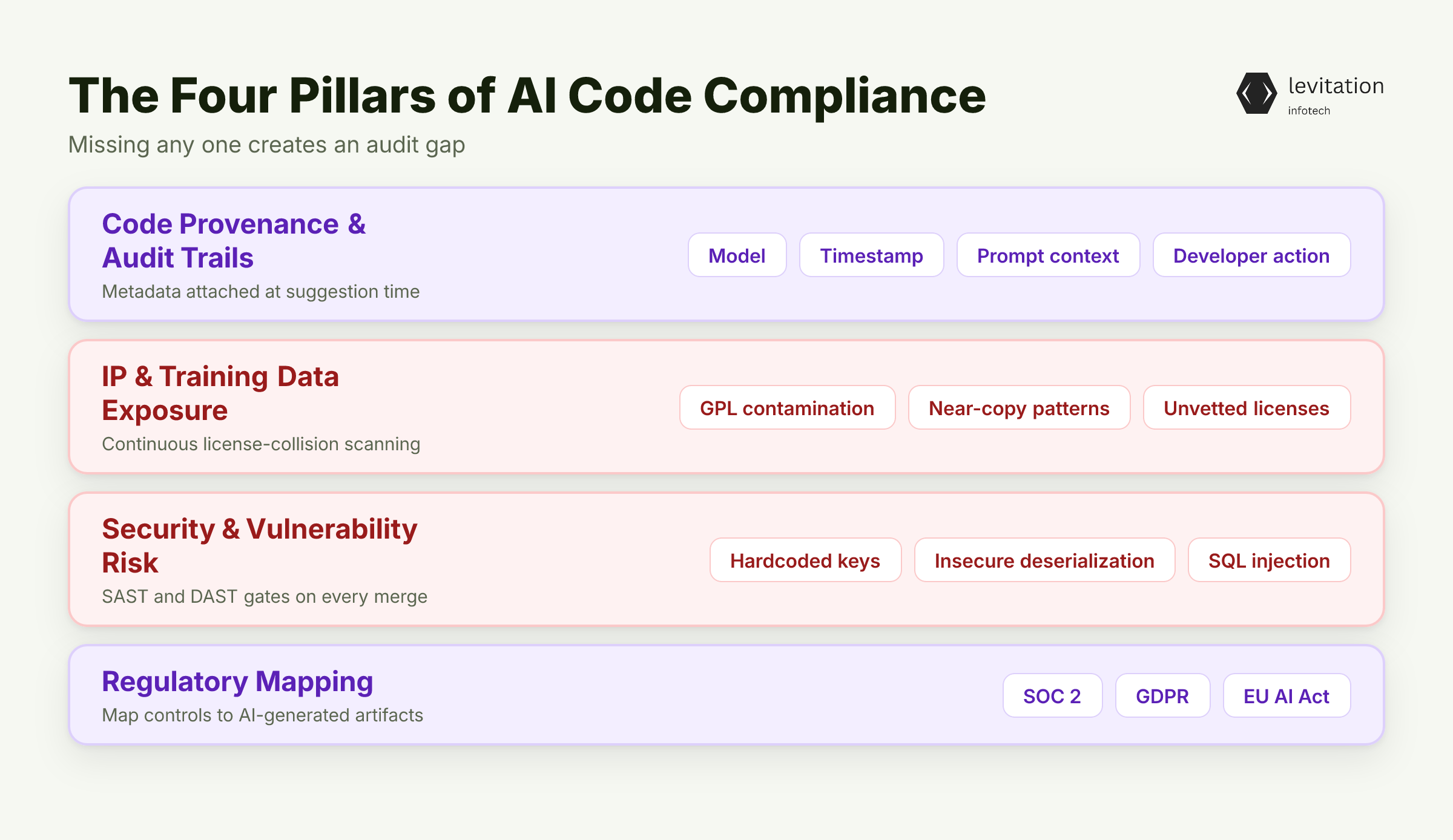
Four pillars make AI code compliance real. Missing any one of them creates a gap an auditor will eventually find.
Code Provenance and Audit Trails
Every AI-suggested block needs a metadata tag attached at the moment of suggestion. The tag should include the model that produced it. It should also include the timestamp, the prompt or surrounding context, and the developer who accepted or rejected it.
Retro-tagging is unreliable. Developers forget, prompts get lost, and the trail becomes guesswork by the time legal asks. The metadata has to live with the code from line one.
IP and Training Data Exposure
LLMs can reproduce licensed code patterns from their training data. The risk is not just GPL contamination in a proprietary product.
The real risk is the subtle case. A function that looks original but is a near-copy of a permissively-licensed library. Or a snippet that matches a public repo with an unvetted license. Compliance here means license-collision scanning against both public and private repositories. The scanning must be automated and continuous, not a quarterly sweep.
Security and Vulnerability Risk
AI suggestions reproduce security antipatterns picked up from training data. Hardcoded API keys. Insecure deserialization. SQL injection in generated ORM queries.
The model has seen these patterns during training. It then reproduces them fluently in suggestions. Without automated SAST and DAST gates on every AI-touched merge, your attack surface grows faster than your team can review it. We covered how this compounds in AI-Written IaC Is Your New Compliance Blind Spot, and the same dynamic applies to application code.
Regulatory Mapping
SOC 2 requires change-management trails. GDPR demands data-provenance for personal data handling. The EU AI Act classifies certain AI-assisted decisions as high-risk.
None of these were written for LLM-generated code. The compliance work is mapping. You map which control covers which AI-generated artifact, and where the gap is. Without that map, audits become archaeology.
The four pillars together form the minimum surface area for any defensible AI compliance program in an engineering org. Knowing what to govern is half the battle. Building the workflow without slowing engineers down is where most teams fail.
A Governance Framework That Ships With Your Code
A working framework does not need a year-long build. It needs four steps wired into the developer workflow, not bolted on after the fact.
Step 1: Tag AI-Generated Code at the Point of Suggestion
Integrate provenance tooling into the IDE and CI/CD so every AI-suggested block carries metadata before it reaches a pull request. The tag travels with the code through review, merge, and deploy.
This is the only place the metadata is reliable. Once the commit is made, no one can rebuild which lines were AI-suggested and which were hand-written. The tooling needs to be invisible to the developer in flow. It should surface only when a tag is missing or malformed.
Step 2: Add Review Gates to the Pipeline
Treat AI-generated code the way you'd treat code from a new junior hire. Run a mandatory SAST scan, license check, secret-detection pass, and peer review before merge. None of these are new.
What is new is that they must run automatically on every AI-tagged block, not at the developer's discretion. The acceptance criteria don't change. The enforcement does.
Step 3: Automate the Audit Trail
Generate immutable logs. They should show who suggested, who accepted, who reviewed, what was deployed, and against which controls. Legal should be able to pull a report without filing a ticket with engineering.
If the trail lives in a developer's head or a Slack thread, it does not exist. The trail must be queryable by model, by developer, by date range, and by regulatory framework.
Step 4: Map to Regulatory Frameworks
Build a controls matrix linking each governance step to SOC 2, GDPR, HIPAA, and EU AI Act requirements. When an auditor asks how you handle AI-assisted changes to systems that process personal data, you point at a row in the matrix. You do not point at a folder of screenshots.
The mapping turns audits from archaeology into evidence collection. The right AI compliance framework automates all four steps.
The pattern across deployments in regulated industries is consistent. It shows automation in the developer workflow, evidence collection for legal, and no manual gate that engineers can route around. The teams that get this right don't just reduce legal risk.
They ship faster than teams that ignore the problem entirely. That's because their review gates run in parallel with their merges instead of after them. That speed advantage is not theoretical. It shows up the moment governance goes live, and it reshapes how engineering and legal work together.
What Changes When AI Code Governance Actually Works
Engineering velocity increases instead of stalling. Review gates run automatically, so developers aren't blocked waiting for manual compliance checks.
The code that needs human eyes still gets them. The code that an automated scan can clear goes through without a human bottleneck. Net effect: fewer meetings, faster PR cycles, and cleaner production.
Legal shifts from reactive firefighting to proactive policy enforcement. Dashboards show AI-generated code volume, review status, and exception rates in real time. When a regulator asks a question, the answer is a query, not a project.
The same dynamic shows up in Why AI Coding Assistants Are Quietly Breaking Your Engineering Metrics. Once you can measure the AI footprint, you can manage it.
Audit prep drops from weeks of evidence-gathering to hours, because the trail is already structured. Auditors stop asking "show me" and start asking "filter by." The difference compounds across every audit cycle for years.
Enterprise trust compounds too. Clients and regulators see a governance posture, not a patchwork of ad-hoc reviews. Companies that take AI compliance seriously do it because the alternative is rebuilding the trust layer every two years.
The uncomfortable truth is that AI-generated code is not going away. The developers using it are shipping faster than the developers who aren't.
The companies that win the next five years will be the ones that let their engineers use AI coding assistants without creating invisible liability. That needs governance, not prohibition.
Frequently Asked Questions
Q: Who is legally liable for AI-generated code?
A: Liability typically falls on the enterprise deploying the code, not the AI tool vendor. Developers carry responsibility for what they accept and ship, but the organization is accountable for the governance framework around AI-assisted development. Courts and regulators haven't fully settled this. The EU AI Act is the first framework clearly assigning tiered risk to AI systems.
Q: Can AI-generated code be copyrighted or patented?
A: In the US, the Copyright Office has ruled that purely AI-generated code without enough human creative contribution is not copyrightable. Code that a developer substantially modifies, reviews, and integrates into a larger system generally keeps copyright protection. The legal picture varies by jurisdiction and is still evolving.
Q: How do you audit AI-generated code for compliance?
A: You need provenance metadata attached at the suggestion level. It should include the model used, the prompt, the timestamp, and the developer who accepted it. On top of that, you need automated scans for license collisions, security vulnerabilities, and regulatory controls like SOC 2, GDPR, and HIPAA. Without that metadata layer, auditing AI code is guesswork.
Q: Does SOC 2 require disclosure of AI coding tools?
A: SOC 2 doesn't mandate naming specific tools, but it does need documented change-management controls. If AI assistants are part of your development process and not reflected in your controls, you have a gap. Auditors increasingly ask about AI-assisted development during scoping. "We don't track that" is no longer a defensible answer.
Q: What is an AI code governance framework?
A: It's a structured set of policies and tooling covering provenance tracking, review gates, security scanning, license checks, and audit trails for AI-generated code. A mature framework automates these steps inside the developer workflow so governance doesn't become a bottleneck. The alternative is a manual review process that scales linearly with adoption. That breaks within months.
About the author
Mayank Singh is a software developer at Levitation Infotech, where he builds web and AI-powered applications across the company’s fintech, healthcare, and enterprise projects.